Phone:
0086-757-8938 9313
Email:
Address:
Caochang Industrial Zone, Liguang Rd, Lishui, Nanhai, Foshan, Guangdong, China
Reply within 1 hour, 24x7

Phone:
0086-757-8938 9313
Email:
Address:
Caochang Industrial Zone, Liguang Rd, Lishui, Nanhai, Foshan, Guangdong, China
Reply within 1 hour, 24x7

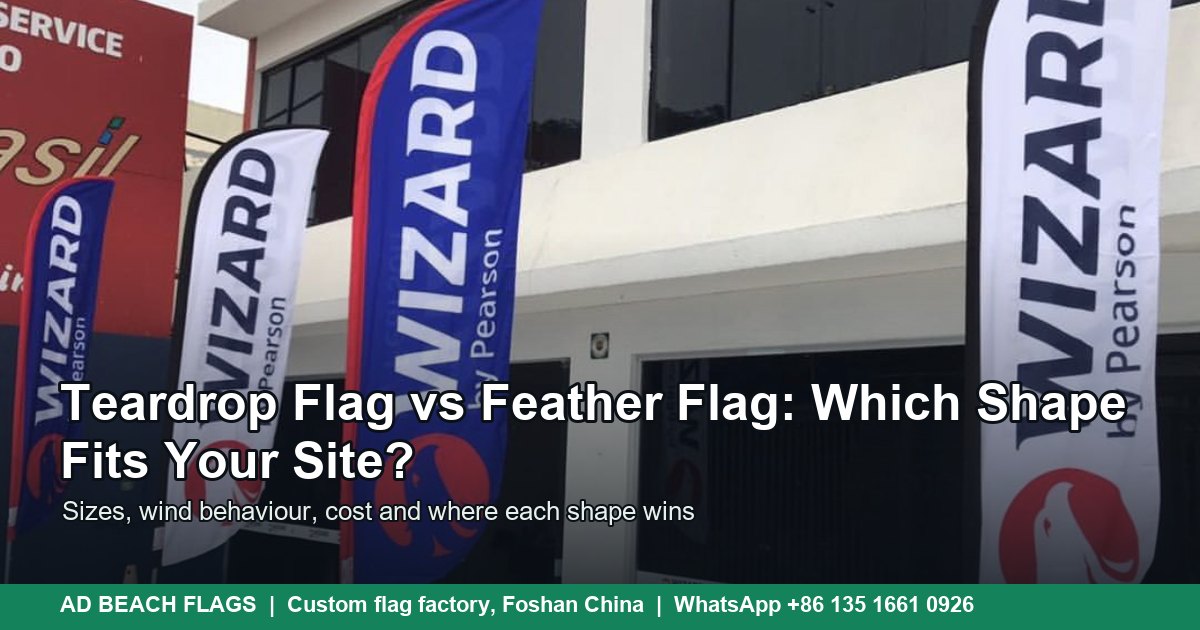
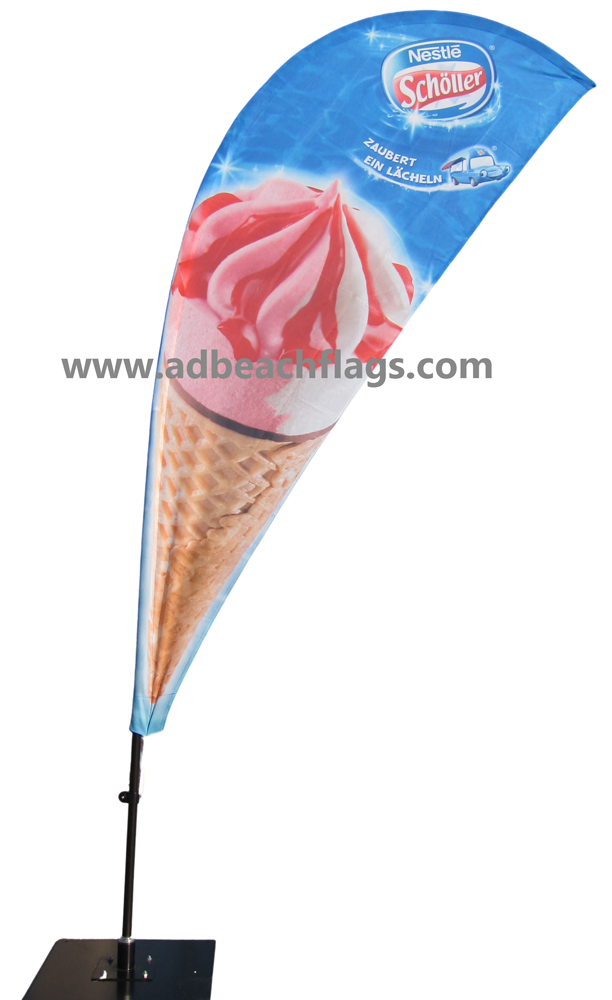
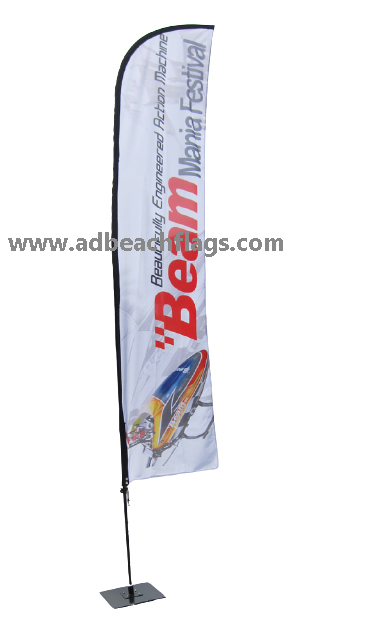
Two flags, same job, one difference that decides the purchase: how the fabric behaves when the air moves. A feather flag flies free at the leading edge and reads like a moving banner. A teardrop flag is held under tension by a curved pole, so its shape does not depend on wind at all. Everything else, the fabric, the poles, the bases, the printing, is largely shared between the two.
This guide is written from inside a flag factory in Foshan, China, where both shapes are printed on the same machines and packed into the same export cartons. We will show where each shape earns its keep, and where it quietly costs you money.
1. The teardrop holds its own shape. A fibreglass tip curves over the top of the flag and stretches the polyester from top to bottom, like a drum skin. Wind changes the pressure on the fabric but not the silhouette. On a windless Monday morning outside a shop, the design is exactly as readable as it was on Saturday.
2. The feather needs airflow to look its best. The long edge of a feather flag is free, which is what creates the flutter that catches eyes on a roadside. In dead calm the fabric can sag against the pole. In strong, steady wind it works hard, and constant flapping is the main reason feather flags wear out faster than teardrops at the same site.
3. Print area is the feather’s trump card. A feather flag is a tall blade shape, so a 4.5 m feather carries noticeably more printable square metres than a 4.6 m teardrop. If your message includes a logo, a headline and a phone number, the feather is the friendlier canvas.
4. The teardrop is the more efficient shape per metre of height. Its width sits lower down, near eye level, where pedestrians actually look. For a logo-only design, it delivers a bigger visual punch from a smaller footprint.
| Question | Teardrop flag | Feather flag |
|---|---|---|
| Shape in still air | Holds full shape, taut fabric | Hangs loose, fills out with wind |
| Printable area | Medium, best for logos and short lines | Largest of the two, fits a headline plus details |
| Wind behaviour | Steady, quiet, sheds gusts around the curve | Lively, moving, more wear at the free edge |
| Setup time | About 2 to 3 minutes, one person | About 2 to 3 minutes, one person |
| Poles and bases | Same system | Same system |
| Best message | Logo, brand name, one short offer | Logo plus sentence, price, phone number |
| Typical cost | Same price band at equal height | Same price band at equal height |
Flag suppliers label sizes Small, Medium and Large, but the labels mean different things in different factories. We avoid the confusion by quoting the flag dimensions and the pole height together.
| Teardrop flag (W x H) | Pole height | Feather flag (W x H) | Pole height |
|---|---|---|---|
| 75 x 165 cm | 280 cm | 60 x 200 cm | 280 cm |
| 85 x 190 cm | 340 cm | 60 x 240 cm | 340 cm |
| 95 x 230 cm | 400 cm | 70 x 290 cm | 400 cm |
| 110 x 260 cm | 460 cm | 70 x 325 cm | 460 cm |
| 110 x 300 cm | 500 cm | 75 x 360 cm | 500 cm |
| 130 x 330 cm | 560 cm | 75 x 410 cm | 560 cm |
Both shapes use the same sectional poles and the same base range, which keeps your spares simple. Buy the pole system once, and you can run teardrop flags this season and feather flags next season without replacing the hardware.
Storefront on a narrow pavement. Teardrop. The curved shape keeps its width at chest height instead of up in the air, and the small footprint leaves walkers a clear path.
Roadside forecourt or car lot. Feather at large or extra-large. Drivers read vertical text at speed, and the extra print area carries a price or a model name. On forecourts with gusts between buildings, a teardrop on a car base is the calmer alternative.
Cafés, bakeries and salons. Teardrop in the small sizes, double-sided if customers approach from both directions. Long messages rarely work on a 340 cm pole anyway, so the feather’s advantage shrinks.
Trade shows and exhibition halls. Feather indoors, on full aluminium poles. There is no wind on a show floor, so shape stability is free, and the extra print area helps across a crowded aisle.
Coast, harbour and open festival fields. Teardrop, and in mesh fabric if salt and steady breeze are constant. Mesh is about 30% open weave, which lets air pass through and cuts the load on the pole. Keep in mind that any portable flag should come down when a serious storm rolls in.
Sports clubs and school grounds. Feather along a fence line where movement draws the eye; teardrop at the ticket gate where the message must stay readable for hours.
At equal height, teardrop and feather flags sit in the same price band. The variables that move the price are fabric, printing sides and quantity, not shape:
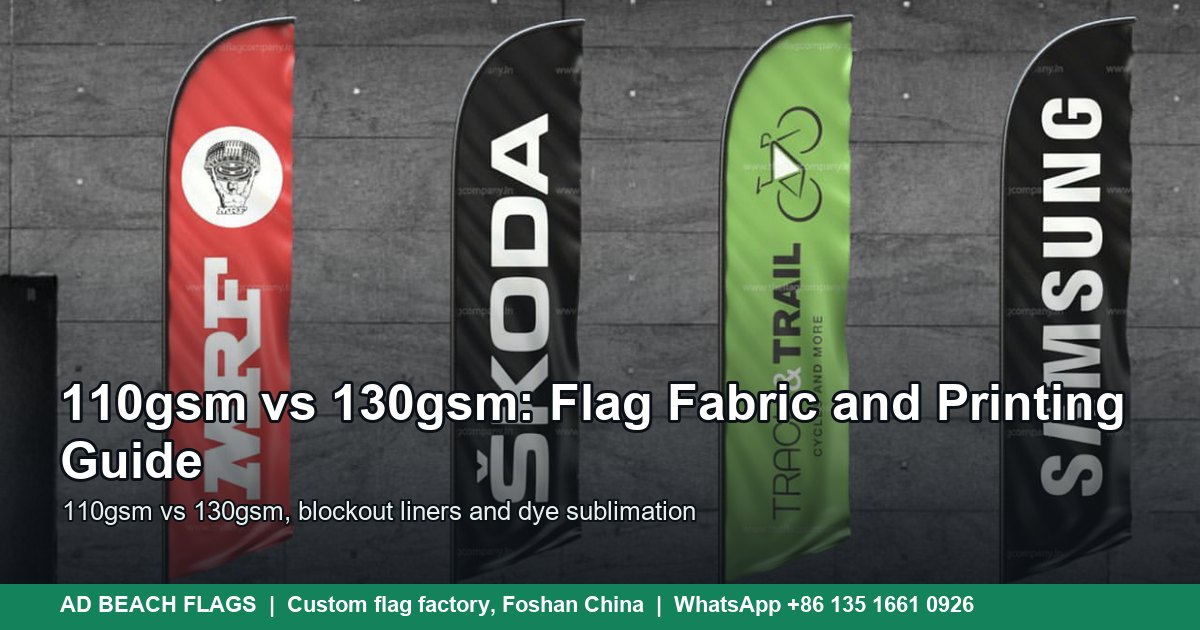
1. Fabric. 110gsm knitted polyester is the industry standard. 115gsm lasts longer under hard sun and costs a little more. Mesh is a special weave and priced accordingly.
2. Single or double-sided. Double-sided flags use two printed layers plus a blockout liner, so they cost more than single-sided. The multiple depends on the factory and the quantity; treat anything under a 30% premium as a red flag on quality. Double-sided builds also weigh around 30% more, which matters for freight.
3. Quantity. Digital printing needs no screens, so a single sample is possible. Per-piece cost drops sharply from the tens to the hundreds, and again from hundreds to thousands. If you are testing a design across several stores, combine the order into one print run and split the packing.
Send the same three questions to every supplier on your shortlist:
1. What is the flag size and the pole height, in centimetres? If the answer is only Small, Medium, Large, ask again. Mixed labels are the number one source of wrong orders.
2. What fabric weight do you print on? 110gsm knitted polyester is the baseline. If a quote cannot name the fabric, the quote is not comparable.
3. Can you send a photo of the finished goods before shipping? Factories used to export orders answer this casually. Factories that only sell online often cannot.
Businesses that run flags across several locations usually start with a mixed cupboard: three pole lengths, four base types, and a drawer of adapters nobody understands. The cheaper long-term strategy is to standardise the pole and base system and vary only the flag skin.
1. Pick one pole family. Aluminium with a fibreglass top covers most shops and events; move to full fibreglass only for coastal or exposed sites. One family means one spare parts box.
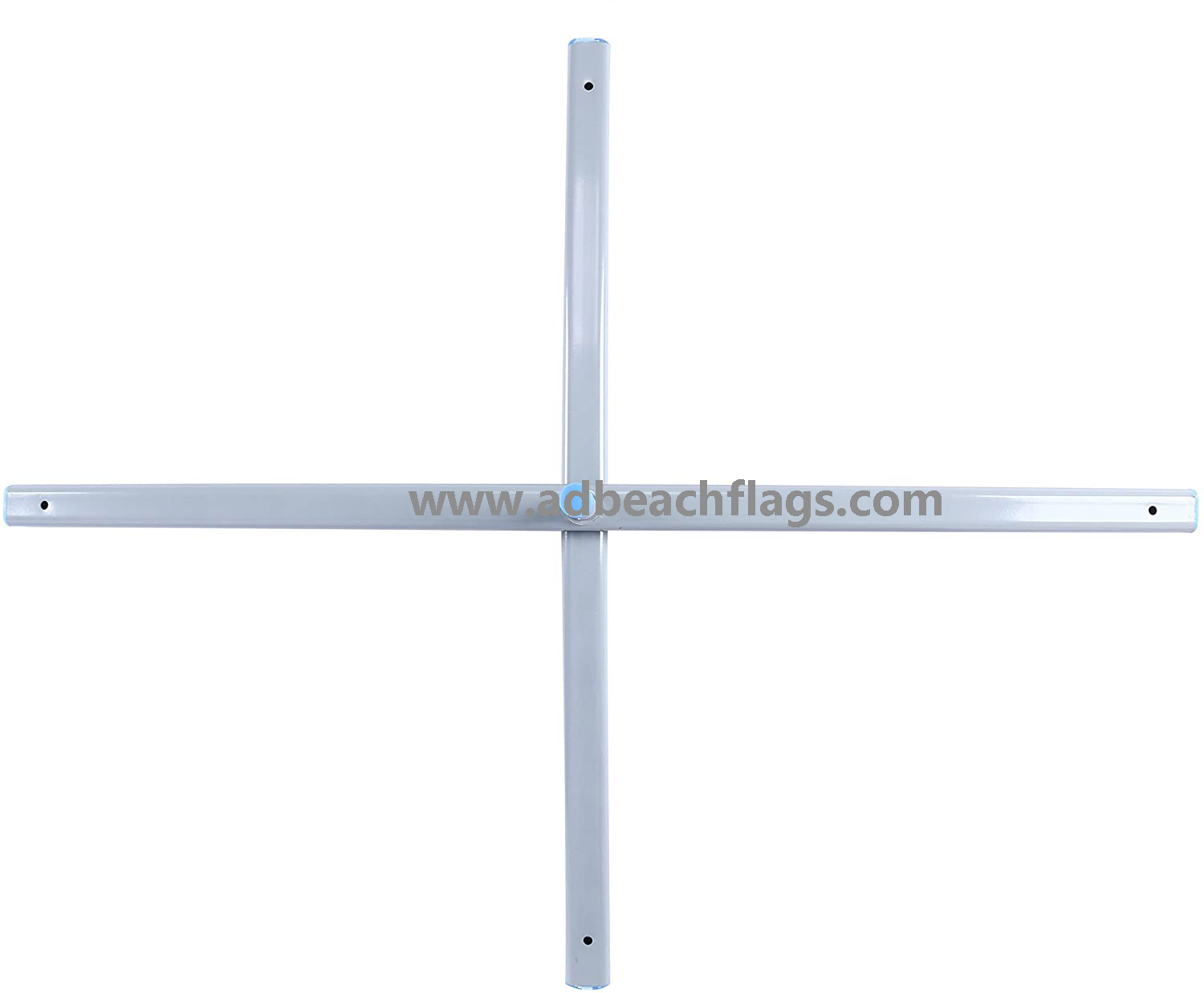
2. Pick two base types, not six. A cross base with water bags covers pavement, and a spike covers soil. Everything else is a special case you can buy when a site actually demands it.
3. Let the flag skin change with the promotion. A flag skin is the cheapest part of the kit. Reordering skins against a stored artwork file costs less than new hardware and keeps the brand consistent across every store.
4. Keep a spare pole section. Poles fail at the joints, not in the middle. One spare bottom section per ten poles is cheaper than an emergency air shipment before an event.
United States. Most buyers search for feather flags and swooper flags, and the phrase beach flag often means a lifeguard warning flag instead. Ask for a teardrop if your site is gusty, and check local sign rules: some cities limit portable flag height or ban them near roads.
United Kingdom and Ireland. Teardrop and sail flag are the common terms. Pavement sites usually need a cross base with a water bag, and some councils ask for public liability paperwork for anything on the highway.
Germany, Austria and Switzerland. Werbefahne or Beachflag are the search terms, and the drop shape is a standard catalogue item. Buyers here ask for fabric weight and flame certificates first, so have the paperwork ready before the first call.
Australia and New Zealand. Teardrop flags on car bases are standard at dealerships, and mesh is popular at coastal venues. UV is brutal; 115gsm or a planned annual replacement is the realistic option.
Latin America and Brazil. Bandera pluma in Spanish-speaking markets, bandeira pluma in Brazil. Single-sided keeps the landed cost down on volume orders, and mesh suits the coastal cities.
We would rather lose a small order than support a bad one. Skip both shapes if any of these is true:
1. You need a permanent sign. A flag is portable by design. If the sign must survive a decade of weather without attention, buy a metal structure instead.
2. The site has no space for a base and clearance. Allow roughly 1.2 m of clear radius for small flags and up to 3.6 m for the largest kits, plus space to walk around the base.
3. Your message is a paragraph. At 40 m, nobody reads a paragraph on any flag. Shorten the text, or use a banner that gives you a rectangular canvas.
4. Permits forbid it. Some jurisdictions, including parts of the United States and Australia, restrict portable advertising signs near roads or in heritage zones. One phone call to the council saves a fine.
Q1. Is a teardrop flag or a feather flag more wind resistant?
At equal size, the teardrop sheds gusts more smoothly because the fabric stays under tension and the profile is rounded. Feather flags flutter more, which is what makes them eye-catching, and also what wears the free edge sooner. Both should come indoors before a storm.
Q2. Can I use the same pole for both shapes?
Yes. Our teardrop and feather flags share the same sectional pole system and the same base range. You can swap flag skins season to season and keep the hardware.
Q3. Do teardrop and feather flags cost the same?
At equal height and equal fabric, yes, they sit in the same band. Price differences between suppliers usually come from fabric weight, stitching quality and whether a pole and base are included, not from the shape itself.
Q4. Which shape is better for double-sided printing?
Both can be double-sided. The teardrop is often the better buy for two-way foot traffic because the print area sits lower and closer to eye level. Double-sided builds add two printed layers and a blockout liner, so expect a higher unit price and roughly 30% more weight to ship.
Q5. Which shape should a first-time buyer order as a sample?
Order the size you will actually deploy at your busiest location, in the shape that suits that site. A 75 cm sample tells you almost nothing about how a 130 cm flag behaves on a forecourt.
Q6. How long do the flags last?
With daily outdoor use, plan on about six months before a flag looks tired, longer if you bring it in each evening and rotate between two sets. UV fading is part of fabric life, not a defect, and darker designs hide it better than pale ones.
Still on the fence? Use this order of questions:
1. Is the site windy, coastal or between buildings? If yes, teardrop.
2. Does the message run past five words? If yes, feather.
3. Does the flag face two-way traffic? If yes, double-sided in either shape.
4. Is the surface grass, pavement, sand or a car park? That decides the base, not the shape.
If you send us the location, the surface and a photo of the site, we will answer with a size, a shape and a base in one reply, usually within the hour.
We print teardrop and feather flags on 110gsm knitted polyester, match your colours to Pantone or RAL, and ship complete kits with poles and bases. Low MOQ accepted, and we will tell you plainly if a different product suits your site better.
Send your artwork or a site photo and get a proof plus a factory price within one hour. Tell us the shape you are considering, the quantity, and the surface the flags will stand on. WhatsApp and email both reach our export team directly, and someone answers around the clock.
Tell us the flag size, the quantity, single or double-sided, and the surface the flags will stand on. Our export team replies within 1 hour, 24×7, with an artwork proof and a factory price. Low MOQ accepted.
Chat on WhatsApp (+86 135 1661 0926) Email Us Now
Prefer a form? Fill in the details below and we will come back with a proof and a price within 1 hour, 24×7.
Related reading: Beach Flag Size Guide | Flag Base Guide | Flag Fabric and Printing Guide | Teardrop Flags | Feather Flags | Cross Bases | Double-Sided Beach Flags
| Item | Detail |
|---|---|
| Product | Custom teardrop and feather advertising flags, also called sail flags and swooper flags |
| Manufacturer | Ad Beach Flags, Foshan, Guangdong, China |
| Fabric | 110gsm knitted polyester standard; 115gsm, 130gsm and 120gsm mesh optional |
| Printing | Dye sublimation with Pantone and RAL colour matching |
| Sides | Single-sided (mirror print on back, about 90% show-through) or double-sided with blockout liner |
| Teardrop sizes | 75×165 cm to 130×330 cm, poles 280 cm to 560 cm |
| Feather sizes | 60×200 cm to 75×410 cm, poles 280 cm to 560 cm |
| Poles | Aluminium with fibreglass top, full aluminium, full fibreglass |
| Bases | Ground spike, cross base, heavy cross base, metal plate, car base, water tank base |
| MOQ and lead time | Low MOQ accepted; samples 2 to 3 days, bulk 5 to 10 days after artwork approval |
| Contact | WhatsApp +86 135 1661 0926, [email protected], reply within 1 hour 24×7 |
| Point | Detail |
|---|---|
| Manufacturer, not a reseller | Printed and sewn in our own Foshan workshop, so specification questions reach the people who make the goods. |
| Colour you can hold us to | Pantone and RAL matching with a printed swatch approved before the bulk run; about 5% is the accepted tolerance for CMYK sublimation. |
| One kit, one supplier | Flag, pole, base and carry bag ship from one factory with one fitting standard, so nothing is missing on install day. |
| Fast sampling | Digital printing needs no screens: samples in 2 to 3 days and bulk in 5 to 10 days after artwork approval. |
| Low MOQ accepted | Trial orders do not need a container, with wholesale pricing from small quantities per design. |
| Customer 5stars Feedback | warmly welcomed in 150+ countries across Europe, the Americas, the Middle East, Africa and Oceania. |