Phone:
0086-757-8938 9313
Email:
Address:
Caochang Industrial Zone, Liguang Rd, Lishui, Nanhai, Foshan, Guangdong, China
Reply within 1 hour, 24x7

Phone:
0086-757-8938 9313
Email:
Address:
Caochang Industrial Zone, Liguang Rd, Lishui, Nanhai, Foshan, Guangdong, China
Reply within 1 hour, 24x7

Every flag failure story we hear from customers traces back to the same root: the wrong base. A flag is a lever, and the base is the pivot. Get the pivot right and a 5.6 metre flag stands through a working day without drama. Get it wrong and a 2.8 metre flag spends the afternoon lying across a footpath.
This guide covers the six base types we build, what each one is actually for, and the numbers that make the decision for you.
| Base | Surface it suits | Weight or ballast | Flag size it holds |
|---|---|---|---|
| Ground spike | Grass, soil, garden beds | None needed; the ground does the work | XS to M |
| Cross base | Hard flat ground indoors, plus water bag outdoors | Water bag about 10 to 12 litres | XS to M |
| Heavy cross base | Hard ground in gusty streets | Heavier steel, wider footprint | S to L |
| Metal plate | Pavement, forecourt, long-term display | Roughly 4 to 12 kg depending on size | M to XXL |
| Car base | Dealership forecourts, car parks, shows | Borrows the vehicle’s weight | M to XXL |
| Water tank base | Hard ground, all-season outdoor sites | Fills to 12 to 32 litres on site | M to XXL |
A ground spike is a steel shaft that goes into soil. Setup takes seconds with a rubber mallet, nothing needs filling, and there is no ballast to carry. For a garden centre, a school fete or a real estate open house, it is the obvious choice.
1. It only works where there is soil. On asphalt, the spike is furniture that falls over politely.
2. Sand behaves differently from soil. A straight stake pulls out of loose sand in a breeze. Beach sites need a spiral anchor, which screws into the sand and resists upward pull far better than a straight shaft.
3. Keep the spike head above ground. If the collar is buried, the flag cannot rotate with the wind and the pole takes the load sideways, which is how poles bend.
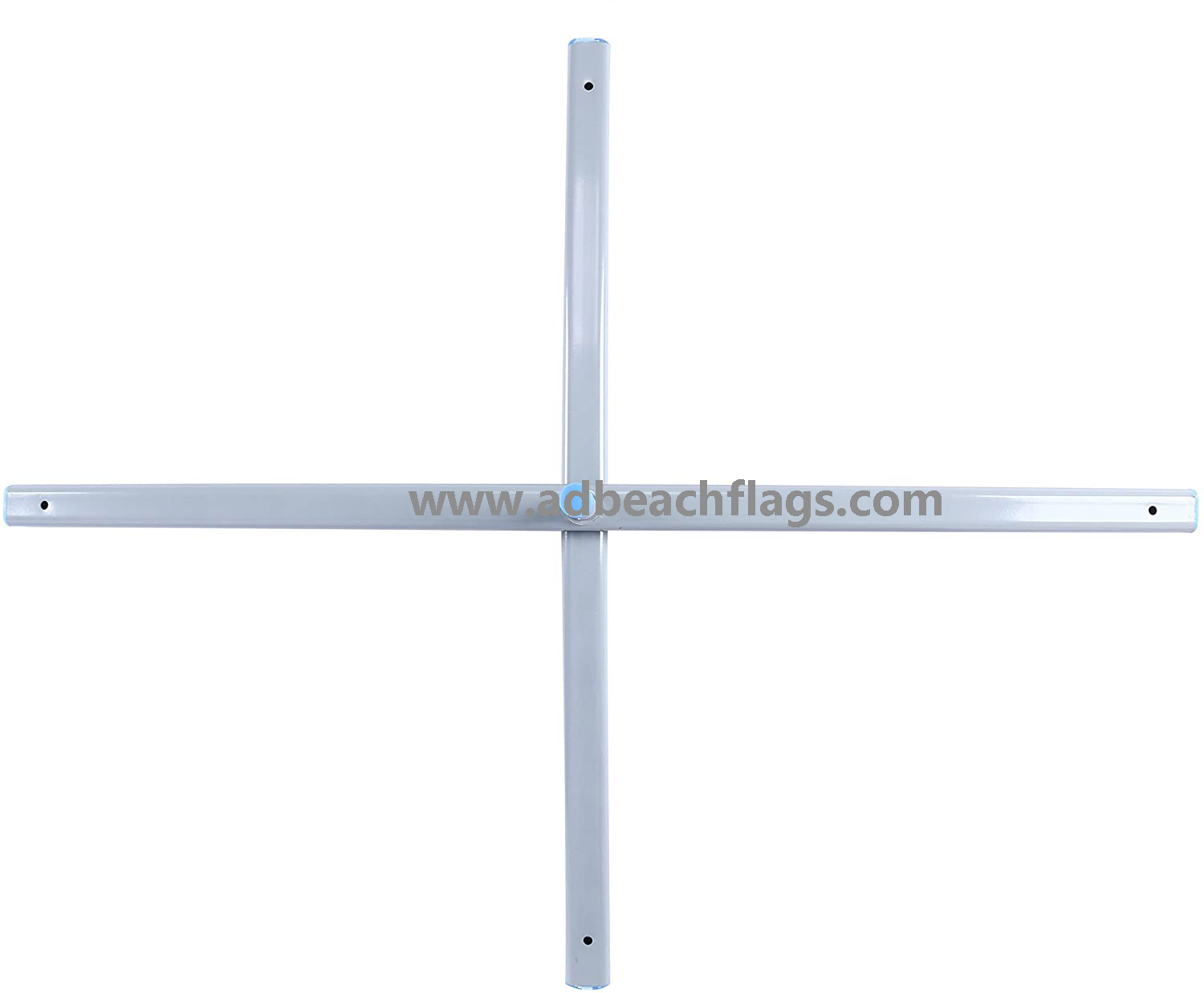
A cross base is four steel legs in a plus shape with a socket in the middle. Indoors, on a level floor, it is stable enough on its own. Outdoors, every cross base needs a water bag or two draped over the legs; the industry standard bag holds around 10 to 12 litres, and you can stack additional bags for more weight.
1. Folds flat. Cross bases collapse into a bundle about the size of a folded camp chair, which is why they travel well to events.
2. Wide is better than heavy. A cross base works because the legs spread the tipping point outward. If you are choosing between a heavier small base and a lighter wide base, take the wide one.
3. Frost and the water bag. Empty the bag before a hard freeze, or the ice will split the seams. In winter, fill with sand instead of water.
Between buildings, wind accelerates. City centres, station forecourts and shopping streets can turn a calm day into a steady push. A heavy cross base uses thicker steel and a longer leg span to absorb that load. It still folds, still travels, and it is the base we recommend most often for mid-size flags on city pavements.
A plate base is a flat steel square, roughly 4 to 12 kg, with a socket welded in the centre. There is nothing to fill, nothing to leak, nothing to freeze. For a shop that leaves a flag out every day, the plate is the least maintenance of any option, and the one most likely to still be in service after three winters. Two practical notes:
1. Put a mat under it indoors. Bare steel scratches tiles, and shopfitters remember who scratched their floor.
2. Weight is fixed, so match it to the flag. A plate cannot be topped up like a water tank. If the flag is large or the site is exposed, choose a heavier plate or step up to a water tank base.
The car base slides under a tyre, and the vehicle’s weight pins it down. No tools, no ballast, and the flag moves in minutes when the lot is rearranged. It is the default for dealerships, tyre shops and motorsport events.
1. Fixed direction. The flag does not rotate, which is fine for a forecourt where the audience arrives from one road.
2. Mind the paint. Use the base the way it was designed, and place it so the flag cannot swing against the bodywork.
Water tank bases hold 12 to 32 litres of water or sand, with larger versions sitting low and wide. They ship empty, so freight stays reasonable, and they fill on site from any tap. Choose this base when a flag will stand outside for months rather than hours.
1. Sand beats water where it freezes. Water expands when it freezes and will crack a tank. In cold climates, fill with sand and skip the problem.
2. Look for a rotating socket. On an exposed site, a flag that swings to face the wind puts far less strain on the pole than one that stands rigid.
3. Weight on the ground has limits. A full 32 litre tank is over 30 kg. Check that the surface underneath is not a lightweight roof, a wooden deck or a glass canopy.
Print this table, leave it in the stockroom, and the argument about which base to take to a site ends in ten seconds.
| Flag on a 280 to 400 cm pole | Flag on a 460 to 560 cm pole | Ballast to use | Time to set up |
|---|---|---|---|
| Spike in soil | Spike only in firm soil, never in sand | None, the ground holds it | Under 1 minute |
| Cross base indoors | Not recommended | None indoors on level floor | Under 1 minute |
| Cross base plus one water bag | Two water bags or a tank base | 10 to 12 litres per bag | 2 to 3 minutes with a tap nearby |
| Heavy cross base | Water tank base, 12 to 32 litres | Steel plus water, or sand in winter | 3 to 5 minutes |
| Metal plate 4 to 6 kg | Plate 8 to 12 kg or tank base | Fixed weight, nothing to fill | Under 1 minute |
| Car base | Car base | Vehicle weight does the work | Under 1 minute, drive-on style |
The taller the flag, the longer the lever. Going from a 2.8 m pole to a 5.6 m pole roughly doubles the height and multiplies the tipping force by far more than two. As a working rule from our own sizing table:
1. XS and S flags. Spike on soil, cross base with one water bag on pavement.
2. M and L flags. Heavy cross base or plate on hard ground; two water bags minimum.
3. XL and XXL flags. Water tank base of 12 litres and up, heavy plate, or a car base. Nothing lighter belongs under a 5.6 m flag.
1. Outdoors, let it turn. A fixed flag in a crosswind acts like a sail pinned at one edge. Rotation converts a side load into a much smaller frontal load.
2. Leave a clear circle. About 1.2 m of radius for small flags, up to 3.6 m for the largest. The flag needs room to swing, and pedestrians need room to pass.
3. Watch the forecast, not the flag. By the time a flag is bending hard, the load is already higher than the base was chosen for. Bring flags in ahead of storms; portable signage is not a permanent fixture.
1. Buying the base last. Buyers choose the flag first, then discover the base they need costs more than they expected, and substitute a lighter one. The flag pays for that decision.
2. Filling a water bag once and forgetting it. Evaporation, leaks and cracked seams quietly reduce the weight. Check before every event week.
3. Spikes on hard ground with a “temporary” hole. A drilled hole does not hold a spike. On hard surfaces, use a base designed for hard surfaces.
4. Ignoring the pedestrians. A base is a trip hazard. Tuck it against the kerb line, or place it where foot traffic naturally curves around it.
United States. Forecourts favour car bases and heavy plates; grass verges favour spikes. Several cities limit where portable signs may block a footpath, so keep the setback generous.
United Kingdom and Ireland. Cross base with water bag is the standard pavement setup, and landlords often require it in writing for retail parks.
Germany, Austria and Switzerland. Buyers ask about ballast weight in kilograms rather than litres. Tanks filled with sand are common through winter.
Australia and New Zealand. UV degrades plastic bags quickly, so plates and water tanks outlast water bags in the north. Coastal venues generally run stainless-friendly hardware and rinse after salt exposure.
Latin America and Brazil. Water tanks and plates dominate on commercial streets; spikes are common for garden and roadside sites.
1. Exposed sites with a steady strong breeze. If the wind is relentless rather than occasional, the honest answer is a fixed post or a wall-mounted bracket, not a portable base.
2. Narrow pavements in a busy city. The base takes more floor space than the flag. Consider a smaller flag, or mounting a banner on the building instead.
3. Shared or public spaces with strict rules. Museums, transport hubs and some shopping centres require weighted, insured installations and specific documentation. Ask before assuming any base is allowed.
Q1. What is the difference between a cross base and a spike?
A spike goes into soil and needs nothing else. A cross base sits on a hard surface and needs a water bag or other ballast outdoors. The surface at your site usually decides between them in one question.
Q2. How much water should a flag base hold?
Standard water bags hold about 10 to 12 litres, and tank bases from 12 to 32 litres. Small flags are happy with one bag; large flags need a tank or a heavy plate.
Q3. Can I fill the base with sand instead of water?
Yes, and in freezing climates you should. Sand does not expand when it freezes, so it will not crack the tank or split the bag seams.
Q4. Do all bases fit all flags?
Our bases and poles share one socket standard, so a base can move between flag sizes. That said, always match the base to the flag you are actually deploying, because a large flag on a small base will fail.
Q5. How do I stop a flag tipping over in wind?
Rotate rather than resist. Use a rotating socket so the flag faces the wind, increase ballast, and widen the footprint. If the site is windy every day, a heavier permanent fixing is the honest answer.
Q6. Does the base come with the flag kit?
Our complete kits ship with the base you choose, and bases are also available separately if you already own poles. Tell us the surface and the flag size and we will match the base in the quote.
One picture of the surface your flag will stand on answers most of these questions. Send it with the flag size you have in mind, and our export team replies within 1 hour, 24×7, with the base, the ballast and the accessories that fit, plus a factory price. Low MOQ accepted, and bases ship with or without the flags. If a spike will hold your flag safely, we will recommend the spike and save you the cost of a tank.
Tell us the flag size, the quantity, single or double-sided, and the surface the flags will stand on. Our export team replies within 1 hour, 24×7, with an artwork proof and a factory price. Low MOQ accepted.
Chat on WhatsApp (+86 135 1661 0926) Email Us Now
Prefer a form? Fill in the details below and we will come back with a proof and a price within 1 hour, 24×7.
Related reading: Beach Flag Size Guide | Teardrop vs Feather Flags | Flag Fabric and Printing Guide | Cross Bases | Spike Base Stands | Water Bases | Car Bases | Metal Plate Bases
| Item | Detail |
|---|---|
| Product | Flag bases for teardrop, feather and advertising flags |
| Manufacturer | Ad Beach Flags, Foshan, Guangdong, China |
| Base types | Ground spike, cross base, heavy cross base, metal plate, car base, water tank base |
| Ballast | Water bags about 10 to 12 litres; tank bases 12 to 32 litres; plates about 4 to 12 kg |
| Surface matching | Spike for grass, cross base plus water bag for pavement, car base for forecourts, tank for long-term outdoor |
| Flag size limits | XS to M on spikes and cross bases; XL to XXL on water tanks, plates or car bases |
| Rotation | Rotating sockets available so flags swing to face the wind |
| Accessories | Water bags, portable oxford carrying bags, spare poles |
| MOQ and lead time | Low MOQ accepted; bases ship with or without flags, bulk 5 to 10 days after artwork approval |
| Contact | WhatsApp +86 135 1661 0926, [email protected], reply within 1 hour 24×7 |
| Point | Detail |
|---|---|
| Manufacturer, not a reseller | Printed and sewn in our own Foshan workshop, so specification questions reach the people who make the goods. |
| Colour you can hold us to | Pantone and RAL matching with a printed swatch approved before the bulk run; about 5% is the accepted tolerance for CMYK sublimation. |
| One kit, one supplier | Flag, pole, base and carry bag ship from one factory with one fitting standard, so nothing is missing on install day. |
| Fast sampling | Digital printing needs no screens: samples in 2 to 3 days and bulk in 5 to 10 days after artwork approval. |
| Low MOQ accepted | Trial orders do not need a container, with wholesale pricing from small quantities per design. |
| Customer 5stars Feedback | warmly welcomed in 150+ countries across Europe, the Americas, the Middle East, Africa and Oceania. |