Phone:
0086-757-8938 9313
Email:
Address:
Caochang Industrial Zone, Liguang Rd, Lishui, Nanhai, Foshan, Guangdong, China
Reply within 1 hour, 24x7

Phone:
0086-757-8938 9313
Email:
Address:
Caochang Industrial Zone, Liguang Rd, Lishui, Nanhai, Foshan, Guangdong, China
Reply within 1 hour, 24x7

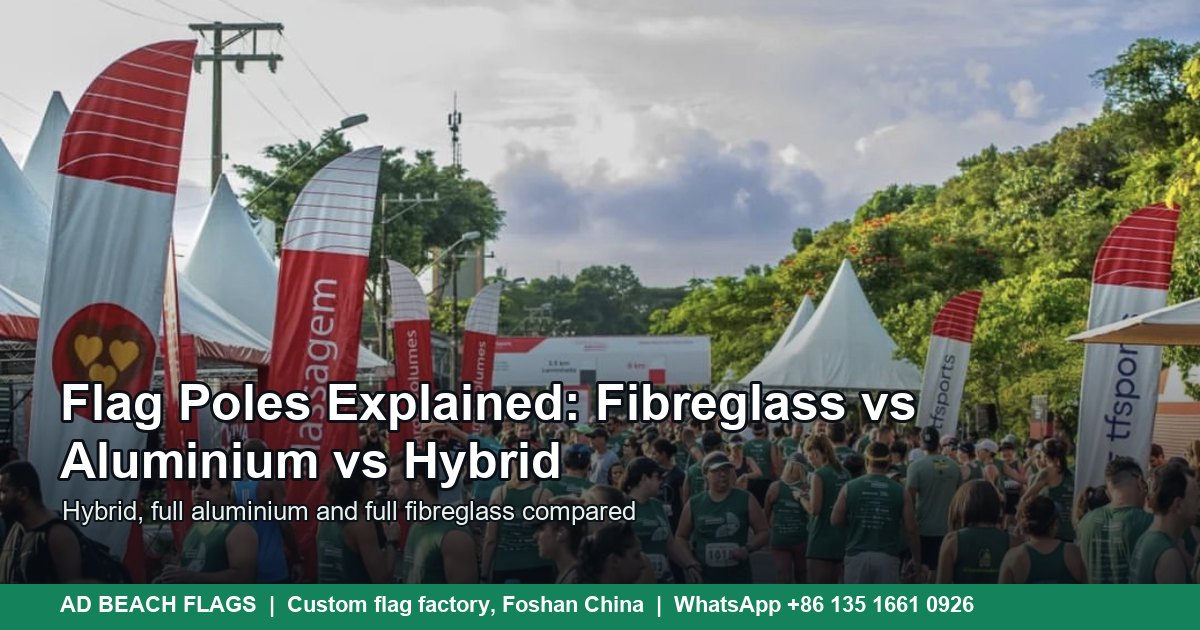
Buyers spend their time choosing the flag and treat the pole as packaging. Then a pole bends in the second week, the flag lies on the pavement, and the cheapest part of the order becomes the most expensive decision of the season.
Poles are not all the same tool with a different label. Three constructions dominate the market, and each one behaves differently in wind. This guide explains the difference in plain terms, with the sizes and part numbers buyers actually work with.
| Construction | How it behaves | Best for |
|---|---|---|
| Aluminium with fibreglass top | Stiff lower sections, flexible tip that curves and recovers | Everyday retail, events, mixed weather |
| Full aluminium | Straightest, heaviest, least flex; indoors it never leans | Exhibition halls, showrooms, long straight lines |
| Full fibreglass | Bends far and returns to shape; lightest in hand | Coastal sites, headlands, gusty forecourts |
The hybrid pole is the default for a reason. Aluminium holds the lower sections straight, which keeps the flag’s body upright, while the fibreglass tip supplies the curve that gives a teardrop its shape or a feather its flick. For a shop, a café or an event stand, it is the balanced choice.
Full aluminium earns its place indoors. On a trade show floor there is no wind, so flexibility has no value; straightness does, because a flag leaning over a stand looks careless. Full aluminium also suits buyers who dislike the slight sway of fibreglass in a breeze.
Full fibreglass exists for exposed sites. It bends further before it fails, and it returns rather than staying bent, which is why coastal buyers and outdoor event companies specify it even though it costs more. On a headland or a seafront promenade, that extra give is the difference between a flag that leans back into shape and one that stays folded over for the rest of the season.
Pole length is quoted in metres, and the pole is matched to the flag size rather than chosen on its own. The standard ladder for advertising flags runs as follows.
| Pole | Typical flag | Where it works |
|---|---|---|
| 2.8 m | Teardrop 75×165 cm / feather 60×200 cm | Pavements, shop doorways, indoor corners |
| 3.4 m | Teardrop 85×190 cm / feather 60×240 cm | Storefronts, terraces, reception forecourts |
| 4.0 to 4.6 m | Teardrop 95×230 to 110×260 cm | Street-level retail, car lot approaches |
| 5.0 to 5.6 m | Teardrop up to 130×330 cm / feather up to 75×410 cm | Highways, expos, sports grounds, dealerships |
Two details matter when you order spares. Bearing diameter describes the socket fitting where the pole meets the base, and it must match; our bases and poles share one standard, which keeps replacements simple. Section length describes how the pole breaks down for transport, and it decides whether the kit fits in a car boot or needs a van.
1. Wind with no rotation. A flag pinned in a crosswind levers against its pole at the socket. A rotating base lets the flag swing to face the wind instead, and that single change prevents most bent lower sections.
2. Leaving flags out in storms. No advertising pole is designed for a gale. Bringing flags in before bad weather is the cheapest maintenance there is.
3. A base that is too light for the size. The pole is the lever, the base is the pivot and the flag is the load. Undersize the base and the failure appears in the pole.
4. Bent tips left in service. A tip that has lost its curve never shapes the flag correctly again. Replacement tips are inexpensive and restore the display in minutes.
1. Wipe and dry sections before storage. Grit inside a joint grinds the coating every time the pole is assembled.
2. Store in a bag, not a bundle. An oxford carry bag keeps sections separated and stops the tip catching on other hardware.
3. Check the bungee or cord. Tension is what makes a flag look sharp; a stretched cord makes a good flag look tired.
4. Keep one spare section per ten poles. Failures happen at joints. A spare bottom section costs little and rescues an event.
United States. Feather flag poles are commonly ordered with aluminium lower sections and fibreglass tips, and buyers in coastal states step up to full fibreglass for beach sites.
United Kingdom and Ireland. Indoor trade show buyers favour full aluminium for straightness; street sites use hybrid poles with cross bases and water bags.
Germany, Austria and Switzerland. Buyers ask for pole hardware details in writing, including shaft diameters, and often specify silver or black finishes for uniformity across a chain.
Australia and New Zealand. Full fibreglass is the coastal standard, and replacement tips are a routine part of the spares order.
Brazil and Latin America. Hybrid poles dominate volume orders; full fibreglass appears where resellers supply exposed beaches.
It is worth saying plainly, because it saves buyers money. A portable pole and base is a temporary display system, and it stays inside those limits.
1. Permanent installation. If the pole must stay up for years, the answer is a fixed mast with a footing, not a portable pole and base.
2. Very high wind sites with year-round exposure. A wall-mounted bracket or a fixed post will outlast any portable system, and it is honest to say so.
3. Sites with no storage. A pole that cannot be brought in will fail early regardless of construction. Plan storage before you plan the flag.
Businesses that run flags across multiple sites learn the same lesson: the spares that matter are the cheap ones, and they matter on the worst possible day. A rental fleet, a dealership group or a chain of cafés should hold a small standard kit rather than improvising when something fails.
1. One spare bottom section per ten poles. The lowest section carries the most load and takes the most knocks from bases, kerbs and van floors. It is also the cheapest section to keep.
2. One spare fibreglass tip per five poles. Tips lose their curve if they are stored under load or stepped on. A tired tip makes a good flag hang wrong, and replacing it takes seconds.
3. Tension cords and a spare set of bungees. The cord stretches before the fabric fails. New cord restores a taut display for a fraction of the cost of a new flag.
4. One spare printed skin per flagship design. Not for every design, but for the two or three that appear in every photograph. When a skin is damaged the day before an event, a stored spare turns a crisis into a swap.
5. A printed parts sheet. One page listing every pole length, bearing diameter and base type in the fleet, with quantities. When a new staff member packs a van at six in the morning, that sheet is the difference between a complete kit and a missing base.
Pole orders look simple until freight is quoted. Four decisions keep the cost down.
1. Section length drives carton size. A pole that breaks into shorter sections fits a smaller carton and ships at a lower volumetric weight. Ask for section length before you assume a pole is too bulky to ship economically.
2. Poles and bases travel separately for a reason. Metal bases at the bottom of a carton crush printed flags and bend tips. Keeping them in their own cartons costs a little more in handling and saves a lot in replacements.
3. Setup time is a specification. In practice, a small kit assembles in roughly two to three minutes with one person, and a large form stands with two people in five to eight minutes when a water tank is involved. That number belongs in the quote, because labour is the cost that surprises buyers later.
4. Pack-down time is the number that decides whether a kit gets used. A kit that takes ten minutes to strike stays out overnight and dies in the first storm. A kit that takes two minutes comes in every evening and lasts.
Most pole complaints trace back to assembly, not to manufacturing, and the tell usually appears in the first minute.
1. Sections only fit one way. The widest section goes at the bottom, the fibreglass tip at the top. Forcing a joint the wrong way round splits the ferrule and shortens the pole’s life by most of it. If a section resists, stop and re-order it rather than pushing harder.
2. The sleeve takes the pole bottom first. Feeding a teardrop or feather sleeve from the bottom, with the shorter section leading, keeps the fabric from bunching around the joint. Bunching looks like a wrinkled print and is read as a quality fault even when it is a technique issue.
3. The tip must reach the top corner. A tip that stops short leaves the flag hanging from the second corner. Push it fully home; the visible difference is obvious within a metre.
4. Tension last, base before wind. Set the base, then tension the cord. Tensioning before the pole is seated simply pulls the whole assembly over.
5. Striking in reverse saves tips. Take the pole out of the sleeve before collapsing the sections, and the tip never takes a side load. Rental crews who strike in this order report far fewer cracked tips.
Two minutes of technique is worth more than a grade of material, which is why we ship an assembly sheet with every kit and a video link on request. If a crew keeps cracking tips, the answer is almost always in the striking order rather than in the pole.
Q7. Does a heavier pole bend less in the wind?
Weight helps less than construction does. A full fibreglass pole of the same length will outlive an aluminium one on an exposed site, because it bends further before it fails and returns to shape instead of staying set. Adding ballast at the base does more good than adding metal to the shaft.
Q8. Can poles be repaired, or must they be replaced?
Sections and tips are replaceable individually, which is the practical answer for fleets. A bent tip or a split ferrule never needs a whole new pole, and keeping two or three common spares in the warehouse turns a failure into a five-minute fix.
Q1. Which pole is best for a windy site?
Full fibreglass. It bends further before failing and returns to shape, which is what exposed coastal and headland sites need.
Q2. Can I use the same pole for teardrop and feather flags?
Yes. Our teardrop and feather flags share the same sectional pole system and bases, so you can change flag shape season to season without replacing hardware.
Q3. What sizes do poles come in?
The standard ladder runs 2.8 m, 3.4 m, 4.0 to 4.6 m and 5.0 to 5.6 m, matched to the flag size. Custom lengths are available on request.
Q4. Why did my pole bend at the joint?
Almost always wind load with no rotation, or a base that is too light for the flag size. Fit a rotating socket, increase ballast, and the problem largely disappears.
Q5. Are spare sections available?
Yes. Poles break at joints, so we supply individual sections and tips. Keeping one spare bottom section per ten poles is standard practice for rental fleets.
Q6. Do poles come with a warranty?
Aluminium poles carry a one year warranty and full fibreglass poles two years, from our factory, against manufacturing defects.
Send the flag size and the site, and we will confirm the pole construction, the length and the base in one reply, within 1 hour, 24×7. Low MOQ accepted, poles ship with or without flags, and we keep your specification on file so the next order matches exactly.
Tell us the flag size, the quantity, single or double-sided, and the surface the flags will stand on. Our export team replies within 1 hour, 24×7, with an artwork proof and a factory price. Low MOQ accepted.
Chat on WhatsApp (+86 135 1661 0926) Email Us Now
Prefer a form? Fill in the details below and we will come back with a proof and a price within 1 hour, 24×7.
Related reading: Flag Base Guide | Flag Fabric and Printing Guide | Surf Flags for Coastal Campaigns | Aluminium Poles | Full Aluminium Poles | Full Fiberglass Poles | Flag Bases
| Item | Detail |
|---|---|
| Product | Flag poles for teardrop, feather, backpack and beach flags |
| Manufacturer | Ad Beach Flags, Foshan, Guangdong, China |
| Constructions | Aluminium with fibreglass top, full aluminium, full fibreglass |
| Lengths | 2.8 m, 3.4 m, 4.0 to 4.6 m, 5.0 to 5.6 m; custom lengths on request |
| Fittings | Standard bearing socket shared with our full base range, 14.5 to 16.7 mm diameters |
| Finishes | Silver and black standard; other finishes on request |
| Warranty | Aluminium poles 1 year; full fibreglass poles 2 years |
| Spares | Individual sections and replacement tips available |
| MOQ and lead time | Low MOQ accepted; poles ship with or without flags; bulk 5 to 10 days |
| Contact | WhatsApp +86 135 1661 0926, [email protected], reply within 1 hour 24×7 |
| Point | Detail |
|---|---|
| Manufacturer, not a reseller | Printed and sewn in our own Foshan workshop, so specification questions reach the people who make the goods. |
| Colour you can hold us to | Pantone and RAL matching with a printed swatch approved before the bulk run; about 5% is the accepted tolerance for CMYK sublimation. |
| One kit, one supplier | Flag, pole, base and carry bag ship from one factory with one fitting standard, so nothing is missing on install day. |
| Fast sampling | Digital printing needs no screens: samples in 2 to 3 days and bulk in 5 to 10 days after artwork approval. |
| Low MOQ accepted | Trial orders do not need a container, with wholesale pricing from small quantities per design. |
| Customer 5stars Feedback | warmly welcomed in 150+ countries across Europe, the Americas, the Middle East, Africa and Oceania. |