Phone:
0086-757-8938 9313
Email:
Address:
Caochang Industrial Zone, Liguang Rd, Lishui, Nanhai, Foshan, Guangdong, China
Reply within 1 hour, 24x7

Phone:
0086-757-8938 9313
Email:
Address:
Caochang Industrial Zone, Liguang Rd, Lishui, Nanhai, Foshan, Guangdong, China
Reply within 1 hour, 24x7

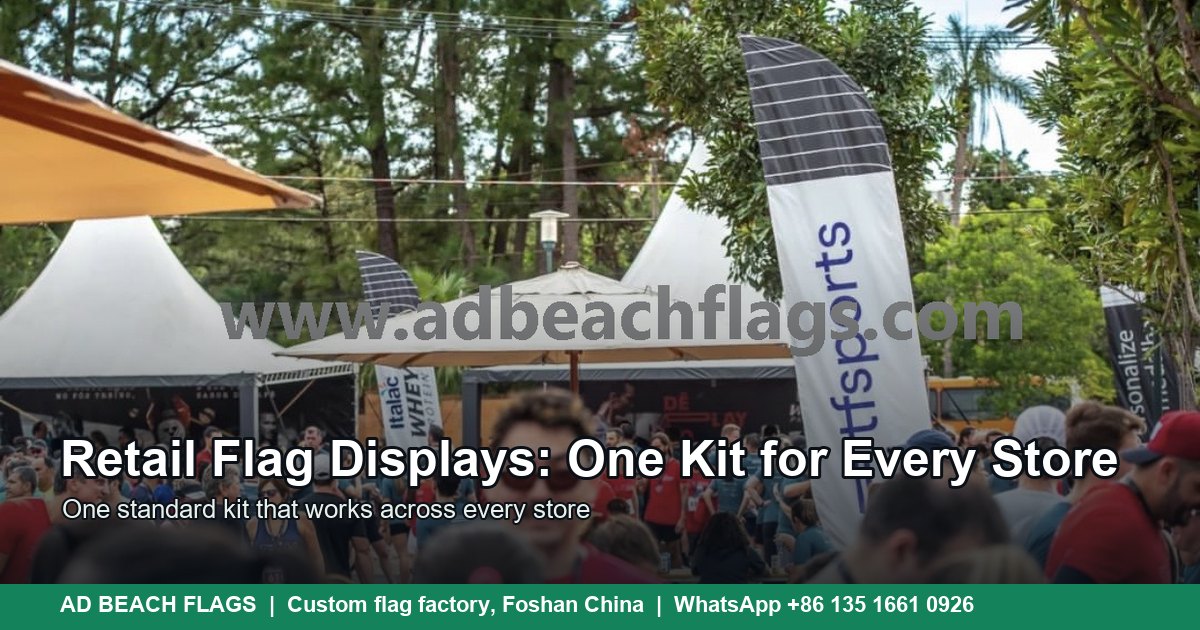
One store can be styled by instinct. Forty stores cannot. The moment a retail group tries to give every branch the same look, the problems move from design to logistics: pavement widths differ, surfaces differ, landlords differ, and the staff who put the flags out on Monday morning have other jobs to do.
This guide covers the way retail chains build flag displays that survive all of that: a standard kit that adapts by exception, bases chosen by surface, artwork sets that change without new hardware, and a rollout checklist that stops forty stores from ordering forty slightly different things.
1. They mark the entrance. Shoppers decide at thirty metres whether to cross the road. A flag display answers that question before the shopfront does.
2. They change with the calendar. Seasonal sales, refresh dates and promotions all need signs that change, and a new printed skin costs a fraction of a new sign.
3. They work inside and out. The same panel format hangs on an indoor stand in a mall unit and on a pole on a high street, which keeps one design language across mixed estates.
4. They scale. Once the specification is fixed, adding a hundred stores is a purchase order rather than a project.
| Component | Standard choice | Why it travels well across branches |
|---|---|---|
| Flag shape and size | Teardrop 85×190 cm on a 340 cm pole | Fits most pavements, reads at street distance, small enough for one person to handle |
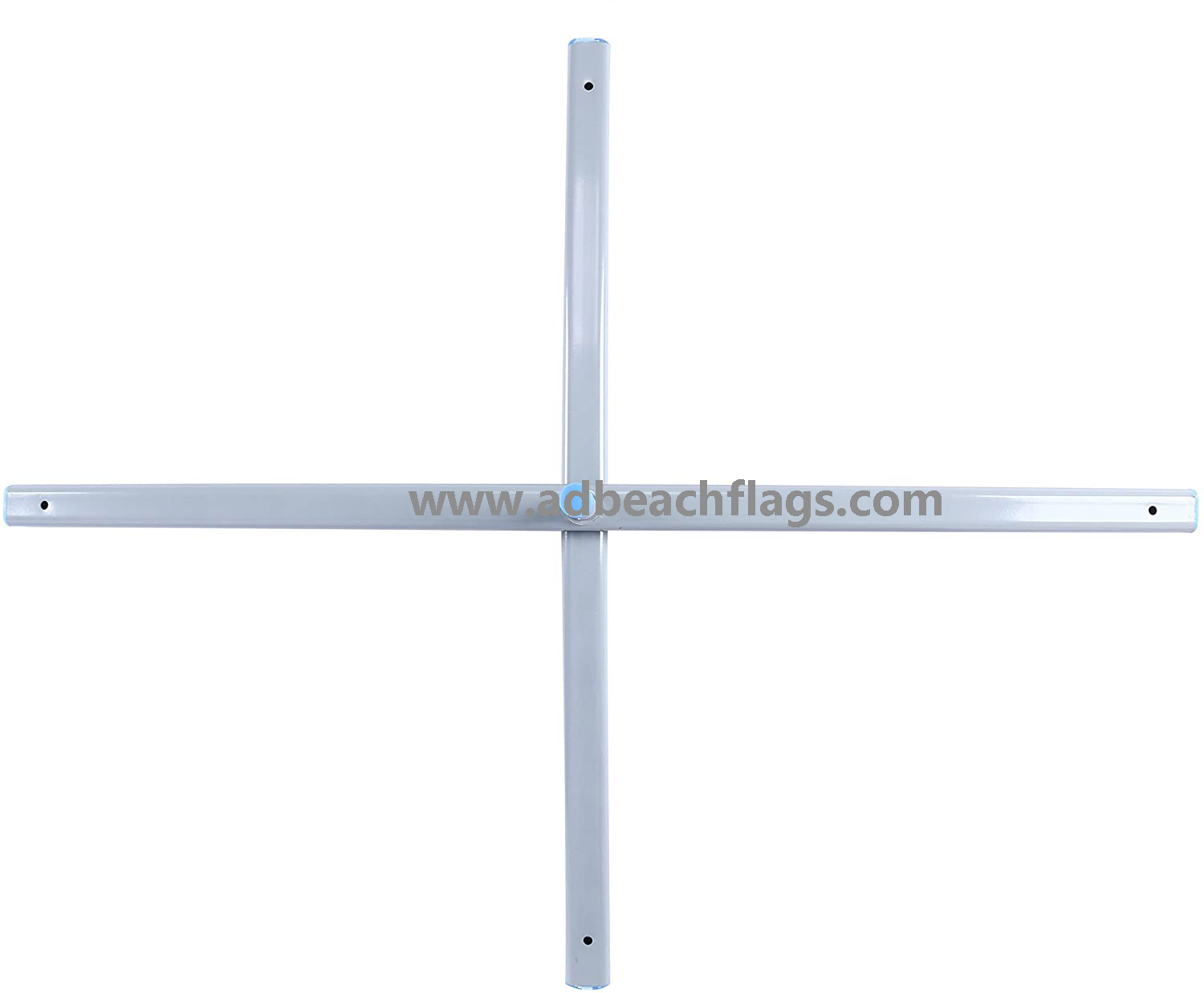
| Base | Cross base 1.25 to 1.45 kg plus water bag | Folds flat for storage, works on any hard surface, ballast added on site |
| Pole | Aluminium with fibreglass top | One spare section covers most breakages across the estate |
| Carry bag | Oxford bag sized to the pole set | Store rooms are small; a bag keeps the kit together and undamaged |
| Spares | One spare skin and one spare bottom section per ten stores | Covers damage without an emergency order per branch |
The design principle is exceptions, not options. A standard kit for every store, with a documented exception list for the handful of branches that genuinely cannot use it: a mall unit with no exterior frontage, a listed building with a narrow pavement, or an outlet where the landlord forbids pavement signage.
Most rollout problems come from bases, not flags. The practical approach is to survey surfaces during the rollout and map every store to one of four cases.
1. Pavement and paving. Cross base with a water bag of about 10 to 12 litres. Standard and cheap to repeat.
2. Grass or planted verge. Ground spike, pulled before mowing and refitted after.
3. Exposed corner or coastal store. Heavy cross base of 2.2 to 2.8 kg, or a metal plate of 6.3 kg, because the standard base will lean in funneled wind.
4. Indoor mall unit. Metal plate of 3 to 6 kg with a mat underneath, or a cross base if the centre allows it. Many centres restrict spikes and require weights, so check the tenant handbook first.
A chain does not need one design per campaign, it needs a small repeated set that every store understands.
1. Brand skin. Logo, brand colours, no offer. This one runs permanently and never changes.
2. Campaign skin. A seasonal or promotional message in exactly the same layout as the brand skin, so the family still looks related when both are standing side by side.
3. Wayfinding skin. Used at branches with multiple entrances or a car park, carrying an arrow or a short direction.
4. Template discipline. Every skin is produced from the same template file with the same safe zones, which is what keeps flags readable when the artwork team changes.
Holding artwork on file at the factory is the single biggest operational saving for a chain: a new campaign becomes a reprint order, not a design and sampling project.
1. Confirm the flag positions against the store plan before drilling or placing anything, and photograph the approved position so every other branch can copy it exactly.
2. Record the surface in the store database, because the base choice follows from it and the person ordering may never visit the site.
3. Brief the daily routine. Flags go out on opening and in on closing; the bag lives in a dry store room, not against a radiator.
4. Name a responsible person per store. A named person keeps the kit complete, and a complete kit is what makes replacement planning possible.
5. Log damage honestly. A bent section or a missing base logged at the time it happens is far cheaper than discovering it during a regional visit, when the trail has gone cold.
Flags left outdoors every day are consumables, and a chain with forty branches should plan them like any other consumable, not react store by store.
1. Set a skin replacement interval. Roughly eight to twelve months for daily outdoor use, sooner for south-facing or coastal sites.
2. Rotate where it matters. The most exposed branches benefit from two skins per pole, swapped mid-season, which halves the sun exposure of each.
3. Order skins centrally. One order for the estate costs less per unit than forty small orders and guarantees the colour matches.
4. Keep hardware longer than artwork. Poles and bases last years; only the printed skins and the occasional section need replacing.
1. Letting each store order its own kit. Forty orders produce forty slightly different colours, sizes and bases, and the brand looks inconsistent on every street.
2. Choosing one kit without a site survey. The exception list exists because ten percent of sites are genuinely different; discovering that after delivery is expensive.
3. Skipping the store briefing. Staff who were never told why the flags matter leave them out in storms and in overnight theft territory.
4. No spares on the estate. One bent section should not take a store’s display down for three weeks while a replacement ships.
5. Artwork drift. Every campaign designed from scratch slowly diverges; a fixed template is what keeps year three looking like year one.
United Kingdom and Ireland. Pavement displays often need permission, and mall landlords typically require weighted bases rather than spikes. Chains standardise on cross bases with water bags and check the tenant handbook per centre.
United States. Storefront flag displays are common in strip malls and roadside retail, where larger feather flags on plates carry the offer and local code limits are checked per municipality.
Germany, Austria and Switzerland. Retail groups ask for written specifications and consistent silver hardware, and standardise artwork across chains with a single colour reference held at the factory.
Australia and New Zealand. Hard UV means chains plan an annual skin replacement and often specify 115gsm or mesh for west-facing and coastal stores.
Brazil and Latin America. Shopping centre rules usually require indoor bases, so plate and cross bases dominate there, with single-sided skins kept as a cost line on volume orders.
We would rather flag these exceptions before a rollout than after one.
1. Stores with no external frontage. Inside a mall with strict sign rules, an indoor display stand or window graphics do the job legally and better.
2. Locations where the pavement is too narrow. A flag plus a base plus a walking line is a compliance problem; use window vinyls instead.
3. Groups that cannot support a daily routine. Flags left out permanently fade and fail; if no store team can be responsible for them, budget for replacement more often or choose a different medium.
Groups usually standardise on one shape, and the choice has a practical answer.
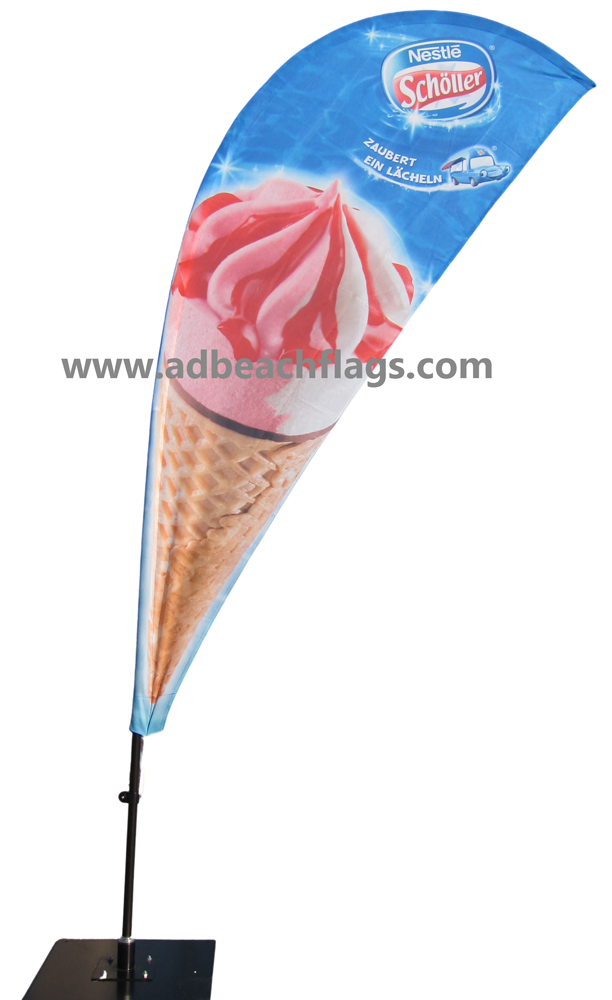
1. Teardrop for storefront estates. The shape holds its tension in any wind, the print sits at pedestrian eye level, and it needs the least footprint on a pavement. For high-street and shopping parade branches it is the safer default.
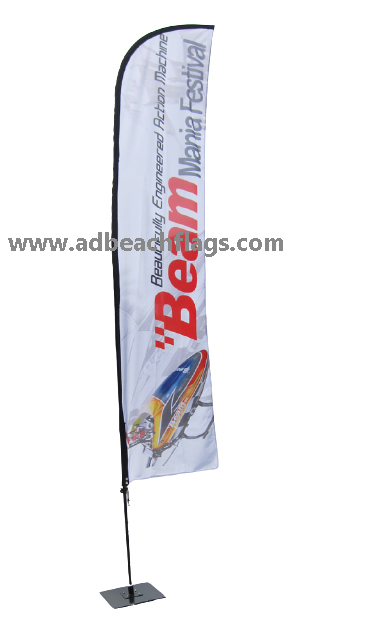
2. Feather for roadside and retail park branches. More printable area and more movement mean better reading at distance, which suits stores set back from the road with a car park in front.
3. Mixed estates. Chains with both site types often standardise on the pole and base family, then stock two flag shapes on the same hardware. Staff learn one setup routine, spares stay interchangeable, and each store gets the shape that suits its frontage.
4. Indoor formats. Mall units frequently specify the printed panel on an indoor stand, because centres restrict poles and bases in common areas. The same artwork file produces both the pole flag and the indoor panel, which keeps one design language across the whole estate.
Q1. What kit should a retail chain standardise on?
Most chains do well with a teardrop flag at 85×190 cm on a 340 cm pole, a cross base of 1.25 to 1.45 kg with a water bag, and an oxford carry bag, with a documented exception list for mall units and exposed corners.
Q2. How do we handle stores with different surfaces?
Survey during rollout and map each store to one of four cases: hard pavement with a cross base, soft ground with a spike, exposed sites with a heavy cross base or plate, and indoor units with a plate on a mat.
Q3. How many flags does each store need?
Two usually: one at the main approach and one at the entrance. Stores on a corner or with two entrances need three so each approach is covered.
Q4. How do we keep forty stores looking identical?
Fix the kit specification, produce all skins from one template, hold artwork and the colour reference at the factory, and order skins centrally rather than store by store.
Q5. How often should a chain replace flag skins?
Plan on eight to twelve months for daily outdoor use, sooner for coastal or west-facing stores. Rotating two skins per pole on the most exposed sites extends the interval.
Q6. What spares should the estate hold?
One bottom pole section and one spare skin per ten stores covers most damage, and a written parts sheet listing every size in the estate keeps ordering simple.
| Point | Detail |
|---|---|
| Manufacturer, not a reseller | Flags, poles and bases produced in our own Foshan workshop, so a multi-store specification is met from one production line. |
| Colour you can hold us to | Pantone and RAL matching with a printed swatch approved before bulk, so store 1 and store 40 carry the same red. |
| Skins, not whole kits | Artwork stays on file, so a campaign change is a reprint order rather than a new project. |
| One fitting standard | Bases, poles and spares interchange across the estate, which keeps the parts sheet short. |
| Low MOQ accepted | Pilot two or three stores first, then roll the proven specification out across the network. |
| Customer 5stars Feedback | warmly welcomed in 150+ countries across Europe, the Americas, the Middle East, Africa and Oceania. |
A retail flag display is a supply chain decision wearing a marketing hat. Fix one kit specification, let the site survey decide the base, print every skin from the same template, and plan skins as an annual consumable. Chains that do those four things get a consistent street presence for years; chains that let each store order its own kit spend the same money and look improvised in forty places at once.
Send us the branch list, the surfaces and the campaign calendar, and we will reply within 1 hour, 24×7 with a standard kit specification, an exception list for the awkward sites and a central ordering plan. Low MOQ accepted, and we will pilot three stores before you commit to forty, because a specification that survives a pilot usually survives the estate.
Tell us the flag size, the quantity, single or double-sided, and the surface the flags will stand on. Our export team replies within 1 hour, 24×7, with an artwork proof and a factory price. Low MOQ accepted.
Chat on WhatsApp (+86 135 1661 0926) Email Us Now
Prefer a form? Fill in the details below and we will come back with a proof and a price within 1 hour, 24×7.
Related reading: Sidewalk Flags for Cafés | Flags for Forecourts | Beach Flag Size Guide | Teardrop Flags | Cross Bases | Heavy Cross Bases | Portable Oxford Bags | Feather Flags
| Item | Detail |
|---|---|
| Product | Retail flag displays and storefront flag kits for multi-site chains |
| Manufacturer | Ad Beach Flags, Foshan, Guangdong, China |
| Standard kit | Teardrop 85×190 cm on 340 cm pole, cross base 1.25 to 1.45 kg with water bag, oxford carry bag |
| Bases by surface | Cross base for pavement, spike for soil, heavy cross 2.2 to 2.8 kg or plate 6.3 kg for exposed sites, plate 3 to 6 kg indoors |
| Fabric | 110gsm knitted polyester standard; 115gsm and mesh for exposed or coastal stores |
| Printing | Dye sublimation with Pantone and RAL matching; artwork held on file for reprints |
| Artwork set | Permanent brand skin, campaign skin and wayfinding skin, all produced from one template |
| Replacement cycle | Skin replacement every 8 to 12 months of daily outdoor use; hardware lasts years |
| Spares policy | One bottom pole section and one spare skin per ten stores |
| Contact | WhatsApp +86 135 1661 0926, [email protected], reply within 1 hour 24×7 |