Phone:
0086-757-8938 9313
Email:
Address:
Caochang Industrial Zone, Liguang Rd, Lishui, Nanhai, Foshan, Guangdong, China
Reply within 1 hour, 24x7

Phone:
0086-757-8938 9313
Email:
Address:
Caochang Industrial Zone, Liguang Rd, Lishui, Nanhai, Foshan, Guangdong, China
Reply within 1 hour, 24x7

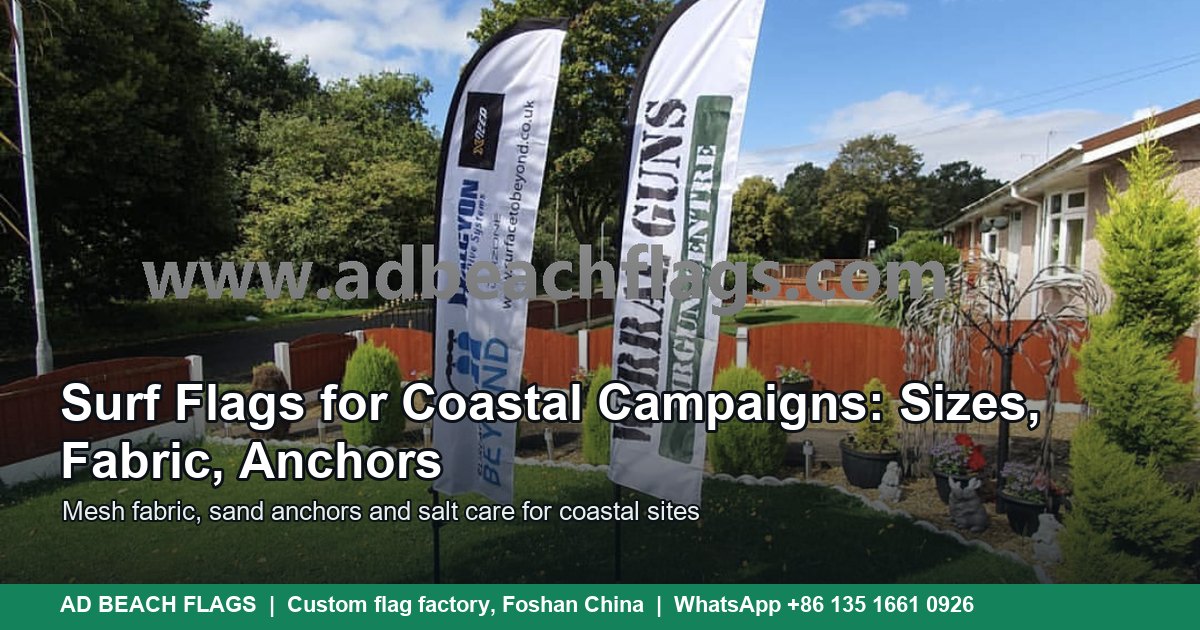
Coastal signage fails in ways inland signage never does. Salt eats stitching, glare flattens pale colours, and sand refuses to hold a straight stake. A flag that looks perfect in a warehouse photo can be flat on the beach by the second afternoon.
This guide is written for the buyers who live with that reality: surf shops, beach clubs, resort marketing teams, surf schools and event organisers along a coast. It covers the four decisions that actually matter.
Standard flag fabric is 110gsm knitted polyester, and it is excellent for streets and shows. On an exposed beach it has one weakness: it catches every gust at full force, and that load travels straight down the pole into the base.
Mesh fabric solves this. The weave is roughly 30% open, so air passes through the flag instead of pushing it flat. The practical effects:
1. Lower load on the pole. Less wind pressure means less flexing and fewer bent sections at the joints.
2. Less flogging. The fabric does not snap and crack in the same way, so seams last longer.
3. Better behaviour in cross-shore wind. A beach wind rarely arrives straight at the flag; mesh tolerates the angles.
The trade-off is print depth. Mesh print reads slightly lighter than solid polyester because you see sky through the weave. For bold logos and high-contrast colours it is barely noticeable; for fine photographic detail, it is.
| Fabric | Coastal behaviour | Best for |
|---|---|---|
| 110gsm knitted polyester | Strong colour, takes the full wind load | Sheltered promenades and terraces |
| 115gsm knitted polyester | Heavier knit resists UV fading longer | Sunny coasts with moderate wind |
| Mesh, about 120gsm | Air passes through, load drops, print softens slightly | Open beaches, headlands, winter swells |
A straight ground spike pulls out of loose sand in minutes. Coastal sites need one of three alternatives:
1. Spiral anchor. A screw-in stake with a helical blade. It bites into sand and resists upward pull, which is exactly how a flag loads its anchor. Light to carry, quick to fit, and the cheapest of the three.
2. Water tank base. Filled on site with 12 to 32 litres of water, or with sand where the temperature drops below freezing. Heavy, stable, and the standard choice for a flag that stays out all season. Remember that a full tank is over 30 kg, so plan how you will carry it.
3. Car base. Slides under a vehicle tyre. Ideal for surf schools with a van at the beach, and for surf shop forecourts where the flag moves with the parking.
Whatever you choose, allow about 1.2 to 3.6 metres of clear radius so the flag can swing without hitting people, vehicles or the sea wall.
Beach light is brutal. Three design rules come up again and again with coastal clients:
1. Contrast beats detail. White on sand disappears. A dark field with one bright accent reads at 40 metres; a pastel gradient reads at none.
2. Fewer, larger elements. A single logo and three words beat a busy layout every time. Wind moves the flag, and movement costs you reading time.
3. Test at the brightest hour. If a design cannot be read at midday in July, it will not be read at all in season.
| Site | Recommended size | Why |
|---|---|---|
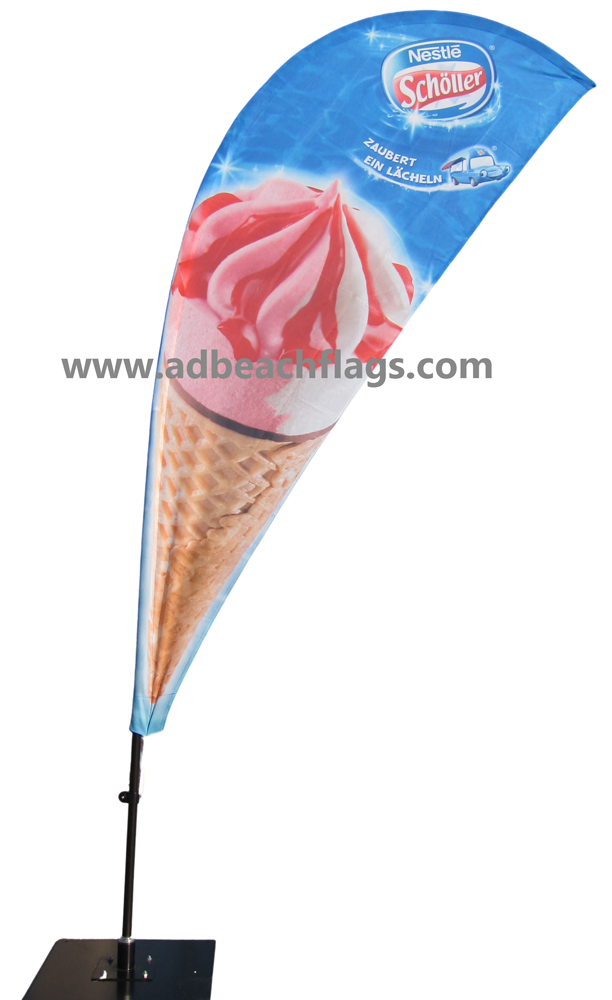
| Surf shop doorway | Teardrop 85×190 cm on a 340 cm pole | Holds shape in onshore gusts, small footprint |
| Beach club terrace | Teardrop 95×230 cm on a 400 cm pole | Readable from the water line |
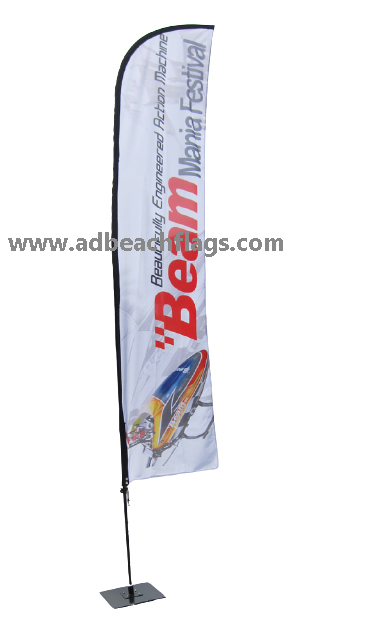
| Surf school meeting point | Feather 60×240 cm on a 340 cm pole | Maximum print area for schedules and prices |
| Event finish line | Feather 75×410 cm on a 560 cm pole | Visible above crowds on the sand |
1. Rinse before you store. Salt crystals grind stitching, and they attract moisture. A quick freshwater rinse and a full dry adds weeks to a seam’s life.
2. Dry completely, always. A flag folded damp in a bag grows mildew, and mildew staining does not wash out.
3. Rotate two skins per pole. Rental fleets along the coast routinely keep two printed skins per pole and swap them monthly, so each skin takes half the sun. The set always looks new and the poles never sit idle.
4. Replace the tension cord, not the flag. The bungee at the base of the sleeve wears before the fabric does. A new cord restores a taut print for a fraction of a new flag.
Australia and New Zealand. UV drives every specification decision. Buyers step up to 115gsm or plan an annual replacement, and mesh is standard at exposed beaches.
United States. Coastal campaigns often run feather flags in the largest sizes on the Pacific coast, with mesh where wind is constant. Check local rules; some beach towns restrict signage on the sand itself.
Brazil. Bandeira pluma and beach flag campaigns peak around summer events and surf championships. Single-sided printing keeps landed cost down on volume orders, with mesh for the open coast.
Spain, Portugal and Chile. Bandera vela and bandera pluma orders arrive with a photograph rather than a catalogue number. Send the photo and a rough height; the millimetres can be matched from there.
United Kingdom and Ireland. Coastal sites here frequently pair teardrop flags with water tank bases and accept a shorter season; the flag comes in for winter storage.
1. On the open sand in a storm season. Anything portable comes down before a serious blow. If you need permanent signage on a beach, that is a council permit and a fixed structure, not a flag.
2. Where councils prohibit it. Many beaches restrict commercial signage on the sand. One call to the local authority saves a fine and an awkward conversation.
3. When the flag would sit in breaking surf. Salt spray is survivable; being knocked flat by waves is not. Keep flags above the tide line.
Most coastal businesses end up buying one of three kit patterns. Knowing which one you are building for keeps the order coherent and the spares box tidy.
1. The shopfront kit. Two teardrop flags at 85×190 cm on 3.4 m hybrid poles, cross bases with one water bag each, one oxford carry bag. It lives out front on pavement or decking, comes in at night, and takes two minutes to set up or strike. This is the lowest-risk first purchase and it covers the whole season on one set of hardware with two spare printed skins.
2. The beach presence kit. One feather flag at 60×240 cm or 70×290 cm in mesh fabric, spiral anchor for sand, plus a water tank base for the harder upper beach when the sand is too loose. The feather carries the schedule or the lesson price; the tank gives you the option to move off the sand entirely when a storm system parks offshore for a week.
3. The event kit. Four to eight flags at mixed sizes for a competition, a surf contest or a brand activation: two large flags marking the site boundary, two medium flags at the registration table, and small flags on the route to the water. Fold-flat cross bases travel in a van better than tanks, and mesh fabric keeps the whole set standing when the onshore breeze picks up at midday, which is exactly when the crowd arrives.
Whichever kit you build, buy the hardware once and treat printed skins as the consumable. A skin replaced for a fraction of the kit price refreshes the display; a whole new kit for the same reason wastes the poles, the bases and the freight.
Surf contests, beach volleyball tournaments and coastal festivals buy flags in a particular way, and suppliers who understand that pattern win the repeat order.
1. Deadlines are absolute. An event has one date. Flag orders that miss it are worthless, so organisers order early and pay for certainty. If a supplier promises production in five days and delivers in twelve, the relationship ends there regardless of quality.
2. Artwork arrives late and changes. Sponsor logos land after the entry list, and the entry list lands after the sponsorship deal. The practical answer is a fast proof loop: layout within the hour, one round of changes, then print. Digital printing needs no screens, so a changed sponsor mark is a file swap rather than a new plate.
3. Sets must look like sets. Twelve flags in three slightly different greens look like a mistake. Colour matching across a single order, run in one production batch, is what makes an event look sponsored rather than improvised.
4. Somebody has to carry it. Organisers value packing they can lift. Flags flat, poles bundled by size, bases in one carton with a printed count on the side. It sounds trivial until a volunteer is trying to find the right pole at six in the morning.
Coastal businesses often start by renting flags for a season and wonder when ownership pays. The crossover point is roughly two to three seasons of use, and it depends on three numbers.
1. Rental cost per event against purchase cost per flag. A single event rental can approach the price of a small flag kit. Once a site uses flags more than a handful of times a year, ownership wins on arithmetic alone.
2. Storage. Ownership costs a cupboard. If there is genuinely nowhere dry to keep a folded kit, renting stays rational, because a flag stored damp is a flag thrown away.
3. Artwork changes. A shop that changes its offer weekly gets more value from skins and poles it owns than from rented sets that must be returned on a schedule. A business running one event a year is the opposite case.
Q1. Is mesh or polyester better for a beach?
Mesh where wind is constant, because air passes through the weave and the load on the pole drops sharply. Polyester where the site is sheltered but very sunny, because the denser fabric holds colour longer.
Q2. How do I stop a flag falling over on sand?
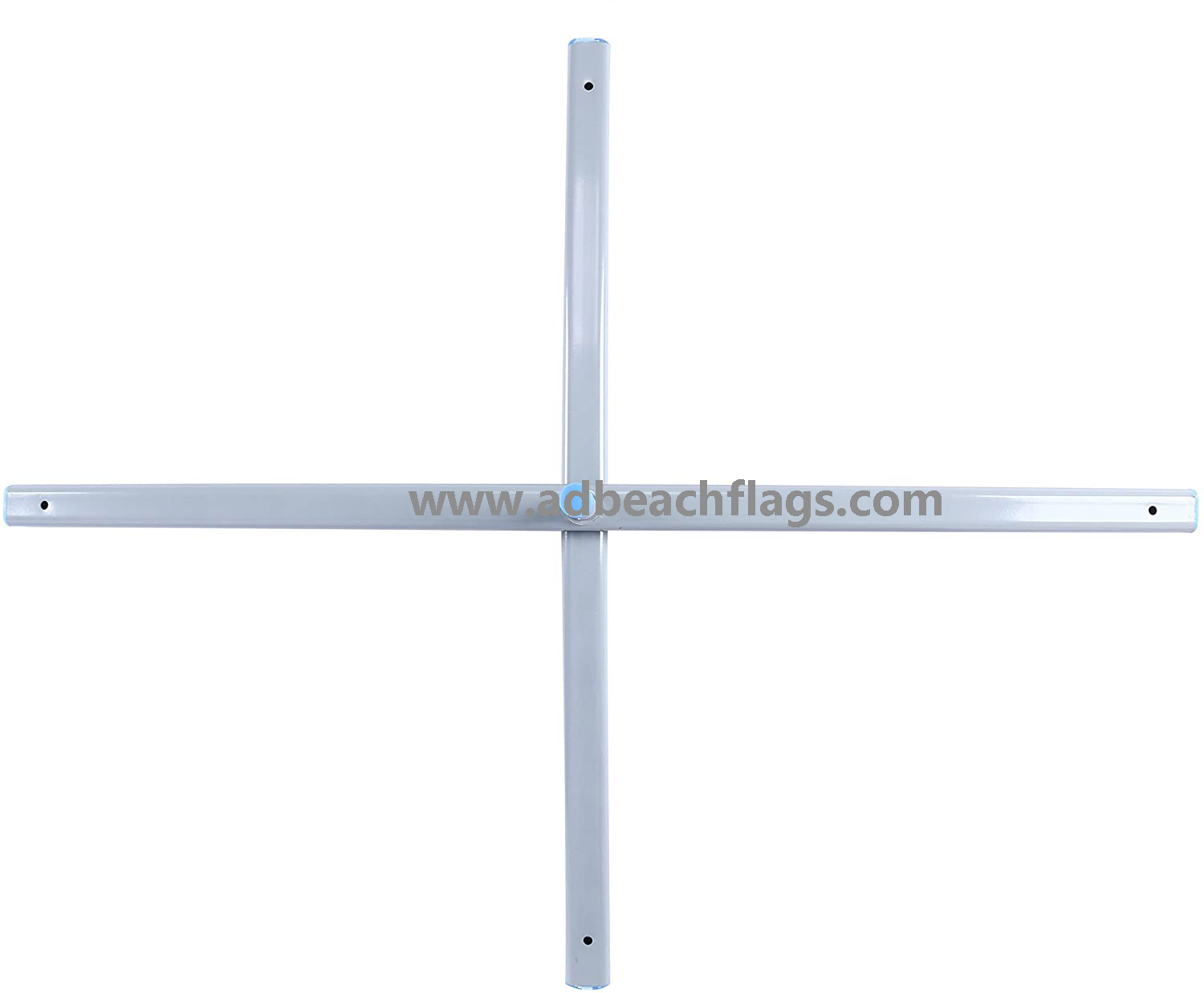
Use a spiral anchor, a water tank base or a car base. A straight spike will not hold in loose sand, and a cross base needs solid ground to spread its load.
Q3. How long will a coastal flag last?
Plan on roughly six months of daily outdoor use, less on an exposed headland. Rinsing salt off, drying fully and rotating two skins per pole are the habits that stretch it further.
Q4. Can I print a photograph on a surf flag?
Yes, with dye sublimation. Keep in mind that mesh softens fine detail, so photographic artwork suits solid polyester better than an open weave.
Q5. What sizes do surf shops usually order?
Most order teardrop flags from 85×190 cm to 95×230 cm for the shopfront, and feather flags at 60×240 cm or larger for the beach itself where the flag competes with crowds.
Q6. Do you supply replacement skins only?
Yes. With your artwork on file we print replacement skins that match the original colours, which is how rental fleets keep a consistent look across seasons.
Tell us the beach, the wind you actually get and how long the flag stays out. We will come back within 1 hour, 24×7, with a fabric, a size and an anchor that suit that specific spot, plus the artwork template for the size. Low MOQ accepted, and if a mesh flag will not survive your site we will say so before you order. Coastal campaigns reward planning more than enthusiasm, so bring the photograph, the wind direction and the tide line, and the quote will fit the site rather than the catalogue.
Tell us the flag size, the quantity, single or double-sided, and the surface the flags will stand on. Our export team replies within 1 hour, 24×7, with an artwork proof and a factory price. Low MOQ accepted.
Chat on WhatsApp (+86 135 1661 0926) Email Us Now
Prefer a form? Fill in the details below and we will come back with a proof and a price within 1 hour, 24×7.
Related reading: Flag Base Guide | Flag Fabric and Printing Guide | Beach Flag Size Guide | Customized Beach Flags | Feather Flags | Water Bases | Car Bases | OEM / ODM Surf Flags
| Item | Detail |
|---|---|
| Product | Custom printed surf flags and beach flags for coastal sites |
| Manufacturer | Ad Beach Flags, Foshan, Guangdong, China |
| Coastal fabric | Mesh about 120gsm with roughly 30% open weave; 110gsm and 115gsm knitted polyester also available |
| Printing | Dye sublimation with Pantone and RAL colour matching |
| Sand anchors | Spiral anchor, water tank base 12-32 litres, car base |
| Sizes | Teardrop 75×165 cm to 130×330 cm; feather 60×200 cm to 75×410 cm |
| Poles | Aluminium with fibreglass top, full aluminium, full fibreglass |
| Expected life | About six months of daily outdoor use; salt rinse and full drying extend it |
| MOQ and lead time | Low MOQ accepted; samples 2-3 days, bulk 5-10 days after artwork approval |
| Contact | WhatsApp +86 135 1661 0926, [email protected], reply within 1 hour 24×7 |
| Point | Detail |
|---|---|
| Manufacturer, not a reseller | Printed and sewn in our own Foshan workshop, so specification questions reach the people who make the goods. |
| Colour you can hold us to | Pantone and RAL matching with a printed swatch approved before the bulk run; about 5% is the accepted tolerance for CMYK sublimation. |
| One kit, one supplier | Flag, pole, base and carry bag ship from one factory with one fitting standard, so nothing is missing on install day. |
| Fast sampling | Digital printing needs no screens: samples in 2 to 3 days and bulk in 5 to 10 days after artwork approval. |
| Low MOQ accepted | Trial orders do not need a container, with wholesale pricing from small quantities per design. |
| Customer 5stars Feedback | warmly welcomed in 150+ countries across Europe, the Americas, the Middle East, Africa and Oceania. |