Phone:
0086-757-8938 9313
Email:
Address:
Caochang Industrial Zone, Liguang Rd, Lishui, Nanhai, Foshan, Guangdong, China
Reply within 1 hour, 24x7

Phone:
0086-757-8938 9313
Email:
Address:
Caochang Industrial Zone, Liguang Rd, Lishui, Nanhai, Foshan, Guangdong, China
Reply within 1 hour, 24x7

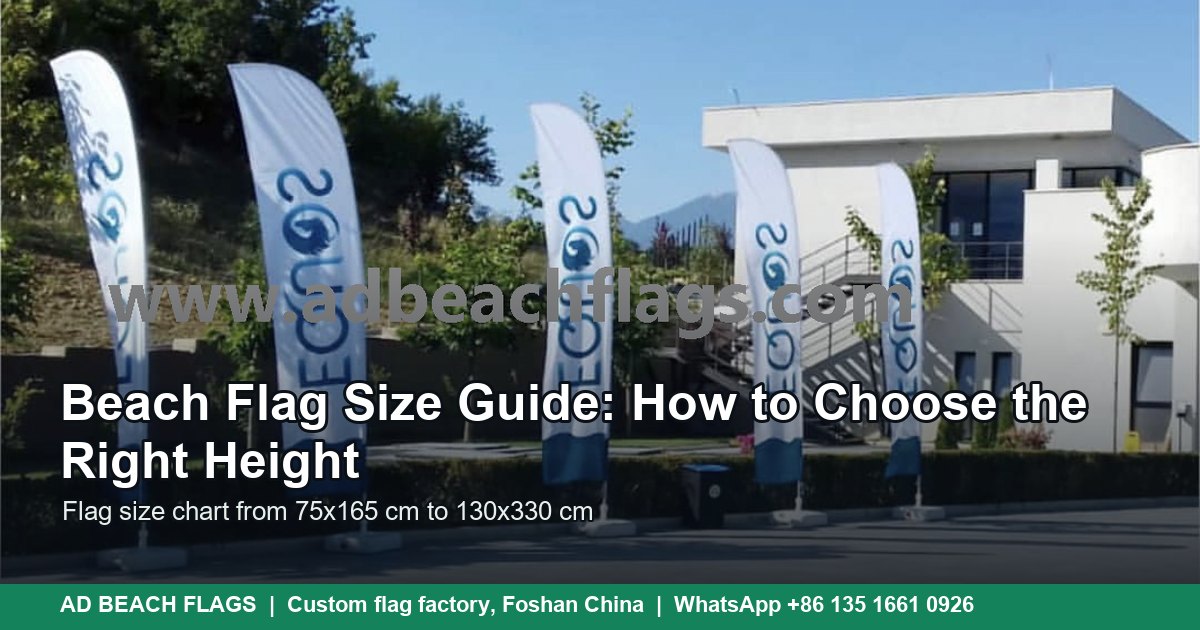
Choosing a flag size is the single decision buyers most often get wrong, and the mistake is expensive in both directions. Order too small and the flag disappears against a busy street. Order too large and it crowds the pavement, fights the wind, and needs a base heavy enough to damage a delivery van’s bumper.
The good news is that flag sizing follows a few physical rules, not taste. This guide gives you the chart and the rules, straight from the factory floor where these sizes are printed every week.
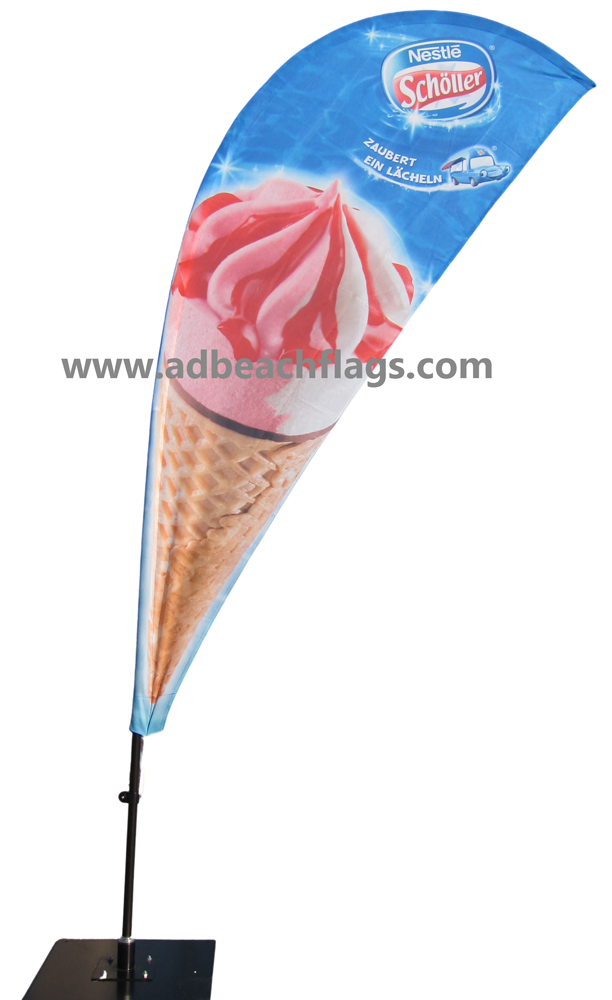
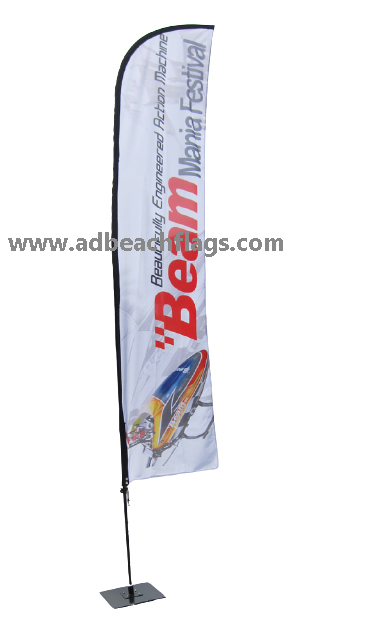
Flag and pole are matched pairs. Each flag size is designed for one pole height, and mixing them makes the flag look either stretched or cramped.
| Size name | Teardrop (W x H) | Pole | Feather (W x H) | Pole |
|---|---|---|---|---|
| XS | 75 x 165 cm | 280 cm | 60 x 200 cm | 280 cm |
| S | 85 x 190 cm | 340 cm | 60 x 240 cm | 340 cm |
| M | 95 x 230 cm | 400 cm | 70 x 290 cm | 400 cm |
| L | 110 x 260 cm | 460 cm | 70 x 325 cm | 460 cm |
| XL | 110 x 300 cm | 500 cm | 75 x 360 cm | 500 cm |
| XXL | 130 x 330 cm | 560 cm | 75 x 410 cm | 560 cm |
One warning before you compare charts across suppliers: the words Small, Medium and Large are not standardised. A large feather flag from one factory can measure 3.4 m while another calls a 4.1 m flag large. Always compare the centimetres of the flag and the pole, never the label.
The pole is a scaffold, not the sign. What people see is the printed flag plus the visible bare pole above it. Three numbers matter:
1. Pole height. The length of the assembled pole, measured from the base up. A 400 cm pole with a spike base gives roughly 400 cm above ground.
2. Printable height. The height of the fabric itself, for example 230 cm on a medium teardrop.
3. Assembled height. Where the top of the flag actually sits once the curved tip pulls the fabric into shape. On teardrop flags this is lower than the pole, usually by 30 to 80 cm depending on size, because the tip bends over.
Suppliers who quote only the pole height are technically correct and practically useless. Ask for the assembled height, or measure it from a sample if you can.
1. Pavement in front of a shop. Small to medium, 340 cm to 400 cm pole. This is eye level for walkers, which is the only level that matters. A 560 cm flag on a narrow pavement spends most of its height advertising to birds and first-floor windows.
2. Roadside forecourt or car lot. Large to XXL, 460 cm to 560 cm. Drivers read size at distance, and height is what puts your message above parked cars and hedges. Pair the big sizes with a car base or metal plate.
3. Restaurant terrace or café cluster. XS to S. Several small flags along a terrace usually beat one big flag, because each one can carry a different offer and the group reads as a busy, open business.
4. Trade show booth inside a hall. Medium to large on a full aluminium pole. Hall ceilings are usually generous, but check the venue rules; some organisers cap booth heights and require weights instead of spikes.
5. Sports field, festival or expo entrance. XXL, and plan for wind. At 560 cm, the flag is a sail, so the base matters as much as the flag. Water tank bases from 12 litres up, or heavy plates, keep the whole assembly honest.
6. Real estate open house in a garden. S on a ground spike, positioned so the flag is visible from the road but out of the sprinkler arc. One flag at the drive and one at the corner beats a single large flag.
A practical rule used by sign makers is that readable distance scales with letter height. Brand logos are read as shapes rather than text, so they travel further. As a working guide:
1. 1 to 10 metres (pedestrians). XS and S work. Text should stay above about 5 cm tall on the artwork.
2. 10 to 30 metres (street traffic). M and L. Keep the message to a logo plus three or four words.
3. 30 to 100 metres (roadside). L to XXL, and design for shape recognition. A logo that is recognisable at a glance earns its keep here; a slogan does not.
Two practical notes on distance. First, the flag usually sits lower than the driver’s eye line on a raised road, so add half a metre of pole if the site slopes. Second, evening trade changes the maths: after dark, flags work only where there is street lighting or a lit forecourt, because printed polyester has no reflective coating. Ask for reflective or fluorescent inks only if a supplier genuinely offers them, and test a swatch before ordering a hundred flags on that assumption.
| Flag size | Surface and base | Clearance to leave |
|---|---|---|
| XS, S | Pavement: cross base with water bag. Grass: ground spike | About 1.2 m radius |
| M, L | Cross base plus water bag, or metal plate on hard ground | 1.5 to 2.5 m radius |
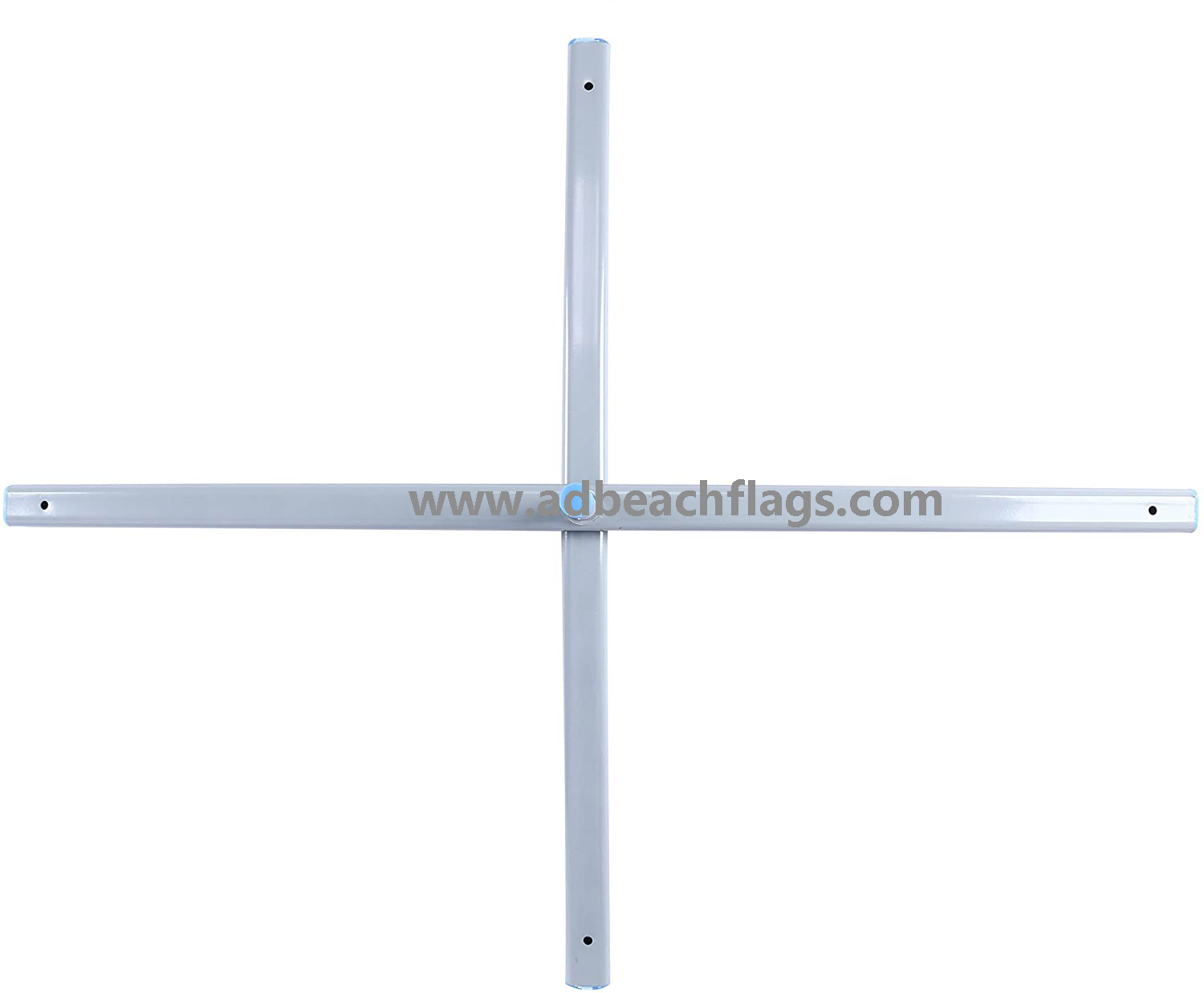
| XL, XXL | Water tank base 12 to 32 litres, or heavy plate; car base at dealerships | Up to about 3.6 m radius |
Two smaller flags with proper bases generally outperform one oversized flag with a marginal base. The oversized flag leans, spins and eventually bends a pole, and the repair bill eats the difference. If a site is tight, reduce the flag size before you reduce the base.
1. Ordering by price instead of by site. The cheapest quote is usually the smallest flag. Compare price per square metre of fabric, not price per flag.
2. Ignoring the assembled height. Buyers plan around the pole, install the flag, and discover the top of the design sits half a metre lower than expected, hidden behind a parked van.
3. Forgetting the wind lever. Doubling the flag height multiplies the load on the base far more than twice. The pole becomes a lever and the base is the pivot. Big flag means big base, every time.
4. Forgetting the artwork ratio. Designs made for a rectangular banner squeeze badly into a teardrop. The template matters as much as the size, which is why every size we sell comes with a free template that includes the bleed and the safe zone. Send the artwork with the order and we will check the fit before printing, not after.
United States. Feather flag heights are often quoted in feet, from 8 ft to about 17 ft. Note the local sign codes; several cities regulate the height and the number of portable signs per business.
United Kingdom and Ireland. Expect sizes quoted in metres, and remember that pavement sites may need permission from the council. Cross bases with water bags are normal practice.
Germany, Austria, Switzerland. Beachflag and Werbefahne sizes usually follow the 2.8 m, 3.4 m, 4.5 m and 5.6 m pole ladder that Chinese factories also use, so the centimetres line up easily.
Australia and New Zealand. Strong UV means buyers often step up one fabric weight rather than one flag size. Mesh fabrics are common in coastal cities.
Latin America and Brazil. Bandera pluma sizing follows the same metric ladder. Buyers commonly order the medium size for commercial streets and the extra-large for roadside junctions.
Size is only half the plan. Count comes next, and the honest answer depends on how people arrive at your site rather than on the size of your budget.
1. One entrance, one direction. One flag, placed a few metres before the entrance, is enough. Two flags on the same line simply repeat the same message.
2. Two entrances, or a corner site. One flag per approach. A customer who arrives from the side street never sees a flag planted at the main door.
3. A long shopfront or a car lot. Space them so the gaps stay under about 15 metres. Beyond that, gaps read as other businesses’ territory.
4. An event stand or festival pitch. Three to five flags work well: two at the corners marking the space, one to three at the counter or entrance carrying the offer. Ten matching flags bunched together read as one blur.
5. A dealership forecourt. One flag per vehicle line, or per model group, on car bases. Buyers walking the lot read flags the way they read price stickers, one at a time.
A useful habit is to stand at the point where customers decide to stop, then walk towards your door. Every flag you cannot see on that walk is a flag in the wrong place, whatever its size.
1. Narrow pavements and covered arcades. A big flag becomes an obstacle and a liability. Two small flags leave room for wheelchairs and prams.
2. Low awnings, tree canopies, cables. Anything overhead decides your maximum height. Measure before you choose, not after.
3. Indoors with a low ceiling. A 5 m pole in a 3.5 m hall is a repair job waiting to happen. Choose medium, or a banner instead.
4. Sites where the flag moves indoors every night. Weight of the base and pack-down time start to matter more than size. Small kits get used; heavy kits stay in storage.
Q1. What is the most popular flag size?
For shops and cafés, the small to medium range on 340 cm and 400 cm poles. For roadside and dealership use, the large and extra-large sizes on 460 cm to 560 cm poles. When in doubt, most buyers regret going too small more often than too large.
Q2. Can I order a custom size?
Yes. We print custom flag sizes, and the pole is chosen to match. Custom sizes need a little extra artwork setup time, so send the dimensions with your enquiry.
Q3. Do all sizes use the same base?
The base is chosen by surface and flag size. Small flags run happily on a cross base with a water bag; extra-large flags need a water tank base or a heavy plate. Every base fits the standard pole system, so you can upgrade the base later.
Q4. How tall is a flag once it is standing?
Roughly the pole height, minus whatever the base adds or removes, and minus 30 to 80 cm where the curved tip bends over on teardrop flags. We quote the assembled height on request so you can plan against doorways and awnings.
Q5. How much space do I need around a flag?
Leave about 1.2 m of clear radius for small flags and up to roughly 3.6 m for the largest, so the flag can swing into the wind without hitting walls, vehicles or pedestrians.
Q6. Will a bigger flag last longer?
No. A larger flag carries more load and usually wears faster than a small flag in the same weather. If longevity is the priority, choose a heavier fabric weight and a sensible size for the site.
Sizing is easier with a photo. Send one picture of the spot where the flag will stand, the surface it will sit on, and the rough distance customers see it from. Our export team replies within 1 hour, 24×7, with a size, a shape and a base, plus the free artwork template for that exact size. Low MOQ accepted, and the advice costs nothing whether you order one flag or one thousand. If a smaller flag does the job for your site, we will say so, because a right-sized order comes back next season and an oversized one does not.
Tell us the flag size, the quantity, single or double-sided, and the surface the flags will stand on. Our export team replies within 1 hour, 24×7, with an artwork proof and a factory price. Low MOQ accepted.
Chat on WhatsApp (+86 135 1661 0926) Email Us Now
Prefer a form? Fill in the details below and we will come back with a proof and a price within 1 hour, 24×7.
Related reading: Teardrop vs Feather Flags | Flag Base Guide | Flag Fabric and Printing Guide | Teardrop Flags | Feather Flags | Giant Flags | Full Fiberglass Poles
| Item | Detail |
|---|---|
| Product | Custom printed teardrop and feather advertising flags with matched poles |
| Manufacturer | Ad Beach Flags, Foshan, Guangdong, China |
| Teardrop sizes | 75×165 cm, 85×190 cm, 95×230 cm, 110×260 cm, 110×300 cm, 130×330 cm |
| Matching poles | 280 cm, 340 cm, 400 cm, 460 cm, 500 cm, 560 cm |
| Feather sizes | 60×200 cm, 60×240 cm, 70×290 cm, 70×325 cm, 75×360 cm, 75×410 cm with 280 to 560 cm poles |
| Custom sizes | Available; free artwork template with bleed and safe zone for every size |
| Base matching | Cross base with water bag for pavement, spike for grass, water tank or plate for large flags |
| Fabric | 110gsm knitted polyester standard; 115gsm and mesh options |
| MOQ and lead time | Low MOQ accepted; samples 2 to 3 days, bulk 5 to 10 days after artwork approval |
| Contact | WhatsApp +86 135 1661 0926, [email protected], reply within 1 hour 24×7 |
| Point | Detail |
|---|---|
| Manufacturer, not a reseller | Printed and sewn in our own Foshan workshop, so specification questions reach the people who make the goods. |
| Colour you can hold us to | Pantone and RAL matching with a printed swatch approved before the bulk run; about 5% is the accepted tolerance for CMYK sublimation. |
| One kit, one supplier | Flag, pole, base and carry bag ship from one factory with one fitting standard, so nothing is missing on install day. |
| Fast sampling | Digital printing needs no screens: samples in 2 to 3 days and bulk in 5 to 10 days after artwork approval. |
| Low MOQ accepted | Trial orders do not need a container, with wholesale pricing from small quantities per design. |
| Customer 5stars Feedback | warmly welcomed in 150+ countries across Europe, the Americas, the Middle East, Africa and Oceania. |