Phone:
0086-757-8938 9313
Email:
Address:
Caochang Industrial Zone, Liguang Rd, Lishui, Nanhai, Foshan, Guangdong, China
Reply within 1 hour, 24x7

Phone:
0086-757-8938 9313
Email:
Address:
Caochang Industrial Zone, Liguang Rd, Lishui, Nanhai, Foshan, Guangdong, China
Reply within 1 hour, 24x7

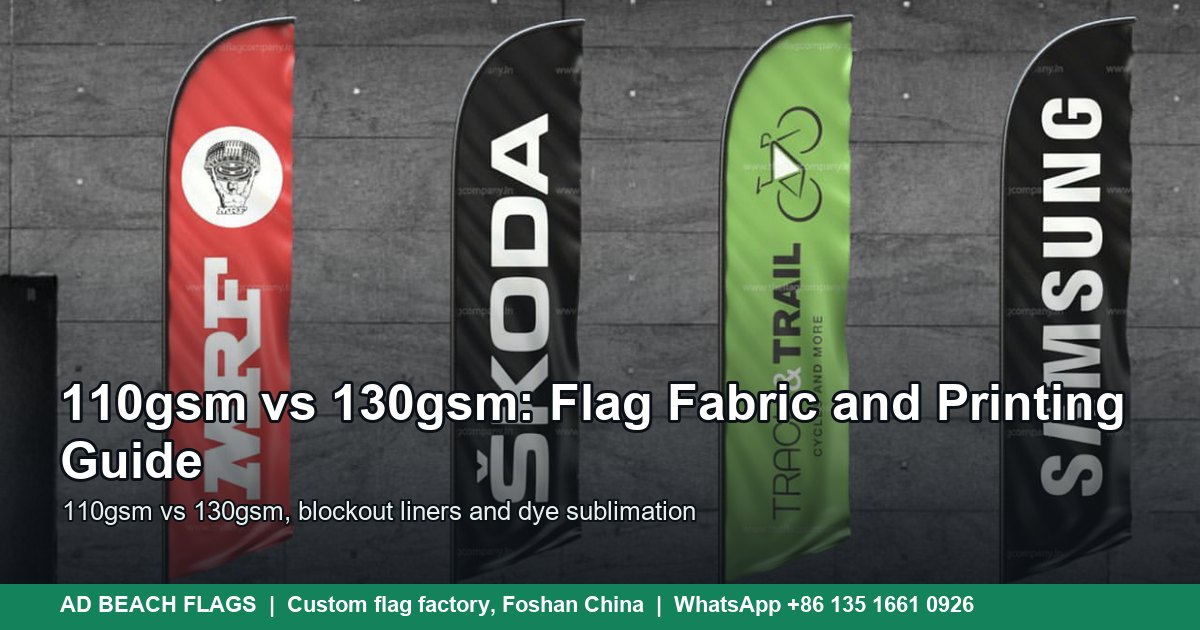
Two flags can look identical in a product photo and behave like different products outdoors. The difference is inside the build: which fabric, which ink, how many layers, how the seams are finished. This guide explains each choice in plain terms, with the numbers buyers use to compare quotes.
Flag fabric is sold by weight, measured in grams per square metre. The number is a rough proxy for density and durability, and it is the first thing to check on any quote.
| Fabric | Weight | What it is good for | Notes |
|---|---|---|---|
| Knitted polyester | 110gsm | Everyday commercial flags; the industry baseline | Light, tear-resistant, holds sublimation colour well |
| Knitted polyester | 115gsm | Hard sun markets; longer display cycles | A small step up in cost for noticeably more life |
| Shiny knitted polyester | 130gsm | Premium look; heavier hand feel; retail | Richer colour depth; slightly heavier to ship |
| Mesh polyester | about 120gsm, roughly 30% open weave | Coastal and breezy sites | Air passes through, cutting wind load on the pole |
| Double-sided build | two printed layers plus blockout liner | Two-way traffic, junctions, camera-facing walls | Heavier and pricier than single-sided |
One honest note about the numbers: gsm is a starting point, not a guarantee. A well-finished 110gsm flag with double-stitched seams and a reinforced pole sleeve will outlast a poorly made 130gsm flag every time. Ask about the seams as well as the weight, and ask where the corners are reinforced, because that is where flags fail first.
Single-sided flags print one layer of fabric. The ink passes through during sublimation, so the back shows a mirrored version of the design with roughly 90% show-through. This is normal and it is how most flags in the world are made.
Double-sided flags are a sandwich: two printed layers with a light-blocking liner in the middle. Text reads correctly from both directions, nothing shows through, and the flag is roughly 30% heavier.
The right question is not which is better, it is which way your customers arrive. Traffic coming from one direction reads a single-sided flag perfectly. A storefront on a junction, a hotel entrance on a corner, or any flag photographed for social media earns the upgrade to double-sided.
Advertising flags are printed by dye sublimation, sometimes called heat transfer. The process prints the design onto transfer paper, then presses it against the fabric at around 190 to 210 degrees Celsius for one to two minutes. The heat turns the ink into gas, and the gas bonds inside the polyester fibres.
Three consequences that matter to buyers:
1. The print cannot peel or crack. The colour is inside the cloth, not on top of it. Fold the flag, pack it wet, run it through a washing machine at low temperature, the print survives.
2. Both faces of a single fabric read the same. This is what makes show-through a feature rather than a defect.
3. Colour is managed like print, not like paint. We match artwork against Pantone and RAL references and print a swatch for approval before the bulk run. A difference of about 5% is the accepted tolerance for CMYK sublimation on polyester, because fabric absorbs ink differently from paper.
Some factories also offer silk screen printing for very large runs of a simple design, and digital printing for short runs. Both can produce good flags. Ask which method the quote uses, because the answer changes the minimum order and the colour behaviour.
| Method | How it works | Best for | Watch out for |
|---|---|---|---|
| Dye sublimation, transfer | Printed to paper, then heat-pressed into the fabric at 190 to 210 degrees | Full-colour artwork, logos, gradients, photos | Colour is flat on polyester, so expect about 5% variance |
| Dye sublimation, direct | Printed straight onto fabric, then fixed with heat | Long rolls, continuous production | Detail can soften slightly on very fine text |
| Silk screen | One screen per colour, ink pushed through the mesh | Simple designs in few colours at high volume | Screens cost money, so small runs get expensive |
| Digital direct | Inkjet printing onto prepared fabric | Short runs and proofs | Confirm the fixation step, or colour washes out early |
For advertising flags, transfer sublimation is the right default. It handles photographic logos, needs no screens, and produces the same result on flag one and flag five hundred.
1. Vector is king. Files in .ai, .eps or .pdf scale without losing sharpness, which matters because flags are printed large. Outlined fonts avoid missing-type surprises.
2. Raster at 1:1. If vector is not possible, send a raster file at full size and 300 dpi. Upscaling a small web logo to a 5.6 metre flag produces soft edges that no printer can fix.
3. Respect the safe zone. Every flag shape has curves and a pole sleeve that eat into the artwork. Our free template pack includes the bleed and the safe area for each size, so no part of your logo ends up folded into a seam.
4. Think about the shape. A design built for a rectangle will squeeze into a teardrop. Keep logos centred and leave the outer 10% free of critical detail.
1. Pole sleeve and top corner. The sleeve carries the whole flag, and the top corner takes the most stress. Reinforced, double-stitched construction is what keeps flags flying after weeks of wind.
2. Tension cord at the bottom. The bungee or cord at the base of the sleeve pulls the fabric taut against the pole. Replace worn cords rather than living with a sagging flag.
3. Seam treatment. Double-stitched hems and reinforced corners cost little at the factory and save whole flags in the field. This is also the easiest place to spot a cheap quote early, because thin single stitching shows up the moment you unfold a sample.
Under daily outdoor use, plan on about six months before a flag looks visibly tired. Two factors decide where your flag lands on that curve:
1. Sun hours. UV is what fades dye. A flag in Dubai and a flag in Manchester do not age at the same speed, and nothing in the industry changes that. Dark designs hide fading better than pastels.
2. Wind metres. Flapping is mechanical wear. A flag on a windy corner works its seams every single day. Rotation, mesh fabric and bringing flags in overnight all extend life.
A practical habit from rental companies: own two flag skins per pole and rotate them monthly. Each skin gets half the sun, the set always looks new, and the poles never sit idle.
1. Take flags in overnight and before weather warnings. This single habit does more for flag life than any fabric upgrade.
2. Wash at 30 degrees. Mild detergent, machine wash or by hand, no bleach, no tumble dryer, no ironing, no dry cleaning. Rinse dust and salt out of coastal flags regularly.
3. Dry fully before folding. A flag packed damp grows mildew, and mildew stains do not wash out.
4. Store flat or loosely folded in a dry bag. Our oxford carry bags are sized for this, and they keep pole hardware from poking the fabric.
One more habit worth copying from rental fleets: number the skins and log the dates. A simple sheet with the flag number, the install date and the site tells you which locations eat flags and which fabrics earn their premium. After one season, the sheet pays for itself, because you stop buying heavy fabric for gentle sites and stop buying light fabric for the harsh ones.
1. Comparing price without comparing fabric. A quote without a gsm number is not a quote, it is a guess. Ask, in writing.
2. Choosing double-sided without checking the weight budget. Double-sided flags are heavier, and freight prices follow weight, especially on air and express shipments.
3. Sending screen-resolution artwork. Rejected files add days to a deadline that was already tight. Check the file before you send it, or send the logo and let the factory lay it out.
4. Forgetting the calendar. A flag order is a print order: artwork approval, swatch, production, shipping. Factories do not create time, they only use it. Order before the event rush, not during it.
United States. Buyers commonly specify 110gsm or 115gsm and ask about flame certificates for indoor use. The phrase double-sided usually implies a blockout layer; confirm it in the purchase order.
United Kingdom and Ireland. 110gsm knitted polyester is the everyday standard, with 80 to 90% reverse show-through on single-sided flags considered normal and acceptable.
Germany, Austria and Switzerland. Buyers ask for heavier fabrics and printed colour references. Flammability paperwork such as DIN 4102 or NFPA 701 classes is requested often, so ask your supplier for certificates in writing.
Australia and New Zealand. UV drives the specification here. Mesh for coastal sites and a spare flag skin for high-exposure locations are standard practice.
Latin America and Brazil. Bandera pluma and bandeira pluma buyers usually balance cost against sun exposure: single-sided 110gsm for promotional cycles, heavier fabric for permanent storefronts.
1. Tiny runs of a complex design. Setup costs dominate small orders. If you need three flags with full-colour gradients, the per-unit price will surprise you, and a plain stock colour with a printed logo may serve you better.
2. Mailing a flag as a gift or sample. Sublimation is built for outdoor cloth, not for folding into an envelope without creases. If the presentation matters more than durability, another product wins.
3. Permanent signage again. A flag is cloth and air. If the sign must survive a decade in all weather without maintenance, that is a metal job.
Q1. Is 130gsm always better than 110gsm?
Not always. 130gsm gives a heavier feel and richer colour, and it suits premium retail work. For everyday promotional flags, a well-made 110gsm flag with reinforced seams is the better value, and it ships lighter.
Q2. What does blockout mean on a double-sided flag?
Blockout is the light-blocking liner sewn between the two printed layers. It stops the front design from showing through the back, so each side reads correctly on its own.
Q3. How much does dye sublimation printing actually fade?
Fading is caused by UV over months, not by the printing process. With daily outdoor use, expect visible fading in roughly six months, faster in very sunny markets. Darker colours hide it better.
Q4. Can I wash a printed flag?
Yes, at 30 degrees with mild detergent, then air dry. Never tumble dry, iron, bleach or dry clean. Wash salt and dust off coastal flags so grit does not grind the seams.
Q5. What file format should I send?
Vector files (.ai, .eps, .pdf) are best. Otherwise send a 1:1 scale raster file at 300 dpi. Use our free template for your flag size so the artwork respects the bleed and safe zone.
Q6. Can the two sides of a flag carry different designs?
With a double-sided build, yes. Many retail customers print the brand mark on one side and an offer on the other. Tell us at the artwork stage so both layers are proofed together.
Send your logo and the fabric weight you are considering, and we come back within 1 hour, 24×7, with a quote, an artwork proof and a colour plan. If your market is harsh on colour, ask for a printed swatch first: seeing the real cloth beats reading about it. Low MOQ accepted, and we will say plainly when a lighter fabric does the same job for less. Buyers who compare spec sheets rather than price lists get flags that survive the season, and that is the comparison we are happy to have.
Tell us the flag size, the quantity, single or double-sided, and the surface the flags will stand on. Our export team replies within 1 hour, 24×7, with an artwork proof and a factory price. Low MOQ accepted.
Chat on WhatsApp (+86 135 1661 0926) Email Us Now
Prefer a form? Fill in the details below and we will come back with a proof and a price within 1 hour, 24×7.
Related reading: Teardrop vs Feather Flags | Beach Flag Size Guide | Flag Base Guide | Double-Sided Beach Flags | Customized Beach Flags | Teardrop Flags | Portable Oxford Bags
| Item | Detail |
|---|---|
| Product | Custom printed advertising flags: teardrop, feather, beach, backpack and giant shapes |
| Manufacturer | Ad Beach Flags, Foshan, Guangdong, China |
| Standard fabric | 110gsm knitted polyester; 115gsm, 130gsm shiny and 120gsm mesh options |
| Printing | Dye sublimation (heat transfer) at about 190 to 210 degrees Celsius |
| Colour matching | Pantone and RAL references with printed swatch approval; about 5% tolerance typical |
| Single-sided | One printed layer, mirrored design on the back with roughly 90% show-through |
| Double-sided | Two printed layers plus blockout liner; text reads correctly on both sides; about 30% heavier |
| Artwork | Vector .ai, .eps, .pdf preferred; raster at 1:1 scale and 300 dpi; free templates per size |
| Expected life | About six months of daily outdoor use; UV fading is normal and unavoidable |
| Contact | WhatsApp +86 135 1661 0926, [email protected], reply within 1 hour 24×7 |
| Point | Detail |
|---|---|
| Manufacturer, not a reseller | Printed and sewn in our own Foshan workshop, so specification questions reach the people who make the goods. |
| Colour you can hold us to | Pantone and RAL matching with a printed swatch approved before the bulk run; about 5% is the accepted tolerance for CMYK sublimation. |
| One kit, one supplier | Flag, pole, base and carry bag ship from one factory with one fitting standard, so nothing is missing on install day. |
| Fast sampling | Digital printing needs no screens: samples in 2 to 3 days and bulk in 5 to 10 days after artwork approval. |
| Low MOQ accepted | Trial orders do not need a container, with wholesale pricing from small quantities per design. |
| Customer 5stars Feedback | warmly welcomed in 150+ countries across Europe, the Americas, the Middle East, Africa and Oceania. |