Phone:
0086-757-8938 9313
Email:
Address:
Caochang Industrial Zone, Liguang Rd, Lishui, Nanhai, Foshan, Guangdong, China
Reply within 1 hour, 24x7

Phone:
0086-757-8938 9313
Email:
Address:
Caochang Industrial Zone, Liguang Rd, Lishui, Nanhai, Foshan, Guangdong, China
Reply within 1 hour, 24x7

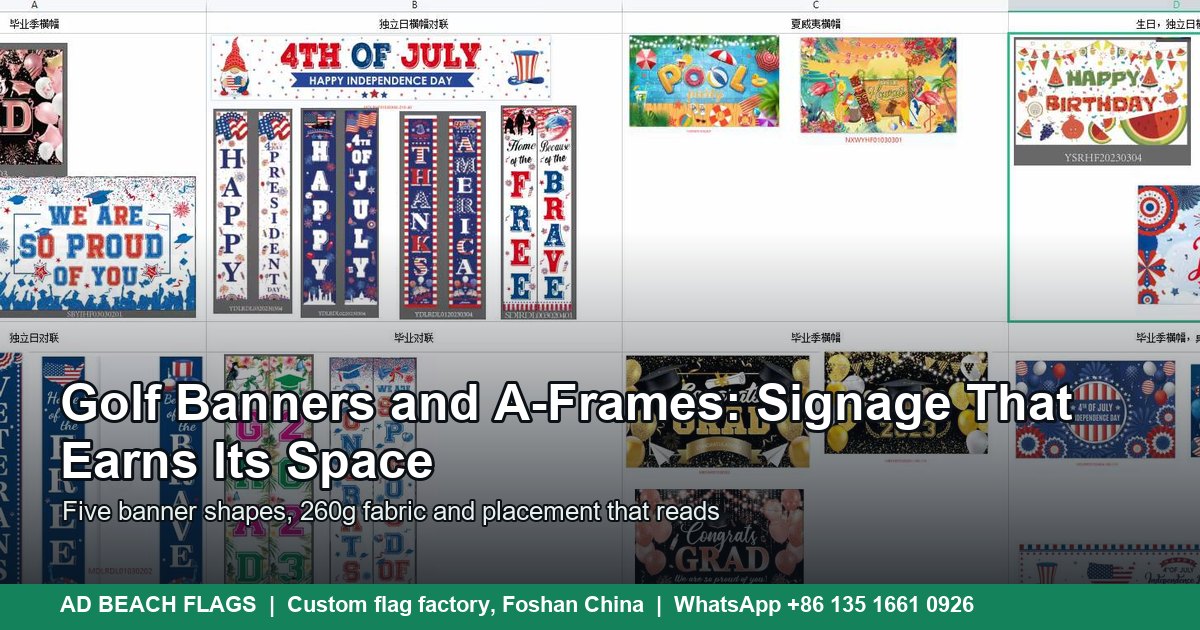
Golf signage has an unusual audience: people standing still, looking at the same view for several minutes, with time to read. That changes the design rules. A message that rewards a second look wins; a message designed for a passing car wastes the placement.
This guide covers the two formats golf venues order most, the five banner shapes we print, and the practical decisions that decide whether signage gets renewed next season.
1. Golf banners are printed fabric signs on a frame or a pair of stakes, positioned on grass beside a tee, a green, a fairway or a driving range bay. They carry a sponsor mark, a hole number, a competition message or a club promotion. Because golfers pass the same banner several times in a round, repetition does the work that a single roadside sign never can.
2. A-frame banners are double-sided panels on a folding frame that stands on hard ground: the clubhouse entrance, the pro shop door, the practice putting green, the car park path. They are the practical answer where stakes cannot be driven.
Most venues end up with both, and the useful split is simple: grass takes banners, hard surfaces take A-frames.
| Shape | Character | Where it works |
|---|---|---|
| Horizontal | Wide canvas, reads like a scoreboard band | Tee boxes, driving range dividers, sponsor walls |
| Vertical | Tall, narrow, visible above rough and bag stands | Hole approaches, walkway edges |
| Round | Softer silhouette, reads as a target | Putting greens, chipping areas, junior zones |
| Triangle | Directional feel, suggests an arrow or a flag | Wayfinding, next tee signs, event routing |
| Heart | Novelty shape for charity and member events | Charity days, weddings at the club, junior camps |
All five print on the same fabric and finish with the same binding, so a club can mix shapes within one order and keep a consistent look across the course.
Golf banners are usually printed on heavier fabric, around 260g, because they stand in one place for months rather than being packed away weekly. The heavier hand helps the panel hang flat between stakes, and it holds colour in strong sun.
Printing is dye sublimation with Pantone or RAL colour matching, the same process used across our flag range. For sponsors, that means their brand colour arrives on the course the way it appears in their brand book, which is the detail sponsorship managers notice first.
| Ground | Solution | Notes |
|---|---|---|
| Fairway and tee grass | Two ground stakes per banner | Fast to move between holes during a tournament |
| Hardstanding and paths | A-frame on a folding frame | Double-sided printing reads from both directions of travel |
| Driving range bays | Horizontal banners on posts or dividers | Messages face the player, not the flight path |
| Indoor clubhouse | A-frame or banner on a display stand | Keep the message above waist height so it is read standing |
1. Face the pause, not the path. Golfers stop at tees, greens and range bays. Signage facing those pauses gets read; signage along a walkway gets passed.
2. One message per banner. A sponsor logo with a contact line performs better than a busy panel. Members already know where the clubhouse is; sponsors want recall, not directions.
3. Repeat the sponsor, vary the shape. Three placements with the same mark teach the course who pays for the event. Varying the shape between them keeps the course looking designed rather than cluttered.
4. Replace the message panel, keep the frame. Banners with replaceable printed panels let a club refresh sponsor artwork each season without rebuying hardware.
1. Contrast first. Courses are green and bright. Dark panels with light type, or light panels with dark type, read from the fairway; mid-tone panels disappear into the landscape.
2. Sponsor hierarchy. If a title sponsor and five supporting sponsors share a banner, the hierarchy should be obvious at a glance, not sorted out by the reader.
3. Keep type large. A golfer reading a tee banner stands 1 to 3 metres away; a golfer in a cart reads at 15 metres. Design for the cart.
4. Allow for the wind. Panels that flap constantly look cheap, and a flapping panel also wears at the stitched edge within a season. Tensioned edges, stakes set wide and a panel that sits just clear of the ground keep the print flat and the fabric intact.
United States. Country clubs and municipal courses order tournament sets, often 18 matched hole banners plus clubhouse A-frames, in the weeks before a member-guest event.
United Kingdom and Ireland. Club competitions and charity days drive demand; buyers often specify heavier fabric for the wetter climate and replace panels seasonally.
Germany, Austria and Switzerland. Golf clubs ask for specification sheets and finish details, and often standardise on silver hardware for a uniform look across the course.
Australia and New Zealand. High UV and strong coastal wind push clubs towards heavier fabric and mesh-backed panels on exposed links courses.
Spain and Portugal. Resort courses order for the tourist season, usually in spring, with multilingual panels for visitors. Clubs that host international members often keep two artwork sets and swap panels between languages rather than printing twice.
1. Permanent wayfinding. If a sign must guide people for years, a manufactured post sign is the honest answer; a fabric banner is portable by nature.
2. Sites where stakes cannot go in. Heritage greens, protected turf and rock surfaces need an A-frame or a post system instead.
3. Events with no storage. Banners stored folded, dry and indoors last for years. Banners left in a shed in a damp corner do not.
Golf signage budgets are annual, and clubs think in seasons rather than units. Three patterns keep spending predictable.
1. Buy hardware once, print panels annually. Frames and stakes last years. Panels last a season or two depending on sun and how they are stored. A club that reorders only panels spends a fraction of the first-year cost every following spring, and the course keeps the same visual rhythm because the frame positions never move.
2. Keep the artwork files, not just the banners. Sponsor logos change more often than sponsors do. When the senior sponsor refreshes its brand, the club that holds the original layout can restage the whole course in days rather than starting from scratch with every hole.
3. Number the panels. A small printed number on the back of each panel, matching the hole, turns packing and set-up into a sorting exercise rather than a memory test. It also tells you immediately which panel went missing after the last tournament.
4. Store flat and dry. Panels stored rolled around a pole take a set and hang with ridges. Panels stored flat, dry and off concrete come out of winter looking like they were printed last month.
The sponsor, not the club, often decides whether signage gets renewed. A few habits make the sponsor’s experience better and the renewal easier.
1. Offer a proof, not a promise. Send the sponsor a laid-out proof on the correct panel shape before printing. It takes minutes and removes the only real source of complaint.
2. Match their brand colour properly. Sponsors notice colour drift faster than anyone else on the course, because their brand book is the reference they live with daily. Pantone or RAL matching with a printed swatch approval is the mechanism that keeps the relationship clean.
3. Give them a photograph of the finished placement. Clubs that photograph sponsor signage during the event and send it on get renewals; a sponsor who can see the exposure values it.
4. Offer the package, not the banner. A title sponsor package that includes hole banners, an A-frame at the clubhouse and a driving range panel reads as a presence rather than a purchase, and it prices accordingly.
A-frames do a different job from banners, and buyers who understand the difference order fewer of them but use them harder.
1. They work where stakes cannot. Clubhouse thresholds, tarmac paths, paved terraces and indoor foyers all reject a ground stake. An A-frame stands on its own folded base without drilling, weighting or permission from a greenkeeper.
2. They are read standing still. Members queue at the pro shop desk, wait at the first tee board and stop at the practice green. Those pauses are exactly where an A-frame earns its space, because the reader is stationary and close.
3. Double-sided is usually the right build. A frame at a doorway is approached from two directions. Printing both faces costs a second printed layer and removes the sorry moment when a visitor reads a mirror image from the path.
4. Weight matters more than it sounds. A light frame in an open entrance becomes a sail. Buyers in exposed coastal or hilltop clubs should choose heavier frames or plan to bring them inside on windy days, exactly like flags.
5. Replaceable panels keep them current. The printed faces can be reordered on their own, so a club can change the Saturday competition, the winter menu or the sponsor line without replacing the frame.
6. Pack flat for storage. Folded frames stack in a cupboard; assembled frames take floor space and get damaged. Buyers who plan storage get years out of hardware that others replace every second season.
Q7. How many banners does a typical tournament need?
Most clubs run one banner per hole on the holes that matter to the sponsor, plus an A-frame at the clubhouse and two or three at the practice areas. A matched set of eighteen reads as a full-course presence; six well-placed panels read as a budget compromise, and sponsors notice the difference.
Q8. Should the club or the sponsor own the banners?
The club almost always should. Owning the hardware lets the club renew sponsors without renegotiating the signage, and a stored frame becomes an asset that gets reused every season rather than a cost that is passed on and argued about.
Q9. What about winter?
Panels come in, frames come in, and both are stored flat and dry. Clubs that leave hardware out through a wet winter replace it in spring, which is the single most common reason signage budgets run short mid season.
Q1. What shapes do golf banners come in?
Five stock shapes: horizontal, vertical, round, triangle and heart. All print on the same fabric, so they can be mixed in a single order.
Q2. What fabric is used for golf banners?
Typically a heavier fabric around 260g, which hangs flat between stakes and holds colour in strong sun. Lighter fabric is available for indoor use.
Q3. Can an A-frame be printed on both sides?
Yes, and for clubhouse entrances it usually is, because visitors approach from both directions.
Q4. How do I secure a banner on grass?
Two ground stakes per banner, set wide enough to keep the panel tensioned. On hard ground, switch to an A-frame.
Q5. Can we reuse the frame and change the artwork?
Yes. Keep the frame and reorder printed panels each season, which is how clubs refresh sponsor artwork without rebuying hardware.
Q6. What is the minimum order for a tournament set?
Low MOQ accepted for trial orders, and tournament sets of matched banners ship together so colours stay consistent across the course.
Send the holes, the surfaces and the sponsor list, and we will come back within 1 hour, 24×7 with shapes, sizes and a packing plan that ships as one matched set. Low MOQ accepted, and we keep your sponsor artwork on file so next season’s reprint matches the last. Clubs that plan the set in spring, with a printed parts sheet and a stored spare frame or two, spend their signage budget on visibility rather than on replacements, and sponsors get the one thing they actually pay for, which is being seen by name on a course that looks organised.
Tell us the flag size, the quantity, single or double-sided, and the surface the flags will stand on. Our export team replies within 1 hour, 24×7, with an artwork proof and a factory price. Low MOQ accepted.
Chat on WhatsApp (+86 135 1661 0926) Email Us Now
Prefer a form? Fill in the details below and we will come back with a proof and a price within 1 hour, 24×7.
Related reading: Flag Fabric and Printing Guide | Flag Base Guide | Beach Flag Size Guide | Golf Banners | Horizontal Golf Banners | Round Golf Banners | A Frame Banners
| Item | Detail |
|---|---|
| Product | Custom printed golf banners and A-frame banners |
| Manufacturer | Ad Beach Flags, Foshan, Guangdong, China |
| Banner shapes | Horizontal, vertical, round, triangle and heart |
| Fabric | Around 260g fabric standard for outdoor banners; lighter fabric for indoor use |
| Printing | Dye sublimation with Pantone and RAL colour matching; single or double-sided |
| Fixing | Ground stakes for grass; folding A-frame for hard surfaces and clubhouse entrances |
| Typical buyers | Golf clubs, resorts, driving ranges, event organisers and sponsors |
| Season | Tournament sets ordered weeks before member-guest and charity events |
| MOQ and lead time | Low MOQ accepted; samples 2-3 days, bulk 5-10 days after artwork approval |
| Contact | WhatsApp +86 135 1661 0926, [email protected], reply within 1 hour 24×7 |
| Point | Detail |
|---|---|
| Manufacturer, not a reseller | Printed and sewn in our own Foshan workshop, so specification questions reach the people who make the goods. |
| Colour you can hold us to | Pantone and RAL matching with a printed swatch approved before the bulk run; about 5% is the accepted tolerance for CMYK sublimation. |
| One kit, one supplier | Flag, pole, base and carry bag ship from one factory with one fitting standard, so nothing is missing on install day. |
| Fast sampling | Digital printing needs no screens: samples in 2 to 3 days and bulk in 5 to 10 days after artwork approval. |
| Low MOQ accepted | Trial orders do not need a container, with wholesale pricing from small quantities per design. |
| Customer 5stars Feedback | warmly welcomed in 150+ countries across Europe, the Americas, the Middle East, Africa and Oceania. |