Phone:
0086-757-8938 9313
Email:
Address:
Caochang Industrial Zone, Liguang Rd, Lishui, Nanhai, Foshan, Guangdong, China
Reply within 1 hour, 24x7

Phone:
0086-757-8938 9313
Email:
Address:
Caochang Industrial Zone, Liguang Rd, Lishui, Nanhai, Foshan, Guangdong, China
Reply within 1 hour, 24x7


Walk any dealership row and you can tell within twenty metres which flags were planned and which were bought in a hurry. Planned flags sit at eye height along the traffic line, carry one message each, and stand straight in the wind. Unplanned flags cluster at the gate, lean on undersized bases, and repeat the same logo six times down the row.
This guide covers the decisions that make the difference: what size belongs where, which base suits a forecourt, how far apart flags should stand, and the artwork rules that make a flag readable from a moving car.
A car lot has one recurring problem: the product is expensive and the message is temporary. Stock changes weekly, offers change monthly, and a painted sign cannot follow either. A flag solves both, because the flag is cheap, movable and replaceable, and the message on it can change without touching the building.
Three jobs get done by flags on a forecourt. They mark the entrance to the site so traffic can find it at speed. They highlight specific rows or individual vehicles. And they carry the offer, the finance headline or the model name that the current campaign depends on.
| Where it stands | Approach | Recommended size | Message it can carry |
|---|---|---|---|
| Site entrance from a main road | 40 to 80 km/h | Feather 75×360 or 75×410 cm on a 500 to 560 cm pole | Brand mark only, high contrast |
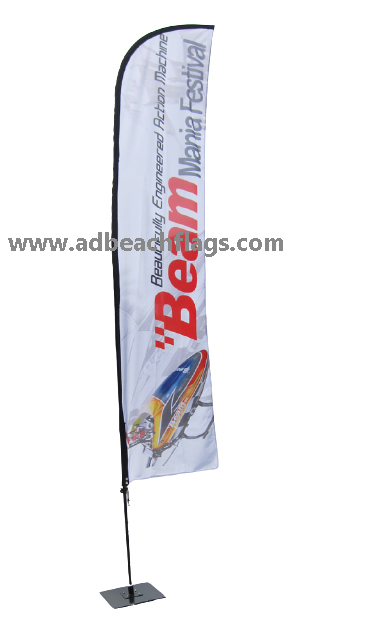
| Boundary along the road | 30 to 60 km/h | Feather 70×325 cm on a 460 cm pole | Model name or offer word |
| Between rows on the lot | Walking pace | Feather 60×240 or 70×290 cm on a 340 to 400 cm pole | Model, price band, finance rate |
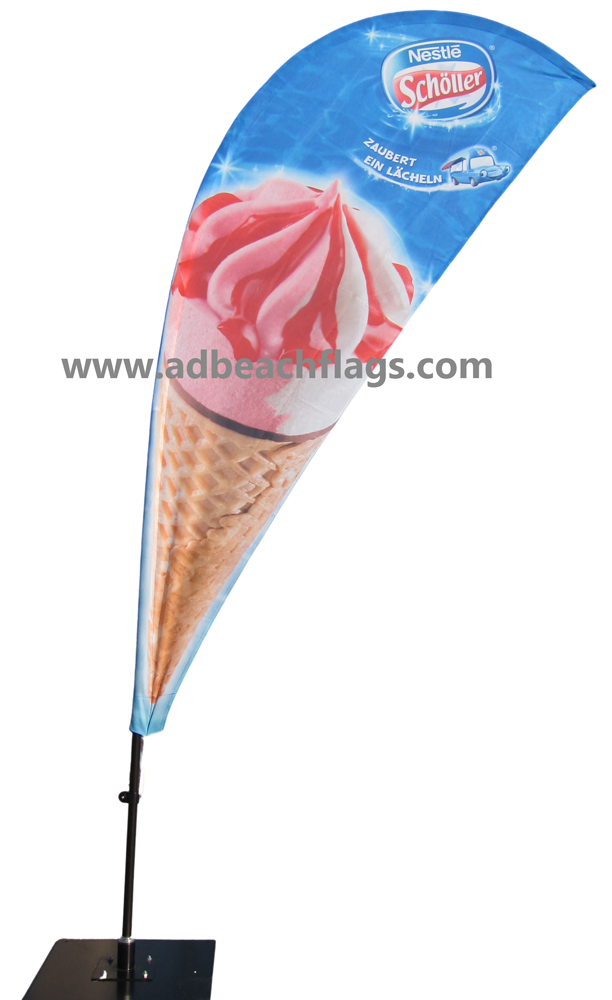
| Showroom door and service reception | Stationary | Teardrop 85×190 or 95×230 cm on a 340 to 400 cm pole | Service hours, offers, directions |
The common mistake is buying one size for the whole site. A 5.6 m flag inside a row is invisible to anyone standing next to it; a 3.4 m flag at the gate is unreadable from the road.
Dealership forecourts are hard ground, moving vehicles and no drilling. That rules out spikes and leaves three practical options.
1. Car base. Slides under a tyre and uses the vehicle’s weight. No ballast, no tools, and the flag moves in minutes when the lot is rearranged. This is the default for dealerships, and the reason is simple: the lot changes more often than the marketing plan.
2. Metal plate base. Three to twelve kilograms of steel with a welded socket. It has nothing to fill or freeze, which suits a flag that stands out every day, and the heavier plates hold large flags on exposed forecourts.
3. Water tank base. Twelve to thirty-two litres of water or sand, filled on site. Heavy enough for the largest sizes and for sites where vehicles cannot be parked against the flag line.
Whichever you choose, position the flag so it cannot swing against bodywork, and keep a clear swing radius of roughly 1.2 to 3.6 m depending on size.
1. Space flags by viewing window, not by available metres. Along a boundary, one flag every 15 to 20 m reads as a continuous line without becoming wallpaper.
2. Do not stand two flags closer than their swing circles. Overlapping flags tangle in a gust and end up looking like one damaged flag.
3. Keep a height family. Mixing 3.4 m and 5.6 m flags in the same row looks accidental; grouping by height looks designed.
4. Leave the gate clear. Entrance flags should frame the entry, not block the sightline for turning traffic.
1. Five words maximum, three is better. At 40 km/h, the driver has roughly two seconds on each flag.
2. High contrast beats brand subtlety. Dark ground with a light mark, or the reverse; mid-tone designs disappear against forecourt tarmac and parked cars.
3. One message per flag. A model name on one, a finance rate on another, the brand on the entrance pair.
4. Keep text in the upper half. The lower section sits behind vehicles and kerb furniture for a large part of the approach.
1. Undersized bases. The most common cause of a tipped display. Weigh the base and match it to the flag size and the site exposure, not to the budget line.
2. Spikes on tarmac. They will not hold, and a flag that leans all day is worse than no flag.
3. No rotation. A flag pinned in a crosswind levers against the pole all day; a rotating socket converts that side load into a much smaller frontal one, which is why rotating bases are worth the small extra cost on an open forecourt.
4. Same message everywhere. Repetition teaches nothing after the third flag. Vary the message and keep the brand mark consistent.
5. No replacement plan. Flags fade and wear; a dealer group that reorders skins as part of the marketing calendar never has a tired row.
1. On public highway verge. Many authorities restrict portable advertising near roads, and forecourt permissions rarely extend to the verge outside.
2. Where the message needs a paragraph. Finance terms and disclaimers belong on a printed board, not on a flag.
3. On sites with permanent signage rights. If the building can carry a proper sign, that should carry the brand; flags are for what changes.
United States. Dealers buy feather flags in large sizes for lot frontage and check local codes for portable sign limits. Swooper flag is the common trade term, and car bases are standard equipment.
United Kingdom and Ireland. Forecourts here are often tighter, so medium sizes with plate bases dominate. Groups standardise on one artwork set so every site looks like the same business.
Germany, Austria and Switzerland. Dealers ask for specification sheets and colour references in writing, and often specify silver hardware for a uniform look across a group.
Australia and New Zealand. Hard sun shortens fabric life, so 115gsm and mesh appear in most lot specifications, and replacement skins are budgeted annually rather than reactively.
Brazil and the Gulf. Bandeira pluma and Arabic-language campaigns run on larger sizes for roadside visibility, with double-sided builds for junctions where buyers approach from two directions.
1. Stand at the point where drivers first see the site. If the brand mark is not identifiable in one glance, the entrance needs a larger flag, not a better design.
2. Walk the boundary. Count how many metres pass between flags. Gaps beyond twenty metres read as another business’s frontage.
3. Check the bases, not just the flags. Leaning flags almost always mean an undersized base, and that is the first thing a buyer notices about a competitor’s lot.
4. Count the messages. If the same offer repeats down the whole row, the site is wasting flags that could each carry a different model or rate.
Groups that buy across many sites save money and argument by fixing one specification and reusing it. This is the version that works for most dealer networks.
1. Entrance pair. Two feather flags at 75×410 cm on 560 cm poles, mesh fabric where the site is exposed, water tank bases of 20 litres and up with rotating sockets.
2. Boundary line. Feather flags at 70×325 cm on 460 cm poles, metal plates of 6.3 kg on hard standing, one every fifteen to twenty metres.
3. Row markers. Feather flags at 60×240 cm on 340 cm poles on car bases, so they move with the stock rather than the site plan.
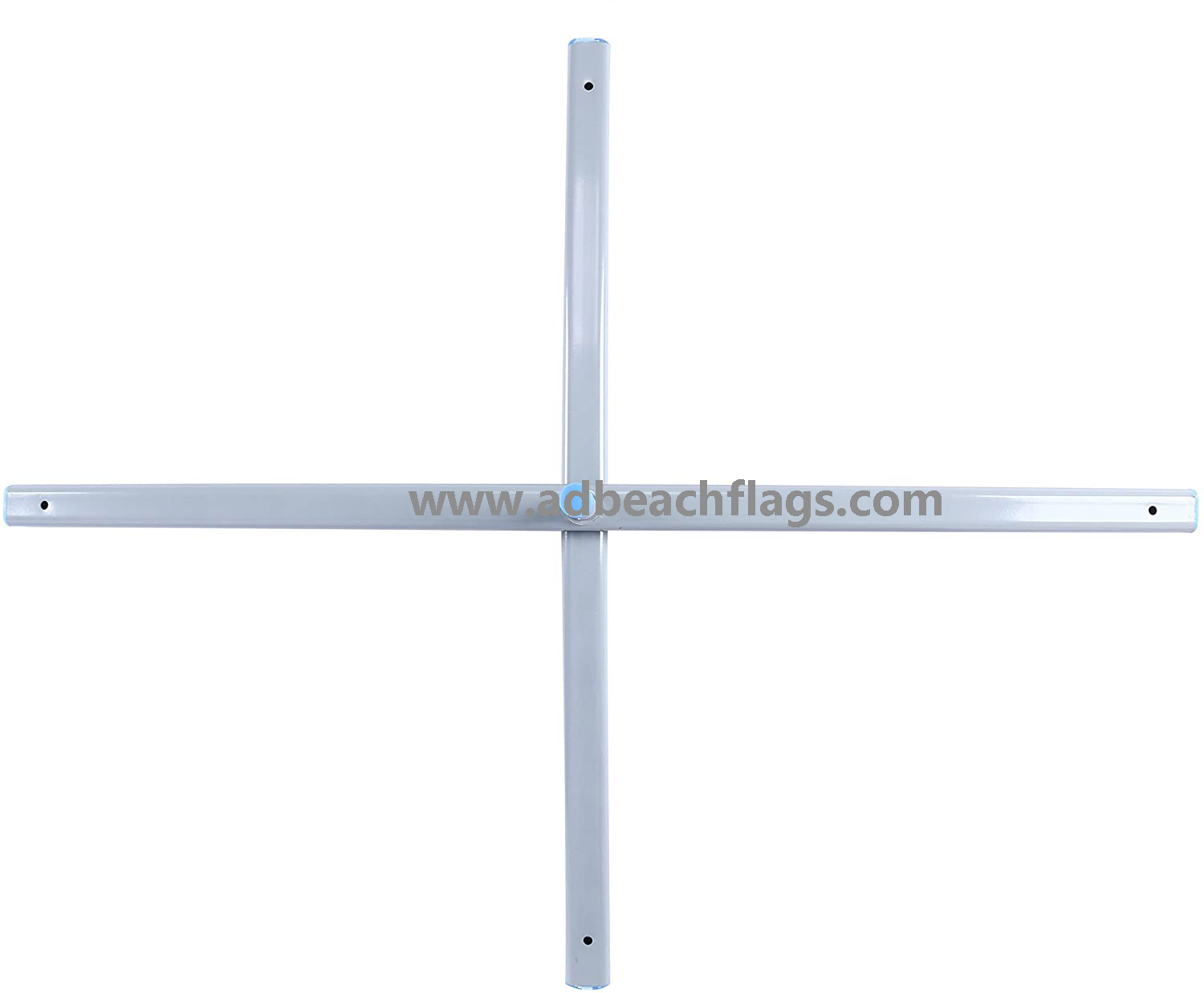
4. Showroom and service. Teardrop flags at 85×190 cm on 340 cm poles, cross bases with water bags on the apron and plates indoors.
5. Artwork set. Brand mark on the entrance pair, model names on the boundary line, and one offer per row marker. Ten words of copy across the whole site, printed consistently from a single colour reference held on file.
6. Spares. One spare bottom pole section per ten poles, one spare flag skin per flagship design, and a written parts sheet listing every size in the network.
Q1. What size flags do car dealerships usually buy?
Most order a mix: large feather flags at 75×360 cm or 75×410 cm for the road boundary, medium at 60×240 to 70×290 cm between rows, and teardrops at 85×190 to 95×230 cm at the showroom and service reception.
Q2. Which base is best on a forecourt?
Car bases for lots that are rearranged often, because they use the vehicle’s weight and move in minutes. Metal plates for daily static display, and water tank bases for the largest sizes or where vehicles cannot park along the flag line.
Q3. How far apart should dealership flags stand?
Fifteen to twenty metres along a boundary, and never closer than the flags’ swing circles, or they tangle in a gust.
Q4. How many words fit on a flag read from a car?
Three to five. At 40 km/h a driver has about two seconds per flag, so brand marks and single offer words work and sentences do not.
Q5. Do flags damage vehicle paint?
Not when they are positioned correctly. Keep enough clearance that the flag cannot swing against bodywork, and use the base the way it was designed.
Q6. How often should dealership flags be replaced?
With daily outdoor use, expect around six months before a flag looks tired, longer if it comes in overnight. Dealer groups usually reorder printed skins on a campaign calendar rather than waiting for visible wear.
| Point | Detail |
|---|---|
| Manufacturer, not a reseller | Flag, pole and base produced and packed in our own Foshan workshop. |
| Colour you can hold us to | Pantone and RAL matching, with a printed swatch approved before the bulk run, so a dealer group sees the same red at every branch. |
| Complete kits, one standard | Car bases, plates and tank bases share one fitting standard with our poles. |
| Fast sampling | Samples in 2 to 3 days so a campaign can be tested before it is rolled out. |
| Low MOQ accepted | Trial orders for a single site, with wholesale pricing for group rollouts. |
| Customer 5stars Feedback | warmly welcomed in 150+ countries across Europe, the Americas, the Middle East, Africa and Oceania. |
Dealership flags earn their place when the layout is planned: one size per job, a base that matches the surface and the flag size, spacing that lets each flag breathe, and artwork that survives two seconds at 40 km/h. Get those four right and the same row sells cars for years instead of looking tired by the second campaign.
Send us the site plan, the approach road and the flag positions you have in mind, and we will reply within 1 hour, 24×7 with sizes, bases and a per-site kit list. Low MOQ accepted, and for dealer groups we keep artwork on file so every branch orders the same red.
One last piece of practical advice. Dealers who treat flags as marketing inventory, rather than as one-off signage purchases, get better results: the poles and bases are bought once, the printed skins change with the campaign calendar, and the site never carries a design that belongs to last quarter. That is a cheaper habit than it sounds, because a skin costs a fraction of a kit, and it is the difference between a lot that looks actively managed and one that looks like it is waiting for the next budget meeting. Start with the two entrance flags and one row marker, measure what they do to footfall and enquiries for a month, and scale the specification from the sites that respond rather than from a plan drawn in an office.
Tell us the flag size, the quantity, single or double-sided, and the surface the flags will stand on. Our export team replies within 1 hour, 24×7, with an artwork proof and a factory price. Low MOQ accepted.
Chat on WhatsApp (+86 135 1661 0926) Email Us Now
Prefer a form? Fill in the details below and we will come back with a proof and a price within 1 hour, 24×7.
Related reading: Flag Base Guide | Beach Flag Size Guide | Wholesale Feather Flags Guide | Feather Flags | Car Bases | Metal Plate Bases | Water Bases | Teardrop Flags
| Item | Detail |
|---|---|
| Product | Advertising flags and feather flags for car dealerships and forecourts |
| Manufacturer | Ad Beach Flags, Foshan, Guangdong, China |
| Sizes | Feather 60×200 cm to 75×410 cm; teardrop 75×165 cm to 130×330 cm |
| Bases for forecourts | Car base, metal plate 3 to 12 kg, water tank 12 to 32 litres |
| Fabric | 110gsm knitted polyester standard; 115gsm and mesh options |
| Printing | Dye sublimation with Pantone and RAL matching |
| Layout guidance | One flag every 15 to 20 m along a boundary; keep swing circles clear |
| Artwork rule | Three to five words, high contrast, text in the upper half of the flag |
| MOQ and lead time | Low MOQ accepted; samples 2 to 3 days, bulk 5 to 10 days after approval |
| Contact | WhatsApp +86 135 1661 0926, [email protected], reply within 1 hour 24×7 |