Phone:
0086-757-8938 9313
Email:
Address:
Caochang Industrial Zone, Liguang Rd, Lishui, Nanhai, Foshan, Guangdong, China
Reply within 1 hour, 24x7

Phone:
0086-757-8938 9313
Email:
Address:
Caochang Industrial Zone, Liguang Rd, Lishui, Nanhai, Foshan, Guangdong, China
Reply within 1 hour, 24x7

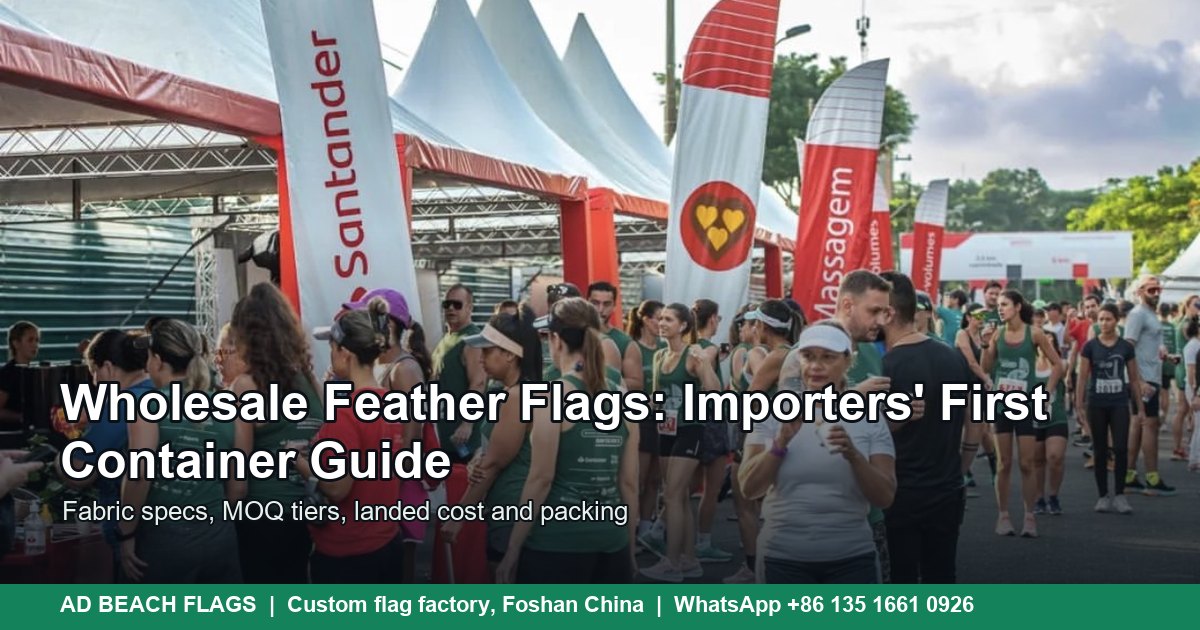
The first container of feather flags is the order that decides whether you have a flag business or a story about a bad supplier. The product is simple, which is exactly why the difference between a good and a bad purchase hides in details that never appear on a listing: fabric weight, stitch density, the pole that ships in the box and whether the colour you approved is the colour that arrives.
This guide is written for importers, distributors and promotional companies buying wholesale. It covers what to specify, what to check and what a realistic landed cost looks like, in the order a purchase decision actually happens.
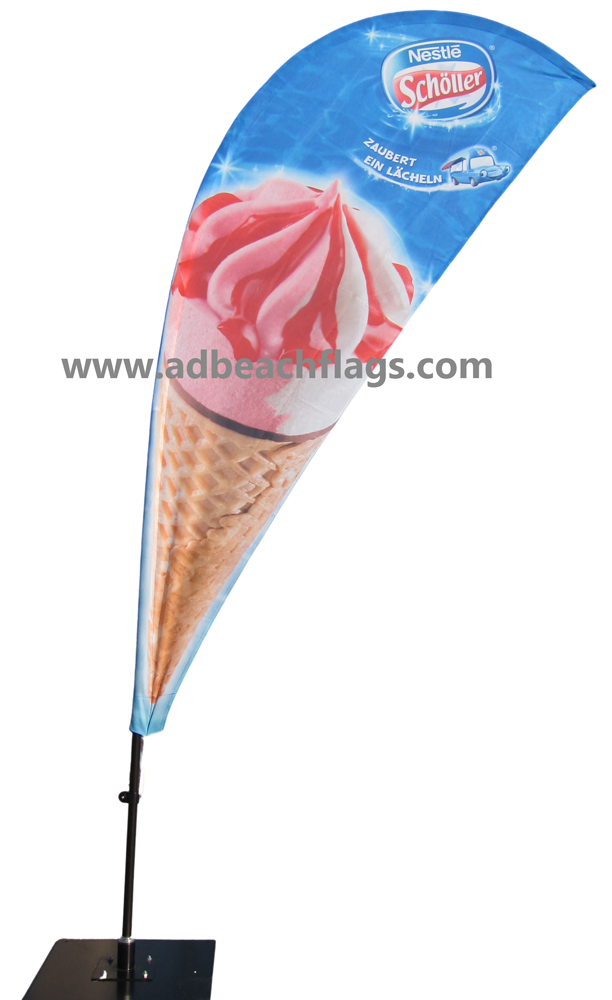
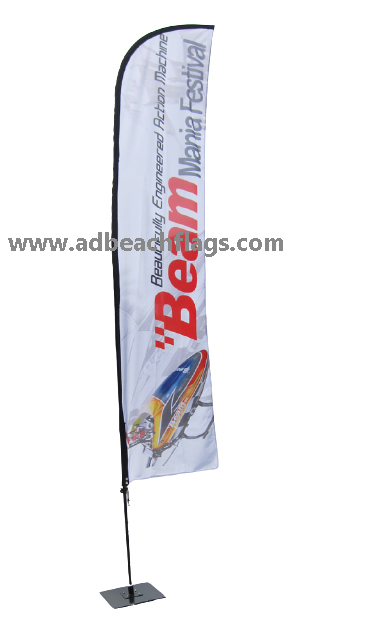
A feather flag is a printed polyester banner on a flexible pole, held taut by a tension cord and stood up by a base. In the United States it is also sold as a swooper flag, and in parts of Europe as a fly banner or wind banner. Buyers searching those terms are shopping for the same product.
The reason it sells well as a wholesale line is that it solves a retail problem: it delivers a branded presence in under a minute, needs no electricity, packs into a bag, and costs a fraction of a printed rigid sign. Storefronts, forecourts, dealerships, event companies and rental fleets all buy it repeatedly, which is what a distributor needs.
Before comparing prices, make every supplier quote the same list. Quotes that cannot answer these questions are not comparable, and the cheapest one is usually the one that answered none of them.
| Item | What to demand in writing |
|---|---|
| Fabric | Weight in gsm (110gsm knitted polyester is the industry standard; 115gsm and 130gsm are upgrades) and whether it is knitted or woven |
| Flag size | Width and height in centimetres, stated separately, plus the pole length that matches |
| Printing | Dye sublimation, and whether the flag is single-sided, double-sided or reverse-sided |
| Sewing | Reinforced pole sleeve, double-stitched edges, reinforced top corner |
| Pole | Construction (aluminium with fibreglass top, full aluminium, full fibreglass), length and section count |
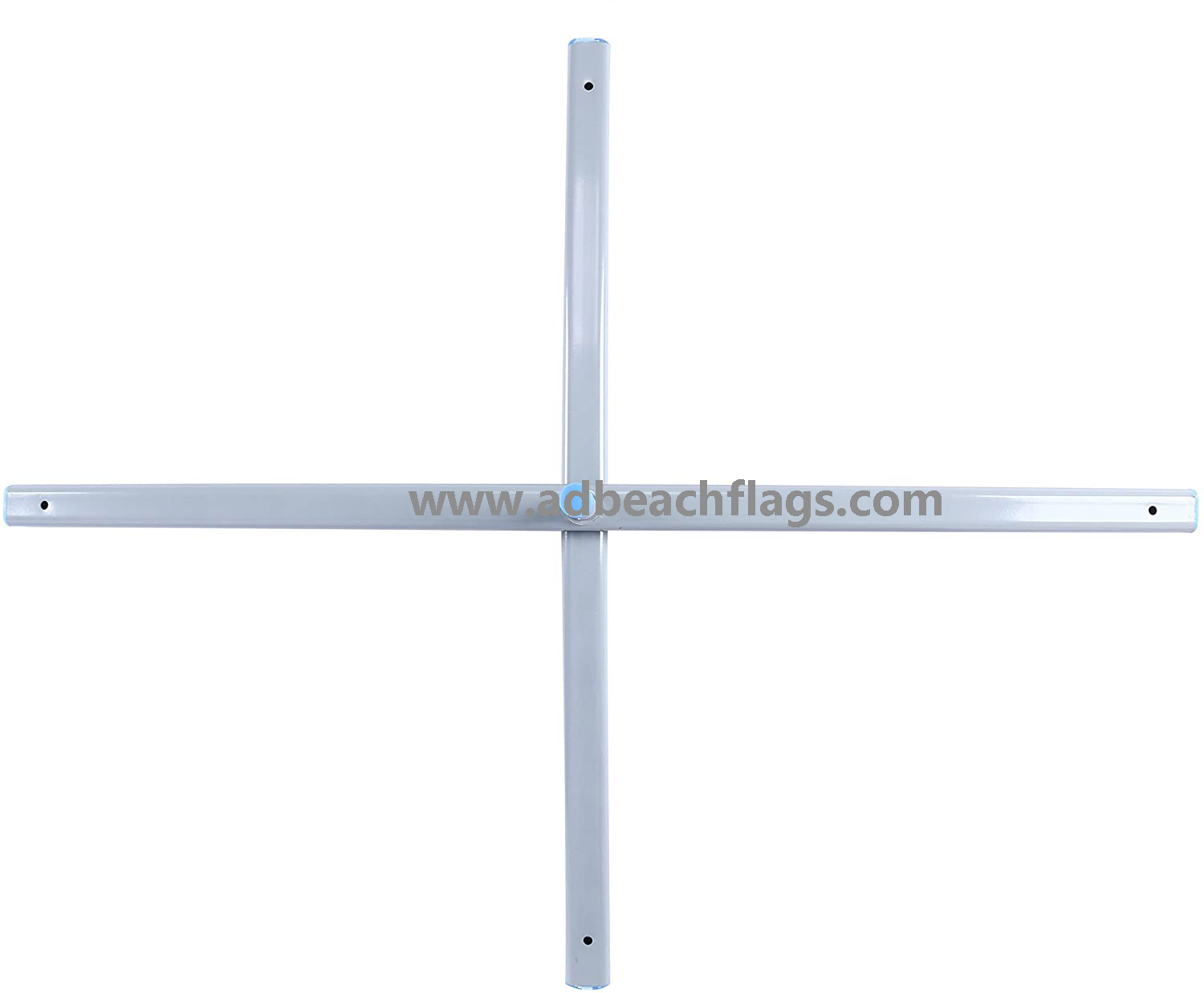
| Base | Type and weight; a cross base of 1.25 to 1.45 kg behaves very differently from a 2.8 kg heavy cross base |
| Finishing | Tension cord type, whether a spare cord is included, grommets if applicable |
| Packing | Carton dimensions, gross weight and pieces per carton, per size |
Two more items belong on the list even though they are not product specifications. First, the artwork process: who proofs it, how many revision rounds are included, and whether a printed colour swatch is part of the deal. Second, the sample policy: what a sample costs, whether the cost is credited against the bulk order, and how long it takes.
Flag factories work in tiers. A single sample is possible because digital printing needs no screens, then price drops sharply as quantity rises, and again at container-scale volumes. Typical market bands at the hundred-piece level land in the low single digits per flag for the printed panel alone, with complete kits costing significantly more because pole and base travel with them.
| Order shape | What it is good for | What to watch |
|---|---|---|
| Sample, 1 to 10 pieces | Approving colour, construction and packed weight | Unit price is meaningless at this tier; judge quality only |
| Trial run, tens of pieces | Testing a market, a shape or a price point | Air freight can double the landed cost of cheap flags |
| Wholesale run, hundreds | Distributor stock, chain rollouts, event seasons | Colour consistency between this order and the next |
| Container, thousands | Established importers with warehouse capacity | Packing plan, carton marks and mixed-size loading |
The number that decides your margin is not the unit price, it is the landed cost per sellable unit. Freight is charged on volume far more often than on weight for flags, because a flag is bulky and light. That is why packing choices, not price negotiation, usually move the landed cost most.
1. Flags should ship flat. Flat packing keeps the print smooth, protects the pole sleeve and stacks predictably in a carton.
2. Poles should be bundled by length. Mixed bundles force the importer to sort every carton; bundles by length let stock go straight to a shelf.
3. Bases belong in their own cartons. Metal in with printed fabric is how flags arrive creased and tips arrive cracked.
4. Ask for carton dimensions and gross weight per size before production. Those numbers decide your storage layout and your inbound freight quote, and they are free to provide.
5. Insist on packing photographs before the balance is due. A supplier who photographs the packed goods is a supplier who expects you to check, which is exactly the relationship you want.
1. Sew checks. Pull the sleeve seam and the top corner. If stitching runs single and loose, the flag will fail at the stress point first, and that is where every warranty claim starts.
2. Colour check under daylight, not under office light. Compare the delivered flag against the printed swatch you approved, in shade and in sun.
3. Pole fit check. Assemble one kit fully. Sections should join without force, and the tip should reach the top corner of the sleeve.
4. Base scale check. Weigh the base. Cross bases vary from about 1.25 kg to 2.8 kg across grades, and a base that is light for the flag is the most common cause of a tipped display.
5. Print alignment check on double-sided flags. Hold the flag up to strong light and confirm the two faces line up and the liner blocks the show-through.
1. Request quotes against the same specification sheet from three to five suppliers.
2. Order one sample kit in your best-selling size, printed with your own artwork, and have it shipped by courier.
3. Inspect it against the check list above, then photograph everything, including the packed carton.
4. Approve artwork and colour on paper, in writing, before the bulk run starts.
5. Ask for pre-shipment photographs of the finished goods and the packed cartons.
6. For container orders, request a loading photograph showing the carton count, and confirm the packing list matches before the balance is released.
We would rather say this before you order than after. Importing is not automatically cheaper than buying locally.
1. You only need a handful of flags. Below a few dozen pieces, retail prices with local delivery usually beat importing once freight, duties and your own handling time are counted.
2. You cannot warehouse them. Flags are bulky. A container that arrives with nowhere to sit becomes a rented storage problem, and storage cost quietly eats the margin you negotiated.
3. You cannot support the product. Selling flags means answering questions about bases, wind, replacements and artwork for months after the sale. A distributor who cannot answer those questions loses the customer to whoever can.
United States. Buyers search for feather flags and swooper flags, and expect single-sided printing as the volume line with double-sided reserved for corners. Note that several cities cap portable sign height and count per business, which retailers pass on to their own customers.
United Kingdom and Ireland. Teardrop and sail flag terminology dominates, and buyers frequently ask for cross bases with water bags as a set, because pavement sites need ballast for permission.
Germany, Austria and Switzerland. Werbefahne and Beachflag are the search terms, and importers here ask for fabric weight and flammability paperwork before the first order. Have certificates ready in writing.
Australia and New Zealand. UV levels shorten flag life, so 115gsm and mesh appear in most specifications, and buyers plan an annual skin change rather than an indefinite service life.
Brazil and Latin America. Bandeira pluma and bandera pluma orders favour single-sided printing to control landed cost, with mesh for coastal cities and heavier fabric for inland sun.
Before committing to a wholesale programme, walk the streets where your customers trade and count what is already standing there.
1. Count the flags per block. Ten flags in one street tells you the product sells locally; two flags tells you the category is still open.
2. Photograph the shapes in use. The mix of feather and teardrop flags you see is the mix your first order should carry, whatever a catalogue suggests.
3. Note the conditions. If the flags you pass are leaning, the local market has a base problem, and a correctly specified kit becomes a selling point you can demonstrate.
4. Check the artwork quality. Faded, wrinkled flags in the market mean the incumbent supply is weak on fabric and colour, which is exactly where a better specification wins the account.
Q1. What is the minimum order for wholesale feather flags?
Low MOQ accepted for trial orders, with wholesale pricing from small quantities per design. Samples are possible because digital printing needs no screens, and prices fall sharply as volume rises.
Q2. What fabric should I specify?
110gsm knitted polyester is the industry standard for flags. 115gsm suits markets with hard sun, 130gsm gives a heavier feel for premium lines, and mesh reduces wind load on coastal sites.
Q3. How long does production take?
Samples are typically ready in 2 to 3 days and bulk orders in 5 to 10 days after artwork approval, plus the freight window: days by courier, about a week by air, and weeks by sea.
Q4. How do I protect colour consistency across reorders?
Approve a printed swatch before the first bulk run and ask the factory to keep the artwork and the colour reference on file. That single habit prevents the batch-to-batch drift that retailers complain about most.
Q5. Single-sided or double-sided for a first container?
Single-sided usually carries the volume, because most storefronts face one direction. Keep a double-sided line for corners and two-way traffic; the double build costs more and weighs roughly 30% more, which affects freight.
Q6. What documents come with the shipment?
Commercial invoice, packing list and HS code 6307.90 for printed textile flags. These travel with the goods and keep customs conversations short.
| Point | Detail |
|---|---|
| Manufacturer, not a reseller | Printed and sewn in our own Foshan workshop; specification questions reach the people who make the goods. |
| Colour you can hold us to | Pantone and RAL matching with a printed swatch approved before the bulk run. |
| Complete kits, one standard | Flag, pole and base share one fitting standard, so spares and reorders stay simple. |
| Fast sampling | Samples in 2 to 3 days, bulk in 5 to 10 days after artwork approval. |
| Low MOQ accepted | Trial orders without a container, wholesale pricing from small quantities. |
| Customer 5stars Feedback | warmly welcomed in 150+ countries across Europe, the Americas, the Middle East, Africa and Oceania. |
Wholesale feather flags are a specification business disguised as a price business. Buyers who pin down fabric weight, size, printing, sewing, packing and colour process before negotiating price get a container that sells; buyers who chase the lowest unit price get a warehouse of flags that faded, creased or came apart, and a market that remembers it.
Send the specification sheet, the sizes and the quantity you are planning, and we will come back within 1 hour, 24×7, with a quoted price, a packing plan and a sample offer. Low MOQ accepted, and if a lighter fabric will do the job for your market, we will say so.
It also helps to decide, before the first container, who will handle the second one. Importers who plan a reorder cycle from day one, with artwork and colour references stored at the factory, spend their time selling rather than re-explaining their own product to a new supplier every season. That habit, more than any single negotiation, is what turns a first container into a durable supply line.
Tell us the flag size, the quantity, single or double-sided, and the surface the flags will stand on. Our export team replies within 1 hour, 24×7, with an artwork proof and a factory price. Low MOQ accepted.
Chat on WhatsApp (+86 135 1661 0926) Email Us Now
Prefer a form? Fill in the details below and we will come back with a proof and a price within 1 hour, 24×7.
Related reading: Flag Fabric and Printing Guide | Beach Flag Size Guide | Advertising Flags Buyer’s Hub | Feather Flags | Teardrop Flags | Double-Sided Flags | Flag Poles | Warehouse & Logistics
| Item | Detail |
|---|---|
| Product | Wholesale feather flags (swooper flags) for importers and distributors |
| Manufacturer | Ad Beach Flags, Foshan, Guangdong, China |
| Fabric | 110gsm knitted polyester standard; 115gsm, 130gsm and mesh options |
| Printing | Dye sublimation with Pantone and RAL matching and swatch approval |
| Sizes | Feather 60×200 cm to 75×410 cm, poles 280 cm to 560 cm; teardrop sizes also available |
| Builds | Single-sided, double-sided with blockout liner, or reverse-sided |
| Packing | Flags flat-packed, poles bundled by length, bases in separate cartons |
| Documents | Commercial invoice, packing list and HS code 6307.90 |
| MOQ and lead time | Low MOQ accepted; samples 2 to 3 days, bulk 5 to 10 days after artwork approval |
| Contact | WhatsApp +86 135 1661 0926, [email protected], reply within 1 hour 24×7 |