Phone:
0086-757-8938 9313
Email:
Address:
Caochang Industrial Zone, Liguang Rd, Lishui, Nanhai, Foshan, Guangdong, China
Reply within 1 hour, 24x7

Phone:
0086-757-8938 9313
Email:
Address:
Caochang Industrial Zone, Liguang Rd, Lishui, Nanhai, Foshan, Guangdong, China
Reply within 1 hour, 24x7


An open house sign has one job: turn a passing car into a turn at the junction. Everything about the kit follows from that. It has to be visible from the road, carry three words at most, fit in the boot of the agent’s car, and go up alone in the two minutes before the first viewer arrives.
This guide covers the sizes and bases that suit that reality, where the flags should stand relative to the junction, and the artwork rules that make a property sign read at thirty kilometres an hour.
1. Height. A board on the ground competes with parked cars, bins and hedges. A flag on a 280 cm pole clears all three, which is why it is visible from further back.
2. Setback. Many councils restrict where a board can stand on a verge. A portable flag on a private garden strip or beside a driveway is often easier to place within the rules.
3. Speed of setup. A spike or a folded cross base goes down in under a minute. Agents setting three flags around a corner can do it between two viewings.
4. Repeatability. The same kit works for every property. Once the agent owns poles and bases, each new listing only needs a fresh printed skin.
| Placement | Recommended size | Why it fits the job |
|---|---|---|
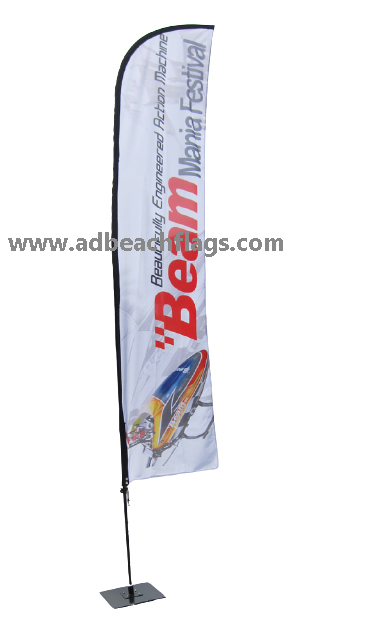
| Junction, first sight line | Feather 60×240 cm on a 340 cm pole | Clears parked cars; readable from 30 to 40 m |
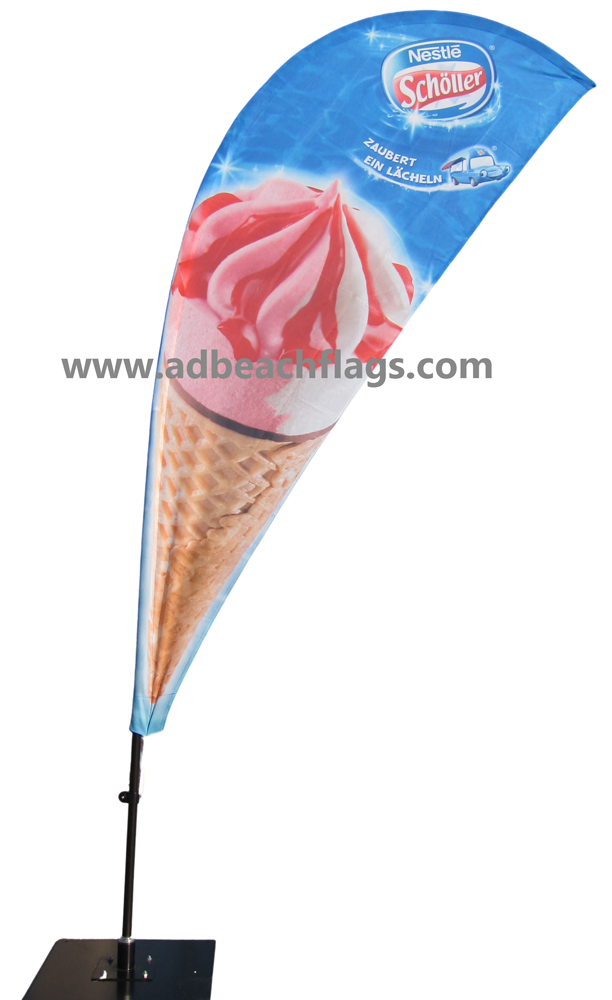
| Street outside the property | Teardrop 75×165 cm on a 280 cm pole | Small footprint on a narrow verge; goes up in seconds |
| Driveway entrance | Teardrop 85×190 cm on a 340 cm pole | Frames the turn without blocking sight lines |
| Apartment block or city centre | Teardrop 75×165 cm on a cross base with water bag | Standing on pavement rather than soft ground |
The temptation is to buy the largest flag available. For estate agents it is usually the wrong call: a 5.6 m flag needs a heavy base, takes longer to handle, and does not fit a car boot alongside a folder of particulars and a sign board. Small and medium kits get used every weekend, which is the only metric that matters.
1. Ground spike. The default for gardens, verges and open ground. Seconds to fit with a mallet, nothing to fill, and no weight to carry. Keep the collar above ground so the flag can rotate with the wind.
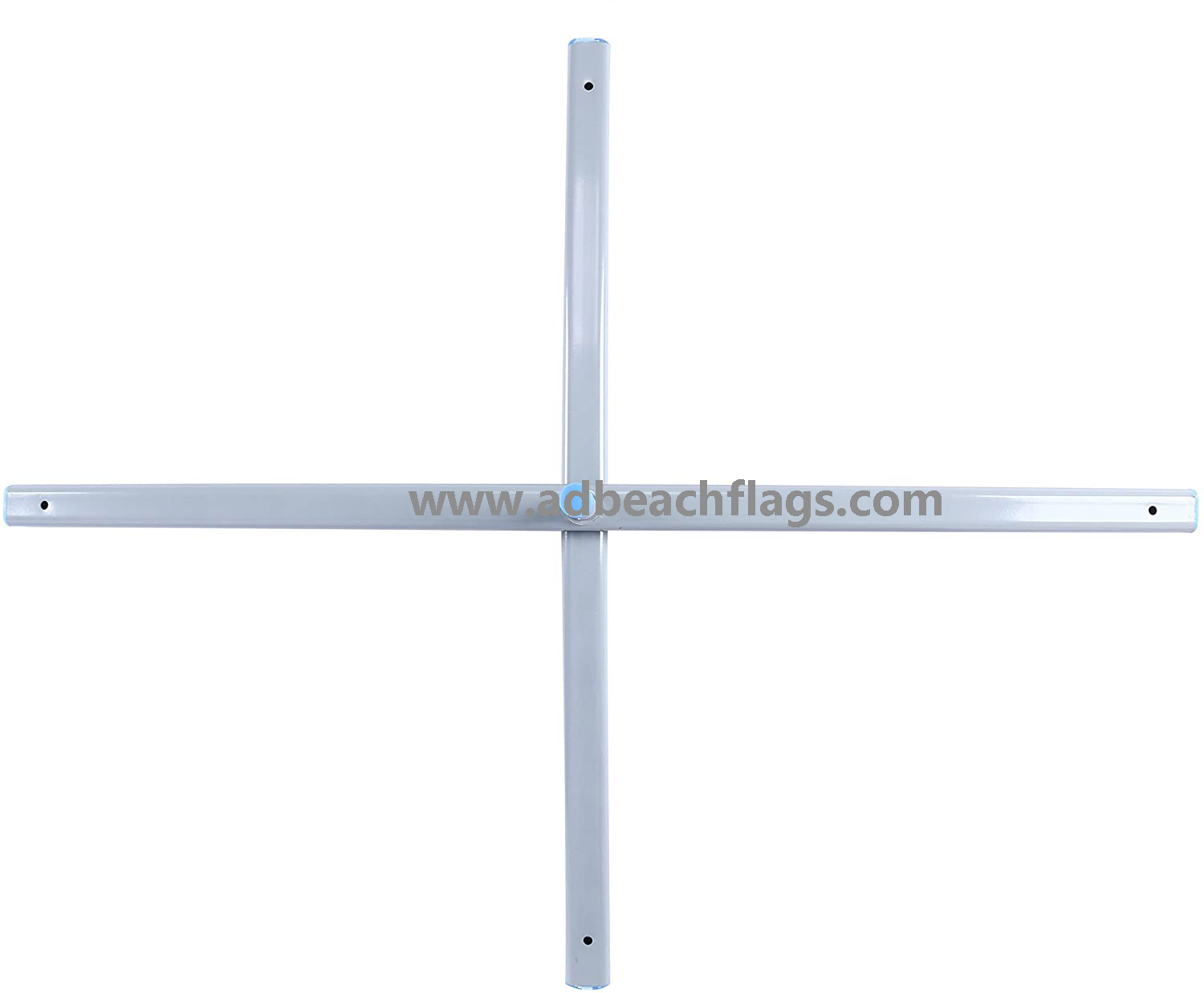
2. Cross base with a water bag. For paving, driveways and city streets where there is nothing to drive a spike into. The base folds flat in the boot and the bag fills from a tap on site, adding about 10 to 12 litres of ballast.
3. Metal plate. Three to six kilograms of steel with nothing to fill, for agents who would rather not manage water bags between viewings. It suits a regular weekly pitch where the plate stays in the boot and never needs topping up.
Two habits keep the kit usable. Bring flags in at the end of each viewing, because signs left out get taken, and keep one spare printed skin per design so that a damaged flag never costs an open house.
1. The junction flag. Stands at the first point where a driver could turn towards the property, carrying the brand and the word OPEN with an arrow if space allows.
2. The turn flag. At the actual turning, so the driver who has already decided does not miss the road. This one is the most important and the most often forgotten.
3. The property flag. At the gate or driveway, confirming the arrival. Three flags trace a route; two flags leave a gap where a car carries on past.
Leave the flags out only while the viewing runs. Portable signage that stays overnight becomes litter with a logo on it, and in some areas a fixed sign in a public place needs permission the agent simply does not have.
1. Three words maximum. OPEN. Open House. House for Sale. With an arrow, that is a complete sign.
2. High contrast against street clutter. A dark ground with a light mark, or a bright brand colour with white text. Pale designs vanish against tarmac and foliage.
3. Brand mark plus one instruction. The agency logo keeps the sign looking professional, and the word OPEN does the work.
4. Keep detail above the midpoint. Hedges, walls and parked cars cover the lower part of the flag from most approach angles.
1. One flag for the whole route. A flag at the property only helps drivers who already found the road. The junction flag is what generates the turn.
2. Undersized bases on paving. A cross base without a water bag on a city pavement is a flag waiting to fall in front of a car.
3. Buying one big flag instead of three small ones. Three small flags cover a route; one big flag covers a spot.
4. Reusing faded skins. A tired flag reads as a tired agency. Skins are the cheap part of the kit.
5. Leaving flags out after the viewing. They are removed by councils, neighbours or the wind, and none of those outcomes helps the next weekend.
United States. Open house flags and realtor flags are the search terms, and signage rules vary by city, so agents check local codes before a weekend campaign.
United Kingdom and Ireland. Estate agent boards on verges need permission in many areas; portable flags in the garden or on a driveway usually avoid the paperwork.
Australia and New Zealand. Open home flags are standard on suburban junctions, and hard UV means skins are replaced roughly annually.
Germany, Austria and Switzerland. Maklerfahnen and Werbefahnen appear mainly on private property, with agents preferring plates over spikes for paved driveways.
Brazil and Latin America. Bandeira pluma flags mark show apartments and loteamentos, usually in small teardrop sizes on pavement bases.
We would rather say this plainly than sell a kit that sits unused in a car boot.
1. Where the property sits on a road with no safe stopping point. A flag that encourages a sudden turn is a liability; directional signage elsewhere is the better answer.
2. When local rules prohibit portable signage. Some authorities restrict advertising on verges and public footways entirely. A window display or a board within the property line is the compliant route.
3. For a single viewing in poor weather. Flags work in wind and rain, but the setup time may not be worth it for one appointment; the kit earns its keep on a viewed weekend.
Estate agents set flags between appointments, so the routine has to be quick and repeatable.
1. Assemble the pole bottom first. Sections fit one way, widest at the bottom and the fibreglass tip at the top. Forcing a joint the wrong way round splits the ferrule and ends the weekend early.
2. Feed the sleeve from the bottom. Starting with the shortest section stops the fabric bunching around a joint, which is what makes a flag look wrinkled in photographs.
3. Push the tip fully home. If the tip stops short, the print hangs from the wrong corner and the sign looks off from the road.
4. Set the base, then tension. Tensioning before the pole is seated simply pulls the whole assembly over; the order matters more than the force.
5. Strike in reverse. Take the pole out of the sleeve before collapsing the sections, and the tip never takes a side load. Fleets that strike in this order report far fewer cracked tips.
Agents often assume the kit is the cost. In practice the hardware is a one-time purchase and the printed skin is the consumable.
1. Hardware lasts years. Poles and bases passed between viewings survive far longer than flags that stand outside permanently, so a branch kit is bought once and replenished rarely.
2. Skins wear with use, not with age. A skin used on weekends lasts several seasons; a skin left out daily will fade within one.
3. Spares are the cheapest insurance. One spare bottom section per branch and one spare skin per design mean a damaged flag never costs a viewing.
4. Central artwork saves the most. Once the agency’s layout is on file, a new property or a new offer is a reprint, not a redesign, and every branch looks consistent on the same day.
That last point is worth more than it sounds. A multi-branch agency that revisits its artwork from scratch every season ends up with branches that look like different businesses, and the fix costs more than the flags.
Q1. What size flags do estate agents use?
Most use small and medium sizes that fit a car boot: teardrops at 75×165 cm on a 280 cm pole for streets and driveways, and feather flags at 60×240 cm on a 340 cm pole for junctions where the sign has to clear parked cars.
Q2. Which base works best for open house flags?
Ground spikes for gardens and verges, cross bases with water bags for paving and city streets, and 3 to 6 kg metal plates for agents who display weekly and prefer nothing to fill.
Q3. How many flags does an open house need?
Three: one at the junction, one at the turn, and one at the property itself. Two flags leave a gap where drivers carry on past.
Q4. What should the artwork say?
Three words at most, with the agency mark and the word OPEN. Add an arrow only if the flag is at the junction where the turn happens.
Q5. Can I leave open house flags out overnight?
Better not to. Flags left out are taken, damaged or reported, and the same kit dried and stored lasts several seasons instead of one.
Q6. How often do estate agents replace flag skins?
With weekend use, a skin lasts a long time. Agencies that display daily replace skins roughly every six to twelve months, and keeping artwork on file makes the reorder a file swap.
| Point | Detail |
|---|---|
| Manufacturer, not a reseller | Printed and sewn in our own Foshan workshop, with sleeves and corners reinforced for repeated weekend setups. |
| Colour you can hold us to | Pantone and RAL matching with a printed swatch approved before bulk, so every branch of an agency looks identical. |
| Skins, not whole kits | Reorder printed skins for new campaigns while keeping the poles and bases already in the boot. |
| Boot-friendly kit sizes | Small and medium formats that pack flat with poles in a carry bag. |
| Low MOQ accepted | Start with three flags for one branch, then standardise the specification across the network. |
| Customer 5stars Feedback | warmly welcomed in 150+ countries across Europe, the Americas, the Middle East, Africa and Oceania. |
Open house flags are route markers, not decoration. Three small flags that trace the turn, bases that suit the ground they stand on, artwork that reads in three words, and a kit that lives in the boot: that is all an agency needs to turn passing traffic into viewings weekend after weekend. Bigger kits look impressive in a catalogue and stay in the office cupboard.
Tell us how your agents approach the properties, what surfaces the flags will stand on and how many branches need kits, and we will reply within 1 hour, 24×7 with sizes, bases and a per-branch kit list. Low MOQ accepted, and we will say plainly when two flags will do the job of four, because an agency that buys more kit than it actually uses tends to stop using the kit altogether.
Tell us the flag size, the quantity, single or double-sided, and the surface the flags will stand on. Our export team replies within 1 hour, 24×7, with an artwork proof and a factory price. Low MOQ accepted.
Chat on WhatsApp (+86 135 1661 0926) Email Us Now
Prefer a form? Fill in the details below and we will come back with a proof and a price within 1 hour, 24×7.
Related reading: Beach Flag Size Guide | Flags for Forecourts | Flag Base Guide | Teardrop Flags | Feather Flags | Spike Base Stands | Metal Plate Bases | Portable Oxford Bags
| Item | Detail |
|---|---|
| Product | Open house and real estate flags for estate agents and property marketing |
| Manufacturer | Ad Beach Flags, Foshan, Guangdong, China |
| Sizes for agents | Teardrop 75×165 cm on 280 cm pole; 85×190 cm on 340 cm pole; feather 60×240 cm on 340 cm pole |
| Bases | Ground spike for gardens, cross base with water bag for paving, metal plate 3 to 6 kg for weekly pitches |
| Fabric | 110gsm knitted polyester standard; 115gsm for hard sun |
| Printing | Dye sublimation with Pantone and RAL matching; branded skins reprinted on file |
| Typical kit | Three flags per branch: junction, turn and property |
| Artwork rule | Three words maximum plus the agency mark; keep detail above the midpoint |
| MOQ and lead time | Low MOQ accepted; samples 2 to 3 days, bulk 5 to 10 days after approval |
| Contact | WhatsApp +86 135 1661 0926, [email protected], reply within 1 hour 24×7 |