Phone: 0086-757-8938 9313
WhatsApp: +86 135 1661 0926
Email: raya@besda.net
Address: Caochang Industrial Zone, Lishui, Nanhai, Foshan, Guangdong, China
24/7 Online Services
Phone: 0086-757-8938 9313
WhatsApp: +86 135 1661 0926
Email: raya@besda.net
Address: Caochang Industrial Zone, Lishui, Nanhai, Foshan, Guangdong, China
24/7 Online Services

A buyer asked us last spring why his feather flag lasted three years in one city and one afternoon in another. Same flag, same pole. The first site was a sheltered high street, the second a coastal promenade with a steady onshore breeze. Wind, not fabric, decides how long a flag lives, and it is the question serious buyers ask before they ask about price.
This guide gives you the working numbers: the wind range where a flag reads well, the point where you take it down, and the hardware choices that move those numbers in your favour. No lab fantasy, no ” hurricane proof” marketing. Just what the flag does at each speed and what crews actually do at outdoor events.
Here is the first thing to know, and almost nobody prints it: there is no independent certification body that rates a beach flag the way it rates a tent or a scaffold. When a supplier writes 25 mph or 30 mph on a product page, that number comes from their own field experience, not from a test house stamp. Nobody should sell you a “hurricane proof” flag, either.
Three different numbers hide behind the phrase “wind rating”:
1. The reading range. The speeds where the flag flies open, stays readable and looks good on camera. Roughly 8 to 24 mph for most single-sided flags.
2. The take-down point. The speed where fabric stress and pole flex stop being worth the exposure. Most suppliers and event crews put this between 25 and 30 mph.
3. The pole survival claim. Some brands advertise poles that survived 72 to 82 mph gusts. That is a claim about the pole, not about your print, and it says nothing about how the flag looked an hour earlier.
Buying on the third number is how people end up disappointed. Ask for the second number instead. It is the honest one.
| Wind speed | What the flag does | What a crew does |
|---|---|---|
| 0 to 8 mph | Flag hangs or barely lifts | Nothing to do; a teardrop shape holds its form best in still air |
| 8 to 12 mph | Gentle, steady flutter | Ideal display window; message reads clearly |
| 12 to 18 mph | Full fly, strong movement | Still fine; check base ballast once |
| 18 to 25 mph | Loud snapping, sleeve stress begins | Single-sided flags on good bases hold; watch gusts |
| 25 to 30 mph | Fabric flogs hard, pole whips | Take the flags down; industry rule of thumb |
| Above 30 mph | Damage zone: seams, sleeves, tips | Everything comes in, no exceptions |
The number that matters most to a buyer is not the maximum. It is the bottom of the range. A flag that still reads at 10 mph gives you more usable hours in a year than a flag that needs 15 mph to open.
A double-sided flag carries two printed layers with a blockout liner between them. That liner stops the mirror-image show-through you get on single-sided prints, and it is the right choice for entrance ways and corner sites. The trade-off is wind load.
Three layers of fabric catch roughly twice the push of one. The industry rule of thumb puts single-sided flags at a 25 to 30 mph take-down point and double-sided flags at 13 to 17 mph. Same pole, same base, less wind tolerance. We would rather tell you this before you order than after your first gusty weekend.
Practical read: if your site is a windy one, run single-sided flags angled toward the main traffic flow. Save the double-sided build for courtyards, malls and streets where wind is a non-issue.
Event crews still think in Beaufort scale, because it needs no instrument. Four steps cover everything a flag owner needs:
1. Force 3, 8 to 12 mph. Leaves in constant motion. Flags fly open and photogenic. Fly everything you have.
2. Force 4, 13 to 18 mph. Dust lifts, small branches move. Double-sided flags start working hard; single-sided flags are fine.
3. Force 5, 19 to 24 mph. Small trees sway. This is the last comfortable window for single-sided flags on real ballast.
4. Force 6, 25 to 31 mph. Umbrellas struggle, wires whistle. Flags come down. Across the trade, Beaufort 4 is the common advisory point for packing up.
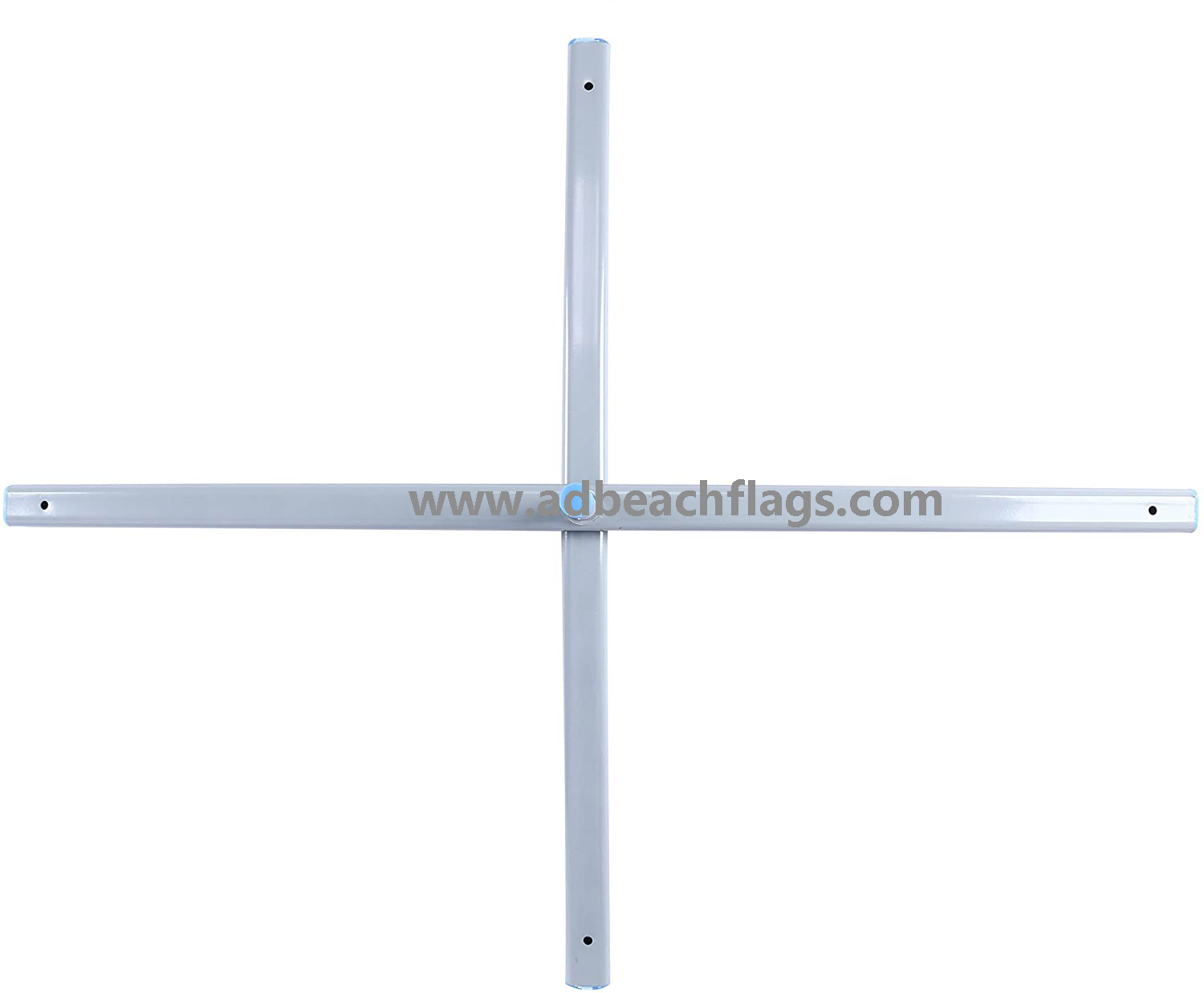
1. The base. A ground spike in firm turf holds a small flag in far more wind than the same flag on an unfilled cross base. Ballast is not optional above 3 m: a cross base wants its water bag, about 10 to 12 litres, before the flag goes up.
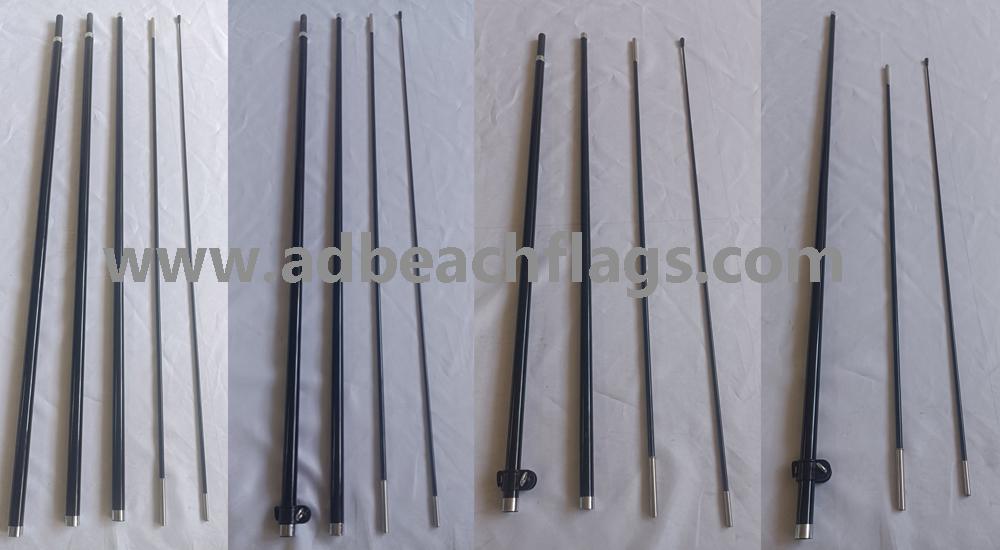
2. The pole. Three builds exist: aluminium with a fibreglass top section, full aluminium, and full fibreglass. The fibreglass tip bends and springs back; that is the section that survives gusts. Full fibreglass poles are the usual choice for coastal sites for exactly this reason.
3. The fabric. Standard 110gsm knitted polyester is the trade default. For wind-exposed sites, mesh polyester with roughly 30 per cent open holes lets air through and cuts the load on the pole by close to half. Print shows through the holes, so artwork needs bolder elements.
4. The flag size. A 130×330 cm XXL face on a 560 cm pole is a sail. The same artwork on a 85×190 cm size stands up to the same gust far better. Big flags belong on sheltered sites or on water-tank bases.
5. Gusts, not averages. A steady 18 mph is easier on a flag than a calm hour with one 35 mph gust. Coastal and mountain sites live in gust country, which is why the take-down habit matters more there than any rating.
| Surface | Base | Wind note |
|---|---|---|
| Grass, soil | Ground spike | Best grip of any base; drive it fully at an angle |
| Sand | Spiral sand anchor | Screws in; a straight spike pulls out in soft dry sand |
| Pavement, floors | Cross base with water bag | 10 to 12 litres of ballast; fine to Beaufort 4 with small flags |
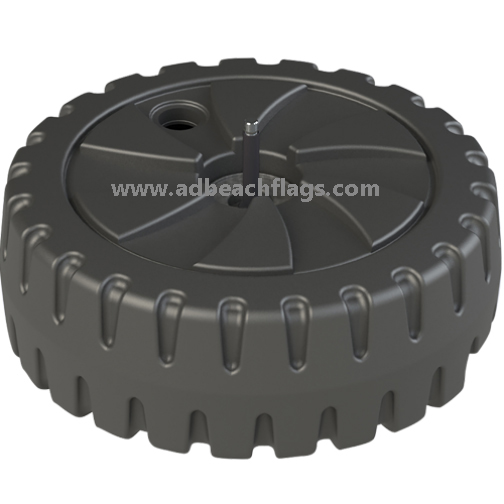
| Long outdoor runs | Water tank base, 12 to 32 litres | Heaviest option; fill with sand in winter to stop freezing |
| Car parks, dealerships | Car base | The vehicle is the ballast; just drive the wheel onto it |
| Flags over 460 cm | Heavy cross or metal plate, 4 to 12 kg | Steel weight under tall flags is standard practice |
Running events taught the trade most of what it knows about wind, because a marathon cannot reschedule. Pace flags stand over the start corral for two to three hours while thousands of runners pass, and the crews follow the same loop all morning:
1. Rig before dawn. Wind is lowest at first light, so bases and poles go in while the air is still and the flags open for the photo crowd.
2. Angle into the breeze. A teardrop set at a slight angle into the wind reads longer than one set broadside.
3. Watch the flags, not the forecast. A designated crew member glances at the line of flags every 20 minutes. Sleeve snap and pole whip show up before any instrument does.
4. Pull before the front, not during it. Gust fronts arrive faster than forecasts update. When the first flag flogs, the whole row comes out, two minutes per flag.
That is the entire secret. The flags that survive a season are not tougher than the ones that tear; they belong to crews that take them down in time.
United States. Lakefront sites in Chicago and gusty plains towns see fast direction changes; crews there standardise on water-tank bases and pull flags overnight as routine.
United Kingdom and Ireland. Coastal promenades run a steady 15 to 20 mph on open days. Full fibreglass poles with single-sided prints are the common sight, and shop crews bring flags in each evening.
Australia and New Zealand. Sea-breeze afternoons are reliable enough to plan around: flags up early, down by mid-afternoon on exposed beaches. Mesh fabric is common on surf club displays.
Latin America. Beach kiosks in Brazil screw spiral anchors straight into the sand and pull the flags when the afternoon wind turns the umbrellas inside out.
Middle East. Winter event season, November to March, brings steady desert wind to open sites; heavy cross bases under tall flags are standard practice at exhibitions grounds.
1. Trusting the marketing number. A pole that survived 80 mph says nothing about your printed flag at 30 mph. Plan around the take-down point instead.
2. Skipping the water bag. An unfilled cross base under a 460 cm flag is the most common cause of bent poles we see in photos. Fill it, every time.
3. Leaving flags up overnight. Night wind is unpredictable and nobody is watching. The flag that comes in at dusk lasts roughly a full season longer than the one that sleeps outside.
4. Reading the average, missing the gust. Sites between buildings, on ridgelines and on corners funnel gusts. If umbrellas struggle, your flag is already past its limit.
We would rather lose an order than sell a flag into a site that will destroy it. Three situations where we tell buyers to choose something else:
1. Exposed ridgelines and harbours with constant Force 6. No flag survives a daily beating. A wind-resistant sign panel or a fixed banner on a rigid frame suits better.
2. Sites with no staff to pull flags. A flag needs a take-down routine. If nobody owns that job, budget for mesh fabric and heavy ballast, or accept a shorter life honestly.
3. Permanent installs. A beach flag is portable by design. Year-round display is the job of a different product, and pretending otherwise just burns your budget.
Tell us the site, the surface and the wind you actually get. We will match the pole, base and fabric to it, and we will say plainly when a flag is the wrong answer. Send your location details on WhatsApp at +86 135 1661 0926 or email [email protected], and our export team replies within 1 hour, 24×7. Low MOQ accepted, samples in 2 to 3 days, bulk in 5 to 10 days after artwork approval.
Q1. How much wind can a beach flag take?
Single-sided flags on proper ballast handle up to about 25 to 30 mph before they should come down. Double-sided flags should come down at 13 to 17 mph because the blockout liner doubles the wind load.
Q2. Is there an official wind certification for flags?
No independent body certifies beach flag wind ratings. Supplier numbers come from field experience, so ask for the take-down point and the recommended base, not just a maximum figure.
Q3. Which flag shape handles wind best?
Teardrop shapes hold their form in light wind because the curved pole keeps tension on the fabric. Feather flags read better in a steady breeze. In strong exposed wind, smaller sizes and mesh fabric beat both.
Q4. Do mesh flags last longer in wind?
Mesh with about 30 per cent open area cuts the load on the pole by close to half, so the whole system lasts longer at exposed sites. The trade-off is that fine artwork detail shows less.
Q5. What base do I need for windy sites?
Grass takes a ground spike driven at an angle. Pavement needs a cross base with a filled water bag, 10 to 12 litres. Long outdoor runs and flags over 460 cm want a water tank base of 12 to 32 litres or a 4 to 12 kg steel plate.
Q6. Can I leave my flag up overnight?
We advise against it. Night wind is the main reason flags age early, and taking a flag down takes about two minutes. The habit adds months to the life of the skin.
| Point | Detail |
|---|---|
| Manufacturer, not a reseller | Flags printed and sewn in our own Foshan workshop, with reinforced sleeves and corners for windy sites. |
| Three pole builds on one price list | Aluminium with fibreglass top, full aluminium and full fibreglass, so the pole matches the site instead of the catalogue. |
| Six base types in one shipment | Spike, cross, heavy cross, plate, car and water tank bases packed with the flags they fit. |
| Mesh option for exposed sites | 120gsm mesh polyester with about 30 per cent open area, printed the same way as standard fabric. |
| Fast sampling | Samples in 2 to 3 days, bulk in 5 to 10 days after artwork approval. |
| Customer 5stars Feedback | warmly welcomed in 150+ countries across Europe, the Americas, the Middle East, Africa and Oceania. |
Wind ratings are honest when you read them as a range, not a badge. Fly your flags in the 8 to 24 mph window where they look their best, take single-sided flags down around 25 to 30 mph and double-sided flags at 13 to 17 mph, and let the base carry the argument: real ballast under real wind. A flag is a consumable that rewards good habits, and the crews with a take-down routine buy replacement skins, not replacement systems.
Tell us the flag size, the quantity, single or double-sided, and the surface the flags will stand on. Our export team replies within 1 hour, 24×7, with an artwork proof and a factory price. Low MOQ accepted.
Chat on WhatsApp (+86 135 1661 0926) Email Us Now
Prefer a form? Fill in the details below and we will come back with a proof and a price within 1 hour, 24×7.
Related reading: Flag Poles Explained | Flag Base Guide | Surf Flags for Coastal Campaigns | Full Fibreglass Poles | Spike Base Stands | Water Tank Bases | Teardrop Flags | Water Bags
| Item | Detail |
|---|---|
| Product | Custom teardrop, feather, surf and giant flags with wind-matched poles and bases |
| Manufacturer | BESDA Advertising Flags, Foshan, Guangdong, China |
| Working wind range | About 8 to 24 mph for single-sided flags; ideal display at 8 to 18 mph |
| Take-down point | Single-sided about 25 to 30 mph; double-sided about 13 to 17 mph (industry rule of thumb) |
| Double-sided build | Two printed layers with a blockout liner; about twice the wind load of single-sided |
| Poles | Aluminium with fibreglass top, full aluminium, or full fibreglass for coastal sites |
| Fabric options | 110gsm knitted polyester standard; 120gsm mesh with about 30 per cent open area for wind |
| Bases | Ground spike, cross base with 10 to 12 litre water bag, water tank 12 to 32 litres, plate 4 to 12 kg, car base |
| Sizes | Teardrop 75×165 cm to 130×330 cm; feather 60×200 cm to 75×410 cm |
| Lead times | Samples 2 to 3 days; bulk 5 to 10 days after artwork approval |
| Contact | WhatsApp +86 135 1661 0926, [email protected], reply within 1 hour 24×7 |