Phone: 0086-757-8938 9313
WhatsApp: +86 135 1661 0926
Email: raya@besda.net
Address: Caochang Industrial Zone, Lishui, Nanhai, Foshan, Guangdong, China
24/7 Online Services
Phone: 0086-757-8938 9313
WhatsApp: +86 135 1661 0926
Email: raya@besda.net
Address: Caochang Industrial Zone, Lishui, Nanhai, Foshan, Guangdong, China
24/7 Online Services

The most expensive moment in custom flags is not the printing. It is the email three weeks later: the blue came out purple, the small text turned to fuzz, the logo sits half inside the pole sleeve. Every one of those jobs was ruined in the file, before the fabric ever met the press. This guide is the checklist our prepress team runs on every order, written out so your first proof can also be your last.
Send the file the way described here and the process is boring in the best way: a free layout preview, a colour swatch, a sample in 2 to 3 days, bulk in 5 to 10 days after approval.
Flag printing is dye sublimation. Your file prints onto transfer paper, then paper and fabric meet in a press at 190 to 210 degrees centigrade for one to two minutes. The ink turns to gas and bonds inside the polyester fibre. Nothing sits on top of the cloth.
That chemistry explains almost every artwork question:
1. Colour lives in the fibre. Prints survive washing, folding and sun far better than surface inks. It also means the fabric, not the paper, has the final word on colour, which is why swatches matter.
2. The fabric shrinks slightly. Knitted polyester pulls in by up to about 2 per cent during pressing. Templates account for it; freehand layouts at exact final size do not.
3. There is no white ink. Sublimation cannot print white. White areas are the unprinted fabric. A white logo on a navy flag is impossible in one layer; we would print the flag white and flood the navy around it, which changes how the design should be built.
4. Light shines through. On a single-sided flag, the reverse shows a mirror image at roughly 80 to 90 per cent strength. Artwork with a strong dark ground hides it; pale grounds show it more.
| Format | Verdict | Notes |
|---|---|---|
| AI, EPS, PDF (vector) | Best | Scales to any flag size; convert text to outlines before sending |
| PSD, TIFF | Good | 1:1 at final print size, 300 dpi, flat layers preferred |
| High-res JPG, PNG | Usable | Fine for photo flags; keep compression low |
| Word, PowerPoint, Canva link | Risky | Fonts and colours shift; export a PDF and check it first |
| Website screenshots | Avoid | 72 dpi screens pixelate fast at flag scale |
Vector wins because a flag file must run at sizes from 75 cm to 4 m. A logo rebuilt as vectors prints edge-clean at every one of them, and the same file serves every future size you order.
Screens are backlit RGB. Flags are daylight CMYK on polyester. Those two facts make every screen colour a rumour until it is printed. The working rules:
1. Build and send files in CMYK. Neon RGB blues and greens have no direct CMYK match, so they land duller than the screen promised.
2. Give us Pantone or RAL numbers for brand colours. We match against physical colour cards and print a swatch for your approval before bulk. The industry works to roughly a 5 per cent tolerance on CMYK sublimation; the swatch is what holds both sides to it.
3. Trust the swatch, not the proof PDF. A PDF on two different monitors shows two different blues. The printed swatch under daylight is the only colour both of us can stand behind.
Two margins decide whether a design survives cutting and sewing:
1. Bleed extends past the cut line. We ask for at least 5 mm of artwork beyond the final edge, and the trade runs anywhere from 5 to 25 mm depending on the shop. Backgrounds must run into the bleed; a white sliver at the flag edge is the classic sign it did not.
2. The safe zone protects the message. Keep text and logos at least 5 cm inside the edge, and clear of the pole sleeve end entirely. The sleeve hem can eat 3 to 5 cm of the design, and the corner reinforcement takes its share too.
Our templates, free for every size in AI and PDF, mark both lines for you. Working inside a template converts these two paragraphs into a five-second glance.
Print-shop folklore demands 300 dpi everywhere. Flags earn their living at 10 to 30 m, read in motion, which relaxes the rule:
1. 300 dpi at 1:1 is ideal. Photos and gradients keep full smoothness.
2. 100 to 150 dpi at 1:1 is acceptable. At viewing distance nobody can tell on a moving flag, and the fabric texture itself hides fine noise.
3. Upscaling does nothing. A 72 dpi screenshot stretched to flag size stays a screenshot. Replace the asset or simplify the design; software cannot invent pixels it never had.
4. Vector never worries about this. Text and logos built as curves are sharp at any size, which is half the reason vector is the preferred format.
1. Outline your fonts. Convert text to curves before sending. Missing fonts are the number one reason a file opens differently on the prepress side.
2. Respect a minimum text size. Below roughly 3 cm cap height, thin letterforms close up on knitted polyester. Chunky sans-serif types survive best; hairline serifs do not.
3. Supply Arabic and right-to-left scripts as outlines. Connected script can break when a file crosses systems, and reshaped letters are a disservice to the reader. Curves are safe everywhere, which is why our Gulf orders always arrive outlined.
4. Own the artwork. We print what you send. Sports logos, band artwork and stock images pulled from search engines create legal risk for you, and we will ask about rights on obvious cases.
A single-sided flag needs one file. The reverse shows a mirrored image through the fabric, which is standard and expected in the trade.
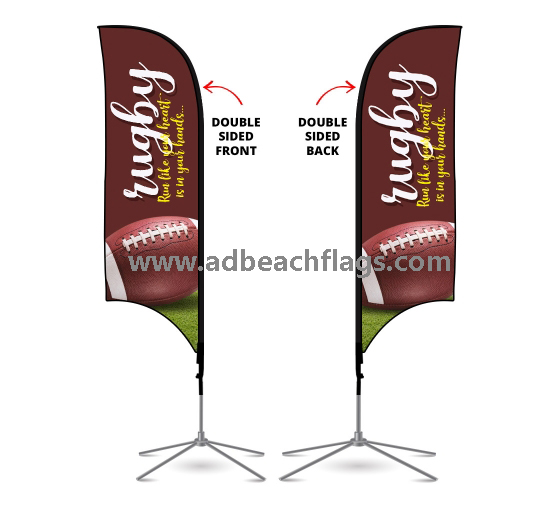
A double-sided flag is two flags plus a blockout liner, so it needs two files: one per face. You do not need to mirror anything yourself; the layout team flips as required. Send both faces in one PDF with page one as the front and page two as the back, and note which edge meets the pole. Designers who want the back to continue the front should extend backgrounds across both pages so the seam lines meet.
1. Free layout preview. The prepress team checks size, bleed, colour mode and fonts, then returns a layout proof within one business day. One or two rounds of adjustments are normal and included.
2. Colour swatch. For brand-critical jobs we print and photograph a Pantone-matched swatch before bulk.
3. Sample. A physical sample in 2 to 3 days, with photos or video on request.
4. Bulk. Production of 5 to 10 days after approval, then packing and shipment with tracking.
Artwork stays on file at the factory. A reorder six months later needs an email, not a redesign.
1. RGB neons that die in CMYK. The screen glows, the flag sulks. Convert early and adjust the design while change is still free.
2. Text inside the sleeve zone. The first 5 cm at the pole end is hardware territory. Every month someone loses a phone number to that hem.
3. JPG artifacts from chat apps. Messaging apps recompress images. Send the original file by email or a file link, not the version that survived three group chats.
4. Tiny text on a big flag. A URL readable on a business card is invisible at 20 m. If it must be read, it must be huge; otherwise drop it.
5. Expecting white ink. Plan white as fabric, not as ink, from the first sketch. The designs that look richest on flags are the ones drawn with this limit in mind.
United States. Most files arrive as Canva exports; the PDF download works fine when the page is set to exact flag size with bleed, so take a minute on the setup screen.
United Kingdom. Agencies send well-built PDFs with Pantone references, and the common extra request is a scaled preview against a shopfront photo for client sign-off.
Germany. Print buyers expect outlined vectors with exact CMYK values and they are right to; files from DE prepress almost never need a second round.
Middle East. Arabic-first artwork should arrive with text converted to curves and diacritics checked at large size; we lay out the Arabic side to match reading direction.
Latin America. Files often travel by WhatsApp, which recompresses them. Send originals by email and keep the chat version for reference only.
We would rather redesign a job than print a disappointment. Three designs that should move to another medium:
1. Dense legal text. Terms, disclaimers and ingredient lists belong on a leaflet or a QR landing page. On a flag they are decoration pretending to be information.
2. Photographic portraits with soft gradients. Fabric weave and wind break up subtle skin tones and shadow steps. A poster or a rigid panel carries photography better.
3. Multi-colour charts and maps. Below about 8 cm of legend height, labels merge. Simplify to one message per flag, or split the information across several flags.
Send your file to [email protected] or WhatsApp +86 135 1661 0926 and the prepress team will check it free of charge, flag anything risky, and return a layout preview. We reply within 1 hour, 24×7. Low MOQ accepted, samples in 2 to 3 days, bulk in 5 to 10 days after artwork approval.
Q1. What file format is best for flag printing?
Vector files save the best results: AI, EPS or PDF with text converted to outlines. High-resolution PSD, TIFF or JPG files at 1:1 size also print well.
Q2. Do I need to convert text to outlines?
Yes. Outlined text cannot lose its font in transit, which prevents the most common prepress delay. Arabic and other connected scripts should always be supplied as curves.
Q3. Can you match my exact brand colours?
Send Pantone or RAL references and we print a physical swatch for approval before bulk. CMYK sublimation works to roughly a 5 per cent tolerance, and the swatch is the agreed reference.
Q4. What bleed and safe zone should my file include?
Keep at least 5 mm of background extending past the cut line, and hold text and logos about 5 cm inside the edge, clear of the pole sleeve. Our free templates mark both zones.
Q5. What resolution do photos need?
300 dpi at full print size is ideal and 100 to 150 dpi is acceptable for flags read at distance. Never upscale low-resolution web images; replace them instead.
Q6. How do I set up artwork for a double-sided flag?
Send two files or a two-page PDF, one page per face, with backgrounds extended so the panels meet at the pole. You do not need to mirror anything; we flip the back face in layout.
| Point | Detail |
|---|---|
| Free prepress check | Layout preview within one business day, with one or two rounds of adjustments included at no charge. |
| Colour you can hold us to | Pantone and RAL matching with a printed swatch approved before bulk production. |
| Free templates for every size | AI and PDF templates with bleed and safe zones marked, from 75×165 cm up to giant formats. |
| Factory-direct pricing | Printing and sewing under one roof in Foshan, so prepress, sample and bulk stay in one pair of hands. |
| Fast sampling | Samples in 2 to 3 days, bulk in 5 to 10 days after artwork approval. |
| Customer 5stars Feedback | warmly welcomed in 150+ countries across Europe, the Americas, the Middle East, Africa and Oceania. |
Good flag artwork is not about design talent. It is about respecting four physical facts: ink enters fibre at 190 to 210 degrees, fabric shrinks up to 2 per cent, white is fabric rather than ink, and the flag is read in motion at distance. Build inside a template, send CMYK vectors with outlined text, approve the swatch, and the factory can promise what buyers actually want: the first proof matches the last shipment, every reorder, for years.
Tell us the flag size, the quantity, single or double-sided, and the surface the flags will stand on. Our export team replies within 1 hour, 24×7, with an artwork proof and a factory price. Low MOQ accepted.
Chat on WhatsApp (+86 135 1661 0926) Email Us Now
Prefer a form? Fill in the details below and we will come back with a proof and a price within 1 hour, 24×7.
Related reading: Flag Fabric and Printing Guide | Beach Flag Size Guide | Teardrop vs Feather Flag | Customized Beach Flags | Feather Flags | Teardrop Flags | Double-Sided Flags | Flag Banners
| Item | Detail |
|---|---|
| Product | Custom printed flags by dye sublimation: teardrop, feather, rectangle, backpack and giant formats |
| Manufacturer | BESDA Advertising Flags, Foshan, Guangdong, China |
| Accepted files | Vector AI, EPS, PDF preferred; PSD, TIFF, JPG at 1:1; text converted to outlines |
| Colour mode | CMYK; Pantone and RAL matching with printed swatch approved before bulk; tolerance about 5 per cent |
| Press conditions | Dye sublimation at 190 to 210 degrees centigrade; ink bonds inside the polyester fibre |
| Shrinkage | Up to about 2 per cent on knitted polyester; covered by factory templates |
| Bleed and safe zone | At least 5 mm bleed; keep text and logos about 5 cm inside the edge, clear of the pole sleeve |
| Resolution | 300 dpi at 1:1 ideal; 100 to 150 dpi acceptable for distance viewing; never upscale web images |
| Double-sided setup | Two files or a two-page PDF; blockout liner between faces; factory mirrors the back |
| Prepress | Free layout preview within one business day; one or two adjustment rounds included |
| Lead times | Samples 2 to 3 days; bulk 5 to 10 days after artwork approval; Low MOQ accepted |
| Contact | WhatsApp +86 135 1661 0926, [email protected], reply within 1 hour 24×7 |