Phone: 0086-757-8938 9313
WhatsApp: +86 135 1661 0926
Email: raya@besda.net
Address: Caochang Industrial Zone, Lishui, Nanhai, Foshan, Guangdong, China
24/7 Online Services
Phone: 0086-757-8938 9313
WhatsApp: +86 135 1661 0926
Email: raya@besda.net
Address: Caochang Industrial Zone, Lishui, Nanhai, Foshan, Guangdong, China
24/7 Online Services

Furniture retail runs on campaign weekends. January sales, bank holidays, Black Friday: the same car parks fill up with the same question, where is the deal. The stores that win those weekends put the answer on a pole, in letters big enough to read from the approach road.
One marketing manager told us: “The flags looked brilliant in week one, but the letters were sized for the sidewalk, not the car park. Nobody read them until they were already parked.” This guide exists to prevent that. It covers the reading-distance maths that sets letter sizes, the flag heights that clear car-park sightlines, the bases landlords actually allow on tarmac, and how to plan a year of sale waves so one print run serves four to six campaigns. Numbers come from signage legibility research, supplier wind tests and our own factory specifications, marked typical where the trade ranges.
The signage trade works from a simple rule: one inch, about 25 mm, of capital letter height for every 10 feet, about 3 m, of viewing distance gives comfortable reading. Stretch the same letters to one inch per 25 feet, about 7.6 m, and you reach the legibility limit, the point where a motivated driver still decodes the word but a casual shopper does not.
Comfortable reading distance runs at roughly 30 to 50 percent of the maximum figure (typical). Plan the comfortable number, because shoppers glance at flags, they do not study them.
| Capital letter height | Comfortable read | Legibility limit |
|---|---|---|
| 100 mm | 12 m | 30 m |
| 200 mm | 24 m | 61 m |
| 300 mm | 36 m | 91 m |
| 400 mm | 48 m | 122 m |
| 500 mm | 60 m | 152 m |
Driver benchmarks put the stakes plainly: at 30 mph a message must be legible from about 73 m, and at 55 mph from about 134 m (typical highway signage values). A 400 to 500 mm headline covers the 30 mph approach into the park. For ring-road speed, accept that the flag closes the deal when the car slows at the entrance, not half a mile early.
1. The approach, 60 m out. One word, SALE, in 500 mm capitals in the brand colour. Nothing else on the flag. This is the flag that turns the head.
2. The entrance, 24 to 36 m. Two short lines, for example SOFA EVENT, in 200 to 300 mm capitals. This is the flag that confirms the turn-in decision.
3. The storefront walk, 8 to 12 m. The detail flag: 100 mm capitals carrying terms such as 3 YEARS FREE CREDIT, or the category on offer. This is the flag people photograph and act on.
Three distances, three jobs, one artwork system. Stores that try to make one flag do all three jobs get a flag that does none of them.
Height decides which obstacles the message clears. A 2.8 m pole reads at eye level along a forecourt. A 4.6 m pole clears a row of vans. A 5.6 m pole reads across a full car park and above heras fencing during refits.
| Pole height | Typical flag face | Reads over | Best position |
|---|---|---|---|
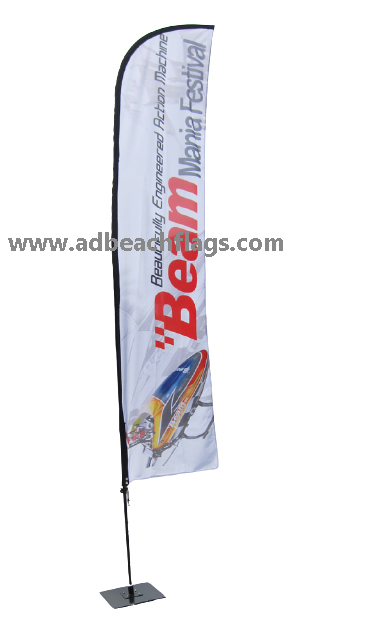
| 2.8 m | 60 x 200 cm feather | Pedestrians | Forecourt and walkway |
| 3.4 m | 60 x 240 cm feather | Hatchbacks | Entrance rows |
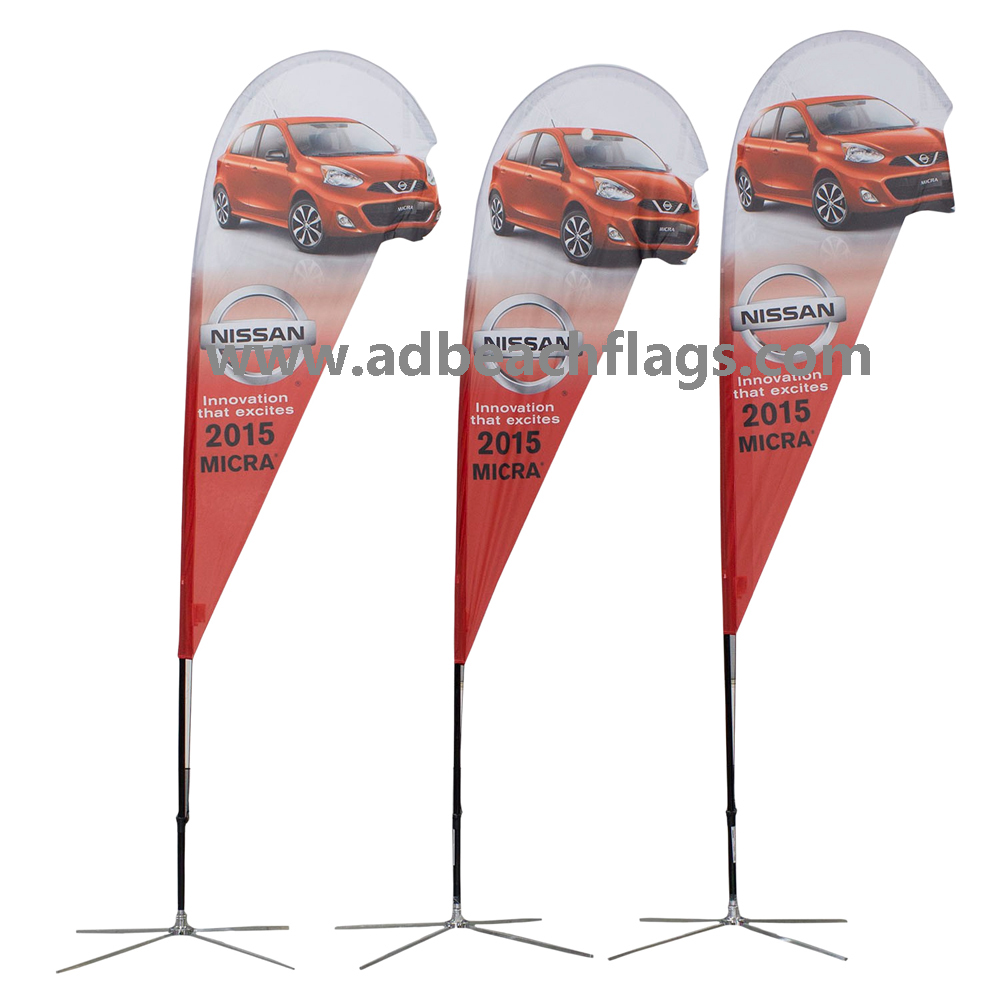
| 4.6 m | 70 x 290 cm feather or 110 x 260 cm teardrop | Vans and SUVs | Car-park rows |
| 5.6 m | 75 x 360 to 410 cm feather | Full park and fencing | Ring-road visibility |
The largest stock swooper kits reach about 4.6 m overall with a 3.38 x 0.83 m flag face (typical US retail kit). Above that, custom feather kits on 5.6 m poles are the factory standard for big-box furniture sites.
Supplier wind tests give the cleanest comparison we have found: a single-sided knitted polyester flag held to about 32 mph, Beaufort 6, without damage, while a three-layer double-sided flag, two printed faces with a blockout liner, failed the same test at force 3, roughly 8 to 12 mph.
1. Single-sided costs less, survives more wind, and shows a mirror image on the reverse, about 80 to 90 percent show-through, which reads fine for a bold one-word SALE.
2. Double-sided reads correctly both ways, costs about 25 to 30 percent more at factory level, and needs to come down earlier when the wind rises.
The decision rule for retail parks: one-way traffic flow or a fence line takes single-sided; island positions and two-way aisles take double-sided on the flags nearest the entrance, single on the far rows to keep the budget sane.
Retail park tarmac is a permission surface, not a free-for-all. Nobody drills the car park for a flag.
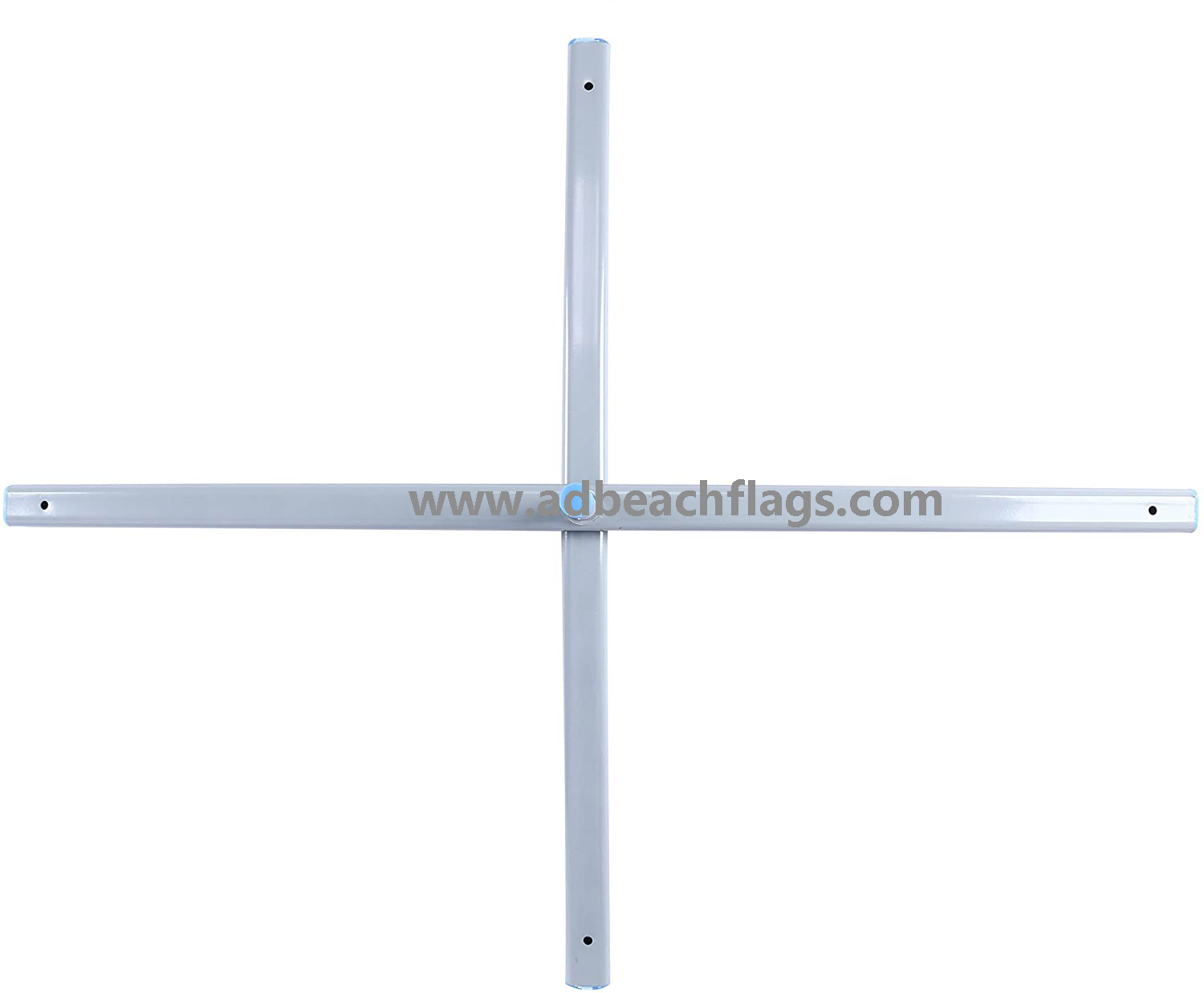
1. Cross base with water bag. Four folding steel arms, about 80 cm open on our build, weighing 1.25 to 1.45 kg, with a 10 to 12 litre water bag on top. Filled ballast around 10 to 12 kg. This is the default for tarmac and paving.
2. Metal plate base. 4 to 12 kg of flat steel for exposed corners and 4.6 m plus flags. No water, no leaks, no freeze risk.
3. Car tyre base. A steel bracket driven over by the vehicle. Common in US car culture, useful on parking rows where the landlord bans freestanding hardware.
4. Ground spikes stay on grass. If the store has a verge or a front lawn strip, the spike is the cheapest and most wind-secure option there. On tarmac it is simply not permitted.
Furniture promotions cluster into waves of 2 to 6 weeks, and a full year holds four to six of them. The calendar below is the one most retail buyers work from.
| Wave | UK and Ireland | United States |
|---|---|---|
| Late winter | January sales, Jan to Feb | Presidents Day, February |
| Spring | Easter and May bank holidays | Memorial Day, late May |
| Summer | Summer clearance, Jul to Aug | Labor Day, early Sep |
| Black Friday | Late Nov, with Boxing Day tail | Late Nov into Dec |
Each wave deserves its own skin, because a January SALE flag left up in March signals a store that has stopped trying. The hardware, poles and bases, carries over year after year.
Continuous outdoor life for dye-sublimated knitted polyester runs 6 to 12 months (typical), and budget inks can fade noticeably within 3 to 6 months of direct sun. Taking flags in overnight and in bad weather extends life by up to about 50 percent.
The practical cycle most retail buyers land on: order new skins per season, store them flat and dry between waves, and replace poles only when a section cracks, which is rare with basic care. A skin costs a fraction of a full kit, so the second campaign is always cheaper than the first.
1. One message per flag. SALE, SOFA EVENT, or the brand mark. Not all three.
2. Two or three flat colours, high contrast. Dark headline on light ground or the reverse. Gradients turn to mud at 40 m and under evening floodlight.
3. Size the headline to the distance, not to the file. At least 300 mm capitals for car-park reading, checked against the table above before the artwork is approved.
4. Word budget. One to two words for driver-facing flags, three to five for pedestrian flags.
5. Send vector files with a Pantone reference. We check the letters against the distance rule and return a proof, usually within one working day.
1. Letters sized for the sidewalk. The most common and most expensive error. Fix it at proof stage with the distance table.
2. Unballasted cross bases on tarmac. A cross base alone weighs under 2 kg. The first windy Saturday ends with the flag on a parked car. Always the water bag.
3. The same artwork all year. Faded, stale, and quietly telling shoppers the deals are old too.
4. Ordering three weeks before Black Friday with no freight buffer. Production runs 5 to 10 days after artwork approval, then express freight takes 3 to 7 days. Approve artwork by mid-October.
United Kingdom and Ireland. January sales and bank-holiday weekends drive the calendar. Landlords often cap the number of freestanding units per store, so ask before planning a twelve-flag run.
United States. Presidents Day, Memorial Day and Labor Day, plus the swooper tradition on car lots. Car tyre bases are widely accepted in parking rows.
Germany, Austria and Switzerland. Buyers ask for written specifications and flame-retardant documentation before ordering. Certificates are available on request, and hardware finishes are expected to look consistent across the park.
France and Belgium. Seasonal oriflamme kits are the familiar format, ordered per season with printed skins replaced each wave.
Australia and New Zealand. High UV means scheduling reprints sooner, every 4 to 6 months of continuous display, and mesh fabric is worth the premium on coastal parks.
| Item | Typical factory terms |
|---|---|
| Single-sided skin, 110gsm | USD 3.50 to 20 by size and quantity; one public tier example runs 11.80 at 2 pcs, 7.80 at 20 to 99, 3.50 at 500 plus |
| Full kit, flag, pole, base | From about USD 12.50 per kit at wholesale quantities (typical listing) |
| Double-sided upgrade | About 25 to 30 percent over single-sided |
| Samples | 2 to 3 days, colour swatch approved first |
| Bulk production | 5 to 10 days after artwork approval |
| Freight | Express 3 to 7 days; sea freight for large restocks |
Low MOQ accepted, wholesale from 5 pieces, so a single-store trial and a forty-park rollout use the same artwork pipeline. Shipping documents and HS code 6307.90 are provided with every order.
1. Indoor centres with a sign plan. If the centre management bans freestanding hardware, the budget belongs on hanging banners negotiated into the lease.
2. Campaigns built on legal copy. Finance terms and price exclusions belong on the window vinyl, where shoppers stand and read. Flags carry the headline only.
3. Parks that permit one totem. If the landlord allows a single entrance totem, no quantity of soft flags will be approved. Buy the totem graphics instead.
Q1. What letter size do we need to be read from a 40 mph approach road?
At 40 mph plan for roughly 100 m of legibility. That means 400 to 500 mm capitals for the headline, one word, on a 4.6 to 5.6 m flag. Confirm the exact sightline from the road before ordering.
Q2. Should a car-park flag be single or double sided?
Single-sided for one-way flows and fence lines, it holds to about 32 mph in supplier tests. Double-sided, about 25 to 30 percent more, for island positions where both directions read the flag, and bring it in above force 3 winds.
Q3. What base can we use on tarmac without landlord trouble?
A cross base with a 10 to 12 litre water bag, total ballast about 10 to 12 kg, or a 4 to 12 kg metal plate on exposed corners. Spikes are for grass verges only.
Q4. Will the print survive a full summer campaign?
Yes. Continuous outdoor life runs 6 to 12 months typical, and a 6 to 8 week summer wave is well inside it. Take the flags in overnight and they will still look fresh for the autumn wave.
Q5. What MOQ and lead time hit Black Friday?
Low MOQ accepted, wholesale from 5 pieces. Production runs 5 to 10 days after artwork approval plus 3 to 7 days express freight, so approve artwork by mid-October.
Q6. Can we reuse poles when the campaign changes?
Yes. Order replacement skins against the stored artwork. Poles and bases carry over for years with basic care, and the skin is the cheapest part of the kit.
| Point | Detail |
|---|---|
| Manufacturer, not a reseller | Flags, poles and bases produced in our own Foshan workshop, one fitting standard across the kit. |
| Colour you can hold us to | Pantone and RAL matching with swatch approval, so the January flag matches the December order. |
| Letter-size check on every proof | We measure headline height against your real viewing distance before printing, not after. |
| Fast sampling | Samples in 2 to 3 days, bulk in 5 to 10 days after artwork approval. |
| Low MOQ accepted | Trial run for one store, wholesale pricing from 5 pieces for the full park rollout. |
| Customer 5stars Feedback | Serving buyers in 150+ countries across Europe, the Americas, the Middle East, Africa and Oceania. |
Furniture sale flags earn their budget when three numbers agree: the letter height, the viewing distance and the pole height. Fix those at proof stage, put the right base under the flag for the surface, and refresh the skin each sale wave, and the same hardware sells January, Easter, summer and Black Friday for years.
Send us the store plan, the approach-road distance and the campaign calendar, and we will reply within 1 hour, 24×7, with a sized kit list and a factory price. Low MOQ accepted, and we will say plainly when a smaller kit does the same job.
Tell us the flag size, the quantity, single or double-sided, and the surface the flags will stand on. Our export team replies within 1 hour, 24×7, with an artwork proof and a factory price. Low MOQ accepted.
Chat on WhatsApp (+86 135 1661 0926) Email Us Now
Prefer a form? Fill in the details below and we will come back with a proof and a price within 1 hour, 24×7.
Related reading: Flag Base Guide | Beach Flag Size Guide | Advertising Flags for Car Dealerships | Customized Beach Flags | Feather Flags | Cross Bases | Water Bags | OEM / ODM Manufacturer
| Item | Detail |
|---|---|
| Product | Furniture sale flags and retail park flag kits |
| Manufacturer | BESDA Advertising Flags, Foshan, Guangdong, China |
| Reading distance rule | 25 mm of capital letter height per 3 m viewing distance for comfortable reading |
| Sizes | Feather 60×200 to 75×410 cm on 280 to 560 cm poles; teardrop 75×165 to 130×330 cm |
| Fabric | 110gsm knitted polyester, dye sublimation; mesh for coastal parks |
| Wind data | Single-sided tested to about 32 mph; double-sided to force 3, roughly 8 to 12 mph |
| Bases for tarmac | Cross base 1.25 to 1.45 kg with 10 to 12 L water bag; metal plates 4 to 12 kg; car tyre base |
| Campaign calendar | January sales, bank holidays, summer clearance, Black Friday; waves of 2 to 6 weeks |
| MOQ and lead time | Low MOQ accepted; samples 2 to 3 days, bulk 5 to 10 days after artwork approval |
| Contact | WhatsApp +86 135 1661 0926, [email protected], reply within 1 hour 24×7 |