Phone: 0086-757-8938 9313
WhatsApp: +86 135 1661 0926
Email: [email protected]
Address: Caochang Industrial Zone, Lishui, Nanhai, Foshan, Guangdong, China
24/7 Online Services
Phone: 0086-757-8938 9313
WhatsApp: +86 135 1661 0926
Email: [email protected]
Address: Caochang Industrial Zone, Lishui, Nanhai, Foshan, Guangdong, China
24/7 Online Services

A used-car manager in Texas had a row of cross bases on his asphalt lot, and every spring gust turned one of them into a lesson. One base tipped in a squall and its pole knuckle kissed a customer’s door panel. The insurance call cost more than the whole flag program, and the quote we sent the next week was for tyre base flags instead: a steel base that slides under a vehicle wheel and borrows the car’s weight as the anchor. Nothing on the lot staked, nothing glued, and the flags stopped falling over.
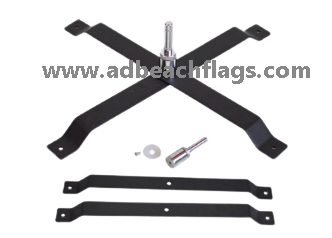
The short answer for buyers: a tyre base is a powder-coated steel bracket, typically V shaped or U shaped, that a vehicle parks on top of. The base itself weighs only about 2 to 6 kg, but the vehicle above it weighs roughly 4,000 lbs, which is why suppliers describe the setup with the line every buyer remembers: it will not blow over while the car is there. Pole sockets take the standard 16 to 19 mm beach flag poles, and folding versions pack flat so one carton ships a row of displays.
This guide is written for car dealership groups, tire and service shops, driving schools, RV and boat dealers, equipment rental yards, event crews and wholesale distributors who buy bases by the hundred. Every figure is a typical range from supplier listings and platform snapshots taken in October 2026, and our quotes state steel gauge, coating and socket fit as written lines.
The product family splits into three forms, and the form decides how you place it each morning.
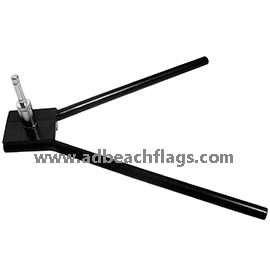
1. V shape, slide-under. A long steel channel whose open mouth accepts a tire pushed or driven into it. Placement takes seconds and the flag stands either ahead of or behind the wheel line.
2. U shape, drive-over. A closed loop with a socket on one arm. The driver rolls the wheel over the near arm so the tire sits inside the loop. This is the classic 16 inch steel drive-over base sold across the United States dealership supply market.
3. Folding scissor. A hinged frame that opens flat and folds to about 20 by 58 cm for transport. Fleets and event crews carry these in a crate because a dozen flat bases stack into one carton.
All three share the same job: turn a parked vehicle into the ballast. Suppliers describe fit as universal for passenger cars, SUVs and light trucks, and the honest measure is not a wheel-inch figure but the unfolded width, which typically runs 50 to 90 cm with folding versions near 58 to 60 cm.
Compare the numbers and the product explains itself. A ground spike holds by soil grip, a cross base holds by its own 2 to 4.5 kg plus whatever water bag you fill, and a weighted plate holds by dead mass. A tyre base holds by whatever parks on it. A compact sedan contributes around 2,800 lbs, a full-size truck 5,000 or more, and the trade shorthand for the class is a 4,000 lb anchor. No portable base in the flag trade carries that figure, which is why dealership lots, where flags stand between cars all day in open wind, converged on this solution.
The same physics writes the limitation, and we put it in every quote: the anchor exists only while the vehicle is there. On a lot where cars sell and drive away, either the flag moves with the vehicle’s departure schedule or the base needs its own plan for the gap. More on that in the honest section below.
| Item | Typical specification | Buyer note |
|---|---|---|
| Unfolded width | 50 to 90 cm; folding versions near 58 to 60 cm | Measure the wheel arch before ordering for wide SUV tires |
| Self weight | 2 to 2.3 kg folding, up to about 6 kg heavy steel | Light is fine; the tire is the ballast |
| Material and finish | Steel tube and angle iron, powder coated; galvanised variants exist | Full welds beat spot welds on multi-year lots |
| Pole socket | 16 to 19 mm spindle class, custom spindles to 14.6 or 17 mm | Match your pole diameter; swooper kits can run thicker sleeves |
| Rotation | Optional rotating spindle so the flag squares to the wind | Worth it on exposed corners of the lot |
| Packing | Folds flat to about 20 by 58 cm; a carton stacks a fleet | Freight maths favours folding forms at quantity |
One more spec hides in plain sight: weld quality. Retail listings in the United States market advertise full line welds against spot welds, because a base that lives under a moving vehicle takes side loads a table-top display never sees. Ask which weld the quote prices.
1. Place the base. Set the folded or open base flat where the flag should stand, socket upright, on the parking surface the vehicle will occupy.
2. Roll the wheel on. The driver parks normally; the tire slides into the V mouth or rolls over the U arm. No stake, no drill, no sandbag, and the whole operation is a ten second job folded into the parking routine.
3. Plant the pole. Drop the sectional pole into the socket, fit the skin, done. Moving the display later is the same loop in reverse: pull the pole, drive the car away, relocate.
The base decision is a ground decision, so here is the four-way comparison our own base guide uses, with the trade’s typical weight bands filled in.
| Base | Self weight or ballast | Ground it suits | Honest limit |
|---|---|---|---|
| Tyre / drive-over | 2 to 6 kg plus the vehicle, about 4,000 lbs class | Any surface a car parks on: asphalt, concrete, pavers | Needs a vehicle; flag leans when the car leaves |
| Cross base | 1.3 to 4.5 kg; water bag adds about 9 to 12 kg filled | Flat hard ground, indoor floors with a pad | Unweighted it tips in open-site gusts |
| Ground spike | 0.7 to 1.4 kg steel stake | Grass, soil, sand only | Useless on asphalt and concrete |
| Weighted plate or water tank | Plate 6 to 10 kg; tanks 15 to 30 kg filled | Hard ground where no vehicle parks | Heavy to move; tanks freeze or crack in frost |
Read the table as a decision tree. Grass gets a spike. Paved ground with no car gets a cross base with a filled water bag or a plate. Paved ground with cars parked on it gets the tyre base, because nothing else borrows 4,000 lbs for free.
1. Dealership rows. One flag per featured car down the line, repositioned every morning with the display plan, no ground fixings to argue about with the property manager.
2. Tire and service shops. The base survives the traffic it advertises to, because every car that rolls over it is a customer.
3. Car washes. Lane direction and membership promos stand where tires run all day, and powder coating handles the wet environment.
4. Driving schools. Course markers on a training pad where staking is banned; the instructor’s own car anchors each flag.
5. RV, boat and machinery dealers. Big tires hold big flags; heavy-vehicle versions take wider arches and thicker poles.
6. Convoys and parking-lot promotions. Event crews fold a dozen bases into one crate and anchor flags wherever the fleet parks.
7. Depot and campus entrances. Temporary guidance that the security gate car will hold down during the event and release after.
8. Tailgating and mobile retail. The consumer version of the same physics: park, slide the base, raise the flag, sell.
| Buy point | What you get | Notes |
|---|---|---|
| China factory wholesale | Steel grade, weld type and coating written on the quote; sockets made to your pole | MOQ around 100 typical; samples ship separately for fit testing |
| US retail supply | The 16 inch drive-over form off the shelf | Dealership supply houses stock it as a standard SKU |
| Freight planning | Folding packs flat; a carton about 49 by 46 by 17 cm carries a batch | A pallet of folded bases is a dense, light shipment |
For wholesale buyers the logic is the category’s pitch: bases ordered with the season’s skins consolidate freight, and the tyre base is the one flag accessory a dealership always reorders, because bases walk off with trade-ins and get borrowed by the service lane.
Powder coat is the working finish: it shrugs off tire contact, oil drips and a season of sun. Three habits stretch the life of a fleet. Keep bases out of the main wheel ruts where vehicles track across them daily at speed, because constant rolling wears any coating. Hose the road film off monthly in winter-salted regions, since brine works on steel through every scratch. And when a socket wall wears loose after years of pole changes, retire the base rather than shim the pole; a wobbling spindle chews pole sections, and poles cost more than bases.
United States and Canada. The home market. Dealership supply catalogs carry the 16 inch drive-over form as a standard SKU, tire and wash franchises buy by the dozen, and the phrase tire base or drive-over base is the search language. Wind ratings matter less here than base physics; the car is the rating.
United Kingdom and Ireland. Buyers say tyre base or wheel base and often pair one base per entrance flag on forecourts where planning rules discourage staking. Metric pocket and spindle talk applies.
Germany and Austria. The product appears under Reifen and drive-over descriptions in dealer supply, and procurement wants steel grade and coating written on the line. Our quotes carry both.
Australia and New Zealand. Car yards and caravan dealers run the same pattern, with UV on the skins as the bigger enemy than wind. Bases ship dense on the long sea lane, so consolidate with skins.
Middle East and Gulf. Showroom forecourts with polished interlock paving forbid staking entirely, which makes the drive-over form the default. Air freight 5 to 8 days covers the short lead times the market expects.
1. Expecting the base to hold without the car. Two to six kilograms of steel is not an anchor. If the display spot outlives the vehicle, plan a plate or water ballast for the gap hours.
2. Buying sockets that ignore the pole fleet. A 16 mm socket against 19 mm poles chews both. State the pole diameter on the order; we match the spindle.
3. Placing bases in the fast lane of the lot. A base in the drive path takes rolling hits all day. Park-row edges and display noses are its habitat.
4. Forgetting the rotating spindle on exposed corners. A fixed socket forces the flag to fight a crosswind; a spindle lets it square up. The part costs little and saves skins.
5. Stacking new bases on rusted ones in the crate. Fleets that sort and retire worn bases keep the rest honest; a seized socket found on install morning costs a display slot.
Honest guidance, because an anchor without its vehicle is a tripping hazard with a flag on top.
1. No vehicle, no anchor. Sidewalks, trade show floors, grass parks and plazas where nothing parks: the tyre base is the wrong tool. Cross base with ballast or a spike does the job.
2. Cars that sell hourly. On a fast lot the flag falls every time a car leaves. Either assign bases to the striping, not the stock, or run ballasted bases in the gaps.
3. Unattended high-wind sites. A base waiting for a car that arrives tomorrow holds nothing in tonight’s gale. Exposed corners overnight want ballast or a strike routine.
4. Grass and gravel. The frame rocks on soft ground and the pole leans. A spike anchors soil better than any steel frame lying on it.
5. Dually wheels and wide arches. Standard widths may not clear heavy truck fits. Measure and order the wide version rather than forcing the frame.
Send the vehicle mix, the pole diameter and the quantity, and the quote returns the same working day with steel spec, coating, weld type and socket fit as written lines. Samples for fit testing ship in 2 to 3 days, bulk runs 5 to 10 days for typical quantities, and Low MOQ accepted, wholesale from 5+ pieces, lets a single dealership group order for all its sites in one shipment. Payment runs 30 to 50 percent deposit with the balance against shipping evidence, and the packed load goes out with a photo set, so the pallet you paid for is the pallet that lands. Freight runs 3 to 7 days express, 5 to 8 air, 25 to 40 sea; bases pack dense, so most buyers let them ride the sea lane with the season’s skins.
Q1. What is a tyre base flag?
A flag whose base is a steel bracket parked on by a vehicle. The car’s weight, thousands of pounds of it, anchors the pole, so the flag stands on asphalt or concrete where spikes cannot go and cross bases can tip.
Q2. How do you display flags on asphalt without drilling?
Three options: a cross base weighted with a filled water bag, a heavy plate, or a tyre base under a vehicle wheel. On lots where cars park all day, the tyre base is the strongest anchor and the fastest to move.
Q3. Will a tyre base flag blow over in high wind?
Not while the vehicle sits on it; suppliers describe the anchor in the thousands of pounds. When the car leaves, the bare base carries only its own 2 to 6 kg, so plan gaps and overnight wind like any portable base.
Q4. What size pole fits a car tyre flag base?
The standard beach flag spindle class is 16 to 19 mm, with custom spindles made to 14.6 or 17 mm. Swooper hardware sometimes runs thicker sleeves, so state your pole diameter on the order.
Q5. Do tyre bases damage wheels or paint?
The frame contacts the tire, not the rim, and powder-coated steel with clean edges is the trade finish. Fleet buyers add a foam sleeve on the pole where it meets the socket, and we supply that on request.
Q6. Can a tyre base go on grass or gravel?
It is the wrong tool there. The frame rocks on soft ground and the pole leans. Use a ground spike in soil, grass and sand, and save the tyre base for the paved ground it was built for.
| Point | Detail |
|---|---|
| Manufacturer, not reseller | Bases weld and coat beside our pole and skin lines in Foshan, so socket and pole fit is engineered, not hoped. |
| Written steel and weld spec | Gauge, coating and full-line welds appear on the quote, so fleet orders compare like with like. |
| Spindle match on request | Sockets made to your pole diameter, rotating spindles available for exposed corners. |
| Low MOQ accepted | Wholesale from 5+ pieces, mixed bases and skins consolidated in one shipment. |
| Photo QC before sealing | Every packed load photographed, so the fleet that ships is the fleet you counted. |
| Reply in 1 hour, 24×7 | WhatsApp +86 135 1661 0926 or [email protected]; programs we ship serve buyers in 150+ countries. |
A tyre base flag is the only portable display that borrows a 4,000 lb anchor for free, and that is the entire pitch. Put it where cars park, match the socket to the pole, keep it out of the fast ruts, and plan for the hours when the car drives away. Nothing staked, nothing glued, nothing tipping into a customer’s door. Send us the vehicle mix and the pole spec, and we reply in 1 hour, 24×7, with a written quote and a fit-test sample. If your display spots outlive their vehicles, we will say so and quote the ballasted alternative instead.
Tell us the flag sizes, the quantities, single or double-sided, and the ground the flags will stand on. Our export team replies within 1 hour, 24×7, with a proof and a factory price. Low MOQ accepted.
Chat on WhatsApp (+86 135 1661 0926) Email Us Now
Prefer a form? Fill in the details below and we will come back with a proof and a price within 1 hour, 24×7.
Related reading: Cross base sizes explained: 60cm, 72cm, 80cm | Water bag vs water tank: ballast maths for windy sites | Flag base guide: pick the base by surface | Advertising flags for car dealerships | Car tyre bases | Heavy cross bases | Spike base stands | Custom feather flags | Water bags | Swooper flags: half sleeve vs windless in dead calm air
| Item | Detail |
|---|---|
| Product | Tyre base flags: V, U and folding scissor steel drive-over bases that anchor flags with a parked vehicle’s weight |
| Manufacturer | BESDA Advertising Flags, Foshan, Guangdong, China |
| Anchor physics | Base self weight 2-6 kg; effective anchor is the vehicle above, about 4,000 lbs class |
| Typical dimensions | Unfolded width 50-90 cm; folding versions pack to about 20 x 58 cm |
| Pole fit | 16-19 mm spindle class standard, custom spindles to 14.6 or 17 mm; rotating spindle option |
| Material and finish | Steel tube and angle iron, powder coated; galvanised variants; full-line welds on quoted grades |
| Packing and freight | Folding forms stack flat; a carton about 49 x 46 x 17 cm ships a batch; pallet-friendly at fleet quantities |
| Lead times | Sample 2-3 days; bulk 5-10 days; express 3-7 days, air 5-8, sea 25-40 |
| MOQ | Low MOQ accepted, wholesale from 5+ pieces; fleet quantities on the sea lane |
| Contact | WhatsApp +86 135 1661 0926, [email protected], reply in 1 hour 24×7 |