Phone: 0086-757-8938 9313
WhatsApp: +86 135 1661 0926
Email: raya@besda.net
Address: Caochang Industrial Zone, Lishui, Nanhai, Foshan, Guangdong, China
24/7 Online Services
Phone: 0086-757-8938 9313
WhatsApp: +86 135 1661 0926
Email: raya@besda.net
Address: Caochang Industrial Zone, Lishui, Nanhai, Foshan, Guangdong, China
24/7 Online Services

A car dealership in Leeds called us on a Monday morning about a flag lying flat across its forecourt. The 4.5 m feather flag had stood fine all week, then a gust line came through on Sunday and the cross base slid a metre with its 3 gallon water bag still attached. Nothing ripped. The pole was straight. The base simply lost the argument with the wind, because the bag held 11 kg of water and the gust asked for more than that. This article puts real numbers on that argument: what each ballast option weighs, what force a flag catches at a given wind speed, and where the honest cutoff sits between a water bag, a water tank and taking the flag down.
The short answer: a round water bag holding 10 to 16 litres suits flags up to about 3.6 m in moderate, sheltered sites, while a 15 to 30 litre tank earns its bulk on exposed pavement and on flags of 4.5 m and above. If your flags fly daily through winter, or your site is an open parking lot, start from the tank. If you carry kits to different venues every week, start from the bag. The rest of this page shows the working, so you can check our maths against your own site.
This guide is written for event companies, rental fleets and distributors who choose hardware for other people’s sites. If you fly one small flag indoors, ballast hardly matters and a simple cross base or a rubber mat is the whole story.
1. A site manager picks ballast by habit, not by site. The same 3 gallon bag gets fitted whether the flag stands in a sheltered courtyard or a coastal parking lot, because the bag came in the kit and the kit has always looked like that.
2. Nobody on site knows what the flag actually catches. A 3.4 m flag presents roughly 2.8 square metres of fabric. At 25 mph that area catches force in the tens of pounds, a number that surprises most crews the first time they see it written down.
3. The spec sheet lists a capacity, not a wind rating. “3 gallon water bag” tells you what it holds, not what it holds down, so the buyer cannot compare a bag against a tank except by feel.
4. The crew compensates by improvising. Sandbags get stacked on top, the base gets shifted against a kerb, or the flag gets lowered “when it looks bad”, which is exactly when whoever noticed it has usually gone home.
5. The consequence lands as damage or downtime. A sliding base scuffs pavement, snaps a finial, or drops the flag into a car park entrance. Rental fleets eat replacement poles; brands eat a visible failure in front of customers.
6. The decision this article settles: pick bag, tank or takedown by wind exposure and flag area, using the force table below, and write that choice into the kit standard so site crews stop guessing.
Both are ballast, and both are water, but they solve different problems.
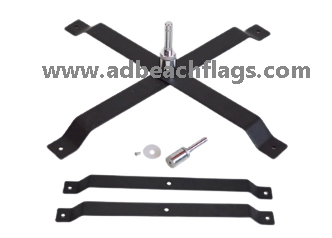
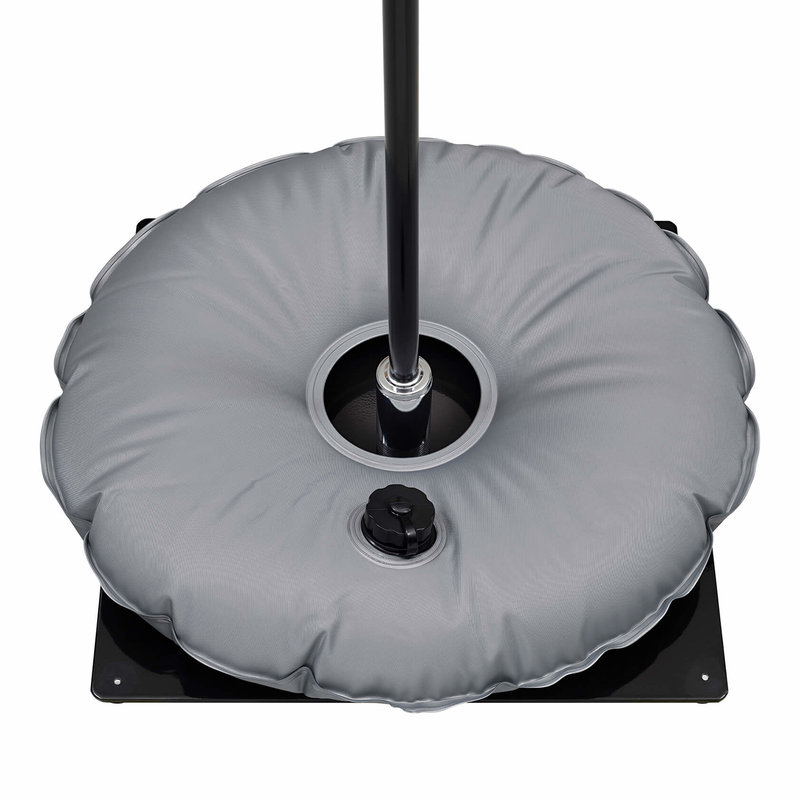
1. The water bag is a ring. A round or donut shaped PVC bag, typically 10 to 12 litres in factory kits and up to 4.25 gallons (about 16 litres) in US retail versions, slides over the pole and sits on a cross base. Filled, a 10 to 12 litre ring adds roughly 10 to 12 kg; the bigger US rings reach 22 to 35 lbs. The bag hugs the base, adds weight low down, and folds flat for transport, which is why it ships inside the kit bag.
2. The water tank is a block. An upright moulded tank, typically 15 to 30 litres, stands on the ground with the pole socketed into its centre. Filled weights run from about 16 kg (15 litre UK style) to around 30 kg; heavy versions reach 67 lbs. Because the tank is a rigid body with a wide footprint, it resists tipping as well as sliding, and many accept a rotating pole head that lets the flag weathervane.
3. There is a third option that costs nothing. A ground spike beats any ballast where soil allows, because a spike does not slide, it anchors. The bag and tank only enter the picture when the surface is pavement, deck or tile.
Wind force on a flat area follows a public formula used across the sign and tent industries: force in pounds equals 0.00256 times wind speed squared, times area in square feet. It is the simplified form of the ASCE 7 wind pressure equation. Flags are flexible, so real force swings lower than a rigid panel of the same size, and engineers add a drag factor near 1.2 to compensate. Treat the results as honest ballparks, not laboratory values.
| Flag size | Fabric area | Force at 15 mph | Force at 25 mph | Force at 30 mph |
|---|---|---|---|---|
| Small teardrop, 2.2 m pole | about 21 sq ft | 12 lbs | 34 lbs | 48 lbs |
| Medium feather, 3.4 m pole | about 30 sq ft | 17 lbs | 48 lbs | 69 lbs |
| Large flag, 5 m pole | about 45 sq ft | 26 lbs | 72 lbs | 104 lbs |
Read the table against what ballast actually weighs. A 10 to 12 litre bag adds about 22 to 26 lbs to a cross base that itself weighs 3 to 10 lbs, so the completed assembly holds roughly 25 to 35 lbs of resistance. That covers a medium flag at 15 mph with margin, and it is already marginal at 25 mph. A 30 litre tank at about 67 lbs carries the same medium flag through 30 mph gusts on paper, and carries a 5 m flag to about 25 mph. Beyond that line, no portable ballast makes sense: the flag comes down.
Two adjustments move the numbers. Fill with sand instead of water and the same bag weighs about 1.6 times more, because sand is denser; a 10 litre bag goes from 22 lbs to about 35 lbs. Place the ballast on the windward side of the base rather than centred, and the same weight resists a longer lever of gust. Site crews rarely do either, which is why the numbers above are the safe version.
| Factor | Water bag on cross base | Water tank |
|---|---|---|
| Filled weight | 22 to 35 lbs (10 to 16 L) | 33 to 67 lbs (15 to 30 L) |
| Best flag range | 2.2 to 3.6 m, single sided | 3.4 to 5.6 m, single or double sided |
| Transport | Folds flat, rides in the kit bag | Bulky even empty, one per carton |
| Fill on site | Any tap or bottle; minutes | Needs a real water source and time |
| Failure mode | Slides on smooth pavement when underfilled | Tips on slopes; rigid body cracks if thrown |
| Factory price band | about $3 to 8 per bag at trade volume | about $6 to 15 per tank at trade volume |
| Pick it when | Kits travel weekly; sites are sheltered | Flags stand for weeks on exposed hard ground |
Price bands above reflect typical factory ranges for welded PVC bags and moulded PE tanks at trade quantities, and we confirm current pricing per order in writing. Retail prices for the same hardware run three to five times higher.
The surface decides more than the wind does. This is the table we walk through with rental fleets.
| Surface | First choice | Why, and the backup |
|---|---|---|
| Grass, soil, sand | Ground spike | Anchors instead of weighing; add a bag only in soft sand |
| Paving, plaza, calm site | Cross base plus water bag | Bag rides the base; step up to a tank if gusts funnel between buildings |
| Asphalt parking lot | Tyre base, or cross base plus bag | Spike is banned on asphalt; a car parks onto the tyre frame for hold down |
| Open exposed forecourt | Water tank, 20 to 30 L | Weight wins over friction; offset a bag windward as a second line |
| Indoor floor | Cross base alone, or flat plate | No water indoors; a rubber mat protects tile and stops creep |

Ballast fails at its seams and its fittings, not at its capacity. These are the checks we hold our own bags and tanks to, and the questions worth asking any supplier.
1. Welded seams, tested filled. Bag seams are heat welded, and every batch gets a 24 hour filled test on sample units before shipment. A bag that weeps at the weld in week two loses the trust the whole kit was sold on.
2. Cap and gasket, not just a plug. The fill cap needs a sealing gasket and a strap so it cannot wander off at a festival. It is a $0.20 part that decides whether the bag is refillable in year two.
3. Fabric class written down. Bag fabric sits in the 400 to 500D PVC coated tarpaulin class in our production, and the specification goes on the quotation, not just on the sample. If a quote says “heavy duty” without a denier and coating weight, ask for the number.
4. Packed dry and flat. Bags ship empty and folded with cardboard separators; tanks ship one per carton with the cap taped. A bag creased wet, or a tank crushed under a cross base, arrives as a claim instead of a sale.
5. Approval before bulk. For custom sizes or printed bags, a pre-production sample goes out in 2 to 3 days, and bulk starts only after written approval. Orders run on 30 to 50 percent deposit with the balance against shipping evidence, so the risk of paying for a container of leaky bags is not yours to carry alone.
We would rather lose an order than watch a flag fail in a place we approved.
1. Sustained winds near 20 mph and above. Industry practice treats about 18 to 20 mph as the working limit for single sided flags on portable ballast, and gustier sites come down earlier. No tank fixes a flag that should be lowered; the hardware only buys margin, not immunity.
2. Large sails on light bases. A 5 m flag catching 72 lbs at 25 mph will defeat a bag and embarrass a small tank. That order goes to a tank pair, a ground anchor, or a different product.
3. Short indoor events. Paying for tanks for a two day mall activation wastes freight and floor space. A plain cross base with a mat does the job at a third of the price, and we will quote it that way.
4. No water on site. A tank that cannot be filled is furniture. Dry ballast plates or sand filled bags solve sites without taps, and they are worth asking for at quotation stage.
1. Underfilling for transport convenience. A half filled bag weighs half as much and slides twice as easily. Either fill it or leave it off.
2. Ignoring the freeze. A full bag left out through a frost night can split its weld as the water expands. Drain before a freeze, refill after.
3. Bag on rough asphalt. Fresh asphalt with exposed aggregate chews thin PVC. A ground cloth under the bag costs pennies and doubles its life.
4. One bag for a double sided flag. A double sided flag weighs more, catches more, and drops faster. Double the ballast, not just the artwork.
5. Forgetting the offset. Ballast centred under the pole is the weakest arrangement in a gust. Slide it windward and the same weight works harder.
United States and Canada. Bags sell by the gallon, 3 gallons being the common ring size, and parking lot duty pushes buyers toward tyre frames with a car as the anchor. Confirm ballast in writing for wind-exposed coastal sites.
United Kingdom and Ireland. The 15 litre tank is the familiar shape, and water and sand filled dual-use bases are the best sellers at UK flag specialists. Pavement permits in some councils restrict spiked hardware, which pushes everything onto ballast.
Australia and New Zealand. Coastal wind is the baseline assumption. Rental fleets standardise on heavier tanks and pair them with mesh flags that shed load, then take flags down on forecast gust days as routine practice.
Gulf and Middle East. Heat is the quiet variable: a filled bag in 45 degree sun warms and softens, and evaporation drops the waterline over a standing week. Refill on a schedule and store bags shaded between events.
Latin America. Beach and street activation crews fill with what is on site, and sand fill is routine. Bags get dragged across sand and cobble, so a thicker base fabric earns its cost within a season.
| Feature | Advantage | Benefit you feel |
|---|---|---|
| 10-16 L ring bag, welded PVC | 22 to 35 lbs low on the base | Flags stay planted on pavement through a normal working day |
| Folds flat for the kit bag | Whole kit ships and carries as one unit | Crews set up in minutes and nothing gets left behind |
| 15-30 L tank option | Up to 67 lbs of hold down with a wide footprint | 4.5 m and 5 m flags stand on exposed sites without hourly checks |
| Sand-fill capable | About 1.6 times the weight of water, same bag | One bag covers both the calm site and the windy one |
| Batch fill-tested | Seams proven before shipping | No week-two leaks, no claims, no red-faced site visits |
Q1. How much weight do I need to hold down a feather flag?
Match the weight to wind and area. A 3.4 m flag on about 30 square feet catches roughly 17 lbs of force at 15 mph and 48 lbs at 25 mph, so a cross base with a filled bag, around 25 to 35 lbs combined, covers calm to moderate sites, while exposed sites and taller flags move to a 60 lb class tank.
Q2. How much water does a flag base water bag hold?
Factory ring bags commonly hold 10 to 12 litres, and US retail versions run 1 to 4.25 gallons, with 3 gallons the popular size. Filled, that is 22 to 35 lbs per bag.
Q3. Can I put sand in a water bag instead of water?
Yes. Sand weighs about 1.6 times as much as water for the same volume, so a bag filled with sand holds down more. The trade-offs are filling mess and faster wear on rough ground, so use a ground cloth and empty the bag before transport.
Q4. What wind speed is too much for feather flags?
Industry practice treats sustained gusts around 18 to 20 mph as the point to lower single sided flags, and double sided flags earlier because they catch more. Ballast buys margin at the margin; above the line, take them down.
Q5. Can you use a spike base on asphalt or concrete?
No. A spike needs soil. On hard standing use a cross base with a water bag, a water tank, or a tyre base that a vehicle parks onto.
Q6. Do water bags fit all cross bases?
Not always. The ring slides over the pole collar and sits on the base arms, so collar and bearing diameters matter. Our bags fit our cross bases out of the box, and we cut custom inner diameters for other poles on request.
| Point | Detail |
|---|---|
| Manufacturer, not reseller | Bags, tanks, poles and flags are welded, moulded and printed in our Foshan works, so ballast questions reach the people who build the tooling. |
| Specification discipline | Capacity, fabric class, cap type and fit diameters are written on the quotation, so what you approved is what ships. |
| Fill-tested batches | Sample units from every bag batch hold water for 24 hours before packing, with photo records on request. |
| Fit honesty | If your pole or base needs a different collar diameter, we say so before quoting instead of shipping a ring that will not seat. |
| Low MOQ accepted | Wholesale from 5+ pieces, so a fleet trial does not need a container. |
| Reply in 1 hour, 24×7 | WhatsApp +86 135 1661 0926 or [email protected], with sizes, ballast advice and factory pricing the same day. |
A water bag is the travelling answer and a water tank is the standing answer, and the wind picks between them with a formula anyone can check. Size the ballast to the flag area, place it windward, fill it properly, and write the takedown speed on the kit card. Do those four things and the Monday morning phone call about a flat flag goes quiet.
Tell us your flag height, the surface and the site’s wind exposure, and we reply in 1 hour, 24×7, with the ballast spec, a packing plan and factory pricing. Low MOQ accepted, sampling in 2 to 3 days, and honest advice when the site needs something we do not sell.
Tell us the flag size, the quantity, single or double-sided, and the surface the flags will stand on. Our export team replies within 1 hour, 24×7, with an artwork proof and a factory price. Low MOQ accepted.
Chat on WhatsApp (+86 135 1661 0926) Email Us Now
Prefer a form? Fill in the details below and we will come back with a proof and a price within 1 hour, 24×7.
Related reading: Cross base sizes explained: match the base to your pole | Flag safety in wind: when to take flags down | Flag base guide: pick the right base for every surface | Heavy cross bases | Water bags | All flag bases | Why choose our factory
| Item | Detail |
|---|---|
| Product | Water bag and water tank ballast for feather flag, teardrop flag and cross base kits |
| Manufacturer | BESDA Advertising Flags, Foshan, Guangdong, China |
| Water bag | 10-12 L ring bags standard, up to 16 L custom; welded PVC tarpaulin 400-500D class; sand-fill capable |
| Water tank | 15-30 L typical factory range; filled weights about 16-30 kg; rotator head options |
| Ballast rule | Cross base + water bag suits flags up to about 3.6 m in moderate wind; 4.5 m and above move to tanks or ground spike in soil |
| Wind guidance | Industry practice lowers single sided flags near 18-20 mph gusts; ballast buys margin, not immunity |
| MOQ & pricing | Low MOQ accepted; wholesale from 5+ pieces; factory price bands confirmed per order in writing |
| Lead times | Sampling 2-3 days; bulk 5-10 days after written approval; express 3-7 days, air 5-8, sea 25-40 |
| Quality gate | 24-hour fill test on sample units per batch; packing photos before shipment |
| Contact | WhatsApp +86 135 1661 0926, [email protected], reply in 1 hour 24×7 |