Phone: 0086-757-8938 9313
WhatsApp: +86 135 1661 0926
Email: [email protected]
Address: Caochang Industrial Zone, Lishui, Nanhai, Foshan, Guangdong, China
24/7 Online Services
Phone: 0086-757-8938 9313
WhatsApp: +86 135 1661 0926
Email: [email protected]
Address: Caochang Industrial Zone, Lishui, Nanhai, Foshan, Guangdong, China
24/7 Online Services

Trade show flags are the cheapest way to be seen across a hall, and the fastest way to get a visit from the venue floor manager. The difference is rarely the design. It is two numbers: the height limit in the exhibitor manual, and the distance from which a buyer can actually read the flag.
This guide is for exhibitors, stand builders, event agencies and distributors who plan booth signage before the show. It covers the venue rules that decide flag height, the sightline maths that decide message length, the base choices for carpet and concrete, and a six-week order calendar that leaves room for freight.
Figures here are typical ranges from venue manuals, supplier specifications and our workshop records in October 2026. Every venue publishes its own rules, and the exhibitor manual always wins over a blog post, including this one.
A backdrop owns the booth. A flag owns the aisle. That is the division of labour, and it explains why flags work at exhibitions even when every stand has a large printed wall.
1. Height. A 3.4 to 5.6 m flag rises above the crowd, the monitors and the queue. From forty metres away, most of a booth is hidden behind people. The top third of a tall flag is not.
2. Motion. A flag moves with the air handling in the hall. Motion catches the eye before text does, which is why a flag often pulls a glance that a static panel misses.
3. Wayfinding. Two flags at the aisle corners mark the booth boundary better than a floor sticker. Buyers who are looking for a stand number find the flags first.
4. Reuse. The poles and bases survive the show. The skins can be replaced for the next event, which makes the flag the part of the stand that improves with each season.
Exhibition halls are governed by height, rigging, aisle and fire rules. A flag plan that ignores them is a plan for a conversation with the floor manager.
| Rule | Typical requirement | What it means for flags |
|---|---|---|
| Stand height, inline | Often 2.4 to 2.5 m (8 ft) to the top of the structure | A 3.4 m flag exceeds it; check whether portable flags count as structure |
| Stand height, island | Often 4 to 6 m (13 to 20 ft), with rigging approval | A 4.5 to 5.6 m flag fits the space, not necessarily the rule |
| Aisle clearance | Usually 2 to 3 m clear, no trip hazards | Bases and ballast must sit inside the stand line |
| Rigging and hanging | Often prohibited without approval and certified hardware | A portable flag avoids rigging, which is its main advantage |
| Fire treatment | NFPA 701 in the US, DIN 4102 B1 or EN 13501 in Europe | Ask for documents before the show, not at the loading dock |
| Floor loading | Raised floors and carpets have limits | A 15 kg plate on a raised floor needs a spreader board |
The practical rule: read the exhibitor manual for the hall, then measure the stand. A flag that is legal in one hall can be a violation in the next, even with the same booth size.
Booth signage has a reading distance problem. A buyer in the aisle is often 10 to 30 metres away, and the first two metres of the booth are filled with people, counters and screens. The flag has to carry the message above that layer.
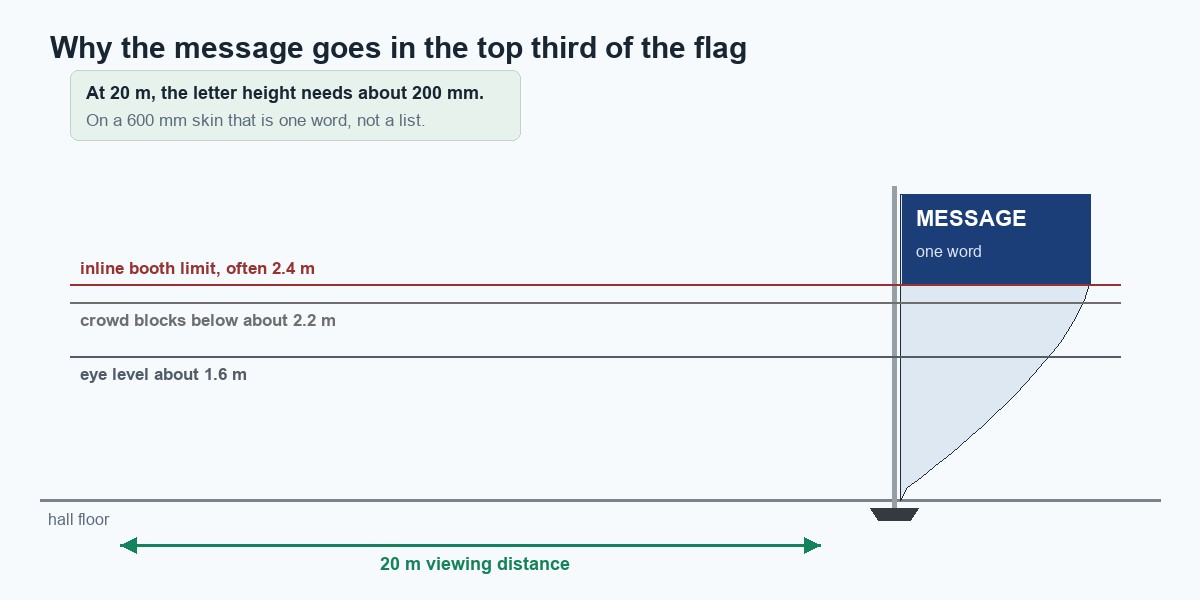
The trade rule for letter height is about one inch per 30 feet of maximum viewing distance, or one centimetre per metre. At 20 feet, about 6 metres, a 25 mm letter is enough. At 20 metres, a 200 mm letter is the starting point. On a 600 mm wide feather skin, a 200 mm letter gives you one word.
That is the 20-foot rule in practice: design for the distance the buyer actually reads from, not the distance you hope. A flag with a logo in the top third, one message of seven words or fewer and one call to action will beat a flag with a full product list every time.
| Viewing distance | Minimum letter height | What fits on a 600 mm skin |
|---|---|---|
| 5 m | About 50 mm | A short line, a stand number |
| 10 m | About 100 mm | Two or three words |
| 20 m | About 200 mm | One word, plus a logo |
| 30 m | About 300 mm | One short word, high on the skin |
Height on the pole matters as much as letter size. Eye level in a hall is around 1.6 m, and a crowd of standing buyers blocks everything below about 2.2 m. The message should sit in the top third of the skin, above the crowd line, with the logo below it if the logo is recognisable at distance.
| Booth | Flag plan | Why it works |
|---|---|---|
| 3 x 3 m (10 x 10 ft), open corner | One 3.4 m feather flag at the open corner, inside the stand line | Adds height without blocking the aisle |
| 3 x 3 m, back wall only | Two 2.8 m teardrops flanking the counter | Frames the meeting point, keeps the aisle clear |
| 3 x 6 m (10 x 20 ft) | Two 4.5 m feather flags at the corners, one teardrop at the demo area | Marks the full frontage from both aisle directions |
| Island 6 x 6 m or larger | Four 5.6 m flags at the corners, subject to the height rule | Creates a landmark visible from the hall entrance |
| Outdoor exhibit space | 5.6 m flags with weighted bases and a wind plan | Height competes with tents and vehicles |
One layout rule saves arguments with the floor manager: keep every base inside the booth line. A plate that sits 20 cm into the aisle is a trip hazard and a rule violation, even if it looks better. If the stand needs a flag at the aisle edge, use a base that fits inside the boundary and angle the flag outward, not the base.
Exhibition halls are not one surface. The same hall can have carpet over concrete, a raised floor over a service void, and a loading area with painted tarmac. The base has to suit all three.
1. Carpet over concrete. A steel plate at 10 to 15 kg is the default. Carpet adds friction, which helps, but a plate on deep pile can rock. Check that the plate sits flat, not on the edge of a carpet tile.
2. Raised floor. Use a spreader board under the plate to spread the load across several panels. A 15 kg plate on one panel is a point load the floor may not be rated for.
3. Polished concrete or vinyl. Rubber pads under the plate, and no dragging. A plate that is dragged across a polished floor leaves a mark that the venue will photograph.
4. Outdoor exhibit space. A 20 kg plate or a water tank base, plus a strike plan. A flag left up overnight in an outdoor exhibit area in a gusty city is a liability, not a display.
5. Low ceiling or mezzanine. If the height limit is under 3 m, use a table flag or a 2.2 m teardrop. A tall flag that touches a ceiling beam is a rule breach and a damage claim.
Trade show dates do not move. Work backwards from the opening day, and leave room for the two things that always slip: artwork approval and freight.
Week 6. Read the exhibitor manual. Confirm the height limit, rigging rules, fire requirements and floor type. Decide flag positions on the stand plan.
Week 5. Finalise artwork for the flag, separate from the backdrop. One message, seven words or fewer, logo in the top third. Send the file for proof.
Week 4. Approve the proof and the Pantone reference. Place the order. Production typically runs 5 to 10 days after written approval.
Week 3. Ship. Express is 3 to 7 days, air 5 to 8, sea 25 to 40. For a show, air or express is the normal choice unless the show is more than six weeks away.
Week 2. Receive and check against the packing list. Set up one flag at the office, time the assembly and confirm the base fits the stand plan.
Week 1. Pack the flag cases, label them with the booth number, and send the advance warehouse paperwork. Rehearse the setup with the stand crew.
Show day. Arrive early. A 3.4 m flag takes about 10 to 15 minutes for two people, including the base and the skin. Keep the spare pin and a repair kit in the case.
Flags are light but long, and that combination creates freight surprises. A 5.6 m pole kit breaks down into sections, but the bag is still long, and long bags are charged by dimension.
1. Use a padded pole bag. Oxford or heavy polyester with a full-length zip and a handle. Tape the joints or use the supplied sleeve so sections do not rub.
2. Pack skins flat, not folded tight. A skin folded on the print line for a week develops a crease that shows under hall lighting. Roll it around a tube if the case allows.
3. Label every case with booth number, company name and contact. Advance warehouse and drayage crews handle thousands of cases; an unlabelled case is a lost case.
4. Keep the base in its own carton. A 15 kg plate in the same case as a printed skin is a damaged skin waiting to happen.
5. Check the drayage weight. Exhibition freight is often charged by weight and dimension. A 20 kg plate can cost more to move than the flag it holds.
6. Pack a repair kit. Spare pin, spare top tie, a needle and heavy thread, gaffer tape, and a small bottle of water for cleaning. Ten minutes of repair saves the show.
1. Check the floor and the boundary. Mark the booth line with tape before placing any base. Keep every base inside it.
2. Assemble the pole flat. Join the sections on the floor, not upright. A joint that is not fully seated will flex at the worst moment.
3. Fit the skin before standing the pole. Top tie, sleeve, bottom strap. A skin fitted upright in a hall with air handling is a wrestling match.
4. Stand and check the rotation. The flag should turn freely. If it rubs a neighbouring stand or a light rig, move the base.
5. Photograph the booth. One wide shot and one from the aisle. The aisle shot is the one that tells you whether the flag reads at 20 metres.
6. Strike in reverse. Skin off, pole down, base last. Bag the skin flat, count the parts, and note any damage before the cases leave the hall.
1. Designing the flag like a brochure. Six lines of copy and a product photo read as texture from the aisle. One message wins.
2. Ignoring the height rule. The most expensive mistake, because the fix often happens on show morning with a hacksaw or a removal order.
3. Putting the base in the aisle. A trip hazard and a rule breach. Keep it inside the stand line.
4. Forgetting the fire documents. Venues ask, and a missing certificate can keep a flag in its case.
5. Shipping late. A flag that arrives on show morning is a flag that goes up stressed, or not at all.
6. No spares. A pin, a top tie and a repair needle cost little and save the day.
Honest guidance, because a flag that breaks the rules is worse than no flag.
1. A hard 2.4 m height limit with no exemption. If the venue counts portable flags as structure, a 3.4 m flag is out. Use a table flag or a backdrop instead.
2. A narrow aisle with no room for a base. If the base cannot sit inside the stand, the flag will be moved. Choose a wall-mounted or counter-top display.
3. A brand guideline that bans temporary signage. Some exhibitors operate under strict brand rules. Check before the design stage.
4. An outdoor space with no secure overnight storage. A tall flag left out in a city at night is a risk. If it cannot be struck, choose a lower, heavier display.
5. A show where the audience is already seated. Conference rooms and lecture theatres do not need aisle flags. The screen owns the room.
United States and Canada. Inline booths often cap at 8 ft and island booths at 20 ft with rigging approval. NFPA 701 is the usual fire reference. Drayage is charged by weight and dimension, so pack tight and label every case.
United Kingdom and Ireland. Hall height rules vary by venue, and fire paperwork is taken seriously. Feather flag and sail flag are the common terms. Aisles are often narrower than in US halls, so base placement matters.
Germany, Austria and Switzerland. Exhibitors expect written specs, fabric weights and DIN 4102 B1 documents. Stand construction rules are strict, and a portable flag is often preferred because it avoids rigging approvals.
Australia and New Zealand. Outdoor exhibit space and field days are common, so wind planning matters. UV is strong, and 130gsm skins last longer across a season of shows.
Gulf and Middle East. Halls are heavily air-conditioned, which creates air movement that keeps flags moving. Heat and sand affect outdoor exhibits, and air freight matches the show calendar.
Latin America. Show organisers often require a local stand builder, and Spanish artwork is expected. Confirm the height rule with the organiser in writing, not with the stand contractor alone.
| Feature | Advantage | Benefit |
|---|---|---|
| Portable pole and plate, no rigging | No rigging approval, no certified hardware | Faster setup and fewer venue surprises |
| 3.4, 4.5 and 5.6 m height options | A flag for inline, corner and island booths | One supplier covers every stand size |
| Replaceable skins on the same pole | New message for the next show | The stand improves each season without new hardware |
| Plate, cross and water base options | Fits carpet, raised floor and outdoor space | No scramble for the right base on show morning |
| Padded pole bags and skin rolls | Packs for drayage and repeated shows | Fewer creases, fewer bent poles, longer kit life |
It depends on the venue and the booth type. Inline booths often cap the structure at about 2.4 to 2.5 m, while island booths may allow 4 to 6 m with rigging approval. Check whether portable flags count as structure in the exhibitor manual.
Yes. A plate base of 10 to 15 kg suits most carpeted halls, with a spreader board on raised floors. Outdoor exhibit space needs 20 kg or a water tank base plus a wind plan.
A 4.5 to 5.6 m flag with a one-word message in the top third can be seen from 30 metres or more. At that distance the letter height needs to be around 300 mm, which limits the message to one short word.
One 3.4 m feather flag at the open corner, or two 2.8 m teardrops flanking the counter. More than two flags in a small stand usually blocks the aisle and competes with the backdrop.
Break poles into sections, pack them in a padded pole bag, roll or fold skins flat, and keep plates in their own cartons. Label every case with booth number, company and contact, and check the drayage weight and dimension charges.
Venues often ask for NFPA 701 in the United States or DIN 4102 B1 in Europe. Treatment documents are available on request in writing, and the request should be made at the order stage, not at the loading dock.
| Point | Detail |
|---|---|
| Manufacturer, not reseller | Skins, poles and bases come off one line in Foshan, so the kit arrives matched and documented. |
| Height and spec in writing | Standing height, print area, pole sections and base weight are quoted as lines for the exhibitor manual. |
| Fire documents on request | NFPA 701 and DIN 4102 B1 references handled in writing with the goods. |
| Low MOQ accepted | Wholesale from 5+ pieces, so a single exhibitor and a stand builder both fit. |
| Reorder archive | Every artwork and cut file stays on file, so the next show is a skin reorder with a date. |
| Reply in 1 hour, 24×7 | WhatsApp +86 135 1661 0926 or [email protected]; buyers in 150+ countries. |
Trade show flags are a height and sightline product. Read the exhibitor manual first, measure the stand, and choose a flag that fits the venue rule before the design stage. Put the message in the top third, keep it to seven words, and size the letters to the distance a buyer actually reads from. Keep every base inside the booth line, match the base to the floor, and leave six weeks between the design and the show. Pack poles in padded bags, skins flat or rolled, and label every case with the booth number. If the height rule is hard, the aisle is narrow or the space is an unsecured outdoor lot, choose a lower display instead. Send us the booth plan, the venue rules and the show date, and we will return a flag layout, a base plan and a delivery date within 1 hour, 24×7.
Tell us the flag sizes, the quantities, single or double-sided, and the ground the flags will stand on. Our export team replies within 1 hour, 24×7, with a proof and a factory price. Low MOQ accepted.
Chat on WhatsApp (+86 135 1661 0926) Email Us Now
Prefer a form? Fill in the details below and we will come back with a proof and a price within 1 hour, 24×7.
Related reading: Festival flags: building the kit from site plan to strike | Oxford carry bags for flag kits: what distributors should check | Backpack flags: how a walking billboard works a crowd | Beach flag size guide: how to choose the right height | Custom feather flags | Custom teardrop flags | Flag banners | Metal plate bases | Heavy cross bases
| Item | Detail |
|---|---|
| Product | Trade show flags: portable feather, teardrop and rectangular flags for exhibition booths |
| Manufacturer | BESDA Advertising Flags, Foshan, Guangdong, China |
| Standard fabric | 110-115gsm knitted polyester; 130gsm for high UV; mesh for air movement and outdoor areas |
| Typical sizes | 3.4 m standing about 3150 mm with a 2600 x 600 mm print area; 4.5 m about 4080 mm with 3400 x 785 mm; 5.6 m about 5140 mm with 3900 x 850 mm |
| Venue height | Inline booths often 2.4 to 2.5 m; island booths often 4 to 6 m with rigging approval; the exhibitor manual governs |
| Sightline rule | About 1 inch of letter height per 30 ft of viewing distance, or roughly 1 cm per metre; message in the top third above the crowd line |
| Base rule | 10-15 kg plate on carpet; spreader board on raised floors; 20 kg or water tank outdoors; keep every base inside the booth line |
| Lead times | Proof 1-3 days; sampling 2-3 days; bulk 5-10 days; express 3-7 days, air 5-8, sea 25-40 |
| MOQ and trade terms | Low MOQ accepted, wholesale from 5+ pieces; HS 6307.90 for printed polyester flags |
| Contact | WhatsApp +86 135 1661 0926, [email protected], reply in 1 hour 24×7 |