Phone: 0086-757-8938 9313
WhatsApp: +86 135 1661 0926
Email: raya@besda.net
Address: Caochang Industrial Zone, Lishui, Nanhai, Foshan, Guangdong, China
24/7 Online Services
Phone: 0086-757-8938 9313
WhatsApp: +86 135 1661 0926
Email: raya@besda.net
Address: Caochang Industrial Zone, Lishui, Nanhai, Foshan, Guangdong, China
24/7 Online Services

A distributor sent us a photo in spring of one of their shelf returns. The flag kit had gone out in a plain polybag, the way it was packed at the factory, and it came back three weeks later as loose parts: a pole section missing its cap, a ground spike nobody could match, and a flag folded around a crushed carton flap. The kit was complete when it shipped. What it lacked was a bag to keep itself together, and by the time the customer lost the second part, the kit had stopped being a product and become a box of pieces. This page is the checklist we hand distributors for choosing oxford carry bags that keep kits whole, carry a logo cleanly, and survive the boot of a car for years.
The direct answer: for a standard feather or teardrop flag kit, look for a 420D to 600D oxford polyester bag with a stated PU coating rating, a full length zip that runs past the pole sleeve, a carry handle plus shoulder strap, and an inner pocket for the parts list and business card. The bag should fit the longest pole section, not the folded flag, and the logo should be screen printed at one colour unless the brand rules say otherwise. Anything lighter saves cents and loses kits; anything heavier usually adds freight without adding life.
This guide is written for distributors, resellers and brand teams who bundle flags with hardware and need the packaging to protect margin as well as fabric.
1. A reseller receives kits packed for shipping, not for selling. Polybags and cartons protect freight; they do not hold a kit together in a stockroom, on a shelf, or in the back of a crew car.
2. The kit leaves the stockroom and starts shedding. Ground spikes and pole caps are the first to go, because they are small, loose and invisible until the moment they are needed at a venue.
3. Nobody can tell which part belongs to which kit. Three flag sizes share similar looking poles, and without a named bag or card window the crew guesses, which is how 3.4 m poles end up supporting 4.5 m flags.
4. The missing part turns into a claim. A complete kit that loses a spike is a warranty email, a replacement shipment and a customer who now doubts the product rather than the packaging.
5. The cost lands three times. Once in the replacement part, once in the shipping, and once in the reseller’s confidence, which is the expensive one.
6. The decision this article settles: specify the bag as part of the kit, check the five things below, and put the logo on it so the bag sells the next kit too.
Oxford is a basket-weave fabric, usually polyester or nylon, named for the weave rather than the fibre. Two numbers describe it honestly:
1. Denier measures the yarn. It is the weight in grams of 9,000 metres of yarn, so 600D yarn is thicker than 420D. Thicker yarn means more abrasion life and more weight.
2. Coating decides water. Most kit bags are polyurethane coated on the inside, and the honest spec is a hydrostatic head number in millimetres, tested under standards such as ISO 811. A coating described only as “waterproof” is a spec that cannot be checked.
3. Weave and fibre complete the picture. At the same denier, nylon outperforms polyester for strength, and the oxford weave resists snagging better than plain weaves. In practice polyester dominates the trade for cost and colour stability.
| Denier | Typical role | Trade price band per bag |
|---|---|---|
| 210D | Light giveaway bags, soft goods | about $1 to 2 |
| 420D | Standard kit bags for flag sets | about $1.5 to 2.5 |
| 600D | Workhorse kit bags with hardware | about $1.5 to 3 |
| 900D and up | Multi-kit and heavy hardware bags | about $3 to 6 |
| 1680D | Ballistic grade, tool cases | quote per project |
Price bands are typical ex-works ranges at order quantities of several hundred pieces and move with coating, hardware and print. The step from 420D to 600D costs pennies and buys the difference between a bag that frays at the pole tips in a season and one that does not.
1. 600D with a PU coating typically tests around 3,000 to 5,000 mm hydrostatic head. That is waterproof for rain exposure and splash, which is what a kit bag actually faces. Above 2,000 mm the bag can sit on wet grass; below 1,500 mm it is a water resistant fabric that will damp the flag in a downpour.
2. PVC coatings trade weight for toughness. They resist abrasion and stay stiff in cold, which suits base hardware, and they cost freight weight that a PU coating does not.
3. The trap is the missing spec line. Two bags can both say “PU coated oxford” while differing by thousands of millimetres. Put the number on the purchase order: fabric, denier, coating type and rating. It is one line that prevents a season of returns.
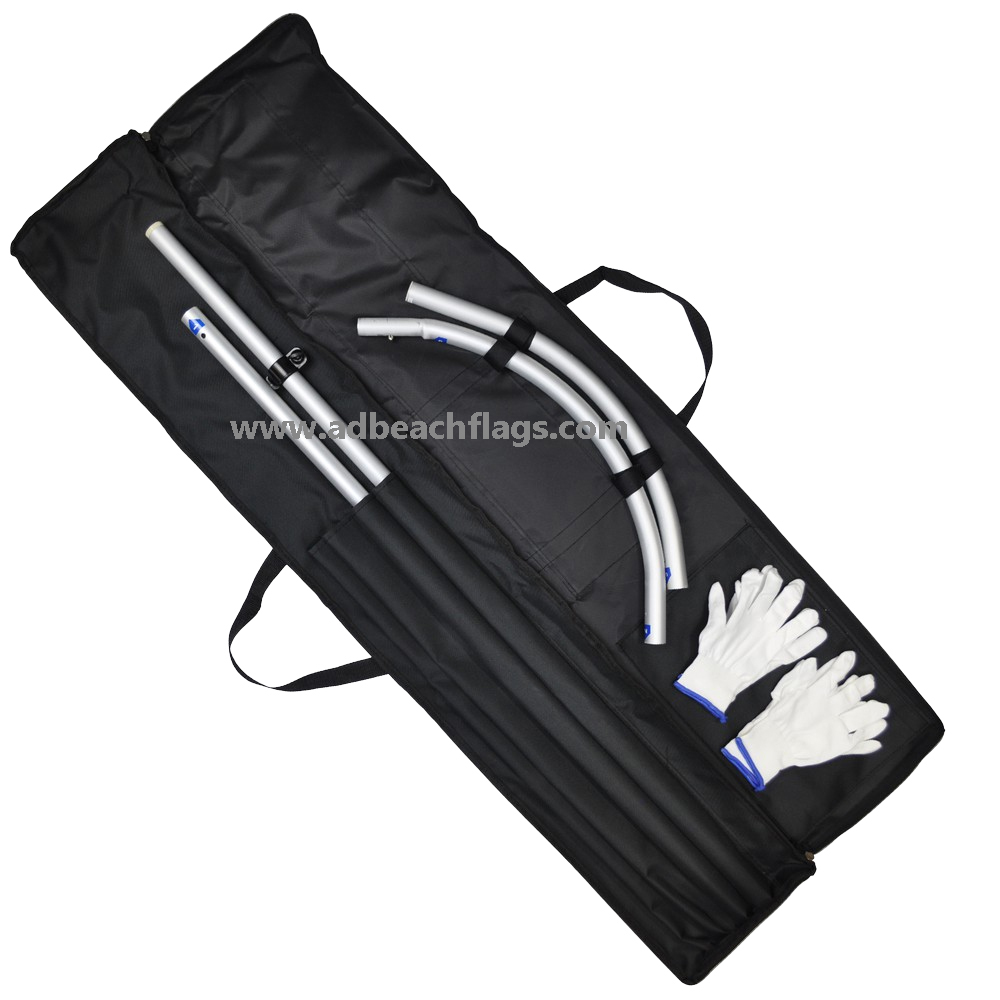
1. Fit the longest pole section. Flag poles ship in sections; the bag length must take the longest one with the caps on. A common working benchmark for full flag kits is around 150 cm long by 20 cm diameter, which swallows four pole sections, a cross base and a folded flag. Bags that fit the flag but not the poles get left behind, and left-behind bags lose kits.
2. Zip along the full length, with a pull that survives. A full length zip opens flat so sections drop in without fighting the mouth. Heavy duty zips with larger teeth are the check on heavier kits.
3. Handle plus shoulder strap. A crew carrying four kits across a car park uses shoulders, not hands. Stitched webbing handles that run under the base of the bag outlast straps sewn to the seam edge.
4. An inner pocket with a window. A parts list, a business card, or the customer’s logo card turns the bag into a sales tool and makes mis-placement obvious. Clear pockets cost pennies and get used.
5. A label that names the kit. Size, kit contents and a reorder code on a sewn label settle stockroom arguments before they start.
1. Screen printing is the default for bag logos. At trade quantities a one colour print typically adds a few tenths of a dollar to about a dollar per bag, with a screen setup charge commonly in the tens of dollars per colour. At run sizes around a thousand pieces, setup is frequently negotiable away.
2. One colour prints cleaner on coated oxford. Fine multi-colour logos lose detail on the texture; the brand rules adapt by printing the mark, not the wordmark.
3. The printed bag is advertising that ships itself. A bag that spends its life at events carries the reseller’s name to the next buyer, which is why the retail trade bundles branded bags by default and why the free-bag convention exists: the bag is part of the marketing, not a cost centre.
1. Pole sections strapped, caps on. Sections are banded as a set before the bag, so even an open bag keeps its set. Caps stay on through packing so nothing rolls loose.
2. Bases boxed separately. A cross base in the same carton as a folded flag creases fabric and scuffs powder coating. The base gets its own carton; the bag carries poles and flag.
3. Carton specs written per order. Carton size, pieces per carton and gross weight go on the quotation, because flag kits are volume-heavy and freight cost lives in the volumetric weight, not the scales.
4. Shipping bands stated. Express runs 3 to 7 days, air freight 5 to 8, sea freight 25 to 40, and bags ride inside the kit cartons, so a bag-heavy order changes the freight maths and we show it before the order rather than after.
5. Approval before bulk. A pre-production sample bag with your logo goes out in 2 to 3 days, bulk runs 5 to 10 days after written approval, and orders settle on 30 to 50 percent deposit with the balance against shipping evidence.
1. Permanent installations. A flag that stands at one site for a year never needs a bag; the money belongs in the flag or the base.
2. Full container programs with fixed venues. Where kits ship once and stay put, poly packing inside the carton does the job, and dropping bags saves real money at container scale. We quote both ways on request.
3. Single-event giveaways. If the kit is issued and not returned, a lighter bag grade is honest. Match the bag to the logistics, not to the catalogue photo.
1. Ordering bags after the kits. Bag lead times can run longer than flag production, and a kit that waits on a bag waits on the whole order. Order them together.
2. Letting “waterproof” stand for a spec. Ask for the hydrostatic number and the coating type. One line, no arguments later.
3. Sizing to the flag, not the poles. The longest pole section is the real constraint. Measure it, add the caps, then choose the bag.
4. Printing six colours on a textured ground. The mark loses and the cost rises. One clean colour on oxford reads better at three metres than a detailed logo that muddies.
5. Ignoring the label. An unnamed bag in a fleet of identical bags is a lost bag. The sewn label with the size and reorder code is the cheapest stockroom tool you will buy.
United States and Canada. The free-bag convention is near universal at retail, so a kit without a bag reads as incomplete on the shelf. Bags ride the volumetric freight maths, which is why carton specs matter on cross-country programs.
United Kingdom and Ireland. Boot-of-the-car logistics dominate event supply, so the shoulder strap and the full length zip earn their place every single hire.
Australia and New Zealand. Dust and UV are the enemies between events; a light coloured bag with a closing flap ages better on an open truck deck than a dark one left in the sun.
Gulf and Middle East. Dust ingress decides bag life more than rain does; a zipper with a rear flap and a parts pocket that closes keeps grit off the flag fabric.
Latin America. Street campaigns move kits daily on public transport, so compact bags that swallow the flag and poles without the base travel best, with the base delivered separately.
| Feature | Advantage | Benefit you feel |
|---|---|---|
| 420D-600D oxford body | Abrasion life past the pole tips | Bags outlive the first artwork, not the first month |
| Stated PU coating rating | Verified water resistance | Wet event pack-downs without a damp flag smell in the van |
| Kit-length fit, full zip | Poles drop in without a fight | Pack-down takes minutes and nothing stays at the venue |
| Card window and sewn label | Kit identity travels with the bag | Stockrooms stop mixing sizes and claims stop growing |
| Screen printed logo | Branding that travels to every event | The bag sells the next kit before you do |
Q1. Do your flag kits come with a carry bag?
Yes, every complete flag kit ships with an oxford carry bag sized to the poles and flag, and replacement bags are available separately for fleets that need spares.
Q2. What is oxford fabric?
A basket-weave polyester or nylon fabric named for its weave. Denier describes the yarn thickness and a PU coating on the inside gives water resistance, specified as a hydrostatic head in millimetres.
Q3. What denier should a flag kit bag be?
420D to 600D is the working range for standard kits, tough enough for pole tips and hardware while keeping freight weight sane. Heavier 900D grades suit multi-kit bags.
Q4. Can I get my logo printed on the bag, and what is the minimum?
Yes. One colour screen print is the standard at trade quantities, with a screen setup charge per colour that often disappears at run sizes near a thousand pieces. Sampling takes 2 to 3 days.
Q5. Is the bag waterproof?
The standard PU coated oxford tests in the 3,000 to 5,000 mm class, which handles rain and wet grass. We state the rating on the quotation so the word means something.
Q6. Can I buy replacement bags on their own?
Yes, and fleets do this routinely when a bag wears out long before the flag. Send us the pole section length and we match the bag to the kit.
| Point | Detail |
|---|---|
| Manufacturer, not reseller | Bags are cut and sewn beside the flag lines in our Foshan works, so fit is checked against the real poles, not a spec sheet. |
| Specs written down | Denier, coating rating, zip class and bag dimensions appear on the quotation, not just on the sample. |
| Pre-production sample | A sample bag with your logo ships in 2-3 days; bulk starts on written approval only. |
| Packing that protects freight | Carton specs, pieces per carton and volumetric weights stated per order, bases boxed separately. |
| Low MOQ accepted | Wholesale from 5+ pieces, so a shelf trial does not need a container. |
| Reply in 1 hour, 24×7 | WhatsApp +86 135 1661 0926 or [email protected], with bag specs and kit pricing the same day. |
A carry bag is not packaging; it is the part of the kit that keeps the other parts a kit. Choose the denier for the poles it will carry, demand the coating number, check the zip and the fit, print the logo in one clean colour, and order it with the kits instead of after them. Do that and the shelf return photo at the top of this page stops being your photo.
Send us your kit contents, pole lengths and logo file, and we reply in 1 hour, 24×7, with bag specs, a sample schedule and factory pricing. Low MOQ accepted, and honest advice when your program is better off without the bag.
Tell us the flag size, the quantity, single or double-sided, and the surface the flags will stand on. Our export team replies within 1 hour, 24×7, with an artwork proof and a factory price. Low MOQ accepted.
Chat on WhatsApp (+86 135 1661 0926) Email Us Now
Prefer a form? Fill in the details below and we will come back with a proof and a price within 1 hour, 24×7.
Related reading: How to order custom flags from a China factory: nine steps | Bulk order guide: price tiers and container packing | Replacement flag covers: keep the pole, change the message | Custom feather flags | Custom teardrop flags | Warehouse and logistics | Factory credentials and QC
| Item | Detail |
|---|---|
| Product | Oxford carry bags for flag kits: feather, teardrop and custom flag sets |
| Manufacturer | BESDA Advertising Flags, Foshan, Guangdong, China |
| Standard bag | 420D-600D oxford polyester, PU coated, 3,000-5,000 mm hydrostatic class, full length zip |
| Fit rule | Bag sized to the longest pole section with caps; common kit benchmark about 150 x 20 cm |
| Branding | One colour screen print standard; setup per colour, waived near thousand-piece runs |
| Packing | Pole sections strapped with caps on; bases boxed separately; carton specs stated per order |
| Shipping | Express 3-7 days, air 5-8, sea 25-40; bags ride inside kit cartons |
| MOQ & pricing | Low MOQ accepted; wholesale from 5+ pieces; trade price bands confirmed per order |
| Lead times | Sampling 2-3 days; bulk 5-10 days after written approval; 30-50% deposit, balance on shipping evidence |
| Contact | WhatsApp +86 135 1661 0926, [email protected], reply in 1 hour 24×7 |