Phone: 0086-757-8938 9313
WhatsApp: +86 135 1661 0926
Email: [email protected]
Address: Caochang Industrial Zone, Lishui, Nanhai, Foshan, Guangdong, China
24/7 Online Services
Phone: 0086-757-8938 9313
WhatsApp: +86 135 1661 0926
Email: [email protected]
Address: Caochang Industrial Zone, Lishui, Nanhai, Foshan, Guangdong, China
24/7 Online Services

Metal base flags are flag kits held upright by a steel plate instead of stakes, water or a vehicle tyre. Most buyers arrive at the plate question after one bad afternoon: the skin survived, the pole survived, and the base slid two metres across the forecourt. The plate is the part that decides whether the kit behaves like signage or like a sail with a weight tied to it.
The short answer for buyers: match the plate to the flag height, the surface and the wind, in that order. A 3.4 m feather flag on paving typically pairs with a 40 x 40 cm plate weighing 5 to 10 kg. A 4.5 m or 5.6 m flag moves up to a 50 x 50 cm plate at 12.5 to 16 kg, or a 20 kg double plate. Grass and sand need a spike, not a plate. And no plate raises the flag’s own wind limit: a double-sided flag on a standard pole is typically rated to about 17 mph, whatever sits under it.
This guide is written for distributors, procurement teams, event companies, retail buyers and importers who order flag kits in tens or hundreds. The numbers are typical ranges from supplier specifications and our workshop records in October 2026. Where a figure depends on the flag size, the table says so.
A complete kit is six parts, and the plate is only one of them. Buyers who price the plate alone usually end up replacing the cheap part twice.
1. The skin. Printed knitted polyester, usually 110 to 115gsm for standard duty and 130gsm for strong sun. The sleeve and the bottom strap take the load, so their stitching matters more than the print.
2. The pole. Four sections on a 3.4 m kit, four on a 4.5 m kit, five on a 5.6 m kit. Most sets run an aluminium lower section with fibreglass above, so the top bends in a gust instead of snapping.
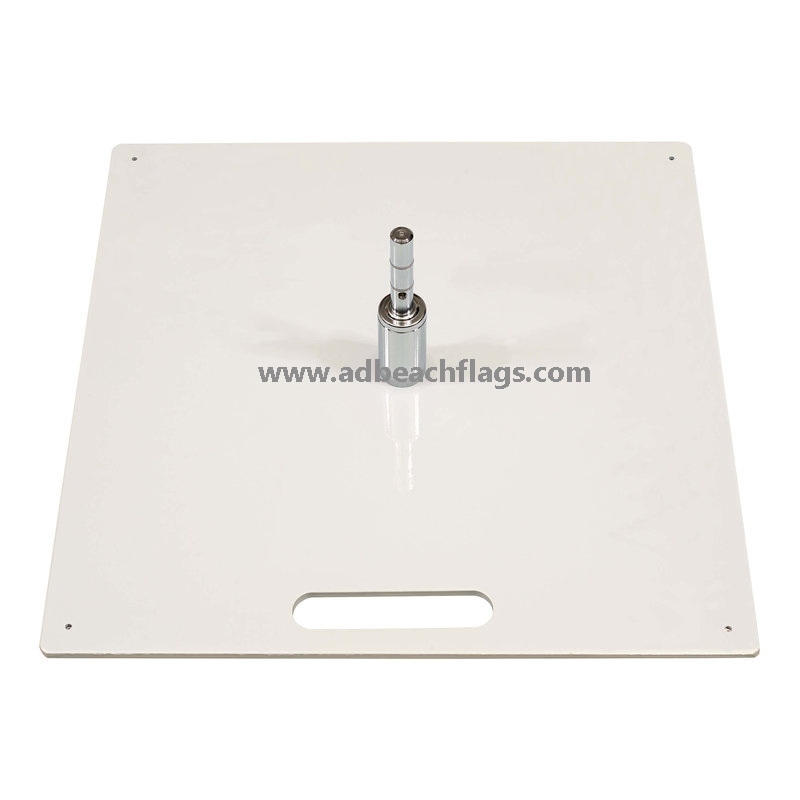
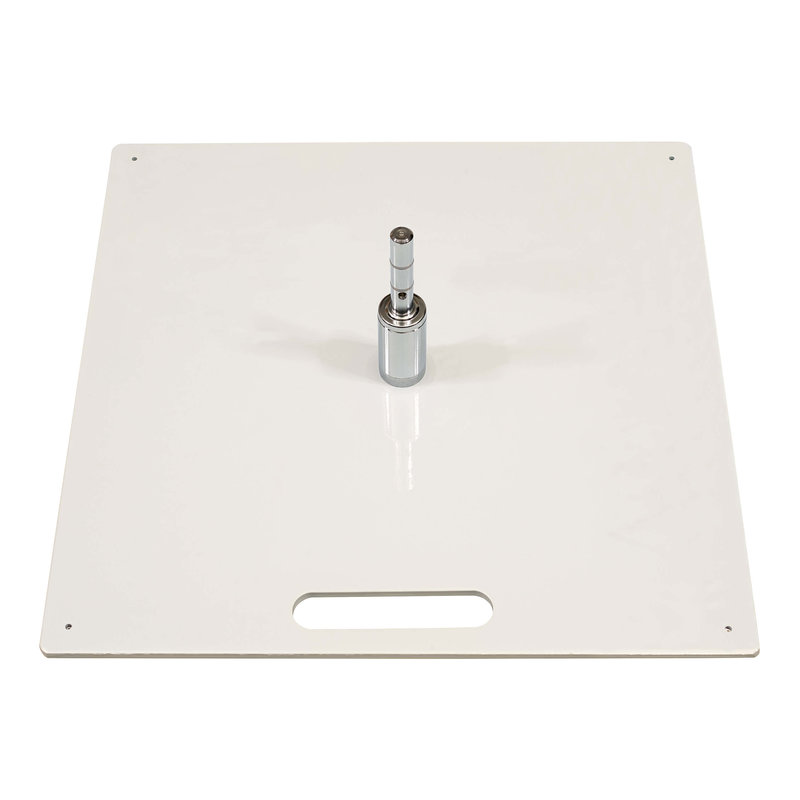
3. The plate. Powder-coated steel, square or round, with a socket in the centre and often four peg holes at the corners. Weight is set by footprint and thickness, not by the colour of the paint.
4. The bearing and pin. A 360 degree swivel lets the flag turn out of the wind. The pin is commonly 16.5 mm, and the pole sleeve usually measures 14.5 to 16.7 mm. A matched pair turns freely; a mismatched pair wears oval in a season.
5. The pads. Rubber or felt feet under the plate. On tile, stone and timber decking these are the difference between a display and a repair bill.
6. The carry handle. A cast or folded handle sounds minor until a 15 kg plate has to move forty times in a day. Sharp edges on a folded handle are a recurring complaint in tenders.
Steel weighs about 7.85 grams per cubic centimetre, so plate weight is arithmetic, not opinion. A 40 x 40 cm plate at 4 mm thickness is 640 cm3 of steel, which comes to about 5.0 kg. The same footprint at 8 mm is 1,280 cm3, or about 10.0 kg. A 50 x 50 cm plate at 8 mm is 2,000 cm3, or about 15.7 kg.
Two plates can look identical in a product photo and differ by 10 kg in the carton. That is why a supplier’s weight claim deserves a scale, and why a written spec should state footprint and thickness, not just a round number.
| Plate | Calculated weight | Typical flag | Where it works |
|---|---|---|---|
| 30 x 30 cm, 3 mm | About 2.1 kg | 2.2 to 2.8 m indoor | Showroom, lobby, trade stand |
| 40 x 40 cm, 4 mm | About 5.0 kg | 2.8 to 3.4 m | Paving and asphalt, sheltered site |
| 40 x 40 cm, 8 mm | About 10.0 kg | 3.4 to 4.5 m | Forecourt, high street, open lot |
| 50 x 50 cm, 8 mm | About 15.7 kg | 4.5 to 5.6 m | Exposed paving, coastal car park |
| Two 40 x 40 cm plates, 8 mm | About 20 kg bolted | 5.6 m and above | Wind funnel between buildings |
| 50 x 50 cm with ballast box | About 16 kg before filling | 4.5 to 5.6 m | Sites where the plate must stay portable |
Two practical notes sit under that table. First, a heavier plate does not make a taller flag safe in a storm; it only buys time before the pole or the skin gives up. Second, the plate’s footprint matters as much as its mass, because a wide base resists tipping over a longer lever arm. A 15 kg plate at 30 x 30 cm is a different product from a 15 kg plate at 50 x 50 cm.
The surface decides more than the wind zone in most city sites. A plate needs a hard, flat, clean surface with enough friction to stop it walking. Order of preference, from best to worst:
| Surface | Plate? | What to specify |
|---|---|---|
| Asphalt and tarmac | Yes | 40 to 50 cm plate; sweep grit away first |
| Concrete pavers | Yes | Rubber pads; avoid plates straddling two levels |
| Polished stone or tile | Yes, with care | Felt pads, lift never drag, no water bag on the stone |
| Timber decking | Yes, spread the load | Wide pad board under the plate; check joist direction |
| Grass and soil | No | Ground spike; a plate sinks and tilts |
| Sand | No | Long sand spike or sand anchor, set deep |
| Loose gravel | No | Plate slides; use a fixed socket or move the site |
| Slope over 5 degrees | No | Level the ground or choose a fixed base |
One exception worth naming: some venues, including listed squares and indoor arenas, prohibit staking and prohibit metal plates on certain floors. In those places a water tank base or a weighted cross base with a protective mat is the honest answer, even if a plate would perform better.
When a buyer says the base failed, the failure is usually one of four things. Each has a different symptom, and each has a different fix.
1. Slide. The plate drifts downwind and the paint scuffs on one edge. The cause is not always mass: wet leaves, fine grit and smooth tile all act as a slip layer. Fix it with a bigger footprint, rubber pads and a clean surface before the flag goes up.
2. Rock and lift. One corner lifts in gusts and the base walks across the paving. This is a moment problem, not a weight problem. A taller flag on a small plate has a long lever arm, and a 5 kg plate cannot hold a 4.5 m pole in a gust. Move up one plate size before you add ballast.
3. Pole wobble. The pole rocks in the socket and the pin wears oval. The usual cause is a mismatched pin and sleeve: a 16.5 mm pin in a 14.5 mm sleeve will move from day one. Measure both with a caliper before you accept a shipment, and keep spare pins in the van.
4. Bearing seize. The flag stops turning, the pole starts to bend, and the skin wraps around the pole. Grit, salt and dried spray are the usual culprits. A fresh-water rinse and a dry PTFE spray at each season change keeps the swivel free; a seized bearing is a replacement part, not a maintenance item.
Standard aluminium and fibreglass kits are typically rated to about 30 mph single-sided and 17 mph double-sided. Premium full fibreglass kits are rated much higher, around 63 mph single-sided and 46 mph double-sided. Those figures come from supplier specifications and describe the pole and skin, not the base.
Pole deflection gives a more useful picture than a single headline number. Test data from supplier spec sheets puts deflection at 8 to 12 percent at 15 mph, 15 to 20 percent at 20 mph, 25 to 30 percent at 25 mph, and 35 to 40 percent at 30 mph. Gusts commonly run 50 to 100 percent above the sustained wind, so a gusty 15 mph day should be treated as 25 mph.
| Sustained wind | Typical pole deflection | Action on site |
|---|---|---|
| 15 mph (24 km/h) | 8 to 12 percent | Normal operation, watch the forecast |
| 20 mph (32 km/h) | 15 to 20 percent | Acceptable with monitoring; check the base |
| 25 mph (40 km/h) | 25 to 30 percent | Take the flag down |
| 30 mph (48 km/h) | 35 to 40 percent | Failure is close; clear the area |
A rough load estimate makes the numbers concrete. A 3.4 m flag carries about 1.56 square metres of skin. At 20 mph, that skin sees roughly 8 to 9 kg of force; at 30 mph, roughly 20 kg. The plate does not reduce that force. It only resists the moment at ground level, which is why the pole and the bearing are the parts that decide the real limit.
| Base type | Weight range | Best surface | Watch out for |
|---|---|---|---|
| Steel plate | 4 to 16 kg, 20 kg double | Asphalt, pavers, indoor floors | Slides on grit; scratches stone without pads |
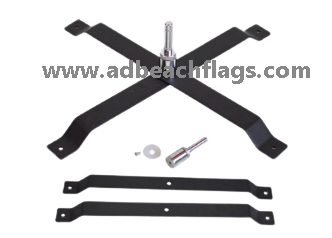
| Cross base | 1 to 4 kg bare, plus 6 to 15 kg ballast | Paving with a water bag | Never use bare outdoors; bag can leak |
| Water tank | 13 to 25 litres | Semi-permanent paving, car parks | Freezing risk; sand is safer in winter |
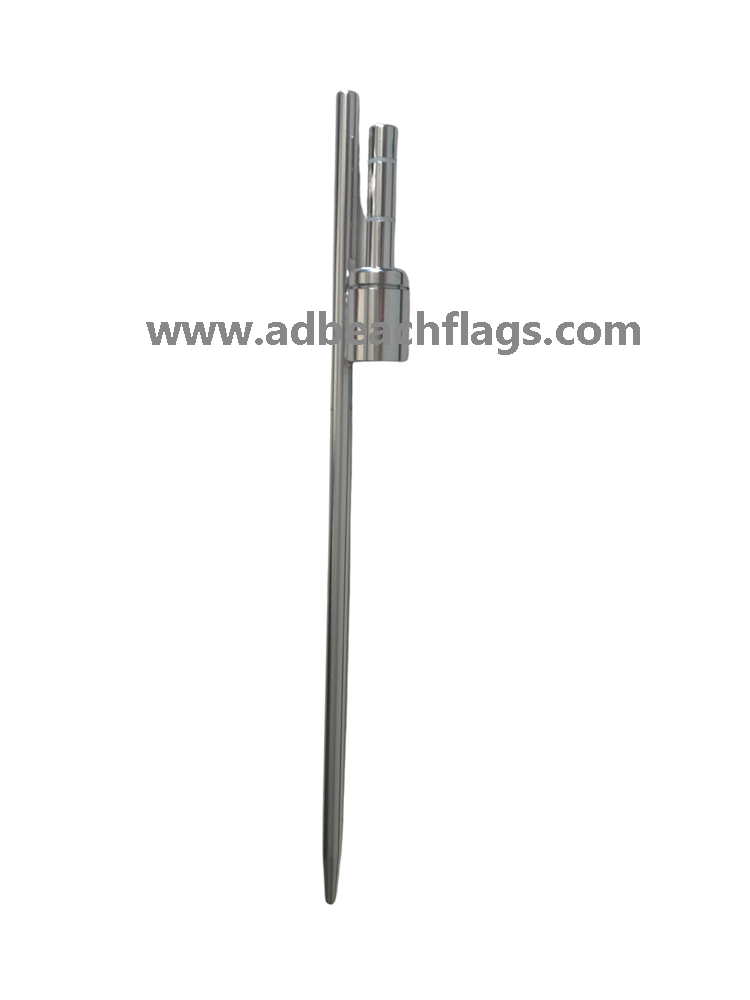
| Ground spike | 0.5 to 2 kg | Grass, soil, sand | Not for paving; sand needs a long spike |
| Tyre base | 6 to 12 kg, plus vehicle | Car lots and forecourts | Needs a vehicle parked on it |
A two-person crew should set a 3.4 m kit in five to eight minutes on paving. The order matters more than the speed.
1. Survey the spot. Check overhead lines, door swings, fire exits, slope and surface. A flag that blocks an exit will be removed by the venue, not by the wind.
2. Clean the paving. Sweep grit and leaves away. A plate standing on a layer of sand is a plate on rollers.
3. Assemble the pole. Join from the bottom up and check that each joint seats fully. Fit the swivel and confirm it turns by hand.
4. Fit the skin. Top tie first, then the sleeve, then the bottom strap. A skin that is tight at the top and loose at the bottom will flap and wear at the sleeve.
5. Stand the pole. Insert it into the socket, fit the pin, and check that the pole sits vertical. A lean of a few degrees becomes a permanent load on one edge of the plate.
6. Test the rotation. Turn the flag through 360 degrees by hand. It should move freely without lifting the plate.
7. Strike in reverse. In wind, remove the skin first, then the pole, then the plate. Taking the plate first turns the flag into a lever with a loose base.
8. Dry before folding. A skin folded wet develops mildew lines that never wash out. Hang it, or lay it flat in the shade, before it goes back in the bag.
1. Weigh one plate. A 40 x 40 cm plate at 8 mm should be close to 10 kg. If the carton says 10 kg and the scale says 7 kg, the thickness is not what was quoted.
2. Measure the pin and the sleeve. A 16.5 mm pin is common. The sleeve should be within about a millimetre. Ask for the numbers in writing, not in a photo.
3. Check the weld. A continuous weld around the socket, with no spatter inside the tube. A socket welded on one side only will crack at the root.
4. Check flatness. Put the plate on a flat bench. A plate that rocks on the bench will rock on the pavement and walk in the wind.
5. Check the pads. Glued or screwed, not loose in a bag. Loose pads disappear on the first installation.
6. Check the handle. Folded steel with a rolled edge, or a cast handle. A sharp edge on a 15 kg plate is an injury waiting for a busy Friday.
7. Check the coating. Powder coat in the 60 to 80 micron range is typical for outdoor steel. Look at the edges, where coating is usually thinnest.
8. Check the packing. One plate per carton with foam, double-wall board for 15 kg and above. A plate that arrives with chipped paint is a return, even if the steel is fine.
Fleet orders fail on the site list, not on the flag design. Our own sequence for a multi-site order runs like this.
1. Build a site table. One row per location: surface, wind exposure, flag height, viewing distance, storage, who installs.
2. Pick the plate from the table. Do not average across sites. A sheltered high street and a coastal car park need different plates even if the flags match.
3. Fix the flag spec. Single or double-sided, 110 or 130gsm, pole family, sleeve type. Double-sided flags cut the wind rating roughly in half on standard poles, so they usually need a bigger plate.
4. Ask for a sample plate. Weigh it, measure the pin, fit a pole, and turn it. Sampling takes 2 to 3 days and settles more arguments than a spec sheet.
5. Approve the artwork and the packing list. Mixed sites usually mean mixed artwork, and a per-site packing list saves a day at the warehouse.
6. Confirm the paperwork. Printed polyester flags usually clear under HS 6307.90. Fire treatment documents, where needed, are available on request in writing.
7. Plan the freight. Express runs 3 to 7 days, air 5 to 8, sea 25 to 40. Plates are heavy, so sea freight usually wins for volume and air wins for a launch date.
8. Keep a reorder line. Record plate size, pin size, sleeve size and coating colour. The second order should be a copy, not a new brief.
1. Buying the flag first and the base last. The base is the part that decides whether the flag stays where marketing put it.
2. One plate for every site. A 5 kg plate that works on a sheltered pavement is a liability on a corner site.
3. Using a plate on grass. It sinks, tilts and slides. A spike costs less and works better.
4. Forgetting the double-sided penalty. A double-sided flag is heavier and rated lower. The plate has to move up a size with it.
5. Leaving flags up overnight in a gusty season. Most base failures happen between midnight and 6 am, when nobody is watching.
6. No spare pins or bearings. A missing 16.5 mm pin can take a whole site out of service for a week. Keep a small spares box per region.
Honest guidance, because a plate sold into the wrong site becomes a complaint.
1. Grass, soil and sand. A plate cannot grip a soft surface. Use a spike or a sand anchor.
2. Slopes and cambers. Above about 5 degrees, a plate slides or rocks. Level the ground or fix the base.
3. Storm-exposed coastlines. No portable plate is a storm anchor. If the site sees regular 40 mph gusts, the honest answer is a fixed socket or no flag.
4. Protected or listed paving. Some locations forbid metal on stone, or require non-marking feet and a mat. Check before the order, not after.
5. Sites with no secure overnight storage. A 15 kg plate is portable enough to walk away. If nobody can bring it in, consider a lighter kit that goes home with staff.
6. Indoor venues with floor restrictions. Sports halls and arenas often require weighted bases with mats, and some ban metal plates outright. Read the venue manual.
United States and Canada. Parking lots and concrete plazas dominate, so 40 x 40 cm and 50 x 50 cm plates are the common stock. Winter salt attacks coating and bearings, and indoor event flags usually need NFPA 701 papers. Double-sided flags are popular at dealerships, which is exactly where the lower wind rating matters.
United Kingdom and Ireland. Pavers and pedestrian zones, with Beaufort 4 as the usual take-down line. Councils often ask about footway obstruction, so the plate footprint belongs in the permit application. Sail flag and teardrop flag are the search terms buyers use.
Australia and New Zealand. UV is the budget line, so 130gsm and full fibreglass poles earn their place. Summer nor’westers arrive fast, and a 15 kg plate that is fine in winter can walk in February. Southern season orders land in September.
Germany, Austria and Switzerland. Buyers ask for fabric weight and fire documents before they ask about the plate. DIN 4102 B1 is the reference for indoor use. Wind zones matter on exposed retail parks, and written specs are expected, not optional.
Gulf and Middle East. Heat and sand are the enemies: sand under the plate acts as a slip layer, and metal surfaces get hot enough to burn a hand. Air freight in 5 to 8 days matches the project clock, and a shade structure often matters more than a heavier plate.
Latin America. Spanish-language documentation and mixed site types, from paved plazas to beachfront promenades. The southern season runs November to March, so artwork and plates should be confirmed by late October.
| Feature | Advantage | Benefit |
|---|---|---|
| Plate weight stated by footprint and thickness | The buyer can calculate 5.0 kg or 10.0 kg before ordering | No surprise at the scale, no dispute at the dock |
| 16.5 mm bearing pin with matched sleeve | 360 degree rotation without play | The flag turns out of gusts instead of bending the pole |
| Powder coat plus rubber pads | Grip on paving and protection for stone | No scratched floors, no sliding base, no venue complaint |
| 40 cm and 50 cm plate family | One hardware family covers 2.8 to 5.6 m flags | Fewer SKUs, simpler reorders across a store network |
| Bolted double plate option | 20 kg without concrete or water | Adapts to a windy corner without a new base type |
A 3.4 m flag on paving usually takes a 40 x 40 cm plate at 5 to 10 kg. A 4.5 m to 5.6 m flag moves up to a 50 x 50 cm plate at 12.5 to 16 kg or a 20 kg bolted double plate. Match the plate to the site, not only to the flag.
No. A plate sinks and tilts on grass, soil and sand, and it slides on gravel. Use a ground spike on grass and soil, and a long sand spike or sand anchor on sand.
Not with pads. Rubber pads on pavers and asphalt, felt pads on polished stone and tile, and a spreader board on timber decking. Lift the plate, never drag it.
Take it down at about 25 mph, and treat gusty 15 mph days as 25 mph because gusts run 50 to 100 percent above the sustained wind. Standard double-sided flags are typically rated to about 17 mph.
The pin and sleeve do not match. A 16.5 mm pin in a 14.5 mm sleeve has play from day one and wears oval. Measure both with a caliper and keep spare pins.
Yes. Plates, pins, bearings and pads are stocked as separate items, and we record the plate spec with your artwork so a reorder matches the first shipment.
| Point | Detail |
|---|---|
| Manufacturer, not reseller | Skins, poles and plates come off one production line in Foshan, so the pin, sleeve and plate are matched before packing. |
| Weighed, not estimated | Every batch is weighed and measured against the written spec, and the numbers go on the packing list. |
| Written specs, not photos | Footprint, thickness, pin, sleeve, coating and pad are quoted as lines, so procurement can compare offers. |
| Low MOQ accepted | Wholesale from 5+ pieces, with mixed plate sizes and artwork variants in one shipment. |
| Reorder archive | Plate spec, pin size and artwork stay on file, so the second order is a copy of the first. |
| Reply in 1 hour, 24×7 | WhatsApp +86 135 1661 0926 or [email protected]; we ship to buyers in 150+ countries. |
A metal base flag is a system, and the plate is the part that translates wind into ground. Buy the plate from the site table, not from a catalogue photo: 40 x 40 cm at 5 to 10 kg for 2.8 to 4.5 m flags, 50 x 50 cm at 12.5 to 16 kg for 4.5 to 5.6 m flags, and a 20 kg double plate for the windy corner. Check the pin and sleeve with a caliper, keep pads under the plate, and take the flag down at 25 mph. If the site is grass, sand, a steep slope or a storm coast, buy a spike or a fixed socket instead. Send us the site list and the surface mix, and we will return a plate plan with weights, pin sizes and packing lines inside 1 hour, 24×7.
Tell us the flag sizes, the quantities, single or double-sided, and the ground the flags will stand on. Our export team replies within 1 hour, 24×7, with a proof and a factory price. Low MOQ accepted.
Chat on WhatsApp (+86 135 1661 0926) Email Us Now
Prefer a form? Fill in the details below and we will come back with a proof and a price within 1 hour, 24×7.
Related reading: Flag base guide: pick the base by surface, not by looks | Cross base sizes explained: 60 cm, 72 cm and 80 cm | Beach flag wind rating: how much wind a flag can take | Flag poles explained: which construction belongs under your flag | Metal plate bases | Heavy cross bases | Spike base stands | Custom feather flags | Water bases
| Item | Detail |
|---|---|
| Product | Metal base flags: steel plate bases for feather, teardrop and rectangular flag kits |
| Manufacturer | BESDA Advertising Flags, Foshan, Guangdong, China |
| Plate weights | 30×30 cm about 2.1 kg; 40×40 cm at 4 mm about 5.0 kg; 40×40 cm at 8 mm about 10.0 kg; 50×50 cm at 8 mm about 15.7 kg; bolted double plate about 20 kg |
| Weight maths | Steel at 7.85 g/cm3: footprint in cm2 x thickness in cm x 7.85 gives the plate weight in grams |
| Pin and sleeve | Bearing pin commonly 16.5 mm; pole sleeve typically 14.5 to 16.7 mm; 360 degree swivel |
| Wind limits | Standard kits typically about 30 mph single-sided and 17 mph double-sided; premium full fibreglass about 63 mph and 46 mph |
| Surface rule | Plate on asphalt, pavers, stone and indoor floors; spike on grass, soil and sand; never plate on gravel or slopes over 5 degrees |
| Lead times | Proof 1-3 days; sampling 2-3 days; bulk 5-10 days; express 3-7 days, air 5-8, sea 25-40 |
| MOQ and trade terms | Low MOQ accepted, wholesale from 5+ pieces; HS 6307.90 for printed polyester flags |
| Contact | WhatsApp +86 135 1661 0926, [email protected], reply in 1 hour 24×7 |