Phone: 0086-757-8938 9313
WhatsApp: +86 135 1661 0926
Email: raya@besda.net
Address: Caochang Industrial Zone, Lishui, Nanhai, Foshan, Guangdong, China
24/7 Online Services
Phone: 0086-757-8938 9313
WhatsApp: +86 135 1661 0926
Email: raya@besda.net
Address: Caochang Industrial Zone, Lishui, Nanhai, Foshan, Guangdong, China
24/7 Online Services

A car dealership ordered twelve feather flags for its street corner, all single-sided, because the quote was forty percent cheaper. Three weeks later the service manager called: the flags read perfectly for traffic heading east, and showed a mirror-image ghost to everyone heading west. The flags were not defective – they were the wrong construction for a corner read from both directions. This guide explains exactly what single-reverse and double-sided feather flags are, what each costs in money, weight and wind, and how to pick the right one per location instead of per quote.
The comparisons below come from our own print and sewing floor in Foshan, where both constructions run daily for distributors, event agencies and retail chains.
The two names describe two very different objects.
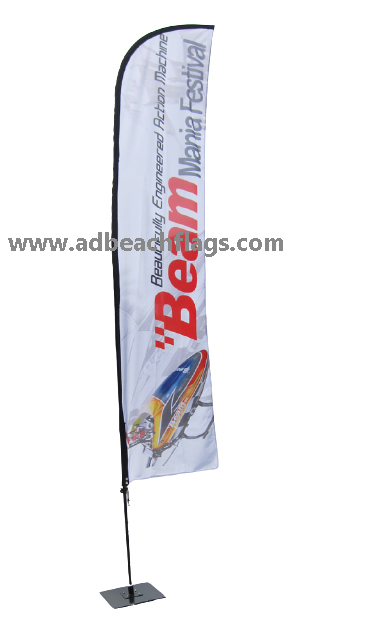
1. Single-reverse (single-sided). One layer of printed polyester. The artwork reads correctly on the front; light passing through shows the mirror image on the back, slightly muted. It is the standard construction for feather flags – lighter, cheaper, and the flag flies more freely because the fabric is thin.
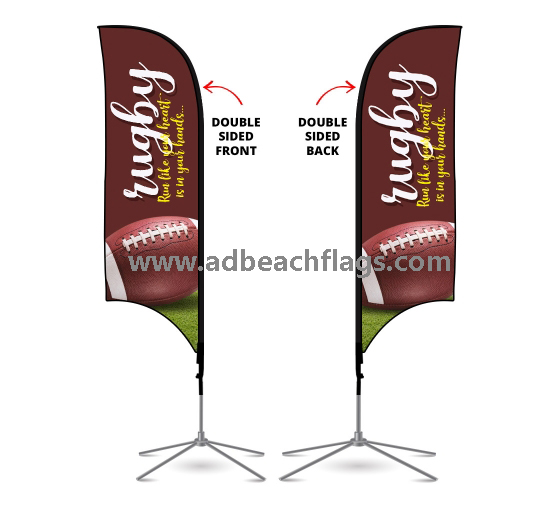
2. True double-sided. Two printed layers sewn together with a blockout liner between them. Each face reads correctly in the correct direction. The liner – a light-tight middle layer – is what kills the show-through. Expect roughly 30% more fabric weight and a visibly stiffer flag.
3. The in-between variant. Some factories offer a single layer woven with blockout threads. It blocks more light than plain single-reverse but less than a true liner sandwich, at a middle price. Ask which build a “double-sided” quote actually describes – the three-layer sandwich and the blockout-thread layer are not the same product and do not cost the same.
| Factor | Single-reverse | Double-sided (3-layer) |
|---|---|---|
| Back face | Mirror image, slightly muted | Correct reading, both directions |
| Fabric weight | Base (110-130 g polyester) | About +30% with liner |
| Price at factory | Baseline | Roughly +40-60% |
| Flight in wind | Flies freely, sheds gusts | Stiffer, needs stronger base |
| Base recommendation | Standard cross base (+ water bag outdoors) | Heavy cross or plate base outdoors |
| Artwork | One file | Two files (or one approved mirrored) |
| Best sites | Walkways, entrances, one-direction reads | Roadsides, corners, islands, medians |
Two rows deserve emphasis. Wind: a double-sided flag is a sail with a stiff spine – the same gust that ripples a single-reverse flag pushes the double-sided one harder, which is why we upsize the base when a double-sided flag goes outdoors. Artwork: two print faces means two files to approve; sending one file and assuming the back is “handled” is how mirror-image typos reach a street corner.
1. Entrances and walkways. Visitors approach from one direction; the back face is decoration, not messaging.
2. Perimeter lines. Row flags along a fence or lot edge usually face one audience – the street – and the savings multiply across twenty flags.
3. Windy coasts. A lighter flag sheds gusts and spares its pole; single-reverse on a fiberglass pole outlasts a stiff double-sided kit on the same shoreline.
4. Budget-rotating campaigns. If sails are swapped every season, the doubled print cost of double-sided buys less rotation room.
1. Traffic islands and medians. Vehicles pass both ways; a mirror image is a wasted impression, and impressions are the whole point.
2. Street corners. The dealership story above is the classic case – one corner, two traffic directions, one flag position.
3. Mall and atrium islands. Foot traffic circulates all the way around the display, and shoppers read the back as often as the front.
4. Premium brand installs. A solid, deeper-reading face photographs better and looks more finished at close range – hotels, showrooms, golf events.
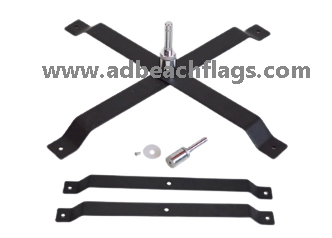
Matching base to construction is where most kits fail, not the flag itself. Our rule of thumb after years of replacements: single-reverse up to 3.4 m poles lives happily on a standard 3-4 kg cross base indoors, with a 10-12 L water bag added outdoors. Double-sided flags step up one base class – heavy cross base or a 5+ kg plate – because the stiffer sail transmits more gust load to the bottom of the pole. Skimp here and the failure mode is not the flag tearing; it is the whole kit walking across a parking lot in a squall.
1. Send two files, or confirm mirroring in writing. If both faces are identical, say “mirror face approved as-is”; if the back differs – different language, different offer – it needs its own file and its own proof.
2. Approve the sample of the construction you ordered. A single-reverse proof says nothing about the double-sided result: show-through, depth and stiffness all differ.
3. Check the sleeve and hem. A three-layer flag has a thicker sleeve; pole diameter compatibility matters more than on single-layer flags.
4. Weigh the shipping. +30% fabric weight nudges freight class on large orders – usually small, occasionally decisive on air freight.
1. Double-sided everywhere “to be safe.” On one-direction sites it is pure overspend; twelve single-reverse flags fund a thirteenth position.
2. Single-reverse on corners “to save.” The mirror-image discount costs every westbound impression for the flag’s whole life.
3. Keeping the light base from the old kit. Upgrading the sail but not the base is how double-sided kits learn to dance in gusts.
4. Assuming blockout-thread layer equals liner sandwich. Different builds, different prices, different show-through. Ask which one the quote names.
Before choosing a construction, watch the site for ten minutes at the hour that matters – school pickup, lunch rush, the evening commute. Count the directions people and cars actually come from. Three patterns decide it: a single approach funnel (parking entrance, pedestrian gate, showroom drive) means single-reverse captures nearly every impression; a split flow (corner, median, roundabout) means the back face carries half the traffic and deserves real print; circulation (mall islands, trade show aisles, plazas) means the audience orbits the flag and double-sided earns its cost twice. The dealership that started this article could have learned all of this from one coffee in the parking lot – and the flags they eventually bought were double-sided on the corner, single-reverse along the side fence, which is exactly how the program should have been built the first time.
Consider the same twelve-flag program bought both ways. Program A: twelve double-sided kits at roughly $58 each – about $696. Program B: four double-sided kits for the two corners and entries at $58, eight single-reverse kits for the perimeter fence at $38 – about $536, one hundred and sixty dollars less, with correct construction everywhere. Program B also rotates better: perimeter sails fade first, and replacing eight single-reverse sails costs far less than refreshing twelve double-sided ones. Same budget category, same twelve positions, and the mixed program reads correctly at every point a customer actually stands. That arithmetic – construction matched to position – is the entire argument of this guide in one row of a spreadsheet.
United States. Roadside lots and medians drive double-sided demand; distributors standardize on heavy cross bases for the 4.6 m size.
United Kingdom. Gusts are the decider – many buyers choose single-reverse for coastal promenades and double-sided with plate bases for town-centre pedestals.
Gulf states. Malls run double-sided almost by default; the air-conditioned calm and circular foot traffic flatter the three-layer build.
Australia. Beachfront retail mixes both: mesh single-reverse for seafront wind, double-sided for sheltered high streets.
Germany and France. City-centre pedestrian zones run double-sided on weighted plate bases where drilling is forbidden; planners ask for wind-load notes in writing, which the heavier build documents naturally.
Canada. Bilingual programs lean double-sided by default: two languages on one flag position beats two flags on one permit, and property managers appreciate the smaller footprint at the same message count.
Brazil. Coastal avenue campaigns pair mesh single-reverse sails with spike bases for the sand strips, and reserve the double-sided blockout builds for the sheltered arcade entrances where foot traffic circulates both ways.
We would rather quote the honest build than the bigger one.
1. One-direction read, short campaign. The extra print never pays itself back.
2. Exposed coastline with light poles. A stiff sail on a thin pole shortens the whole kit’s life; single-reverse is the durable answer.
3. Weight-limited air freight. When the deadline forces air shipping for a large set, the doubled fabric weight can cost more than the print upgrade saved.
Construction choice shows up in three details that never make the brochure. The sleeve: a three-layer flag carries a thicker pocket, so pole diameter tolerances matter more – a double-sided sail on an under-diameter pole spins; on an over-diameter one it jams halfway. The hem: double-sided flags carry two hems and a liner edge, which is why corner reinforcement at the sleeve end matters more than on single-layer sails – that top corner takes the pole’s whole load. The hardware: our kits keep one sleeve standard across the range precisely so a single-reverse trial can graduate to double-sided sails later without re-buying poles. When you compare quotes, ask what happens at those three points; the answers separate kits that will still look right in year three from kits that photograph well in year zero.
Q1. What is the difference between single-reverse and double-sided feather flags?
Single-reverse is one printed layer – correct on the front, mirror image through the back. Double-sided is two printed layers with a blockout liner between, reading correctly in both directions, at roughly 30% more weight and 40-60% more cost.
Q2. Is a double-sided flag worth the extra cost?
Yes where both directions carry traffic – roadsides, corners, circulation islands. No where the audience approaches from one side; there the extra print is an expense with no extra impressions.
Q3. Does a double-sided flag need a different base?
Step up one base class outdoors: a heavy cross base or plate base instead of a standard cross with water bag. The stiffer sail transmits more gust load.
Q4. Which construction lasts longer?
In wind-exposed sites, single-reverse often outlasts double-sided on the same pole because it flexes. In sheltered, high-touch settings, the three-layer build keeps its looks longer.
Q5. Can both sides show different designs?
Yes – two separate print faces means two files. Approve each face’s proof separately; do not assume one file covers both.
Q6. Is “blockout thread” fabric the same as a blockout liner?
No. Blockout-thread fabric is a single layer with dense threading – better than plain single-reverse but lighter than a true two-layer sandwich with liner. Ask which build your quote names.
| Point | Detail |
|---|---|
| Both builds under one roof | Single-reverse, blockout-thread and true 3-layer double-sided run on the same Foshan floor, same Pantone process. |
| Site-based advice | Tell us where the flag stands and we recommend construction plus base – including when the cheaper option is the right one. |
| Kit-matched hardware | Poles, sleeves and bases ship as one tested standard; replacement sails fit years later. |
| Two-face proofing | Each print face gets its own proof before bulk – no mirror-image surprises. |
| Low MOQ accepted | Trial one position in both constructions and compare before scaling. |
| Reply in 1 hour, 24×7 | WhatsApp +86 135 1661 0926 or [email protected] with your site description. |
Choose by site, not by quote. One direction of approach, wind, rotation budget – these three answers pick the construction for you. A corner read from both streets justifies every cent of the blockout liner; a walkway entrance wastes it.
Describe your site – traffic direction, ground, typical wind – and we reply in 1 hour, 24×7 with a construction and base recommendation, pricing for both builds side by side, and sample scheduling. Low MOQ accepted, and if single-reverse is honestly enough for your location, we will say so and let you keep the difference.
Tell us the flag size, the quantity, single or double-sided, and the surface the flags will stand on. Our export team replies within 1 hour, 24×7, with an artwork proof and a factory price. Low MOQ accepted.
Chat on WhatsApp (+86 135 1661 0926) Email Us Now
Prefer a form? Fill in the details below and we will come back with a proof and a price within 1 hour, 24×7.
Related reading: Beach Flag Wind Rating | Flag Base Guide | Pantone Color Matching | Custom Feather Flags | Double Sided Beach Flags | Flag Bases | Heavy Cross Bases
| Item | Detail |
|---|---|
| Product | Single-reverse and double-sided feather flags, teardrop flags and beach flags |
| Manufacturer | BESDA Advertising Flags, Foshan, Guangdong, China |
| Constructions | Single-reverse; single layer with blockout threads; true double-sided, two printed layers with blockout liner |
| Weight delta | Double-sided adds roughly 30% fabric weight versus single-reverse |
| Price delta | Double-sided typically +40-60% at factory level |
| Base pairing | Single-reverse: cross base (+water bag outdoors); double-sided: heavy cross or plate base outdoors |
| Artwork | One file single-reverse; two files for double-sided faces |
| Fabrics | 110 g / 115 g / 130 g polyester, mesh for coastal wind |
| Sample lead time | 2-3 days sample, 5-10 days bulk after approval |
| Contact | WhatsApp +86 135 1661 0926, [email protected], reply in 1 hour 24×7 |