Phone: 0086-757-8938 9313
WhatsApp: +86 135 1661 0926
Email: raya@besda.net
Address: Caochang Industrial Zone, Lishui, Nanhai, Foshan, Guangdong, China
24/7 Online Services
Phone: 0086-757-8938 9313
WhatsApp: +86 135 1661 0926
Email: raya@besda.net
Address: Caochang Industrial Zone, Lishui, Nanhai, Foshan, Guangdong, China
24/7 Online Services

Every sports club has the same inventory: a pitch, a season, and a fence line that local businesses will pay to sit behind. The question for a committee is what to sell that visibility on. For most grassroots and semi-pro clubs, the honest answer is flags: cheaper than static boards, easier to store, and renewing cleanly every season with a new skin instead of new hardware.
One club officer described the failure mode: “The sponsor’s logo was sun-bleached pink by March. He saw it every week, and we lost the renewal.” This guide covers the rules that keep flags legal at the pitch line, what sponsors actually pay at each level, the kit specification that survives a 30 to 40 week season, and the reprint calendar that turns renewals into a one-week order. Benchmarks are marked typical where they range across clubs and countries.
Pitchside visibility is the entry tier of club sponsorship, well below shirt fronts. Published club rates give a clear ladder.
| Level | Typical published rate per season | Examples from club rate cards |
|---|---|---|
| Grassroots football | GBP 120 to 500 per board | Newhaven FC GBP 300 first year, 120 renewal; Atherton GBP 250 plus VAT; Lymington GBP 350 to 500 |
| Rugby clubs | GBP 375 to 695 | Stafford GBP 395 single or 695 double-sided; Reading GBP 375; Lincoln GBP 500; Bromley from GBP 500 |
| Cricket boundary | GBP 250 per board, typical | Atherton CC GBP 250 per year for 8 x 2 ft double-sided boards, renewal discounted |
| Semi-pro football | GBP 1,250 to 2,400 | Ebbsfleet United GBP 1,250 for a 10 ft board, GBP 2,400 for 20 ft, per season ex VAT |
| Swiss amateur benchmark | CHF 300 to 650 | Most common CHF 400 to 450 for a 3 x 0.75 m board |
Context from the same rate cards: shirt fronts run GBP 3,000 to 10,000 a year and sleeve deals GBP 500 to 2,000, so pitchside flags are the product a local builder, pub or estate agent can actually say yes to.
Published clubs renew at 40 to 60 percent off the first-year price, for example GBP 300 falling to GBP 120. The reason is physical: the hardware is bought once, and only the slot and the skin renew.
1. Year one price includes the kit. Flag, pole, base and first skin, plus the volunteer labour of installing it.
2. Renewal price is the skin. A UK reprint of a 2.8 m flag face retails around GBP 38.50 against GBP 60.50 for the full flag, and factory reprints cost a fraction of that.
3. Price the ladder honestly. If the renewal still looks expensive next to the first year, the sponsor suspects padding. Show them the skin price and keep the relationship for a decade.
Advertising at the pitch line is governed, and the governing bodies publish the numbers.
1. IFAB Law 1 requires upright advertising at least 1 m from the touchline and at least 1 m from the goal nets, the baseline for grassroots football everywhere.
2. FIFA competition standard sets boards at least 4 m from the touchline and 5 m from the goal line, useful when a club hosts higher-round cup ties.
3. League ground grading adds local layers. One club’s lesson: “We ordered boards for a semi-pro ground and league inspection failed them for sitting too close to the touchline.” Flags on removable bases pass these inspections more easily than fixed boards, because the 1 m line can be re-measured every matchday.
Grassroots clubs typically sell 15 to 40 pitchside positions along the main touchline, a 50 to 100 m run. Semi-pro grounds wrap 100 to 130 boards around roughly 250 linear metres. A practical first-season kit for a community club is 12 to 24 flags, which fills the main stand side without overselling the view.
Spacing matters as much as count: at 6 to 8 m centres, 16 flags cover about 100 to 128 m of touchline, and every sponsor gets a readable slot instead of a shared blur.
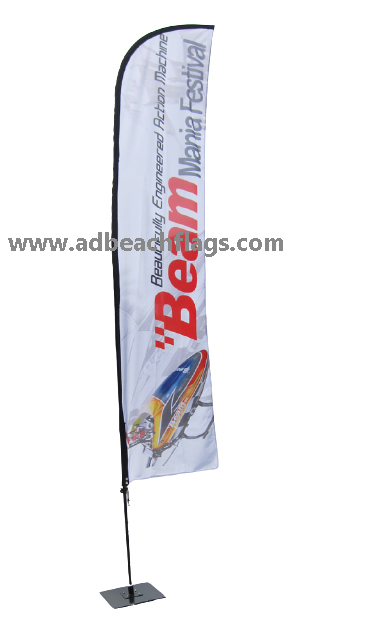
1. 2.8 to 3.4 m poles for enclosed small grounds. Where the stand is three rows of steps, everything above 3.4 m is sky.
2. 4.5 to 5.6 m poles where crowds stand and fencing intervenes. Supplier guidance and club practice agree: read over standing spectators and railings needs 4.5 m plus.
3. Feather for distance, teardrop for near stands. Feather faces are longer and read from the far touchline; teardrops hold shape in gusts and suit positions behind goals.
4. Fabric for mown-grass sites. 110gsm knitted polyester, dye sublimated, is the standard; one season of continuous display is the normal reprint cycle, because UV fades dyes within months of 24/7 exposure. Clubs that store flags between matches get two to three seasons per skin.
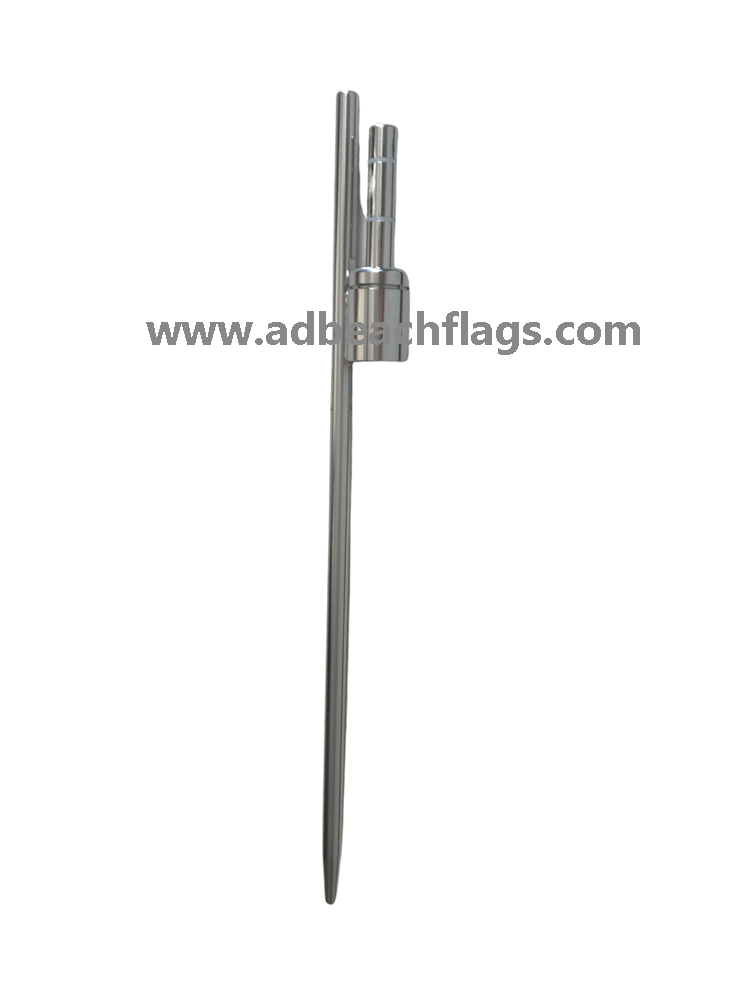
1. Grass aprons take spikes. The pitch surround is soil and turf, and a 1 kg steel spike holds a 4 to 5 m pole through a match afternoon.
2. Hardstanding takes cross base plus water bag. Club car parks, athletics tracks and artificial surfaces need the folding cross base with 10 to 12 litres of ballast.
3. Exposed ends take plates. The flags at the open ends of a ground catch the prevailing wind; 4 to 12 kg steel plates stop the lever action.
4. Rotating bearings save poles. A pinned flag in a crosswind levers its pole all afternoon. Rotating base bearings let the flag swing with the gust and are standard on our club kits.
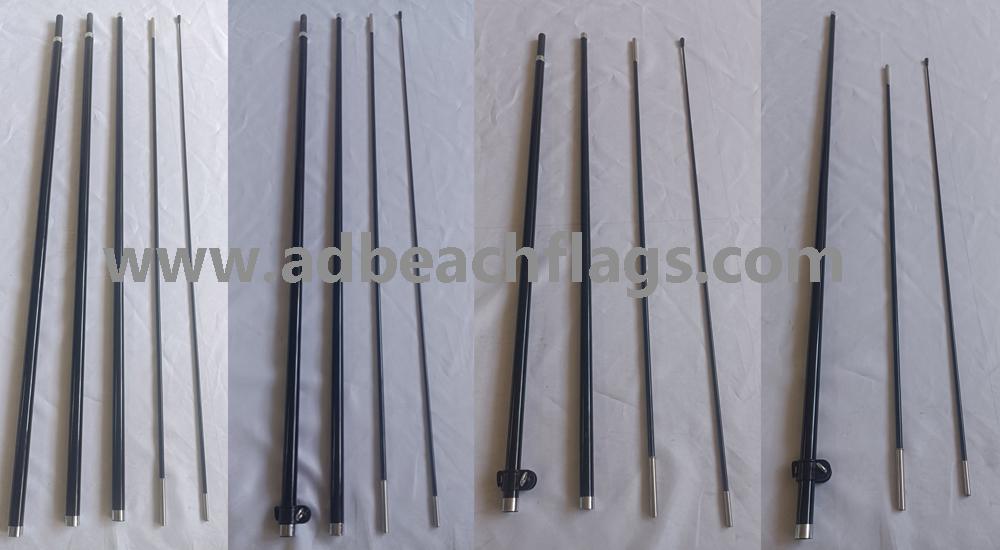
A flag kit that needs riggers will not go up. Published supplier guidance and club practice agree on the maths: one flag takes 1 to 5 minutes for one person, and 20 to 30 flags take a pair of volunteers 60 to 90 minutes, poles screwing together in 3 to 4 sections and spikes tapping in by hand. Static boards for the same run need two people 30 to 60 minutes and a van.
The rest of the routine is discipline: flags come down after the final whistle, skins are dried before storage, and damage is logged at strike so a cracked tip is replaced before the next home fixture, not discovered during it.
Season lengths make a shared kit viable. Football runs August to May, about 38 to 40 weeks, and grassroots September to April, about 30 to 34 weeks. Community rugby runs roughly 36 weeks. Cricket runs late April to late September, about 22 to 26 weeks.
A dual-sport club, or two clubs sharing a ground, can sell the same flag positions to a football sponsor in winter and a cricket sponsor in summer, with two skin sets on one hardware set. The second sport’s revenue is nearly all margin, because the hardware is already paid for.
| Sport | Season window | Weeks | Storage gap |
|---|---|---|---|
| Football, semi-pro | Aug to May | 38 to 40 | 12 to 14 weeks |
| Football, grassroots | Sep to Apr | 30 to 34 | 16 to 20 weeks |
| Community rugby | Sep to May | About 36 | 14 to 16 weeks |
| Cricket | Late Apr to late Sep | 22 to 26 | 26 to 30 weeks |
1. Order skins 4 to 6 weeks before the season. Production runs 5 to 10 days after artwork approval; the buffer covers artwork delays, which are the real bottleneck.
2. Reprint on renewal, not on failure. A skin that lasts one continuous season costs less than losing one renewal over a faded logo.
3. Store dry, off the floor. Damp skins folded into bags grow mildew over summer; a dry shelf adds a season of life.
4. Photograph the built line each season. The photo library becomes next season’s sales deck for new sponsors.
1. Flags too close to the line. The league inspector measures. Keep the 1 m rule from day one.
2. One print, three seasons. UV wins, sponsors notice, renewals drop. One skin per season of display is the norm.
3. Mixed hardware. Three pole brands means three spares inventories and volunteer confusion at 9 am on matchday.
4. Static thinking. Boards sold as permanent stop earning when the sponsor changes. Flags with reprintable skins re-sell the position every year.
United Kingdom and Ireland. The rate-card culture above is strongest here; committees expect written specs and season pricing.
Germany, Austria and Switzerland. Clubs ask for documentation with quotes, and the CHF 300 to 650 benchmark shows pitchside flags selling at continental clubs of every size.
United States and Canada. Youth soccer complexes and multi-field parks run sponsor rows on 4.5 m plus feather flags, spaced per field rather than per ground, often on spikes in the irrigated turf.
Australia and New Zealand. High UV shortens skin life to a season even with careful storage; clubs budget reprints annually and use mesh on exposed coastal grounds.
France and Belgium. Oriflamme kits are the familiar pitchside format at amateur clubs, typically 3.4 to 4.6 m rows behind the try line or along the touchline.
1. Grounds with board-only lease conditions. Some leases grant perimeter boards to a single contractor. Flags will not override a lease.
2. Clubs with no matchday volunteers. If nobody will spend 60 minutes on setup, sponsor money buys static boards instead.
3. One-off tournaments. A single weekend event is cheaper rented than bought, unless the club expects to host annually.
Q1. How far from the touchline must sponsor flags stand?
IFAB Law 1 sets a minimum of 1 m from the touchline and 1 m from the goal nets, and league rules can add more. Removable flag bases make the re-measure easy every matchday.
Q2. How many flags does a standard grassroots ground need?
12 to 24 along the main touchline is the working kit, at 6 to 8 m centres. Full wraps run 40 plus positions and belong to semi-pro grounds.
Q3. Spike or cross base at a club?
Spike in the grass apron, cross base with a 10 to 12 litre water bag on hardstanding and artificial surfaces, steel plates at exposed ends. Rotating bearings are worth it on any open side.
Q4. How long does a printed flag last at a ground?
One season of continuous display is the normal cycle before visible fade, typical for dye-sublimated polyester in full sun. Clubs that take flags down after matches get two to three seasons per skin.
Q5. Can we reuse the poles when a sponsor changes?
Yes, that is the model. Reprint the skin with the new sponsor, about GBP 38.50 retail for a 2.8 m face in the UK and far less factory-direct, and the hardware carries over.
Q6. What does a full club kit cost from the factory?
Custom printed sports flags run roughly USD 26 to 52 per piece at factory level, with tier discounts for 12-plus position kits. Samples take 2 to 3 days and bulk 5 to 10 days after artwork approval.
| Point | Detail |
|---|---|
| Manufacturer, not a reseller | Flags, poles and bases from our own Foshan workshop, one fitting standard across the whole club line. |
| Colour you can hold us to | Pantone and RAL matching with swatch approval, so the sponsor’s logo keeps its colour on camera. |
| Season-tested hardware | Reinforced sleeves, double-stitched seams and rotating bearings specified for volunteer crews. |
| Reprint-only renewals | Artwork stored per sponsor; season two is a skin, not a kit. |
| Low MOQ accepted | A 12-position first line or a full ground wrap, wholesale from 5 pieces. |
| Customer 5stars Feedback | Serving buyers in 150+ countries across Europe, the Americas, the Middle East, Africa and Oceania. |
Sponsor flags work at sports clubs because the economics stack: entry pricing local businesses accept, hardware bought once, skins renewed each season at a fraction of kit cost, and matchday labour measured in volunteer minutes. Sell the position, print the skin, bank the renewal.
Send us the touchline length, the ground surfaces and the sponsor count, and we will reply within 1 hour, 24×7, with a position plan and a factory price. Low MOQ accepted, and we will tell you plainly if your ground suits fewer, taller flags instead of a full row.
Tell us the flag size, the quantity, single or double-sided, and the surface the flags will stand on. Our export team replies within 1 hour, 24×7, with an artwork proof and a factory price. Low MOQ accepted.
Chat on WhatsApp (+86 135 1661 0926) Email Us Now
Prefer a form? Fill in the details below and we will come back with a proof and a price within 1 hour, 24×7.
Related reading: Flag Poles Explained | Flag Base Guide | Beach Flags for Beverage Brands | Feather Flags | Spike Base Stands | Full Fibreglass Poles | Cross Bases | OEM / ODM Manufacturer
| Item | Detail |
|---|---|
| Product | Sponsor flags and season-long pitchside kits for sports clubs |
| Manufacturer | BESDA Advertising Flags, Foshan, Guangdong, China |
| Pitch-line rule | IFAB Law 1: upright advertising at least 1 m from touchline and goal nets |
| Kit sizes | 12 to 24 flags for grassroots main touchline at 6 to 8 m centres; poles 2.8 to 5.6 m |
| Fabric | 110gsm knitted polyester, dye sublimation; one season per continuous-display skin |
| Bases | Spike on grass aprons; cross base plus 10 to 12 L water bag on hardstanding; 4 to 12 kg plates at exposed ends |
| Operations | 1 to 5 minutes per flag, 20 to 30 flags in 60 to 90 minutes by two volunteers |
| Season benchmarks | Football 30 to 40 weeks, rugby about 36, cricket 22 to 26; dual-sport grounds double-sell positions |
| MOQ and lead time | Low MOQ accepted; samples 2 to 3 days, bulk 5 to 10 days after artwork approval |
| Contact | WhatsApp +86 135 1661 0926, [email protected], reply within 1 hour 24×7 |