Phone: 0086-757-8938 9313
WhatsApp: +86 135 1661 0926
Email: [email protected]
Address: Caochang Industrial Zone, Lishui, Nanhai, Foshan, Guangdong, China
24/7 Online Services
Phone: 0086-757-8938 9313
WhatsApp: +86 135 1661 0926
Email: [email protected]
Address: Caochang Industrial Zone, Lishui, Nanhai, Foshan, Guangdong, China
24/7 Online Services

A cafe owner sent us two flags last spring and asked why one read like a poster and the other like a smudge. Same pole height, same fabric, same logo. The difference was the shape. The teardrop curved her two-line message into the taper and the corners ate her letters, while the rectangle flags beside it printed every character at full width. That comparison is the whole subject of this page, and it settles most arguments in about ten minutes of arithmetic.
The short answer: rectangle flags, the straight-edge blade family sold in many catalogues as rectangular feather flags or blade flags, give you the largest usable print area per kit. A teardrop prints roughly 60 to 70 percent of its bounding size because the curve eats the edges, but it holds that printed face taut in wind and calm, which makes it the better stage for a single logo or one bold word. The rest of this page puts numbers on that trade so you can pick by arithmetic instead of by catalogue mood.
It is written for distributors, event companies, retail buyers and importers who choose between the two shapes before the artwork exists, which is the only moment the choice is cheap.
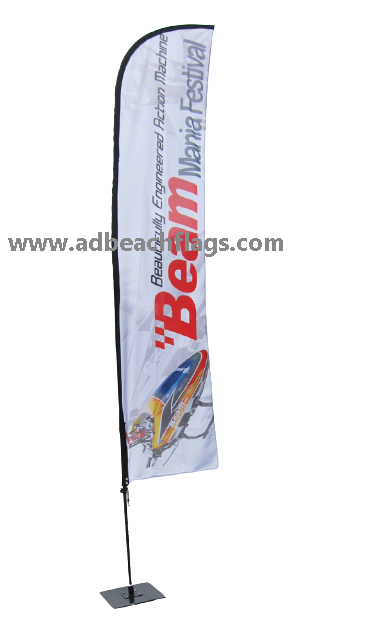
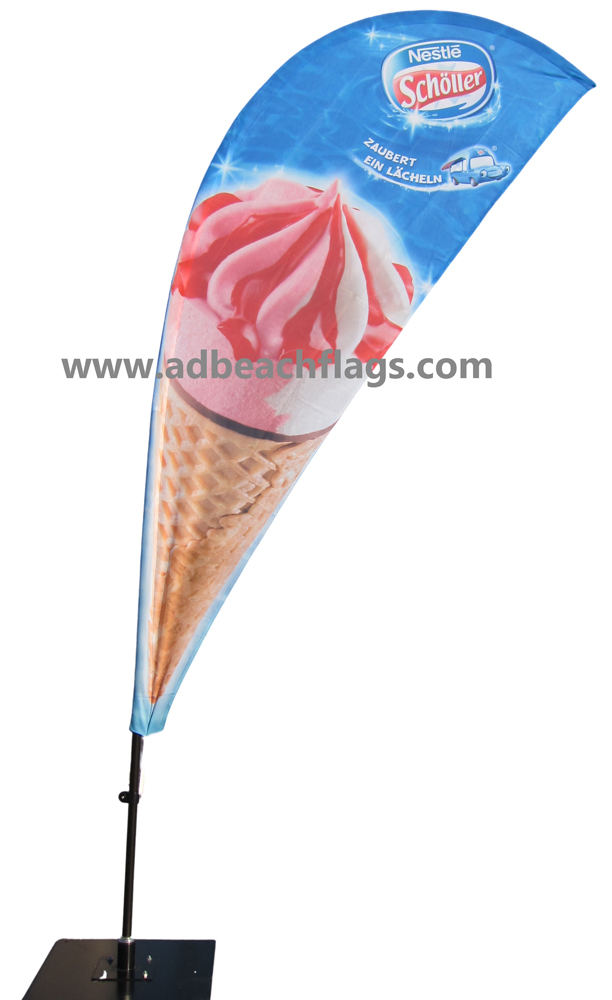
Naming first, because catalogues muddle it. What most suppliers call a rectangle flag is a straight-sided blade with parallel vertical edges and a swept or angled top. In our own catalogue the same family sits under feather flags, and US buyers also say flutter flag or blade flag. The teardrop is the drop shape: a rounded dome top that tapers to a point near the pole foot, called bandiera a goccia in Italy, Rechteckfahne versus Drop-Flagge in Germany, and drapeau rectangulaire versus drapeau goutte in France.
Behaviour follows the shape. A rectangle flag catches air along its straight edge and flutters, which moves the print but also moves the eye, and the full width is print from pole sleeve to edge. A teardrop is stretched on a curved top section, so the fabric is always under tension. It reads flat when the wind drops, which is why indoor halls and windless courtyards favour it.
Every flag starts as a rectangle of fabric, the bounding size. Two deductions turn that into what you can actually print. The pole sleeve takes about 4 cm along one edge, hems take about 2 cm per edge, and a teardrop then loses more to the curve, because the printable band narrows toward the top dome and the bottom taper. Our factory works on a usable area of about 85 to 90 percent of bounding for rectangle blades and about 60 to 70 percent for teardrops, and those bands match the way trade templates are cut across the industry.
| Flag | Size (cm) | Bounding area | Usable print, about | Share of bounding |
|---|---|---|---|---|
| Rectangle M (feather) | 70 x 290 | 2.03 m2 | 1.80 m2 | about 89% |
| Rectangle XL (feather) | 75 x 410 | 3.08 m2 | 2.77 m2 | about 90% |
| Teardrop S | 85 x 190 | 1.62 m2 | 1.00-1.15 m2 | about 62-71% |
| Teardrop M | 95 x 230 | 2.19 m2 | 1.30-1.50 m2 | about 59-68% |
| Teardrop XL | 110 x 300 | 3.30 m2 | 2.00-2.30 m2 | about 61-70% |
| Teardrop XXL | 130 x 330 | 4.29 m2 | 2.60-3.00 m2 | about 61-70% |
Read one comparison off the table and the argument ends. A rectangle M blade on a 400 cm pole prints about 1.80 square metres. A teardrop M on the same pole class prints about 1.30 to 1.50. The teardrop needs to jump two sizes, to a 110 x 300 skin, before its usable area catches the mid rectangle, and by then the pole, the bag and the freight have grown with it.
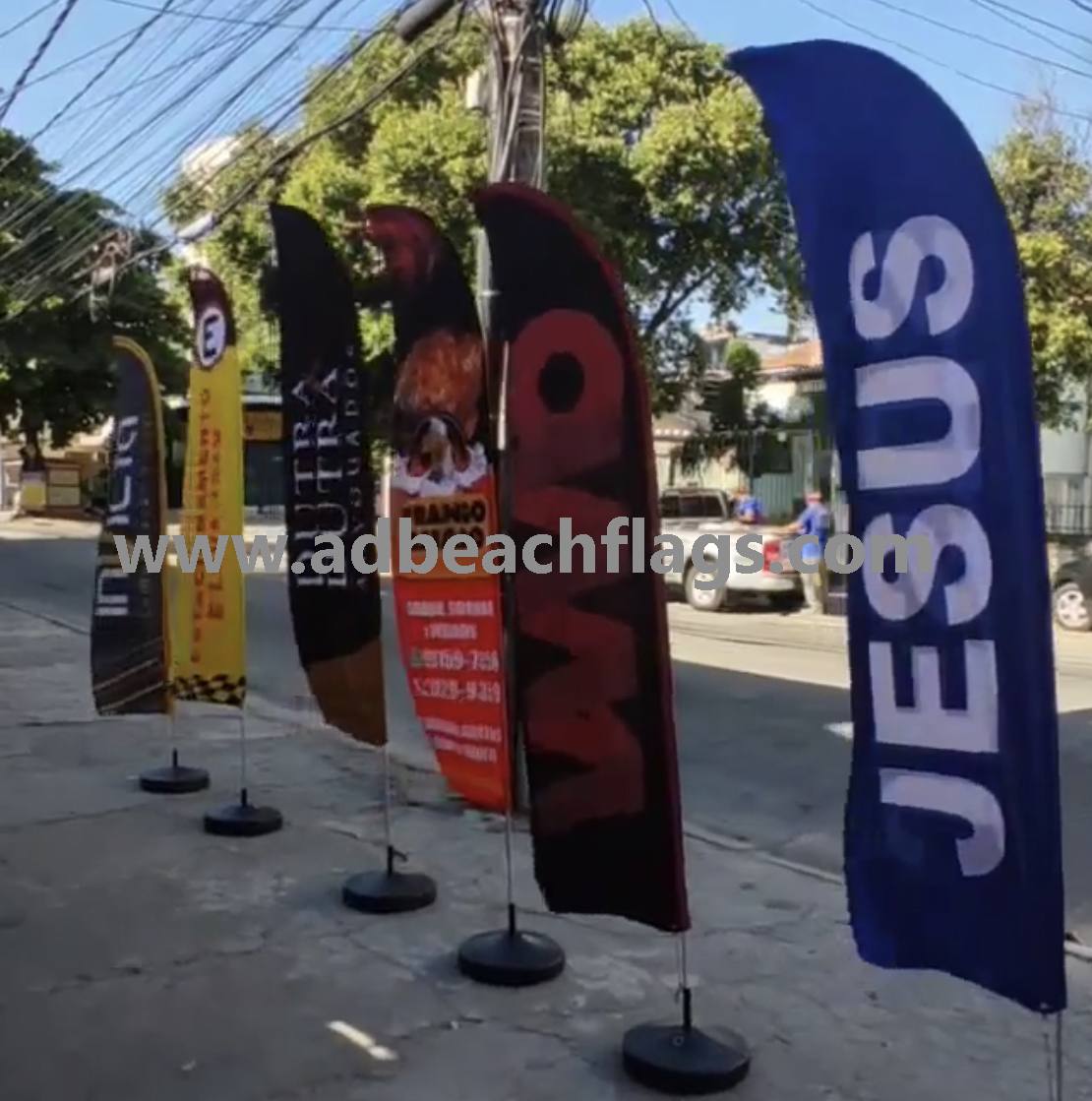
Print area matters only when it converts into letters someone can read. A common industry guideline, credited to the US Sign Council Foundation, allows about 30 feet, 9 metres, of reading distance per inch of capital letter height. Comfortable reading sits closer to 1 inch per 10 feet, 3 metres, which is the figure our own size guide uses for sidewalk work.
| Viewing distance | Capital letter height | What fits on the flag |
|---|---|---|
| 3 m (sidewalk, stall front) | about 100 mm | Rectangle M usable width 64 cm fits 6-8 characters per line |
| 10 m (park path, forecourt) | about 330 mm | Rectangle XL fits 2-3 large words; teardrop XL fits 1-2 in the top band |
| 25 m and beyond (roadside) | 750 mm and up | One word or one mark; either shape becomes a poster, not a paragraph |
The teardrop width figure in the middle row deserves a caution. Its widest band sits high on the dome, and the usable band narrows below it, so the 110 cm bounding width is not 110 cm of print all the way down. Set type to the narrowest band the letters will live in, not to the widest point of the fabric.
1. Rectangle flags carry text for a living. Parallel edges hold a baseline, so names, price lines and two-language messages set cleanly. Retail parks, dealer forecourts and market rows buy rectangles because the message is usually more than a logo.
2. Teardrops carry a mark and a word. The tensioned face suits one logo, one symbol or one word set large. Keep the content in the upper two thirds, above where the taper begins, and the flag reads like a stamp from any distance.
3. Design to the template, not to the bounding size. Every supplier cuts to a template with the pocket and bleed built in. Our artwork guidelines send AI and PDF templates with the safe area marked, and designs that respect it survive both shapes.
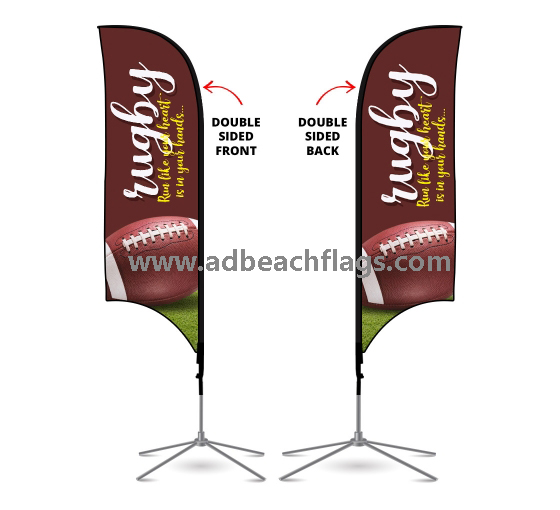
4. Face the second side honestly. A single-reversed rectangle shows the back of the print mirrored and lighter, roughly 90 percent show-through on 110gsm fabric. Where two-way traffic reads the flag, a double-sided build with a blockout liner prints both faces true and adds about 30 percent weight.
Wind is the other half of the decision. A teardrop stays taut from still air to the top of the range, so the artwork never collapses into a limp fold. A rectangle flies and flutters, which draws the eye in a breeze but folds the letters when the air stops, and a word-heavy rectangle in a windless hall reads worse than a teardrop carrying one word.
The limits run roughly as follows across the trade. Single-sided flags take a typical limit of 25 to 30 mph, double-sided builds about 13 to 17 mph because three layers catch more load, and sustained Beaufort 4 winds, 13 to 18 mph, are the sensible strike threshold for anything marginal. On exposed coastal sites a 120gsm mesh rectangle cuts wind load by about half while the teardrop shape itself sheds load by tension. Both strategies work; pick per site, not per catalogue.
Prices sit close between the two shapes at the same size class, which is what makes the area maths worth doing. At trade quantity, complete kits from Chinese factories typically run about 5 to 25 dollars per flag depending on size and sides, and European retail for a full kit runs about 73 to 160 euros. US retail for custom kits sits near 110 to 170 dollars. Double-sided printing adds roughly 15 to 30 percent across the trade, and the blockout liner explains why on its own.
Divide kit price by usable print area and the rectangle wins the per-square-metre contest at every matched size, usually by 20 to 40 percent. The teardrop wins the per-glance contest when the message is one mark. So the honest framing is: buy rectangles to say more, buy teardrops to say it steadier.
| Site and message | Shape | Size and sides | Why |
|---|---|---|---|
| Sidewalk cafe, two-way foot traffic | Rectangle | M, double sided | Word plus prices, read from both directions |
| Trade show hall, still air | Teardrop | S or M, single | Stays taut when nothing moves the fabric |
| Dealer forecourt, roadside speed | Rectangle | XL, single | Largest letters per kit at the money |
| Sponsor line at a festival fence | Teardrop or rectangle | M, single | One mark repeated; match the whole line |
| Coastal promenade, open wind | Rectangle in mesh | M or XL, single | Mesh sheds about half the load |
| Market stall, one bold word | Teardrop | S, single | Cheapest taut face, reads like a stamp |
Honest guidance, because the maths also says stop sometimes.
1. Text-heavy artwork on a small budget. If the message runs past 15 words, a flag of either shape is the wrong board. A rect banner or an A-frame prints that copy at reading size for less money, and the flag above it carries the one pulling word.
2. Fleets with poles already in the van. If your hardware exists, the shape debate is settled by the poles. Order replacement skins matched to sleeve width and flag length, three measurements or one photo, and the new print lands without new metal.
3. Single weekend, sheltered lawn. At two events a year in calm conditions, the durability and tautness differences barely show. Buy on price and proof speed, and single-sided rectangles usually win that.
1. Designing to the bounding size. Artwork drawn edge to edge loses the corners and the bottom band when the template cuts it. Design to the safe area and the loss is planned, not discovered.
2. Small caps on a big flag. Letters under 100 mm die past sidewalk distance. Scale the type to the farthest reader, then let the flag size follow the type, not the other way round.
3. Teardrop type below the taper. Content that sinks into the narrowing bottom band prints at half width. Keep it in the upper two thirds of the dome.
4. Double-sided everywhere by default. The liner adds weight, cost and wind load. Fit it where two-way reading pays for it, and spend the saving elsewhere.
5. Matching skin to pole by eye. Sleeve width and flag length are pairs, not approximations. Send the pole class or a photo and the skin ships right the first time.
United States and Canada. Buyers say rectangle flag, blade flag or flutter flag, and the rectangle is the default forecourt and retail-park shape. Sizes quote in feet, so our 4.6 m pole class sells as a 15 ft kit.
United Kingdom and Ireland. Sail flag and rectangle feather flag dominate the trade vocabulary, and teardrops hold a strong second on high streets. Confirmation of pole class in centimetres avoids the feet-versus-metres mix-up on reorders.
Germany, Austria and Switzerland. Rechteckfahne versus Beachflag in Drop-Form. Written tolerance on print colours matters more here than anywhere else, so colour references go on the order, not in a phone call.
France, Spain and Latin America. Drapeau rectangulaire, bandera rectangular, bandeira retangular: same sums in three languages. Latin American market traders favour short single-sided rectangles for price, with vela the word they search first in coastal towns.
Australia and New Zealand. Rectangle flags for roadside retail, teardrops for surf clubs and markets. UV makes fabric weight a first-order spec, so 115gsm and mesh earn their line on the quote.
| Feature | Advantage | Benefit you bank |
|---|---|---|
| Straight-edge rectangle blades | About 89-90% of bounding prints | More message per kit at the same price |
| Tensioned teardrop face | Reads flat in still air and in gusts | Logo shows steady from open to close |
| Templates with safe areas marked | Artwork survives the cut first time | No reprint rounds eating the schedule |
| Blockout double-sided option | Both faces true in two-way traffic | One flag sells the stall from both ends of the street |
| Skins matched to existing poles | Three measurements clone the fit | Change the message without buying metal again |
Q1. Which shape has more print area?
Rectangle flags. A 70 x 290 cm blade prints about 1.80 square metres, while teardrops use about 60 to 70 percent of their bounding size, so a same-class teardrop prints roughly 1.30 to 1.50.
Q2. Can I put lots of text on a teardrop flag?
Up to about five words prints well if it sits in the upper two thirds. Longer copy belongs on a rectangle blade or a banner, where the baseline stays straight to the bottom.
Q3. Do teardrop and rectangle flags cost the same?
At matched size classes, yes, within a few percent, which is why area per kit decides value. Factory kits typically run 5 to 25 dollars per flag at trade quantity, and double-sided adds about 15 to 30 percent.
Q4. Which shape is better in wind?
The teardrop holds its face taut across the widest wind range. For exposed sites, a single-sided rectangle in 120gsm mesh sheds about half the load and carries more message. Strike anything marginal at Beaufort 4.
Q5. What does single reverse mean for my artwork?
The flag prints one layer, so the reverse shows the design mirrored and lighter, about 90 percent show-through on standard fabric. Double-sided builds add a blockout liner so both faces read true.
Q6. How do I match a new skin to poles I already own?
Send the pole class, or measure sleeve width, flag length and bottom width. We clone the fit from those three numbers and the skin ships to your existing hardware.
| Point | Detail |
|---|---|
| Manufacturer, not reseller | Both shapes print and sew on our own lines in Foshan, so the template, the pole and the skin ship matched. |
| Templates before money | Free AI and PDF templates with safe areas marked, and a proof before any payment. |
| Written specs | Fabric weight, sides, sleeve width and finished size stated on the quotation, with test documents on request. |
| Pre-production sample | A printed sample in 2-3 days; bulk starts on your written approval only. |
| Low MOQ accepted | Wholesale from 5+ pieces, so a mixed teardrop and rectangle trial does not need a container. |
| Reply in 1 hour, 24×7 | WhatsApp +86 135 1661 0926 or [email protected]. Brands we have served in 150+ countries buy both shapes from the same lines. |
Print area maths settles the shape argument in one sitting. Rectangle flags return about 90 percent of their bounding size, so they carry the words, the prices and the two-language messages. Teardrops return 60 to 70 percent but hold the face taut, so they carry the mark that must never wrinkle. Match the shape to the message, the sides to the traffic and the fabric to the wind, and either flag pays for itself in a season. Send us the artwork or just the list of words, and we reply in 1 hour, 24×7, with the template, the area sums and factory pricing for both shapes.
Tell us the flag sizes, the quantities, single or double-sided, and the ground the flags will stand on. Our export team replies within 1 hour, 24×7, with a proof and a factory price. Low MOQ accepted.
Chat on WhatsApp (+86 135 1661 0926) Email Us Now
Prefer a form? Fill in the details below and we will come back with a proof and a price within 1 hour, 24×7.
Related reading: Teardrop vs feather flag: which shape fits your site | Beach flag size guide: choosing the height | Flag artwork guidelines: files, templates and safe areas | Single vs double sided flags: when the liner pays | Custom feather and rectangle blade flags | Custom teardrop flags | Double sided beach flags | Flag poles | Factory credentials and QC
| Item | Detail |
|---|---|
| Product | Teardrop flags and rectangle (blade) feather flags, single or double sided, with poles and bases |
| Manufacturer | BESDA Advertising Flags, Foshan, Guangdong, China |
| Print area rule | Rectangle blades print about 85-90% of bounding size; teardrops about 60-70% after pocket, hems and curve |
| Rectangle example | 70 x 290 cm blade: 2.03 m2 bounding, about 1.80 m2 usable print |
| Teardrop example | 95 x 230 cm teardrop: 2.19 m2 bounding, about 1.30-1.50 m2 usable print |
| Letter height guide | About 30 ft of reading distance per inch of capital height (industry guideline); 1 inch per 10 ft comfortable |
| Fabric | 110gsm knitted polyester standard; 120gsm mesh for exposed sites; blockout liner for double sided |
| Lead times | Sampling 2-3 days; bulk 5-10 days after written approval; express 3-7 days |
| MOQ & pricing | Low MOQ accepted, wholesale from 5+; factory kits typically $5-25 per flag at trade quantity |
| Contact | WhatsApp +86 135 1661 0926, [email protected], reply in 1 hour 24×7 |