Phone: 0086-757-8938 9313
WhatsApp: +86 135 1661 0926
Email: [email protected]
Address: Caochang Industrial Zone, Lishui, Nanhai, Foshan, Guangdong, China
24/7 Online Services
Phone: 0086-757-8938 9313
WhatsApp: +86 135 1661 0926
Email: [email protected]
Address: Caochang Industrial Zone, Lishui, Nanhai, Foshan, Guangdong, China
24/7 Online Services

Flag, banner and sign are three answers to one question: where does the message stand, and how far away is the reader? Buyers who mix them up usually pay twice, once for the medium that cannot do the job and again for the one that can. The flag moves. The banner hangs. The sign stands still and carries detail. Everything else is detail about where the reader stands.
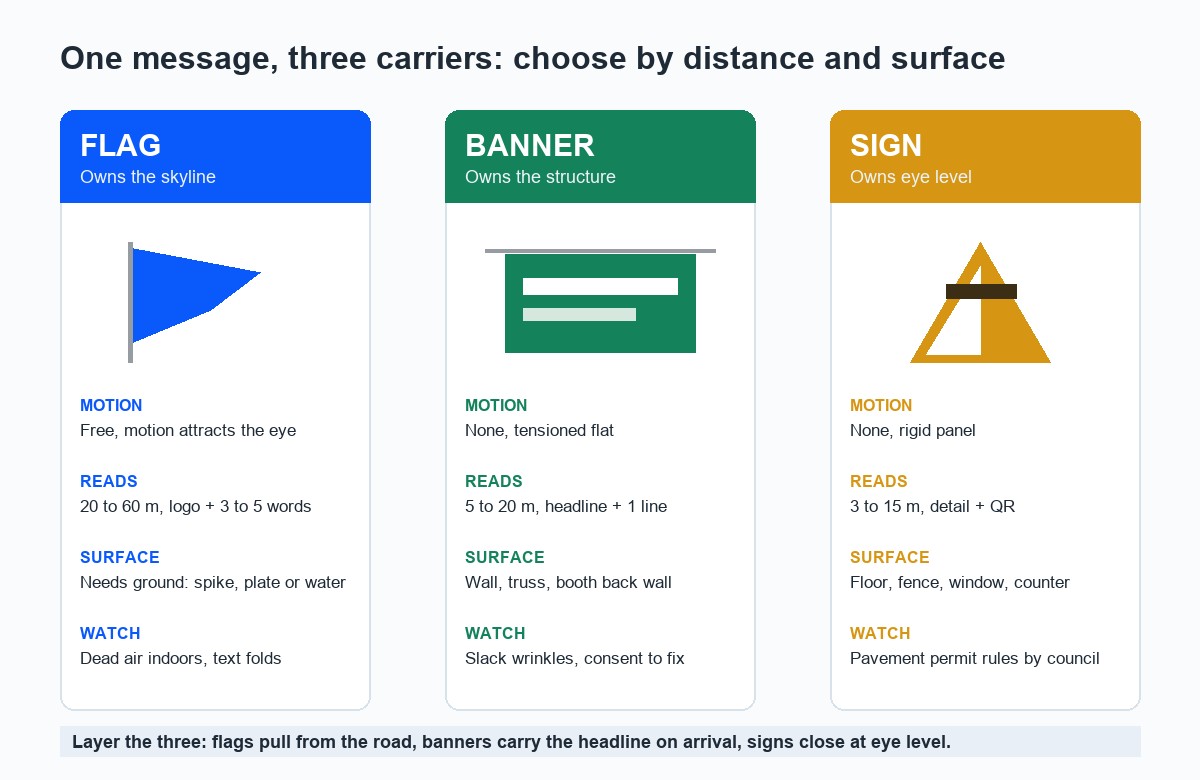
The short answer for buyers: a flag owns the skyline above a crowd, a banner owns a wall or a backdrop, and a sign owns eye level. A three word message travels 20 to 60 metres on a flag at height. A headline plus one support line works on a banner at 5 to 20 metres. A sign carries the fine print, the opening hours and the directions that people read from 3 to 15 metres. Choose by distance and surface first, and the rest of the decision follows.
This guide is written for brand teams, event companies, retail buyers and distributors who plan sites in the US, UK, Australia, Germany and the Gulf and need one message system, not three random purchases. The ranges are typical field values from supplier specifications and our workshop records in October 2026.
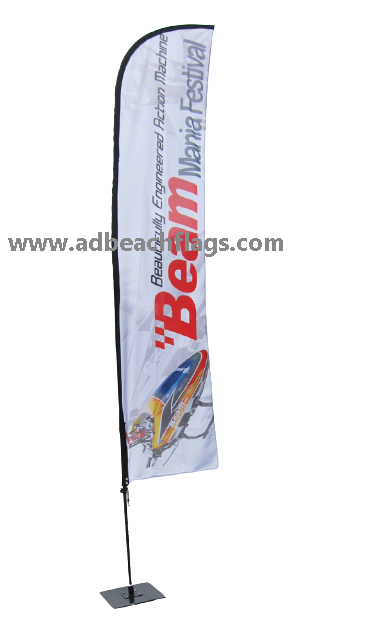
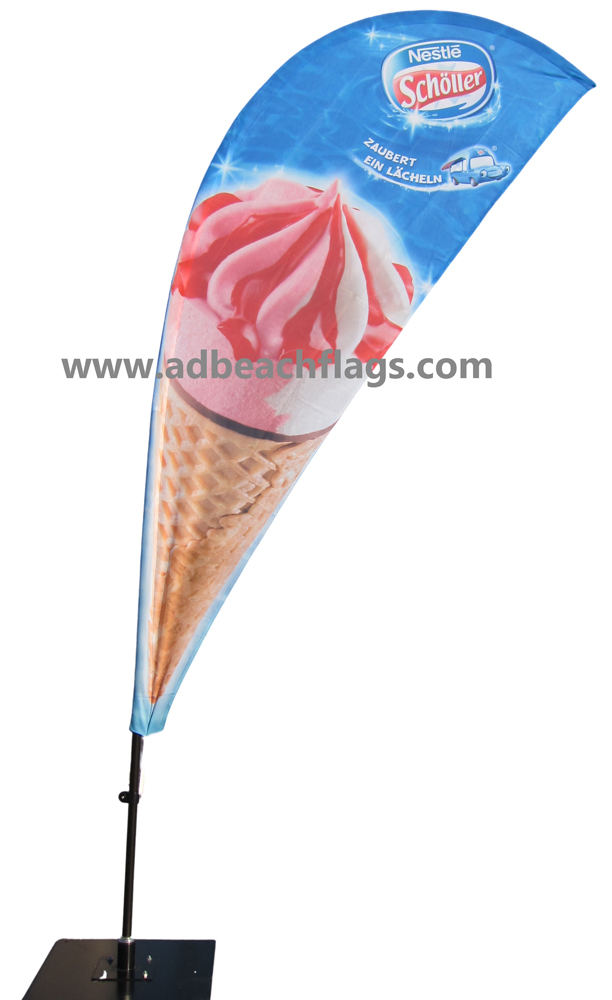
A flag is printed fabric held by a pole, free to move in the wind. Feather, teardrop and rectangular flags all belong here, at kit heights from 2.8 to 5.6 m. The fabric is usually 110 to 130gsm knitted polyester, single or double-sided, and the movement is not a side effect. Motion is the flag’s main channel: a still flag at 30 m is a decoration, a moving one at 30 m is a signal the eye picks up before anything static.
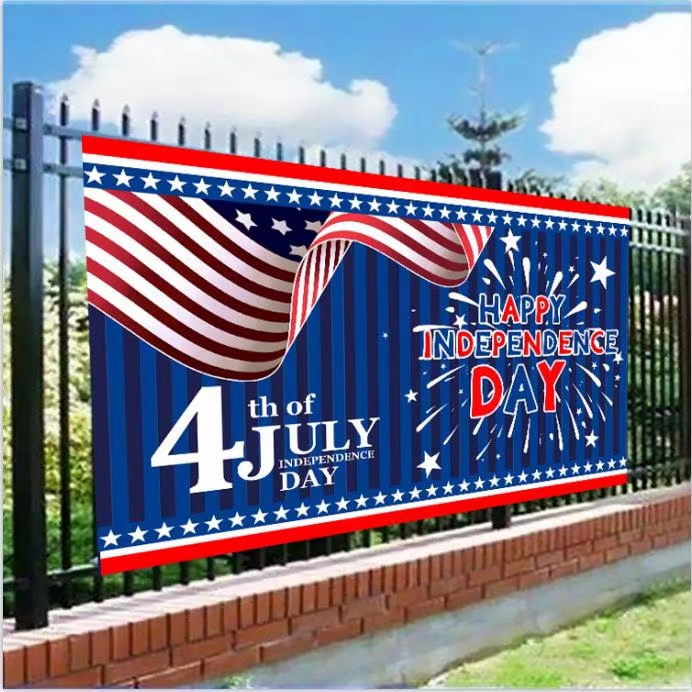
A banner is fabric or vinyl fixed to a structure: a wall banner laced to a shopfront, a backdrop hung behind a stage or booth, a horizontal banner strung across a street festival. It does not move, so it carries more words and cleaner lines. It needs fixing points, a frame or a stand, and its enemy is flapping, which is why wind-rated mesh or tensioned builds exist for exposed walls.
A sign is rigid: an A-board on the pavement, a Correx panel cable-tied to a fence, a foam board in a window, an aluminium composite panel bolted to a wall. It does not flex, so it prints small text, arrows, prices-free detail like opening hours and QR codes. It needs no ground and no wind rating, which makes it the default indoors and the most regulated medium outdoors, because every council from Sydney to Frankfurt has rules about A-boards on public pavement.
The rectangular flag deserves its own sentence, because it is a hybrid: mounted and moving like a flag, but with a print area closer to a banner. When the message needs both motion and a paragraph, the rectangle is usually the honest answer, and the print area maths article covers what actually fits.
Almost every wrong purchase traces back to skipping one of four questions. Ask them in order.
| Axis | Flag | Banner | Sign |
|---|---|---|---|
| Motion | Free, motion is the message | None, tension or lace flat | None, rigid |
| Height | 2.8 to 5.6 m on its own pole | Whatever the wall or frame allows | Eye level, 1.2 to 1.8 m |
| Message | Logo plus 3 to 5 words | Headline plus one support line | Details, arrows, hours, QR |
| Surface need | Ground: grass, soil, paving, plate or spike | Structure: wall, frame, truss | Floor, fence, window, wall |
| Wind behaviour | Built for it; takedown at 25 mph sustained | Must be tensioned or meshed | Indifferent unless loose |
| Change cycle | Swap the skin, keep the pole | Reprint the whole piece | Reprint the panel |
The field rule of thumb for outdoor text: each 25 mm of letter height buys roughly 10 metres of readability for a paying-attention reader, and you can roughly double the distance by doubling the letter height. Real sites are messier, because glare, crowd and speed all cut the range, so treat the numbers below as planning ranges, not promises.
| Medium | Typical reading range | Message budget | Where it earns its place |
|---|---|---|---|
| Flag at 3 to 5.6 m | 20 to 60 m for a 3 to 5 word message | Logo plus 3 to 5 words | Entrances, forecourts, festival lanes, car lots |
| Banner on wall or truss | 5 to 20 m | Headline plus one support line | Backdrops, stage sets, shopfronts, aisles |
| Sign at eye level | 3 to 15 m | Detail: hours, arrows, QR, terms | Doors, tills, fences, pavement offers |
Two honest notes sit under that table. First, a flag’s range collapses in still air, because the message folds up with the fabric; indoor flags are a different product decision. Second, a banner’s range depends on tension, because a slack banner wrinkles at 5 metres and reads like a rumour. Both problems have fixes, but the fixes are different products, which is exactly why the choice matters before the artwork is drawn.
The flag wins above the crowd. Any site where the reader is moving, the background is busy and the ground is available: forecourts, festival entrances, sports fields, coastal promenades, dealership lots. The flag’s pole lifts the message over heads and cars, and the motion does the attracting for free. This is why car dealerships and fuel stations in the US and Australia run feather flags as their default skyline and put the details on the window instead.
The banner wins where a structure already exists. A stage backdrop, a booth back wall, a shopfront fascia, a festival gate. The banner turns architecture into message area without occupying floor space, and it carries the second line of text a flag cannot. In exhibition halls, where venues cap displays at the 2.4 m booth line, the banner is often the only legal big canvas, and the trade show sightline article explains what that line does to flag choices.
The sign wins at the point of decision. The reader is standing still, close, and ready to act: the A-board at the door, the Correx arrow at the fork in the path, the foam board at the till. Signs carry what flags and banners cannot afford to print, and they move between sites in a stack. Their weakness is the same rigidity: a sign in wind without fixing becomes litter, and a sign with no permission becomes an argument with a council officer.
| Question | Flag | Banner | Sign |
|---|---|---|---|
| Needs ground? | Yes, base by surface | No, needs structure | No |
| Needs wind plan? | Yes, rated 30 or 17 mph by sides | Yes, tension or mesh | Only if loose |
| Carries small text? | No | One line | Yes |
| Sets up in minutes? | Yes, one person | Two people for large builds | Yes, carries in a stack |
| Survives seasons? | Skin fades first, pole outlasts | Fabric ages at the fixings | Panel swaps cheaply |
| Permit exposure | Footprint rules on public land | Structure owner consent | Pavement rules vary by council |
An honest guide needs a SKIP IT list, and for flags it is short and strict. Skip the flag indoors where air does not move: a limp flag in a shopping centre reads as neglect, and a tension fabric wall does the same job better. Skip the flag when the message is more than five words: the text folds, and a folding paragraph is unreadable at any distance. Skip the flag when the venue caps height at the booth line and the aisle is narrow, because the motion that makes flags work needs room. And skip the flag where there is no ground and no base surface, because a flag with nothing to stand on is a banner with extra steps.
The same honesty applies to the other two. A banner is the wrong tool when the wall belongs to someone else, which is a consent problem, not a print problem. A sign is the wrong tool for distance: no A-board ever read at 40 metres, however bold the font.
The strongest sites do not choose. They layer the three media so each one does the job it was built for, and the layers point at each other.
Outside, at distance: two or three flags on the entrance line, each carrying the brand and three words, matched to the surface with the right base. This is the layer that pulls traffic from the road and the next block.
At the point of arrival: a banner or backdrop carrying the headline and the offer, placed where people stop walking. On a booth, this is the back wall under the 2.4 m line. On a shopfront, this is the fascia and the window bays.
At the point of action: signs that carry hours, directions and the QR code, placed exactly where the hand or the phone is ready. Nobody photographs a banner to get the opening hours. They photograph a sign, or better, they scan it.
Ordering the three as one kit from one factory keeps the colour matched across fabric and rigid stock, and it means the pallet arrives with one packing list. Every layer installs in minutes: flags assemble with a push and a twist, banners lace or zip to the frame, signs carry in a flat stack. Distributors who consolidate report fewer mismatches between the flag blue and the panel blue, which is the kind of detail consumers notice without being able to name it.
The feature is one factory covering flags, banners and rigid sign stock. The advantage is colour matched across every medium on the site. The benefit is a message system that reads as one brand from the road to the till.
| What we do | What it means for your site |
|---|---|
| Full range under one roof | Feather and teardrop flags, banners and rigid stock specified together, so colour and message match across media. |
| Written specs, not photos | Fabric weight, kit height, base type and print area quoted as lines, so procurement can compare offers. |
| Mockup before print | Every order gets a proof of the message at real proportions, so the three word budget is tested before production. |
| Low MOQ accepted | Wholesale from 5+ pieces, mixed media in one shipment, one packing list. |
| Reply in 1 hour, 24×7 | WhatsApp +86 135 1661 0926 or [email protected]; we ship to buyers in 150+ countries. |
Both, practically. It mounts on a pole like a flag and carries a print area closer to a banner, which makes it the pick when a message needs motion plus more text than a feather or teardrop can hold.
Plan for a logo plus 3 to 5 words. The text folds with the fabric, so anything longer reads in fragments. Put the detail on a sign at eye level or a banner on the wall behind.
The system outlasts any single piece: poles and bases outlive skins, and rigid panels are the cheapest to reprint. Plan for skin replacement on a seasonal cycle and keep the hardware, the same way the replacement covers guide describes.
Flags on private land with a safe footprint rarely need more than the owner’s consent. Banners need the structure owner’s consent. Signs on public pavement are the most regulated, and rules change council by council in the UK, Australia and Germany, so check locally.
Yes. Flags, fabric banners and rigid sign stock are produced and shipped together, with colour matched across media and one packing list for the whole kit.
Send the site plan or photos, the surface mix, the message for each medium and the quantities. Our export team returns a layout with kit heights, base types and a proof inside 1 hour, 24×7.
Choose by distance and surface and the argument ends: the flag owns the skyline at 20 to 60 metres with 3 to 5 words, the banner owns the structure at 5 to 20 metres with a headline, and the sign owns eye level at 3 to 15 metres with the detail. Layer them as one system, match the bases to the ground, respect the wind limits and the venue lines, and one factory can keep the whole message matched from fabric to panel. Send us the site and the message, and the layout comes back inside 1 hour, 24×7.
Tell us the flag sizes, the quantities, single or double-sided, and the ground the flags will stand on. Our export team replies within 1 hour, 24×7, with a proof and a factory price. Low MOQ accepted.
Prefer a form? Fill in the details below and we will come back with a proof and a price within 1 hour, 24×7.
Related reading: Teardrop vs rectangle flags: print area maths | Teardrop flag vs feather flag: which shape fits | Trade show flags: booth height, aisles and the 20-foot rule | Flag fabric weight explained: 110gsm vs 130gsm vs mesh | Replacement feather flag covers: keep the pole, change the message | Custom feather flags | Custom teardrop flags | Flag banners
| Item | Detail |
|---|---|
| Product | Advertising flags, fabric banners and rigid sign stock, specified and shipped as one system |
| Manufacturer | BESDA Advertising Flags, Foshan, Guangdong, China |
| Flag range | Feather, teardrop and rectangular kits, 2.8 to 5.6 m, knitted polyester 110 to 130gsm |
| Reading ranges | Flag 20 to 60 m for 3 to 5 words; banner 5 to 20 m; sign at eye level 3 to 15 m |
| Wind limits | Standard flag kits about 30 mph single-sided and 17 mph double-sided; takedown at 25 mph sustained |
| Venue rule | Exhibition booths commonly cap displays at the 2.4 m line; banners carry the big canvas under the cap |
| System logic | Flags pull at distance, banners carry the headline at arrival, signs hold detail at the point of action |
| Lead times | Proof 1-3 days; sampling 2-3 days; bulk 5-10 days; express 3-7 days, air 5-8, sea 25-40 |
| MOQ and trade terms | Low MOQ accepted, wholesale from 5+ pieces; HS 6307.90 for printed polyester flags |
| Contact | WhatsApp +86 135 1661 0926, [email protected], reply in 1 hour 24×7 |