Phone: 0086-757-8938 9313
WhatsApp: +86 135 1661 0926
Email: raya@besda.net
Address: Caochang Industrial Zone, Lishui, Nanhai, Foshan, Guangdong, China
24/7 Online Services
Phone: 0086-757-8938 9313
WhatsApp: +86 135 1661 0926
Email: raya@besda.net
Address: Caochang Industrial Zone, Lishui, Nanhai, Foshan, Guangdong, China
24/7 Online Services

A franchise buyer sent us two flags last month and one question. The older flag, printed on 110gsm knit polyester, still read clean after a summer on the forecourt. The newer one, a “premium upgrade” from a marketplace seller, hung heavier, showed a faint mirror of the logo on its back face, and had already gone stiff at the hem. The weight was higher on paper and worse in the field, because fabric weight only pays when it matches the printing process, the wind and the construction around it. This page sets out what 110gsm, 130gsm and mesh actually deliver, what the numbers mean in the ounce terms US buyers use, and where spending more fabric buys nothing at all.
The direct answer: 110gsm knitted polyester is the working standard for single sided advertising flags, 130gsm earns its keep in high UV regions and on the faces of double sided builds, and open mesh belongs on exposed coastal sites where shedding wind matters more than a dense print. If your flags fly for one weekend at a time in a city, the standard weight is the right invoice. If they stand for months against strong sun, the heavier face is the cheap insurance.
This guide is written for distributors, print resellers and brand teams who specify flags and need to read a fabric line on a quotation with confidence.
1. A buyer orders by feel. The quote says “premium polyester” with no weight, and the buyer assumes heavier equals better because that logic works for hoodies.
2. The print process is missing from the comparison. Dye sublimation bonds ink inside polyester fibre, so fabric weight changes how much dye the face can carry and how much shows through. UV printing on coated fabric behaves differently again, so two flags of the same weight can age in different directions.
3. Nobody converts the units. A US spec sheet reads “4 oz”, a UK sheet reads “115gsm”, and a factory invoice reads “110gsm warp knit”. Without a conversion, premium claims cannot be compared, only believed.
4. The first windy weekend writes the review. A heavy flag that barely moves in light wind reads as “durable” until it loads the pole in a gust, and a light flag that flaps beautifully reads as “cheap” the day it frays at the fly end.
5. The consequence is a reorder in the wrong direction. Buyers who were sold overweight fabric for a calm site pay more forever; buyers who were sold underweight fabric for a coastal site pay twice, once now and once for the replacement.
6. The decision this article settles: match weight to wind, sun and construction on purpose, and put the number, not the adjective, on the purchase order.
Two scales describe fabric, and they answer different questions.
1. Denier measures the yarn. It is the weight in grams of 9,000 metres of the yarn itself. A 75D yarn is finer than a 100D yarn; a 100D polyester knit typically lands near 90 to 110gsm as cloth, depending on how tightly it is knitted.
2. gsm measures the cloth. Grams per square metre is the weight of finished fabric, and it is the number that decides feel, opacity and price. Two fabrics of the same denier can differ in gsm because knit density varies.
3. Ounces are the US dialect. One ounce per square yard equals about 33.9gsm, so 3 oz is roughly 102gsm and 4 oz is roughly 136gsm. Here is the trap: parts of the US flag trade label 110gsm fabric as “4 oz” using ounces per linear yard, not per square yard. When a quote says ounces, ask which ounce. The confusion is why identical flags get quoted as both “3 oz” and “4 oz” across the border.
1. 110gsm knitted polyester is the industry workhorse. Dye sublimation bonds cleanly into it, colours read saturated, the flag moves in the lightest breeze, and it carries the single reverse construction that most feather and teardrop flags use. Across typical factory ranges it prints at moderate cost and ships for years of seasonal use, with an outdoor life commonly quoted at 6 to 12 months of continuous display.
2. 130gsm is the sun and double-sided weight. The extra mass deepens solid colours, resists wind-driven abrasion a little better, and gives a double sided build a face that reads solid. In high UV regions, buyers step up to it for flags that stand for months. The trade-offs are real: the flag weighs more on the pole, flaps less eagerly in weak wind, and costs more per square metre.
3. Mesh is the wind tool. An open knit lets air pass, which cuts the sail load on the pole and base on exposed sites. The costs: colours print softer because light passes through the weave, fine detail loses a little edge, and the open structure abrades faster than a closed knit. Coastal rental fleets accept all three costs because a torn-free season is worth more than a punchier print.
| oz/yd² | Equivalent gsm | Typical role in flags |
|---|---|---|
| 2 oz | about 68 gsm | Budget event flags, single weekend use |
| 2.6 to 3 oz | 90 to 102 gsm | Entry promotional flags, standard at some volume printers |
| 3.25 oz | 110 gsm | The advertising flag standard, single sided |
| 3.8 oz | 130 gsm | High UV sites, premium single sided, double sided faces |
| 4.6 oz | 155 gsm | Woven ceremonial flags, applique work |
Ask which ounce a US quotation means before comparing it with a gsm quote. The honest suppliers answer without blinking, and the answer tells you which side of the trade you are talking to.
| Property | 110gsm knit | 130gsm knit | Open mesh |
|---|---|---|---|
| Print saturation | Strong, standard | Deeper solids, heavier ink load | Softer, light-muted |
| Show-through, single reverse | Visible mirror on back | Reduced, not eliminated | High by design |
| Wind load on pole | Baseline | Higher, sail effect | Lowest, air passes through |
| Movement in light wind | Lively | Slower, lazier | Very lively |
| Abrasion resistance | Good | Better | Weakest, frays sooner |
| Typical factory fabric cost | about $0.4 to 0.5 per sqm | about $0.6 to 1.0 per sqm | about $0.2 to 1.5 per sqm by grade |
Fabric cost figures are typical ex-works ranges for the print-grade materials, and they explain something buyers notice on invoices: moving a single sided flag from 110 to 130gsm changes the flag price by a small step, not a leap. The leap happens on double sided builds, because they multiply the fabric by three.
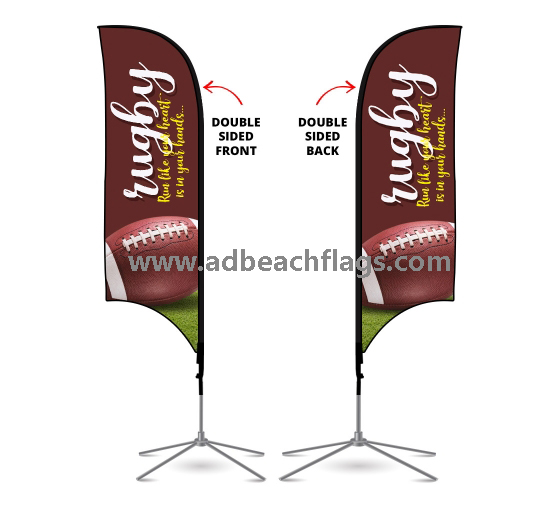
A double sided flag is not one thick fabric. It is two printed faces sewn back to back around a blockout liner, three layers in total. With 110gsm faces the stack lands near 290gsm on the spec sheet; with 130gsm faces it pushes higher, and the pole sleeve feels the difference in the hand. That is why the standard build uses 110gsm faces: the liner already blocks show-through, so heavier faces add cost and pole load without adding anything the eye can see. Step up the face weight when the site demands abrasion resistance or when the brand colour needs the deeper solid, and let the liner do the opacity job it was sewn for.
Weight on the invoice means nothing if the roll on the cutting table is different. These are the controls behind our fabric lines.
1. Declared grammage with a tolerance. Fabric is bought to a stated gsm with the normal industry tolerance, and the grammage is recorded on the job file so a reorder uses the same material, not a near-miss.
2. One lot per program. Repeat orders are woven against the archived fabric lot and dye profile, which is how reorder five matches order one. The colour bar prints on every new batch and gets checked against the approved sample before bulk runs.
3. Printed sample on the real construction. Sampling happens in 2 to 3 days on the production fabric, single or double sided as ordered, and bulk starts only on written approval. Payment runs 30 to 50 percent deposit with the balance against shipping evidence.
4. Certificates on request. Fire retardancy and composition documentation for the fabric range is available in writing per order rather than claimed in passing.
We would rather quote the standard weight than upsell fabric that cannot pay for itself.
1. Calm city sites with short campaigns. A flag that flies weekends on a sheltered high street will be retired by fashion before 130gsm pays back its premium.
2. One weekend events. For a single activation, lighter weights are honest tools. The upgrade cycle matters more than the grammage.
3. Flags that must move. A sponsor paying for motion on camera needs the lively 110gsm cloth; a heavier flag that hangs still photographs worse, whatever the spec sheet says.
4. Double sided builds on short poles. Extra face weight on a small pole loads the sleeve and slows the flag. The liner, not the gram, is doing the work.
1. Comparing ounces without units. Ounces per square yard and ounces per linear yard differ by about a third. Ask.
2. Judging show-through from a swatch. A single reverse flag shows a mirror on the back; that is construction, not weight. A double sided build with a liner is the fix.
3. Sending mesh into the wind and judging it by print depth. Mesh chooses wind load over saturation on purpose. It reads softer from the start, and that is the trade you asked for.
4. Forgetting the hem when counting grams. Stitching, hems and sleeve construction decide how a flag dies. A well sewn 110gsm flag outlives a carelessly sewn heavier one in most fleets, which is why our finishing checklist carries the same weight as the fabric spec.
United States and Canada. Quotes arrive in ounces and the naming confusion above is live. Retail brands rarely print gsm at all, which is why asking for the number gets a cleaner conversation than asking for the adjective.
United Kingdom and Ireland. Buyers speak in gsm, and the trade has historically offered a two-step ladder, an economical knit around 115gsm and a heavier woven grade for ceremonial work. Advertising flags live comfortably on the knit.
Australia and New Zealand. Coastal exposure makes mesh a default for many fleets, and UV performance questions come before print depth. Sun beats fabric up faster than wind does.
Gulf and Middle East. Intense UV and heat push buyers to the 130gsm face and darker blockout builds, with flags stored shaded between events to stretch the season.
Latin America. Budget discipline rules volume programs, and 110gsm knit is the accepted standard from Mexico to Chile. Beach work leans mesh; street campaigns lean knit.
| Feature | Advantage | Benefit you feel |
|---|---|---|
| 110gsm sublimated knit | Saturated print with lively movement | Flags that photograph well and fly in any breeze |
| 130gsm face option | Deeper solids under hard sun | Brand colour holds through a long standing season |
| Blockout liner build | Two readable faces, no mirror | One flag serves traffic from both directions |
| Open mesh grade | Air passes, sail load drops | Exposed coastal sites keep flags up without heroics |
| Archived lot and dye profile | Reorders print on the same cloth and recipe | Reorder five matches order one without renegotiation |
Q1. How long do printed flags last outdoors?
Continuous outdoor display typically runs 6 to 12 months before fading and wear show, and it stretches substantially when flags come down overnight or between events. Sun exposure, not fabric weight, drives most of the aging.
Q2. Is 110gsm strong enough for an advertising flag?
Yes, and it is the standard the industry settled on for single sided flags. It sublimates cleanly, moves in light wind and carries the standard hem constructions well. Step up only for high UV sites or specific colour depth needs.
Q3. Will my design show on the other side of the flag?
On a single reverse flag, the back face shows a mirror image with some light show-through, which is standard. A double sided build with a blockout liner prints two independent faces and blocks the show-through.
Q4. What is the best fabric for windy areas?
Open mesh, because air passes through and the pole and base carry less load. The trade is a softer print and faster edge wear, so it suits exposed coastal sites more than flagship storefronts.
Q5. Why is double sided printing more expensive?
Two printed faces plus a blockout liner mean roughly three times the fabric of a single sided flag, plus the extra sewing. The result reads solid from both directions, which is what roadside and queue-line sites need.
Q6. What does the ounce on a US quote actually mean?
It should be ounces per square yard, where 3.25 oz is about 110gsm, but parts of the trade use ounces per linear yard and call the same cloth 4 oz. Ask for the gsm figure and the comparison becomes honest.
| Point | Detail |
|---|---|
| Manufacturer, not reseller | Printing, cutting and sewing sit in our Foshan works, so fabric questions reach the people who run the presses. |
| Weight declared, not implied | Quotations state grammage and construction in gsm, single or double sided with liner, so comparisons stay honest. |
| Sample before bulk | Printed samples on the production fabric in 2-3 days; bulk starts on your written approval only. |
| Reorder discipline | Fabric lot, dye profile and colour bars are archived per program, so repeat orders match the original. |
| Low MOQ accepted | Wholesale from 5+ pieces with the same process as a full program run. |
| Reply in 1 hour, 24×7 | WhatsApp +86 135 1661 0926 or [email protected], with a fabric recommendation and quote the same day. |
Fabric weight is a tool, not a grade. 110gsm knit is the standard because it prints, flies and prices right for most jobs; 130gsm buys depth and endurance where sun and standing time earn it; mesh buys survival where wind outranks beauty. Put the number on the order, match the construction to the site, and the fabric stops being a gamble.
Send us the artwork, the site and the season, and we reply in 1 hour, 24×7, with the weight we would actually print it on, a sample schedule and factory pricing. If the standard weight is the right answer, we will say so before you pay for the upgrade.
Tell us the flag size, the quantity, single or double-sided, and the surface the flags will stand on. Our export team replies within 1 hour, 24×7, with an artwork proof and a factory price. Low MOQ accepted.
Chat on WhatsApp (+86 135 1661 0926) Email Us Now
Prefer a form? Fill in the details below and we will come back with a proof and a price within 1 hour, 24×7.
Related reading: Flag fabric and printing guide: how dye sublimation works | Single vs double sided feather flags: the show-through maths | Flag safety in wind: when to take flags down | Custom feather flags | Double sided beach flags | Custom teardrop flags | Factory credentials and QC
| Item | Detail |
|---|---|
| Product | Custom flags printed on knitted polyester: 110gsm standard, 130gsm high-UV, open mesh wind grades |
| Manufacturer | BESDA Advertising Flags, Foshan, Guangdong, China |
| Standard fabric | 110gsm knitted polyester, dye sublimation, single reverse construction |
| Double sided | Two printed faces plus blockout liner, about 290gsm stack; solid colour both sides |
| Mesh option | Open knit for exposed sites; lower wind load, softer print, faster edge wear |
| Conversion | 1 oz/yd2 = about 33.9 gsm; 3.25 oz/yd2 = about 110 gsm |
| Outdoor life | 6-12 months continuous display typical; longer with overnight takedown |
| MOQ & pricing | Low MOQ accepted; wholesale from 5+ pieces; fabric cost bands confirmed per order |
| Lead times | Sampling 2-3 days on production fabric; bulk 5-10 days after written approval |
| Contact | WhatsApp +86 135 1661 0926, [email protected], reply in 1 hour 24×7 |