Phone: 0086-757-8938 9313
WhatsApp: +86 135 1661 0926
Email: [email protected]
Address: Caochang Industrial Zone, Lishui, Nanhai, Foshan, Guangdong, China
24/7 Online Services
Phone: 0086-757-8938 9313
WhatsApp: +86 135 1661 0926
Email: [email protected]
Address: Caochang Industrial Zone, Lishui, Nanhai, Foshan, Guangdong, China
24/7 Online Services

Flag permits are where a straightforward purchase turns into a two-week delay. A retailer orders twenty teardrop flags for a weekend sale, the flags arrive, the first one goes up on the pavement outside the shop, and by lunchtime a council officer has photographed it. The flags are fine. The position is not.
This guide is written for the people who buy flags in bulk: retail chains rolling a promotion across sites, event agencies building a perimeter, distributors advising resellers, franchise operators who must keep every branch compliant, and procurement teams who need the paperwork before the purchase order, not after. It sets out the three separate permissions a flag can need, the four questions that identify which ones apply, and how the United Kingdom, United States, Australia and Germany each handle the common cases. It also lists the documents we send with an order so your application does not bounce back.
One rule sits above everything below: this is an overview, not legal advice. Sign codes and council policies change, and the officer who answers your email has the final word. Ask for that answer in writing before you install.
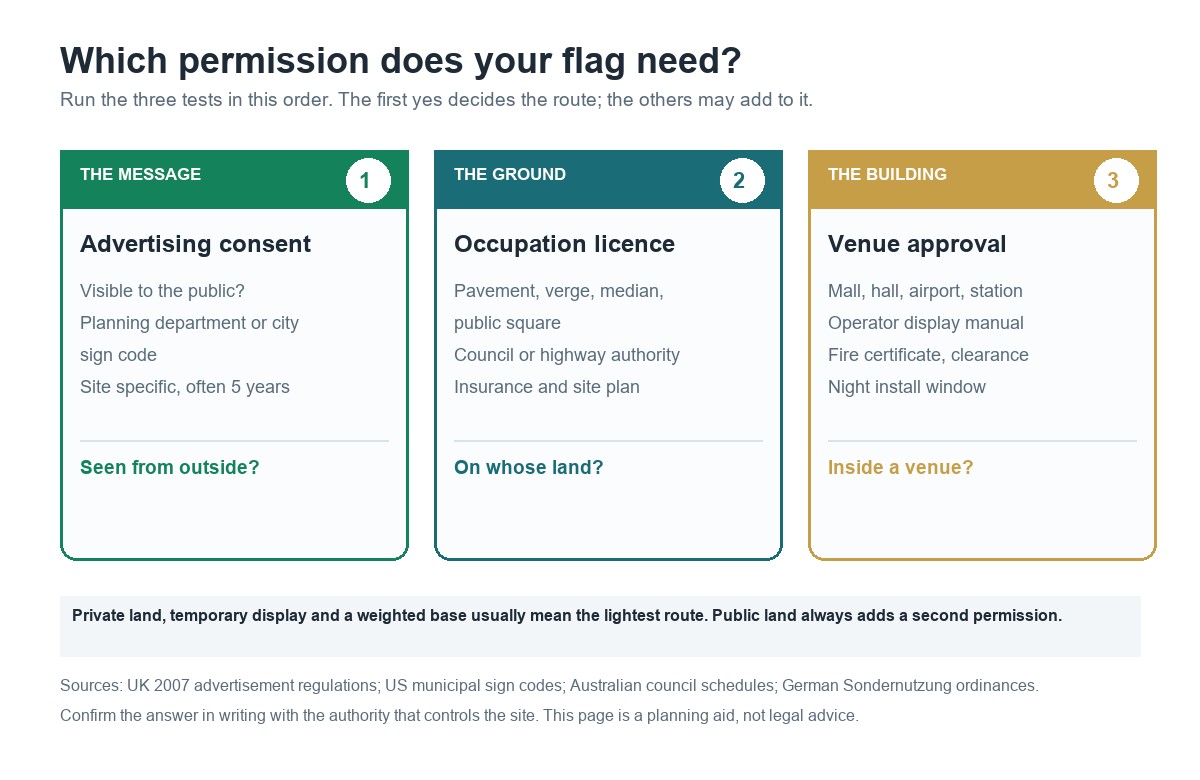
Most buyers think of “a permit” as a single document. In practice a commercial flag can touch three separate regimes, each run by a different office with a different form.
1. Advertising consent. This controls whether the message may be displayed at that location. In the UK it sits inside the planning system. In Germany it sits partly in building law and partly in the municipal advertising ordinance. In the US it is buried in the city sign code, usually under temporary signs.
2. Ground occupation. This controls whether a pole may stand on that piece of land. On your own forecourt the question is mostly about your lease. On a pavement, verge, median or public square it becomes a licence from the highway or council authority, and many of the refusals we hear about start here rather than with the artwork.
3. Venue or landlord approval. Inside a mall, exhibition hall, airport or station, the operator runs its own display policy. That policy covers base types, ceiling clearance, sprinkler clearance, fire certificates for hanging fabric, and the hours when installation crews may work. A council permit does not override it.
The three overlap. A teardrop on a shop forecourt in a British town may need advertisement consent because it is visible from the highway, no ground licence because the land is private, and a landlord letter because the unit is leased. A teardrop on the pavement outside the same shop needs the ground licence as well, and the council can refuse it even when the advertisement consent is granted.
Before any form is opened, four answers narrow the route. They take about five minutes with a site plan and a tape measure.
| Question | If yes | Typical route |
|---|---|---|
| 1. Is the ground public? Pavement, verge, median, square, beach front. | You need the landowner’s permission, not just the shop’s. | Highway or council licence; public liability insurance usually required |
| 2. Is it temporary? Under a month, tied to a campaign or opening. | Temporary sign rules often apply instead of permanent signage rules. | US temporary sign permit; UK advertisement consent; AU portable sign permit |
| 3. Is it fixed to the ground? Spike, bolt, concrete-in socket. | Structure and reinstatement questions join the queue. | Structural notes, socket approval, reinstatement deposit |
| 4. Is it indoors? Mall, hall, airport, station. | The operator’s display manual matters more than the city code. | Venue approval, fire certificate, ceiling and sprinkler clearance |
Write the four answers down and keep them with the order. When a site manager asks why one branch has a different base or a shorter pole, the sheet explains it without a meeting.
Flag advertising in England is controlled under the Town and Country Planning (Control of Advertisements) (England) Regulations 2007, with the equivalent regulations in Wales and Scotland. The local planning authority decides what is allowed, and it judges two things only: amenity, meaning how the display looks in its setting, and public safety, meaning the effect on traffic and pedestrians.
Three categories do most of the work. Some adverts need no consent at all. Some have deemed consent, which means permission is automatic if the conditions are met. Everything else needs express consent, which means an application.
The deemed consent class that people quote most is Class 7, flags on a single flagstaff. Class 7A covers a flag projecting vertically from a roof, and it is narrow: the flag must carry the occupier’s name or device, or advertise a specific event of limited duration at that building. Any character or symbol on it is capped at 0.75 m high, and at 0.3 m inside an area of special control. Class 7B covers flags on residential development sale sites, with the top of the flagstaff no higher than 4.6 m and each flag no larger than 2 square metres.
A freestanding feather or teardrop flag on a base does not usually fit either class. It is not on a roof, and it is not selling houses. Treat it as an advertisement that needs express consent, then confirm with the planning authority. Consent commonly runs for five years, and it is site-specific, so a chain with twelve branches needs twelve answers, not one.
Designations change the answer again. Conservation areas, national parks, areas of outstanding natural beauty and areas of special control all restrict flags further, and a listed building may need separate listed building consent for fixings. A shop in a market town centre can therefore be harder than a unit on a retail park, even with identical flags and identical artwork.
There is no national sign law in the United States. Each city writes its own sign code inside its zoning ordinance, which is why two neighbouring towns can treat the same flag in opposite ways. One allows feather flags as temporary signs with a permit; another caps them at a small face area and a month; a third prohibits them outright in every district.
Published city schedules show the spread. Face area limits of 15 to 16 square feet are common, which is about 1.4 to 1.5 square metres, well below a standard 3.4 m feather flag. Height caps of 6 to 12 feet appear often, with setbacks of 10 to 20 feet from property lines. Display windows of 30 days are typical, sometimes tied to a new opening or a special event, and several cities allow only four temporary sign permits per property per year. Fees range from a weekly charge per sign to a flat charge per application. Placement in the public right of way is banned almost everywhere.
The practical move is to ask the city’s planning or zoning counter for the temporary sign section of the code, in writing, before choosing a size. Send the site plan with the flag position marked and the distance to the property line. If you lease the unit, attach the landlord’s consent, because many applications ask for the property owner’s signature and stall without it.
Australian councils regulate flags on public land under local government and roads legislation, plus their own activities-in-thoroughfares local laws. The rules differ by council to a degree that surprises overseas brands: height caps from 2.3 m to 3.6 m, one or two flags per frontage, a requirement to bring flags in at close of business, and fees that run from nothing to more than a hundred dollars per flag per year.
Public liability insurance is the item that stops applications. Councils commonly ask for cover of ten to twenty million dollars, with the council named as an interested party on the certificate. A brand that self-insures through a global policy often has to request a local certificate, and that request can take a week on its own.
Two more timing facts matter. First, the application is not the same as the approval: metropolitan councils can take up to eight weeks, so a campaign planned for a fixed date should start the paperwork before the artwork is finalised. Second, private land is a separate path. A flag on your own car park may need planning approval rather than a footpath permit, and some councils treat retail forecourts as a change of use question.
In Germany, placing an advertising flag on a public street, path or square goes beyond ordinary public use. It becomes a special use, Sondernutzung, and needs a Sondernutzungserlaubnis from the municipality, under the state road law and the local special use ordinance.
That permit is discretionary. There is no legal entitlement to it, it is issued for a fixed period, it can carry conditions, and it can be revoked. Fees are often calculated per square metre of advertising area per month, with a processing charge on top; one published schedule pairs a monthly rate per square metre with a flat processing fee and a maximum flag height of 3 m. Other towns set their own numbers, so the only reliable step is to read the local ordinance.
The bigger constraint is content. Some municipalities allow only self-advertising, Eigenwerbung, meaning a business may flag its own location and offer. Third-party commercial advertising is refused, and cultural, sporting or church events run on a separate route. A distributor selling flag space to local brands should check this before promising a client a position.
Private property is not a free pass either. Building law and local design statutes can still govern size, fixing method and appearance, and a landlord may add its own conditions on top.
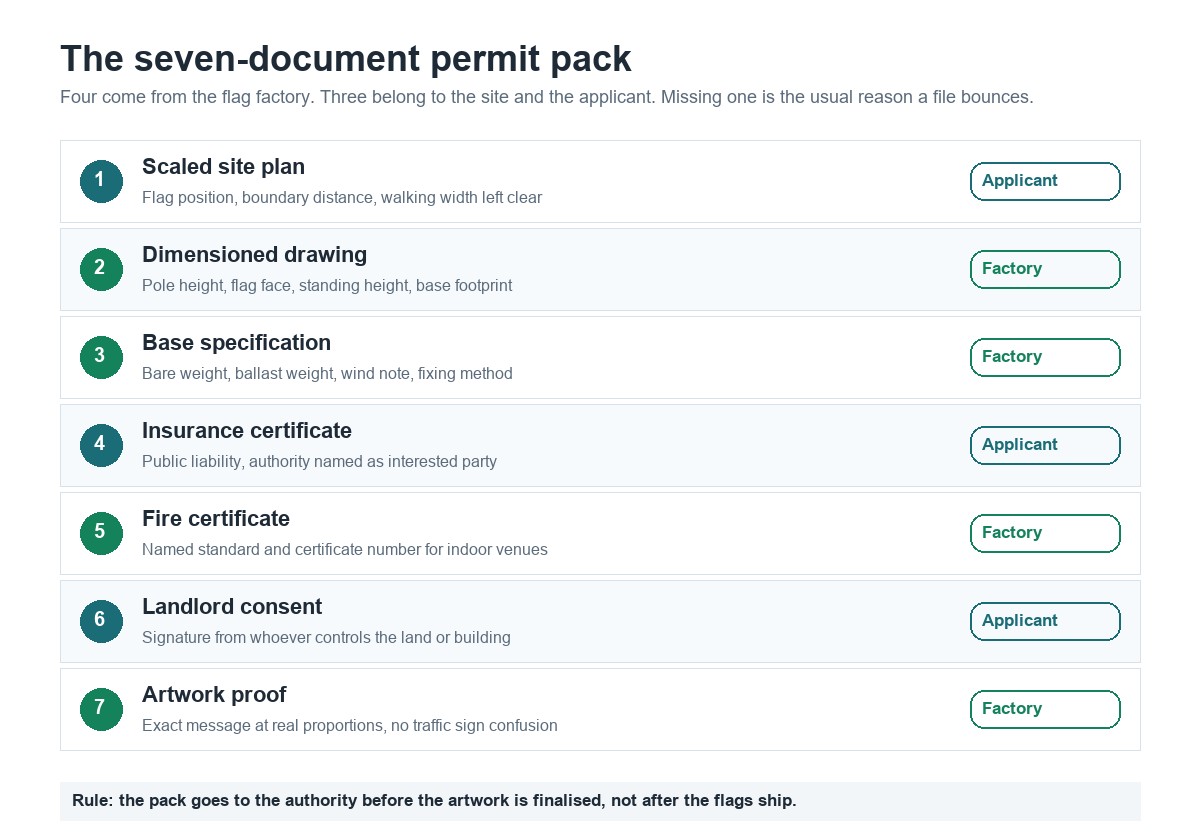
Most refusals we hear about are not refusals of the idea. They are incomplete files. The pack below is what a planning officer, council officer or mall operator typically needs to make a decision, and we supply the first four items with every bulk order.
| Document | What it must show | Who asks for it |
|---|---|---|
| Scaled site plan | Flag position, distance to boundary, distance to the road, walking width left clear | Councils, city sign desks, mall operations |
| Dimensioned drawing | Pole height, flag face width and height, standing height, base footprint | All four countries |
| Base specification | Base type, bare weight, ballast weight, wind note, fixing method | Highways teams, insurers, venues |
| Insurance certificate | Public liability cover with the authority named as interested party | Australian councils in particular |
| Fire certificate | Flame retardancy to a named standard, with the certificate number | Malls, exhibition halls, airports |
| Landlord or venue consent | Signature from the party that controls the land or the building | City sign desks, mall operators |
| Artwork proof | The exact message at real proportions, so no one confuses it with a traffic sign | Highways officers, brand teams |
The base specification is the item buyers underestimate. A cross base weighs one to four kilos bare, so it needs a water bag of about ten to twelve litres to hold a standard flag in a breeze; a steel plate base runs from four to sixteen kilos on its own. Whichever you choose, the footprint matters as much as the weight: a 60 to 80 cm cross on a narrow pavement leaves nothing for a pushchair. Our cross base size guide gives the numbers, and the base guide matches each type to a surface.
One habit saves repeat work. Keep a copy of the pack in the storage bag with the flags, so the dimensioned drawing, the base note and the fire certificate travel with the kit. The next site’s question is then answered from the bag rather than from an old email thread. Clean, dry skins also keep the display in the condition the certificate describes, because an inspector who sees a mildewed flag looks harder at everything else on the base.
1. Measuring the flag and not the footprint. A 3.4 m flag with an 80 cm cross base needs a clear square of about a metre, plus the walking line. Councils measure the obstruction, not the print area.
2. Treating a double-sided flag as one face. Some sign codes count each printed face, so a double-sided flag registers as double the area and can break a square-foot cap that a single-sided flag passes. Check the definition of sign area before specifying double-sided.
3. Starting the clock on the event date. A thirty-day permit starts on the permit date, not the day the campaign launches. Order the permit window to cover installation and removal days, and take the flags down on the stated date, not the morning after.
4. Ignoring the landlord’s insurance clause. A tenant’s policy may exclude signage, and the application then needs the owner’s signature. Read the lease before the flags ship, because a signature can take longer than production.
5. Using a spike on ground you do not control. A ground spike leaves a hole. On a verge, median or landscaped strip, that hole is damage, and the permission for the flag does not cover it. Use a weighted base where the surface must stay intact.
There are sites where no amount of paperwork makes a freestanding flag sensible, and saying so early saves a wasted order. A heritage high street with a narrow pavement and a conservation area designation is one: the flag competes with the street, the base blocks the walkway, and the consent process can outlast the campaign.
A venue that bans free-standing signage is another. Some exhibition halls and airports allow only rigged or wall-mounted media, and a base on the floor fails the safety walk even with a fire certificate. In those spaces, a flag banner on a frame or a fabric wall graphic does the job with less friction.
A third case is the site with no legal standing at all: a roadside verge outside the property boundary, a roundabout, a strip of council land beside a car park. If the ground is not yours and no licence exists, the flag is not worth the argument, and a cheaper medium is the better spend.
| Feature | Advantage | Benefit for your application |
|---|---|---|
| Dimensioned drawings with every order | Heights and footprints on paper, in metric and imperial | The form is completed once, not three times |
| Six pole heights from 2.8 m to 5.6 m | A compliant size exists for a low awning or a tight frontage | Fewer refusals on height limits |
| Weighted bases with stated ballast | No ground penetration on public paving | Removable at close of business, as many councils require |
| Flame retardant options | Certificates issued on request in writing | Indoor venue approval moves forward |
| Single and double-sided builds | Face area can be quoted correctly per code | No surprise on a square-foot or square-metre cap |
| Artwork proof at real proportions | Message size and contrast are visible before print | Highways officers see a commercial sign, not a traffic sign |
We are a flag factory in Foshan, Guangdong, supplying retail chains, event agencies, distributors and venue operators in more than 150 countries. The compliance conversation is part of the order, not an afterthought.
| What we do | What it means for your order |
|---|---|
| Factory-direct production | Fabric, print, pole, base and bag specified as one system, so weights and heights match the drawing. |
| Permit pack on request | Dimensioned drawing, base weights and wind note sent with the quotation. |
| Six heights, six bases | A compliant combination for a tight pavement or a tall atrium. |
| Proof before production | Real-proportion proof approved before cutting, matching what the authority saw. |
| Low MOQ accepted | Wholesale from 5+ pieces, so a pilot site can be trialled before a chain rollout. |
| Reply in 1 hour, 24×7 | WhatsApp +86 135 1661 0926 or [email protected]; lead times confirmed on the quote. |
If you already have a site plan and a draft, send them. We will mark the flag positions, check the faces against the size limits, and tell you which base keeps the footprint legal on that surface. If the site is one of the difficult ones, we will say so.
Often yes, even on your own forecourt, because the flag is an advertisement visible to the public. In the UK that means advertisement consent from the local planning authority. If the flag stands on a pavement or verge, a ground licence is needed as well, and that is the permission most likely to be refused.
Applications commonly take around eight weeks, and consent usually runs for five years at that site. The consent covers the position and the type of display, so a chain needs a separate application per branch. Check conservation area and area of special control designations first, because they restrict flags further.
It depends on the city, not the state. Many cities allow them as temporary signs under a permit, with limits on face area, height, setback and display days. Some restrict them to new openings or special events, and a few prohibit them entirely. Ask the zoning desk for the temporary sign section in writing before you order.
In some sign codes it does, because the area is measured on each printed face. A double-sided 3.4 m flag can then exceed a cap that a single-sided flag passes. Check the definition of sign area in the local code before specifying double-sided, especially where the limit is expressed in square feet.
Only with permission from the authority that controls the pavement, and many town centres refuse it or restrict it to one or two flags per frontage. Public liability insurance, a site plan and a clear walking width are usually part of the application. A weighted base that comes in at close of business is more likely to be approved than a fixed spike.
Ask for a dimensioned drawing, the base weight with and without ballast, a wind note, and the flame retardancy certificate if the flags go indoors. Those four items answer most of the questions on an application form. We send them with the quotation, and the artwork proof follows once the design is set.
Flag permits are not one document. They are advertising consent, ground occupation and venue approval, and the site decides which of the three apply. Answer the four questions, get the local rule in writing, and build the application pack before the artwork is finalised. A flag that passes the code is a cheap, fast medium; a flag that ignores it is a removal notice with a print bill attached.
Tell us the flag sizes, the quantities, single or double-sided, and the ground the flags will stand on. Our export team replies within 1 hour, 24×7, with a proof and a factory price. Low MOQ accepted.
Prefer a form? Fill in the details below and we will come back with a proof and a price within 1 hour, 24×7.
Related reading: Flag bases: which one for which surface | Cross base sizes: 60 cm, 72 cm and 80 cm | Flag safety in wind: when to take them down | Indoor flag displays for malls and centres | Trade show flags: booth height and sightlines | Metal plate bases: weight, surface and wind | Flag, banner or sign: which carrier fits | Custom feather flags | Custom teardrop flags | Cross bases | Spike base stands | Metal plate bases
| Item | Detail |
|---|---|
| Product | Business flags and the documentation needed for display permissions |
| Also searched as | Do you need a permit for a feather flag, advertising flag permission, sign permit for flags, flag planning permission |
| Manufacturer | BESDA Advertising Flags, Foshan, Guangdong, China |
| UK route | Advertisement consent under the 2007 Regulations; Class 7A character height 0.75 m, 0.3 m in areas of special control; Class 7B staff top 4.6 m, flag 2 sq m |
| US route | City sign code, temporary sign permit; published limits include 15 to 16 sq ft face area, 6 to 12 ft height, 30 day windows, right of way banned |
| Australia route | Council footpath or portable sign permit; public liability commonly 10 to 20 million dollars; height caps 2.3 to 3.6 m at many councils |
| Germany route | Sondernutzungserlaubnis for public ground, discretionary and time limited; some municipalities allow self-advertising only |
| Pack we supply | Dimensioned drawing, base weight with and without ballast, wind note, flame retardancy certificate on request in writing |
| Base weights | Cross base 1 to 4 kg bare plus 10 to 12 L water bag; steel plate 4 to 16 kg; water tank 12 to 32 L |
| Lead times | Proof 1 to 3 days; bulk 5 to 10 days; courier 3 to 7 days; sea freight 20 to 35 days |
| MOQ and contact | Low MOQ accepted, wholesale from 5+ pieces; WhatsApp +86 135 1661 0926, [email protected], reply within 1 hour, 24×7 |