Phone: 0086-757-8938 9313
WhatsApp: +86 135 1661 0926
Email: raya@besda.net
Address: Caochang Industrial Zone, Lishui, Nanhai, Foshan, Guangdong, China
24/7 Online Services
Phone: 0086-757-8938 9313
WhatsApp: +86 135 1661 0926
Email: raya@besda.net
Address: Caochang Industrial Zone, Lishui, Nanhai, Foshan, Guangdong, China
24/7 Online Services

A food truck is a three-metre box in a row of three-metre boxes. At a typical market the trader next door has a striped awning, the one beyond has a chalkboard, and the customer walks the row at strolling speed with a hundred things competing for one glance. The trucks that get found have a flag above the canopy.
One trader put it to us plainly: “Customers told me they walked past twice before they found me. The truck blends into the row and the awning hides the sign.” Height fixes that, and height is a specification, not a lucky guess. This guide covers the flag heights that clear a market awning, the letter maths that makes a menu readable at fifteen metres, the bases that stay legal on grass and tarmac, and what small runs actually cost from a factory. Figures are marked typical where the trade ranges.
Market geometry sets the problem. In the UK and Ireland the standard pitch is 3 x 3 m, and in the United States the 10 x 10 ft pop-up canopy is the default shelter. USDA surveys put the average American farmers market at about 31 vendors, and large events run 20 to 50 food trucks in a row.
Three facts follow from that geometry. Every neighbour has the same footprint, so the only free direction is up. The customer’s eye line sits at 1.5 to 1.7 m, right at awning height. And the decision to stop happens 10 to 20 m out, not at the serving window.
A market awning or truck service hatch tops out around 2 m. A flag pole must beat that by enough to put the message in clear air.
1. 2.8 m poles read at awning level. Fine for a forecourt or a gap in the row, invisible two trucks down.
2. 4 to 4.6 m is the working minimum. The flag face starts above the canopy and the message sits in clear air over the row. A 9 ft stock flag shows only about 0.75 m above a 2 m awning, which is why market traders keep stepping up.
3. 5 to 5.6 m for big sites. Festival fields, truck rallies, anything where the row is deep and the customer approaches from 50 m. This is the pole seen from the car park, and it usually carries the brand, not the menu.
| Pole height | Clearance above a 2 m awning | Reads from | Job at the pitch |
|---|---|---|---|
| 2.8 m | About 0.8 m | 5 to 10 m | Queue marker at the window |
| 4 to 4.6 m | 2 to 2.6 m, clear air | 20 to 30 m | Finder flag over the canopy |
| 5 to 5.6 m | 3 to 3.6 m, clear air | 40 to 50 m | Brand flag for the whole row |
The signage rule from the retail trade applies at markets too: 25 mm of capital letter height per 3 m of viewing distance for comfortable reading, and roughly 2.5 times that at the limit.
1. Brand flag at 20 to 30 m. The truck name or logo needs 200 to 250 mm equivalents at that distance, which on a 70 x 290 cm feather means one line, big, in the brand colour.
2. Menu hook at 10 to 15 m. TACOS, CREPES, ESPRESSO. One category word in capitals reads at strolling distance and does the filtering for you.
3. Prices and small print do not belong on flags. A price list is read at 1 to 2 m, at the window, on a board. Flags that try to carry twelve menu lines end up carrying none of them.
4. Windless shapes for calm sites. On still days a standard flag hangs limp. A windless swooper shape, with a full sleeve that holds the face open, keeps the word readable below about 11 mph of wind. On exposed sites take the classic shape and let it move.
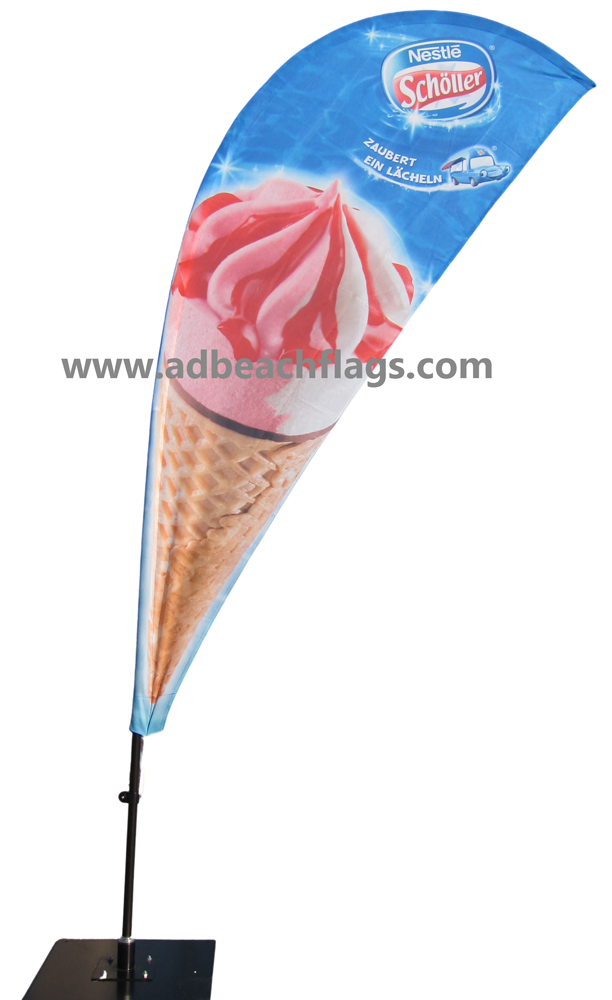
1. The finder flag. 4.6 to 5.6 m, single big message, planted at the pitch corner or the row entrance. This is the one that fixes “walked past twice”.
2. The queue flag. 2.8 to 3.4 m teardrop beside the serving window, carrying the category word. It confirms the choice while people wait.
3. The offer flag. A second skin on the same hardware, THIS WEEK only, swapped in minutes. Skins are cheap; hardware is not.
One kit of two poles covers all three jobs, with the offer skin rotating on the finder pole.
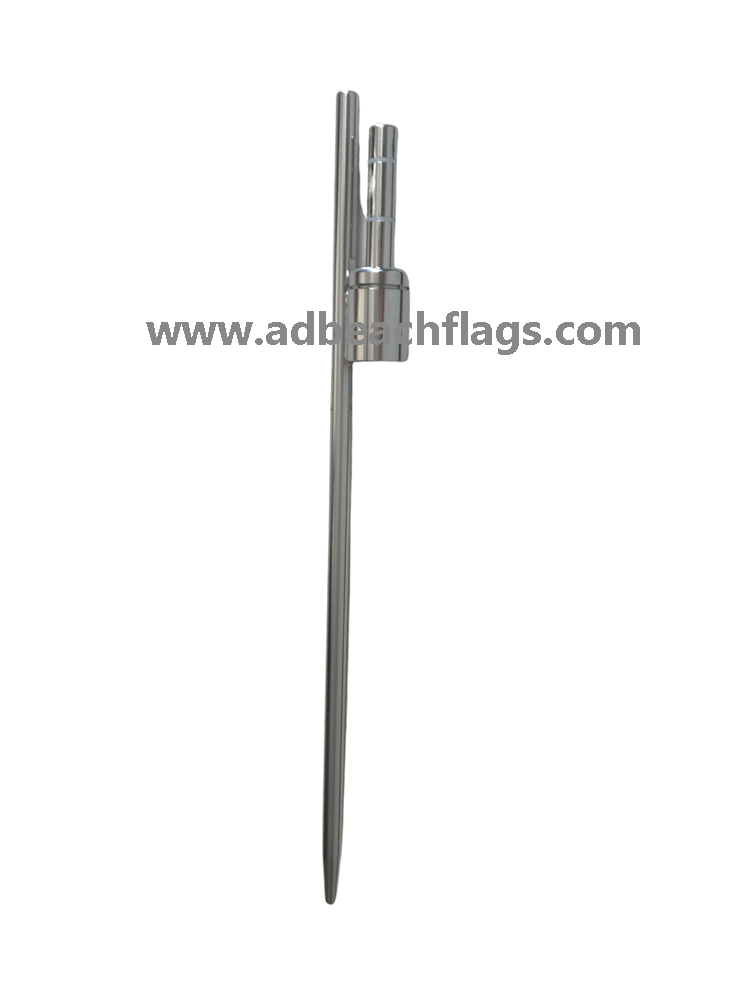
1. Grass and soil pitches take the ground spike. A 1 to 1.5 kg steel spike holds a 4 to 5 m pole in mown turf through normal gusts, and it packs flat.
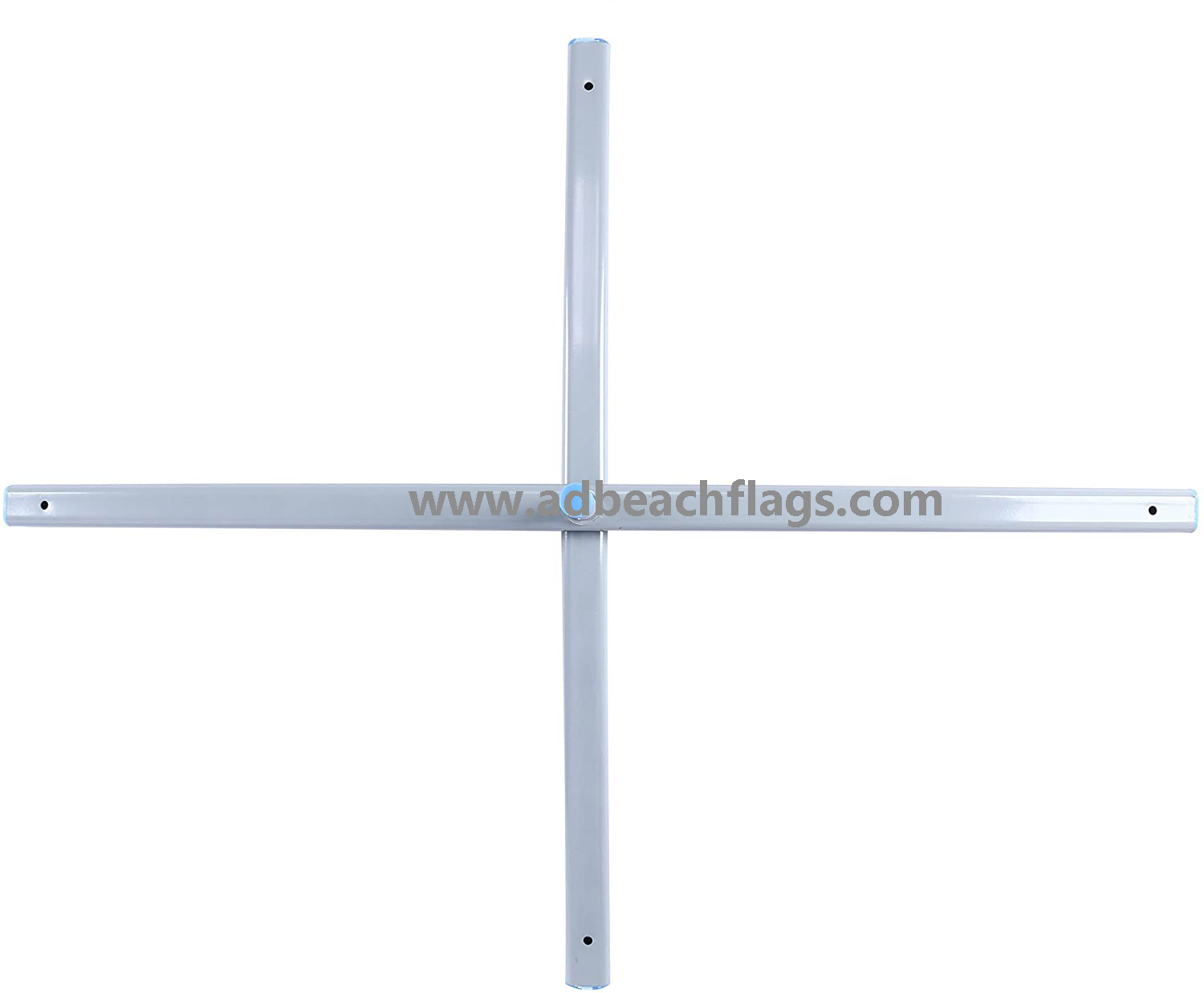
2. Tarmac and concrete take the cross base plus water bag. The cross base alone weighs 1.25 to 1.45 kg, which is not enough on its own. The 10 to 12 litre water bag on top brings ballast to about 10 to 12 kg, and the US-market 3 gallon version runs about 24 lbs. Empty, it folds to nothing for the trip home.
3. Car parks allow the tyre base. A steel bracket under a wheel, borrowed ballast, no tools. Useful at rallies where the truck parks in its selling spot.
4. Check the stake rules first. Some markets ban ground penetration, some cap sign heights in the vendor contract, and some councils treat flags as temporary signage under local codes. One question to the organiser saves an order.
Open-air sites are windy sites. Supplier tests put single-sided 110gsm knitted polyester at roughly 25 mph of continuous working wind, with damage thresholds higher, around 32 mph in one published test. Double-sided, three-layer flags stress poles roughly twice as hard and want to come down sooner.
Practical market rules: mesh fabric for coastal and constantly windy pitches, it passes about half the wind load; take the flag down when the pole starts leaning hard in sustained gusts, which in trade terms is Beaufort 4, about 13 to 18 mph, for double-sided kit; and never leave a flag up overnight at an empty pitch.
Space inside a truck is measured in shoeboxes. The standard kit packs down well: a 4 to 5 m pole in sections inside a 100 to 120 cm bag, the flag skin folded flat, the cross base folded to about 60 cm, the water bag rolled to the size of a paperback when empty. Total kit weight runs 4 to 7 kg including ballast hardware, and an oxford carry bag keeps the pieces from wandering around the service area.
Setup is a one-person job: 2 to 3 minutes for spike kits, 3 to 5 for cross base and water bag, tested repeatedly at trade events. Strike is the same in reverse, with the skin dried before it goes in the bag.
Three layers of rules apply, and they are local. The market’s own vendor contract usually caps sign counts and heights. The site owner, council or private landlord, may ban ground penetration or freestanding hardware on new paving. And city temporary-signage ordinances occasionally treat flags like A-boards, with size limits and daytime-only display windows.
The safe specification that passes almost everywhere: one flag per pitch, on a ballasted base, no ground penetration, taken down at close of trade. Traders running two flags should confirm the second is allowed before ordering.
| Option | Typical price | Notes |
|---|---|---|
| Stock pre-printed kit, US retail | From about USD 28 | Generic words, HOT DOGS, ICE COLD; no brand fit |
| Custom kit, US retail | About USD 169 to 250 | Your artwork, pole and base included |
| Custom skin, factory direct | USD 2.60 to 19.90 by size and run | Tier example: 11.80 at 2 pcs, 7.80 at 20 to 99, 3.50 at 500 plus |
| Replacement skin only | Fraction of kit price | Hardware carries over; the campaign cost is the skin |
For a single truck, one custom flag from a factory with pole and spike often lands near the price of a generic retail kit, with the brand on it. For fleets and franchises the factory tiers are the whole story.
Small festivals charge trucks USD 200 to 500 per day, and large events USD 1,500 to 3,000 or 10 to 20 percent of sales. Against a single event fee, a flag kit that lasts a full season, and costs less than one bad day’s takings, is the cheapest line in the budget. A well-sited truck at a good festival serves roughly one in five attendees and clears about USD 3,500 gross per event (typical benchmarks); being findable is a measurable share of that.
1. The flag under the awning. Printed at window height, hidden by the neighbour’s canopy. Buy the 4 m plus pole.
2. Cross base with no ballast. One trader’s summary: “The cross base alone is basically decoration.” The water bag is not optional on hard ground.
3. Menu on the flag. Twelve lines of prices at 15 m is a grey rectangle. Category word on the flag, prices at the window.
4. Leaving flags up overnight. Night wind, dew and mildew take a season off the skin, and some markets fine for it.
United States. Deep vendor rows and rally culture make 4.6 to 5.6 m finder flags standard, with tyre bases accepted in truck parking spots.
United Kingdom and Ireland. 3 x 3 m pitches and council markets mean tighter height caps in some contracts, usually 4 m plus passes, and spike bans on resurfaced tarmac are common.
Germany, Austria and Switzerland. Organisers ask for written specs and tidy hardware; the windless swooper shape is popular because it reads without wind on calm market mornings.
Australia and New Zealand. Coastal markets and high UV push traders to mesh fabric and shorter reprint cycles, every 4 to 6 months of weekend use.
Brazil and Mexico. Street food fairs favour double-sided teardrops where crowds wrap around the pitch on both sides.
1. Assigned positions with no sightline. If the organiser parks you behind a stage, no flag height is legal. Negotiate the position first.
2. Markets that ban all freestanding signage. They exist. A truck-mounted bracket or the roof sign is the remaining option.
3. Indoor food halls. Ceilings, sprinkler rules and hall management usually kill poles. Spend on counter graphics instead.
Q1. What flag height clears a market awning?
Awning tops sit near 2 m. A 4 to 4.6 m pole puts the flag face in clear air above the canopy; a 2.8 m pole only works in open gaps. For big sites, 5 to 5.6 m.
Q2. Can I use a ground spike on tarmac?
No. Spikes are for grass and soil. On tarmac use a cross base with a 10 to 12 litre water bag, about 10 to 12 kg of ballast, or a tyre base where the vehicle stays parked.
Q3. At what wind should the flag come down?
Single-sided 110gsm kit works to roughly 25 mph and has been tested to about 32 mph. In practice, take double-sided flags down from Beaufort 4, about 13 to 18 mph, and any flag down in sustained hard gusts.
Q4. How many flags does one truck need?
Two covers it: a 4.6 m plus finder flag and a 2.8 to 3.4 m queue teardrop. A rotating offer skin on the finder pole adds the third job without new hardware. Confirm counts against the market contract first.
Q5. What is the MOQ and lead time for a custom flag?
Low MOQ accepted, single runs included, wholesale from 5 pieces. Production runs 5 to 10 days after artwork approval, with samples in 2 to 3 days when colour matters.
Q6. Can I reorder just the flag later?
Yes. We store the approved artwork and reprint skins against it. Poles and bases carry over, so the second season costs a skin, not a kit.
| Point | Detail |
|---|---|
| Manufacturer, not a reseller | Flags, poles and bases from our own Foshan workshop, one fitting standard across the kit. |
| Colour you can hold us to | Pantone and RAL matching with swatch approval, so the truck brand matches across seasons. |
| Built for single-vendor runs | Low MOQ accepted, one truck or a hundred, with wholesale tiers from 5 pieces. |
| Fast sampling | Samples in 2 to 3 days, bulk in 5 to 10 days after artwork approval. |
| Artwork stored for reorders | Season two is a skin reprint, not a new design cycle. |
| Customer 5stars Feedback | Serving buyers in 150+ countries across Europe, the Americas, the Middle East, Africa and Oceania. |
A food truck flag has one job: be the tallest readable thing at the pitch. Get the height above the awning, put one big word on the finder flag, ballast the base for the actual surface, and treat skins as the seasonal cost. That is the whole system, and it costs less than a single event fee.
Tell us your pitch surface, your awning height and your category word, and we will reply within 1 hour, 24×7, with a sized kit and a factory price. Low MOQ accepted, one truck or a fleet.
Tell us the flag size, the quantity, single or double-sided, and the surface the flags will stand on. Our export team replies within 1 hour, 24×7, with an artwork proof and a factory price. Low MOQ accepted.
Chat on WhatsApp (+86 135 1661 0926) Email Us Now
Prefer a form? Fill in the details below and we will come back with a proof and a price within 1 hour, 24×7.
Related reading: Sidewalk Flags for Restaurants and Cafes | Beach Flag Wind Rating | Flag Washing and Storage Guide | Teardrop Flags | Spike Base Stands | Cross Bases | Portable Oxford Bags | Customized Beach Flags
| Item | Detail |
|---|---|
| Product | Food truck flags and market vendor flag kits |
| Manufacturer | BESDA Advertising Flags, Foshan, Guangdong, China |
| Height rule | 4 to 4.6 m poles clear a 2 m market awning; 5 to 5.6 m for festival fields |
| Letter maths | 25 mm capital height per 3 m viewing distance; one category word at 10 to 15 m |
| Fabric | 110gsm knitted polyester, dye sublimation; mesh for coastal pitches |
| Bases | Ground spike for grass; cross base 1.25 to 1.45 kg plus 10 to 12 L water bag on tarmac; tyre base in car parks |
| Wind | Single-sided works to about 25 mph, tested to 32; double-sided down from Beaufort 4 |
| Kit packing | Pole bag 100 to 120 cm, cross base folds to 60 cm, kit weight 4 to 7 kg |
| MOQ and lead time | Low MOQ accepted; samples 2 to 3 days, bulk 5 to 10 days after artwork approval |
| Contact | WhatsApp +86 135 1661 0926, [email protected], reply within 1 hour 24×7 |