Phone: 0086-757-8938 9313
WhatsApp: +86 135 1661 0926
Email: [email protected]
Address: Caochang Industrial Zone, Lishui, Nanhai, Foshan, Guangdong, China
24/7 Online Services
Phone: 0086-757-8938 9313
WhatsApp: +86 135 1661 0926
Email: [email protected]
Address: Caochang Industrial Zone, Lishui, Nanhai, Foshan, Guangdong, China
24/7 Online Services

A food truck changes address every day, and most of its advertising changes with it. The wrap travels, the menu boards travel, but nothing tells tomorrow’s crowd where the truck will be except the truck itself. A flag kit closes that gap: a tall branded panel that rides in the van, stands up beside the serving window in minutes, and reads over every awning in the lot. This page covers the three decisions that make it work – how to mount without drilling the vehicle, where to place the flag at a stop, and how the flag pairs with an A-frame so both the drive-by and the queue get served.
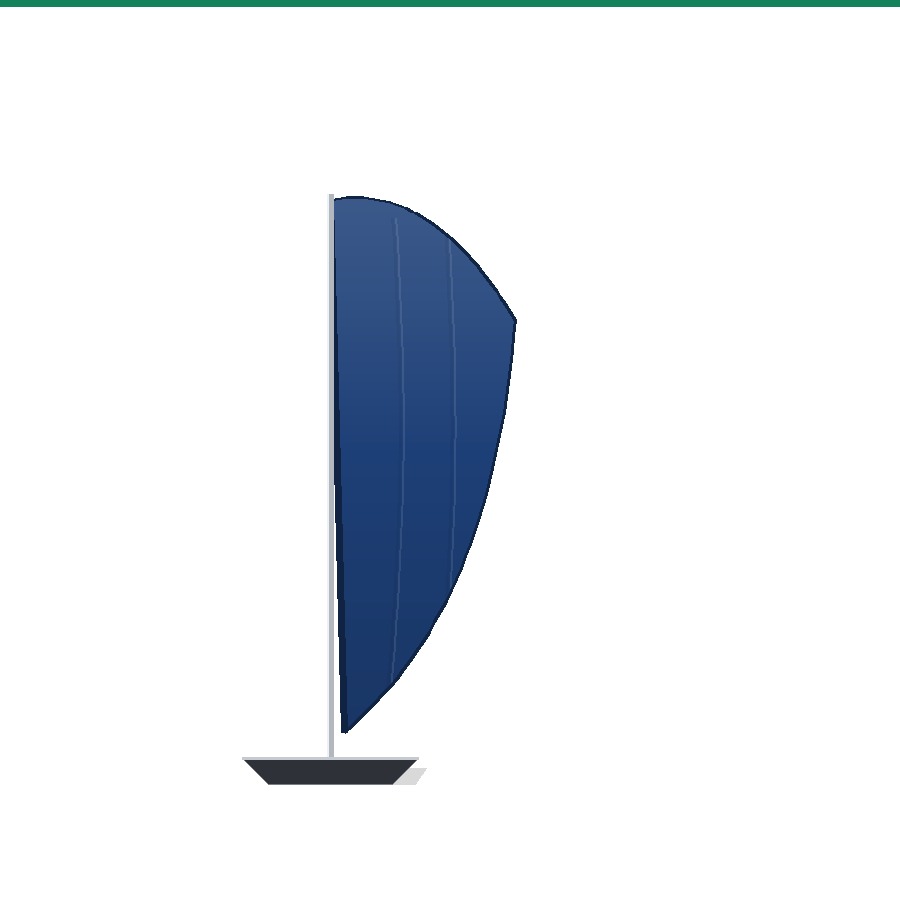
Lunch crowds navigate by landmarks, and in a lot full of trucks and carts the landmarks look identical. From fifty metres, one awning is another; a 2.5-3 metre panel with your brand is what regulars actually steer by. That is the flag’s first job: not persuasion, navigation.
The second job is continuity. A truck that works business parks on weekdays and festivals on weekends collects pitches the way a sales team collects accounts, and each pitch has its own rules, surfaces and sight lines. Fixed signage cannot follow that route. A kit built for repetition – same panel, same pole, base options for every surface – is the only advertising that shows up every day without a new decision.
The third job is photo duty. Private-event bookings – weddings, office parties, school fairs – pay better than street service, and hosts book the truck their guests can find. The flag in the event photos is free marketing with a much longer shelf life than the event.
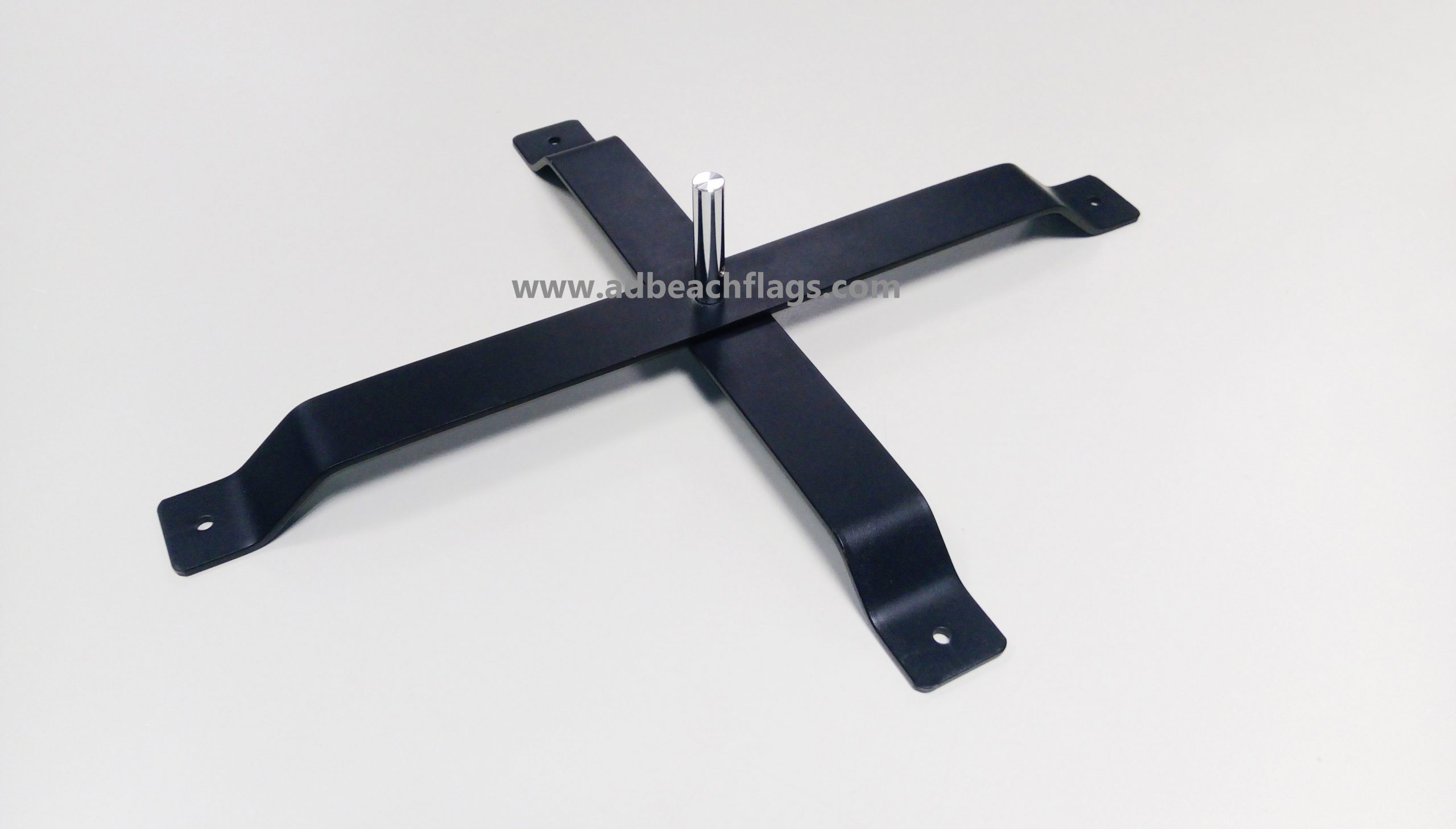
1. Ground-first, every time it is possible. Stand the flag on the ground beside the serving window – spike for grass, cross base for hard standing. It never touches the truck, works at every pitch, and reads over the queue. For most operators this is the whole answer.
2. Tyre-mounted plate. A plate base slides under a vehicle tyre and borrows the truck’s weight as ballast. The standard choice on paved forecourts and slabs where spikes are impossible and the day’s host owns the ground.
3. Hitch or rack sockets. Where the truck already carries a hitch receiver or roof rack, pole sockets exist that use them. No body drilling and decent highway behaviour – but check what local rules allow riding above the vehicle in traffic before you commit.
4. Body bracket, last resort. A bracket screwed to frame-adjacent metal carries the pole at the rear corner. It survives highway windblast, but it means drilling the body – and leases, wraps and resale values all argue against it. Owners who have patched screw holes in a wrapped panel already know this paragraph by heart.
The honest ranking for most trucks: ground placement at every stop, tyre plate on paving, existing sockets if the truck has them, body bracket last. The flag sells lunches at the stop; nothing about the drive between stops needs a flag flying.
One flag at the lot entrance. Half of the day’s customers decide before they reach the truck. A panel at the decision point – the lot corner, the entry gap – catches the traffic the awning cannot.
One flag beside the window. The second panel marks the serving point itself, off the queue line and clear of the menu board. Two flags is the working standard for busy sites; one is acceptable on quiet pitches.
Clear of the food path. A panel that shades the counter hides the product, blocks the menu and collects grease on the sleeve. Stand beside, never over.
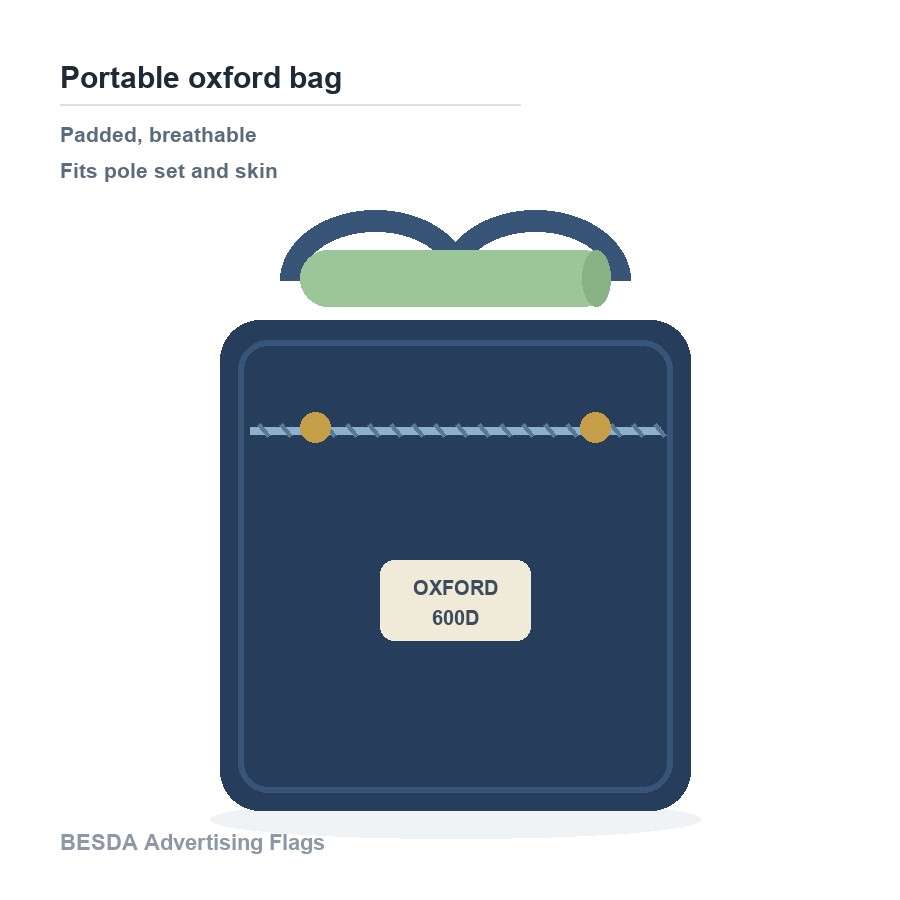
Pack-down is part of the setup. Poles and panels walk away from unattended lots overnight. One padded bag, back into the van, every night – the oxford carry bag exists for exactly this habit, and the habit decides most of the kit’s lifespan.
| Format | Best at | Weak at | Role |
|---|---|---|---|
| Feather flag, 2.5-3 m | Reading over crowds and awnings; brand from distance | Menu detail; calm-day flutter | Beacon: where the truck is |
| A-frame sign | Menu boards and today’s special at queue distance | Distance; wind; crowded walkways | Closer: what to order |
One honest note on calm days: a standard feather needs a breeze to fly its full profile. Trucks that work wind-shadow courtyards and indoor markets should ask for the windless cut on the panel – same pole, same base, readable without moving air. And where night markets are the circuit, plan the lighting: a small uplight or the site’s own floodlights keep the panel working after dark.
Height. A 2.5-3 metre assembly clears rooflines and awnings without fighting low branches or the van’s ceiling when packed.
Panel. Double-sided blockout, logo plus one line. Traffic arrives from both directions of the street, and the back of a single-sided panel reads as a mirror. Artwork to the standard spec – 300 dpi at final size, text inside the safe area – per the artwork guidelines.
Base pair. Spike plus cross base covers grass lots and market slabs in one kit; add the tyre plate if paved forecourts dominate the route. The cross base size guide matches base to pole.
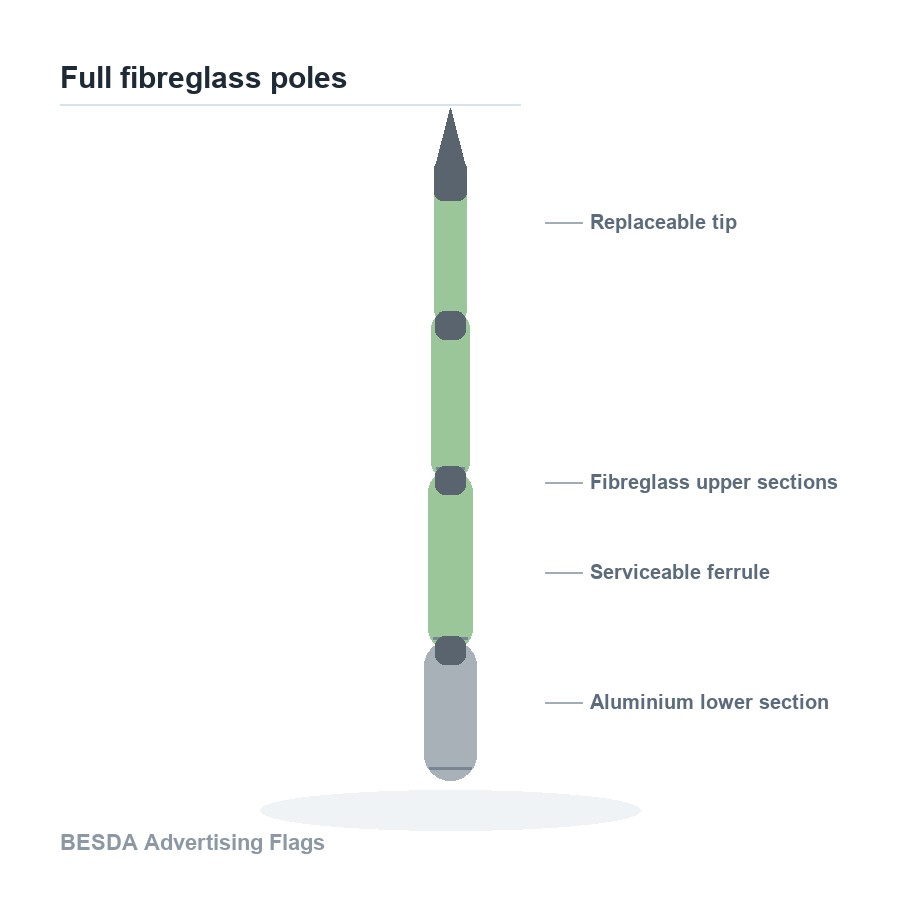
Pole. Fibreglass upper sections. Highway windblast and parking-lot gusts bend aluminium permanently; fibreglass recovers. Our full fibreglass poles are the standard pairing for mobile kits.
Drilling the body first. The bracket is the last resort. Ground placement and tyre plates carry the same message without touching the van or the lease.
Flag over the window. Shade on the counter, grease on the sleeve, a hidden menu board – all from one wrong placement. Beside the window, off the queue line.
Truck-only thinking. A flag mounted to the vehicle reads at the truck; half the customers decide at the lot entrance. Cover the decision path, not just the destination.
Ignoring site rules. Markets enforce stake bans and weight minimums hard, because their insurance depends on them. Carry the spikeless base so a no-stakes site never turns the kit away.
Skipping the bag. The kit that lives loose in a van is the kit that needs replacing in a season. Bag it, every night.
How do you attach a flag to a food truck?
Most operators do not. Ground placement beside the window, or a tyre-mounted plate on paving, carries the message without touching the vehicle. Body brackets exist and work, but drilling the body is a lease and wrap problem – treat it as the last option.
Feather flag or A-frame for a food truck?
Both, if storage allows. The flag is the beacon read across the lot; the A-frame carries the menu at queue distance. Tight storage starts with the flag.
What size flag fits a food truck?
A 2.5-3 metre assembly – tall enough to read over awnings, short enough for market rules, branches and van storage.
Which base works on asphalt?
A cross base with weight, or a tyre plate that borrows the truck’s weight. Spikes are for grass and soil, and many event sites ban them entirely.
Do flags work on calm days?
A standard feather needs a breeze for its full profile. Ask for the windless cut if your circuit is courtyards and indoor markets.
How long does the kit last on the road?
Dye-sublimated knit holds colour through a season of outdoor use as a norm; handling decides the rest. The padded bag, nightly pack-down and dry storage are the difference.
Food truck signage is a routing problem that changes address daily. Solve it with a kit: a 2.5-3 metre double-sided feather, fibreglass pole, base pair for every surface, one bag. Mount to the ground before the vehicle, place one flag at the decision point and one at the window, and let an A-frame carry the menu. The brand then reads at every pitch without a single new hole in the van.
Send your truck photos and typical stop types for a kit written to your route – height, panel, base pair, bag – with sampling and bulk dates confirmed in writing. Low MOQ accepted, wholesale commonly from 5 pieces per design, and single-truck sample kits are possible so you can test one week of pitches before ordering for the fleet.
Tell us the flag sizes, the quantities, single or double-sided, and the ground the flags will stand on. Our export team replies within 1 hour, 24×7, with a proof and a factory price. Low MOQ accepted.
Prefer a form? Fill in the details below and we will come back with a proof and a price within 1 hour, 24×7.
Related reading: Cross base sizes explained: 60, 72, 80 cm | Flag artwork guidelines for print-ready files | Oxford carry bags: denier, coating, printing | Custom feather flags | Full fibreglass poles | Cross bases | Portable oxford bags
| Item | Detail |
|---|---|
| Product | Food truck flag kits: 2.5-3 m double-sided feather panel, sectional pole, base pair, padded carry bag |
| Also searched as | Food truck signage, feather flag for food truck, food truck flag base, truck mounted flag |
| Manufacturer | BESDA Advertising Flags, Foshan, Guangdong, China |
| Mounting order | Ground first, tyre plate on paving, existing sockets next, body bracket last |
| Placement pattern | One flag at the lot entrance decision point, one beside the serving window, clear of the food path |
| Panel | Double-sided blockout, logo plus one line, 110-130 gsm knit, dye-sublimation |
| Pole material | Fibreglass upper sections for windblast recovery |
| Base pair | Spike for grass, cross base for hard standing, tyre plate for paved forecourts |
| Pairing | Feather flag as beacon plus A-frame for menu detail |
| MOQ and lead time | Low MOQ accepted, wholesale commonly from 5 pieces per design; single-truck sample kits possible |