Phone: 0086-757-8938 9313
WhatsApp: +86 135 1661 0926
Email: [email protected]
Address: Caochang Industrial Zone, Lishui, Nanhai, Foshan, Guangdong, China
24/7 Online Services
Phone: 0086-757-8938 9313
WhatsApp: +86 135 1661 0926
Email: [email protected]
Address: Caochang Industrial Zone, Lishui, Nanhai, Foshan, Guangdong, China
24/7 Online Services

A market coordinator in Bavaria wrote to us in late October with a familiar panic about her christmas market flags. Forty stalls booked, opening night in five weeks, and the flag quotes she had were all summer specs: light bases, pastel artwork, eight-week sea freight. Winter markets break summer assumptions. Darkness falls before 17:00, gusts come off the rooftops in bands, and a stall pitch is usually 3 by 3 metres with rules about what you may anchor where. This guide is the winter version of the flag plan we mark up for market operators every autumn, and it starts with the date on the calendar.
The short answer: order christmas market flags on air or express freight if opening night is under six weeks away, weight every hard-standing base, print for evening contrast, and buy the kit as one matched set per stall row. Do that and the flags hold through December. Skip the ballast or the contrast and the flags become the market’s most photographed failure.
This page is written for market operators, event companies, town councils, stall chains and promotional distributors who buy christmas market flags in rows rather than single pieces. The numbers below are the same ones our export team writes on winter quotations, with typical industry ranges marked as typical.
A summer fair sign works at noon. A christmas market sign works at 18:30 in sleet, against headlights and fairy lights, read from across a square. Three jobs, one product.
1. Flags read above the crowd and the stall roofs. A 3.4 m kit on a weighted base clears the awnings on a standard 3 by 3 m pitch, so visitors navigate by flag colour before they can read any stall sign.
2. Flags mark the decision points. Entrance queues, the mulled wine row, the ice rink, the toilets, the kids’ ride: each one is a question a visitor asks in the first ten minutes. A flag at each point answers it without a staff member.
3. Flags carry the season’s identity. One colour recipe across every stall row makes a market look organised in photographs, and photographs are what sell next year’s stall bookings.
We plan a winter market the same way we plan a festival site, in a walk of the ground. Mark these positions before you count anything.
1. Entrances. Two flags per gate, paired so the mouth reads from across the street. This is the spot for the market’s own branding at the tallest height you are allowed.
2. Food and drink rows. One flag per row head, plus the traders’ own flags between stalls. The row flag carries the row name; the stall flags carry what the crowd actually hunts for at queue distance: Glühwein, bratwurst, churros, crepes.
3. Anchor attractions. The ice rink, the carousel, the Santa cabin and the big tree each get one flag on the approach side, not beside it, because the approach is where people decide.
4. Service and safety. First aid, lost children and exits get the tallest kits on site. Winter coats and hoods swallow sight lines, so service flags fly above everything else.
5. Line management. Where the queue for mulled wine doubles back, a short flag every 10 to 15 metres keeps the line from fraying into the walkway.
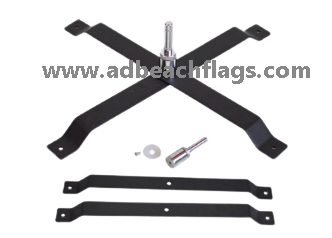
A winter kit is one bag with everything for one standing flag, matched at the factory so the pole, base and skin arrive as one tested unit.
Why 110gsm knitted polyester and not a heavier weave: the lighter knit flies in the weak, cold air of an evening market when a heavy fabric hangs limp. Heavier 130gsm suits exposed coastal sites, and mesh suits gale-prone edges. Winter markets in town squares sit in the middle, which is why 110gsm is the trade default for christmas market flags.
Winter wind is the reason we talk ballast before artwork. The physics is public, so you can check us. The simplified force formula for wind on a flat plate is 0.00256 times the speed in mph squared, times the area in square feet, with a drag factor near 1.2 for a flexible flag. A 15 square foot flag in a 25 mph gust wants roughly 24 lbs of hold-down. A cross base alone does not provide it on open paving. A 10-12 L water bag filled adds 22 to 26 lbs on top of the base weight, which closes the gap for a 3.4 m kit.
| Surface | Base | Ballast | Winter note |
|---|---|---|---|
| Cobblestone, paving, squares | Cross base | Water bag 10-12 L | Top up with sand in freeze-risk weeks |
| Grass, park soil | Ground spike | None | Pull test each flag after setup |
| Exposed edges, gates | Cross base + tank | 12-32 L tank | Fill on site, never move it filled |
| Indoor halls, chalets | Cross base, no bag | Base weight only | Protect the floor, ask about FR fabric |
Improvised ballast shows up at every market, and the photograph below is the honest version: teardrops on cinder blocks. It holds in calm weather and it fails inspection in a gust, because a block that shifts is a liability at ankle height. Our quote always prices the proper base, and we would rather sell you the bag than read about the claim.
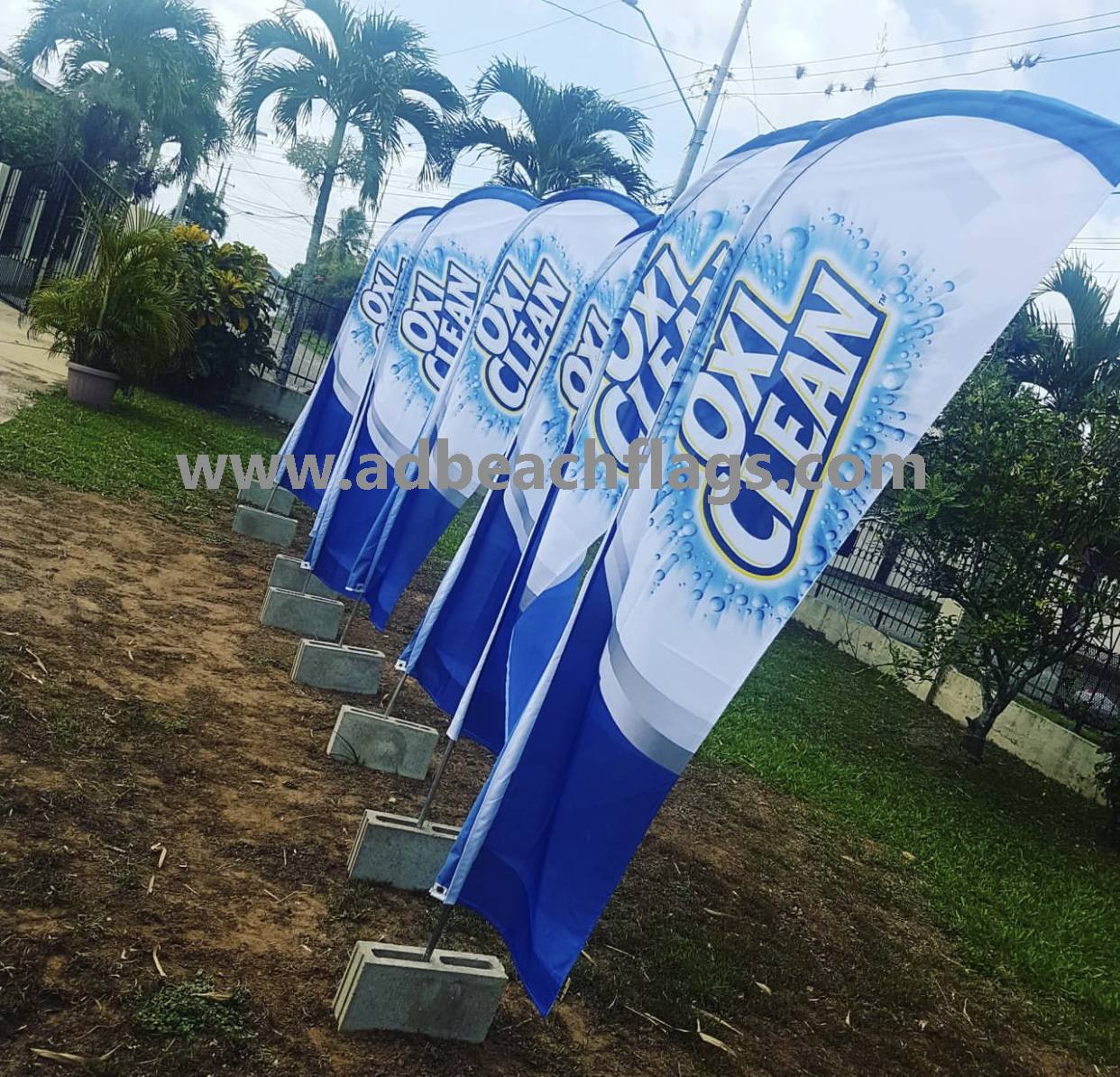
One habit saves December: a two-minute pull test on every flag after setup. A bag that sits half off the base is a ten-second fix at 15:00 and a bent pole at 19:00.
Northern markets run in the dark. Artwork that wins at noon loses under string lights, so we plan prints in two layers.
1. Colour contrast first. Deep red, forest green, navy and black hold their shape against warm light. Pale gold on white reads as glare. If the brand colour is light, put it on a dark field, not the reverse.
2. One word per flag. The flag is a distance board. GLÜHWEIN, CREPES, entrance, exit. Everything longer belongs on the stall’s own counter sign. At 20 to 30 metres, a flag carrying three words carries none.
3. Letter height maths. The event-signage rule of thumb in the trade is roughly one inch of letter height per 30 feet of viewing distance, so a word that must read from 30 m wants letters near 100 mm tall. On a 0.8 by 3.4 m feather skin, that is one or two words, not a sentence.
4. Light the pole, not the sky. Where the market allows it, a clamp light at 2 m washes the skin. Flags above 4 m disappear at night no matter what they cost.
Flag fabric does not carry snow load, and it should never be asked to. Wet snow on a furled skin adds weight the pole was not sized for, and an ice crust in the sleeve abrades the fibreglass tip every time it flexes. The rule we print on every winter packing list: strike the skins when snow settles, dry them overnight, fold in the morning. Skins stored wet fold mildew lines into the print, and mildew is a replacement, not a wash. Our washing and storage guide covers the fold-dry routine in detail for fleets that run all winter.
Winter timelines break more hearts than summer ones, because the calendar is fixed. Opening night does not move. The stages and their typical times:
| Stage | Typical time |
|---|---|
| Artwork proof and revisions | Same day, 1-2 rounds |
| Pre-production sample | 2-3 days |
| Bulk production after written approval | 5-10 days |
| Express shipping | 3-7 days |
| Air freight | 5-8 days |
| Sea freight | 25-40 days |
The honest date maths for a late-November opening: sea freight needed the purchase order in early October. In the last six weeks, express and air are the only lanes that land in time, and a proof held up three days costs a sample round. Payment runs 30 to 50 percent deposit with the balance on shipping evidence, so cash flows while production runs. Next season, the sea lane opens again in July and August, and that is where the unit price drops a tier.
Trade price bands from the sourcing platforms we watch run wide because kit contents differ. Typical factory bands for complete custom kits: single-sided feather or teardrop kits near $5 to $12 per set at wholesale quantity, double-sided kits roughly $7 to $25 depending on size, with sample orders priced higher at low MOQ. Local print shops in Germany or Austria charge more per unit but deliver from one piece overnight. The import maths works when the row is 10 kits or more and the order lands before the season, which is why the order dates above matter more than the unit price.
Our quotes state fabric weight, pole class, base and ballast as written lines, so you can compare like with like across suppliers. Low MOQ accepted, wholesale from 5+ pieces, and mixed artwork across a row at the same spec.
Germany and Austria. The home of the Weihnachtsmarkt runs on Werbefahne and Beachflag vocabulary, and municipal rules can cap display height near 2.44 m on listed squares. German buyers ask for written specs first; we answer with a quotation that states every material line.
United Kingdom. Winter wonderlands and village markets book in September for late November. British buyers say sail flags or event flags, and grass pitches with spike bases dominate outside town squares.
United States and Canada. Christmas tree lots, garden centres and holiday markets run 10 to 15 ft swooper and feather kits from Black Friday through Christmas Eve. Cold air is dense, so flags fly well; the risk is gusts off big-box walls, which means ballast.
France and Spain. Marchés de Noël and mercadillos navideños run through early January, and buyers search drapeaux publicitaires and banderas publicitarias. Coastal markets in Spain stay windy into winter, so mesh on exposed edges earns its keep.
Australia and New Zealand. The seasonal calendar flips: festive trading runs into the southern summer, and UV beats wind as the skin killer. The same kit list applies with 115gsm on west-facing rows.
1. Ordering summer artwork. Pastel flags vanish at 17:00. Winter palettes need dark fields and light type, checked on a proof under warm light, not a phone screen at noon.
2. Unweighted cross bases. The base alone is not ballast on open paving. A 10-12 L water bag per flag closes the gust gap for the standard 3.4 m kit.
3. One giant flag instead of a row. A single 5.6 m flag at the gate cannot tell the food row from the rink. Rows of matched 3.4 m kits do the wayfinding work.
4. Sea freight booked in November. The lane takes 25 to 40 days and customs does not care about your opening night. Late orders go air, at two to three times the freight, or they miss the season.
5. Storing wet. The market ends, the crew bags wet skins, January opens mildew boxes. Dry before fold, every time, even at the last strike.
Honest guidance, because a kit that should not exist is expensive in any fabric.
1. One stall, one weekend, indoor hall. If the chalet is indoors and the hall forbids floor fixings, a counter banner and the hall’s own signage do the job. A flag earns nothing it cannot pay back at a single indoor table.
2. Unlit squares with no power and a midnight curfew. If nobody can see the square after 17:00 and lighting is off the table, print budget belongs on reflective stall signage instead.
3. Gale-exposed sites with no ballast budget. A harbourside market with 35 mph forecasts and no funding for tanks should strike flags on red days. We would rather quote a smaller program than replace a fleet.
| Feature | Advantage | Benefit you bank |
|---|---|---|
| 110gsm knit that flies in cold, weak air | Movement at 18:00, not a hanging rag | The row reads alive all evening |
| Cross base plus 10-12 L water bag | Roughly 22-26 lbs added hold-down | Flags upright through rooftop gusts |
| One colour recipe across the row | Market reads as one event in photos | Stall bookings sell themselves next year |
| Artwork archived at the factory | Next season is a reorder email | Season two spends on print, not setup |
| Photo QC before shipment | Every load photographed packed | No surprises when the cartons land |
Q1. How many flags does a mid-size christmas market need?
Our planning bands: 8 to 14 for a village market, 20 to 40 for a town square with two or three rows, 60 to 120 for a large multi-row site. The stall row walk on your own plan settles the count in an hour.
Q2. What height works on a 3 by 3 metre stall pitch?
Kits of 2.8 to 3.4 m clear the awnings without fighting neighbouring stalls. Taller 4.5 to 5.6 m kits belong at gates and anchor attractions where the organiser allows the height.
Q3. How much ballast does a winter flag need on paving?
A cross base plus a filled 10-12 L water bag, which adds roughly 22 to 26 lbs of hold-down, covers a standard 3.4 m kit in typical December gusts. Exposed gates want a 12-32 L tank.
Q4. Can we still get flags before opening night?
If six weeks or more remain, express freight usually lands in time with samples taking 2 to 3 days and bulk runs 5 to 10 days after written approval. Under four weeks, send the artwork the same day you ask for the quote.
Q5. Do the flags work in snow?
Fabric does not carry snow load. Strike the skins when snow settles, dry overnight and fold in the morning. Skins stored wet grow mildew lines that no wash removes.
Q6. Can every stall have a different design?
Yes. Each skin prints its own artwork at the same fabric and size spec, and Low MOQ accepted, wholesale from 5+ pieces, keeps a mixed row affordable.
| Point | Detail |
|---|---|
| Manufacturer, not reseller | Skins print and sew beside the pole and base lines in our Foshan works, so winter kits ship matched. |
| Winter plan review | Send the market plan and we mark counts, heights and ballast before you spend. |
| Free artwork proof | Proofs and revisions run before any payment, with contrast checked for evening light. |
| Written specs | Fabric weight, pole class, base and ballast appear on the quotation, and test documents are available on request. |
| Low MOQ accepted | Wholesale from 5+ pieces, mixed artwork across the row at trade pricing. |
| Reply in 1 hour, 24×7 | WhatsApp +86 135 1661 0926 or [email protected]. Programs we ship serve buyers in 150+ countries. |
Christmas market flags are a winter engineering job wearing a festive coat. Weight every hard-standing base, print dark fields with one word, walk the stall rows before you count, and order on freight lanes that land before opening night. Do that and the flags hold from the first Glühwein to the last crate. Send us your market plan, the opening date and the surface mix, and we reply in 1 hour, 24×7, with a marked-up flag plan, a proof and factory pricing. If a single indoor stall is the whole job, we will say so and point you at the counter sign instead.
Tell us the flag sizes, the quantities, single or double-sided, and the ground the flags will stand on. Our export team replies within 1 hour, 24×7, with a proof and a factory price. Low MOQ accepted.
Chat on WhatsApp (+86 135 1661 0926) Email Us Now
Prefer a form? Fill in the details below and we will come back with a proof and a price within 1 hour, 24×7.
Related reading: Festival flag kits: the site plan walk for event zones | Water bag vs water tank: ballast maths for windy sites | Beach flag wind rating: when to strike the flags | How to wash and store flags between events | Custom feather flags | Custom teardrop flags | Heavy cross bases | Water bags 10-12 L | Factory credentials and QC
| Item | Detail |
|---|---|
| Product | Christmas market flag kits: feather, teardrop and rectangle flags with poles, bases and carry bags |
| Manufacturer | BESDA Advertising Flags, Foshan, Guangdong, China |
| Standard fabric | 110gsm knitted polyester, dye sublimation printing, Pantone matching on request |
| Winter ballast rule | Cross base plus 10-12 L water bag on paving; 12-32 L tanks on exposed gates |
| Typical kit heights | 2.8-3.4 m on 3×3 m stall pitches; 4.5-5.6 m at gates where height rules allow |
| Night contrast rule | About 100 mm letter height per 30 m viewing distance; one word per flag |
| Lead times | Sampling 2-3 days; bulk 5-10 days after written approval; express 3-7 days, sea 25-40 |
| MOQ & pricing | Low MOQ accepted, wholesale from 5+; typical factory kits $5-25 per set at trade quantity |
| Season timing | Sea lane books July-October; express and air cover late orders inside 6 weeks |
| Contact | WhatsApp +86 135 1661 0926, [email protected], reply in 1 hour 24×7 |