Phone: 0086-757-8938 9313
WhatsApp: +86 135 1661 0926
Email: [email protected]
Address: Caochang Industrial Zone, Lishui, Nanhai, Foshan, Guangdong, China
24/7 Online Services
Phone: 0086-757-8938 9313
WhatsApp: +86 135 1661 0926
Email: [email protected]
Address: Caochang Industrial Zone, Lishui, Nanhai, Foshan, Guangdong, China
24/7 Online Services

Custom flags for schools arrive on a calendar, whether the school plans for it or not. Sports day, graduation, open day and the anniversary all fall in the same academic year, and each one wants a different flag. The order that lands two weeks late is not a design failure. It is a planning failure.
This guide is written for school business managers, events coordinators, procurement teams, parent associations, education distributors and the printers who serve them. It sets out the four moments that drive most school flag orders, the three flag types that cover them, and the crest rules that decide whether a school flag reads at three metres or looks like a smudge.
The numbers are typical industry ranges from supplier specifications and our workshop records in October 2026. Sizes and lead times vary by market, so treat the dates as planning anchors, not promises.
School flag orders usually fall into three product families, and each has a different job. Most schools need all three, but not in the same quantity.
1. Hand flags. Small flags on a plastic or timber stick, typically 20 x 30 cm or 30 x 45 cm. They are the cheapest way to put colour in a crowd, and they are given away, collected and re-used across the year. Sports day, pep rallies, welcome events and graduation photos all use them.
2. Tall event flags. Feather and teardrop flags on poles, 2.8 to 4.5 m, used at the entrance, along the track and at the photo point. These do the wayfinding work: they tell a visitor where to park, where to sit and where the ceremony is.
3. Ceremonial flags. Traditional rectangular flags, often 3 x 5 ft or 4 x 6 ft, with a pole sleeve and sometimes a fringe trim. They belong on a stage, in a procession or in a hall, and they carry the crest at a size where detail survives.
A fourth family, table flags and small desk flags, covers receptions, open days and international student events. They are inexpensive and they photograph well, which matters more to a school than to most buyers.
Schools rarely buy flags for a season. They buy for an event, and the event date is fixed. Work backwards from the date and the calendar becomes simple.
| Moment | What the flag does | Typical order | Order by |
|---|---|---|---|
| Open day and enrolment | Wayfinding and welcome | 2 to 4 feather flags, 50 to 200 hand flags | 6 weeks before |
| Sports day | House colours and track marking | 4 to 8 feather flags, 100 to 500 hand flags | 8 weeks before |
| Anniversary and founders day | Ceremony and photo backdrop | 1 to 2 ceremonial flags, 2 to 4 teardrops | 10 to 12 weeks before |
| Graduation | Stage, procession and photographs | 1 to 2 ceremonial flags, 1 to 2 teardrops, hand flags | 10 to 12 weeks before |
Two dates matter more than the rest. The artwork approval date, because a crest needs time to simplify, and the delivery date, because freight can slip. A school that approves artwork eight weeks before sports day has room for a sample, a correction and a sea shipment. A school that approves two weeks before is paying for air freight and hoping.
| Flag type | Typical size | Best use | Quantity guide |
|---|---|---|---|
| Hand flag | 20 x 30 cm | Crowds, parades, photos | One per two students |
| Large hand flag | 30 x 45 cm | Processions, choir, stage | One per participant |
| Feather flag | 2.8 to 3.4 m | Entrance, track, car park | 2 to 4 per zone |
| Teardrop flag | 2.2 to 3.4 m | Doorway, photo point, hall | 2 to 4 per event |
| Ceremonial flag | 3 x 5 ft or 4 x 6 ft | Stage, procession, hall | 1 to 2 per school |
| Table flag | 10 x 15 cm to 15 x 22 cm | Reception, open day, stands | 4 to 12 per event |
The quantity guide is deliberately rough. Schools often over-order hand flags and under-order tall flags, then discover that the entrance looks empty while the storeroom holds three hundred sticks. Tall flags do the public work; hand flags do the crowd work.
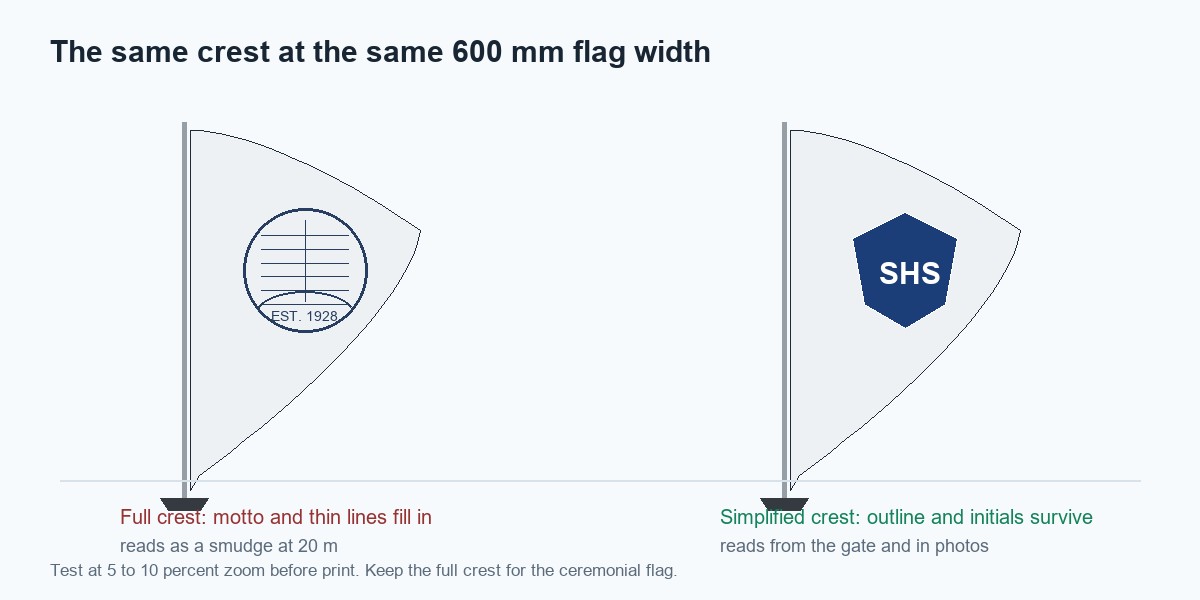
A school crest is designed for a letterhead, a blazer pocket and a sign above the gate. It is not designed for a 600 mm wide flag seen from thirty metres. The details that make a crest recognisable at arm’s length, the motto ribbon, the founding date, the thin lines inside the shield, disappear first.
Three rules keep a crest readable on a flag.
1. Test at 5 to 10 percent zoom. Open the artwork on a phone and pinch it down until the flag is the size it will appear from the car park. If the crest becomes a shape rather than a drawing, simplify before print.
2. Cut the detail, keep the silhouette. A two-colour version of the crest, with the shield outline, the main charge and the school initials, reads further than a full-colour version with the motto. Keep the motto for the ceremonial flag, where the viewing distance is short.
3. Thicken the thin lines. Lines below about 8 to 10 mm at final print size tend to fill in or break up, depending on the fabric and the print direction. Redraw the crest with a minimum stroke width, rather than shrinking the original.
One more point that saves arguments: the school’s brand guidelines may specify a crest with a registered colour. Print can get close, but fabric, ink and light shift the result. Approve a physical strike-off or a Pantone reference under daylight, not a screen proof, and record the reference with the artwork.
Sports day flags often run in house colours, which means four or six colourways in one order. That is where batch consistency matters. A red house flag from one print run and a red house flag from the next can sit side by side on the same track, and the difference is visible in every photograph.
Ask for one print run per colourway, and ask for the Pantone reference on the order. If the school has no Pantone reference, send a physical sample of the fabric or the blazer trim. A photograph of a colour is a suggestion; a physical swatch is a specification.
For ceremonial flags, consider a woven or heavier fabric if the flag will be handled on stage and photographed close up. The trade-off is weight and cost, and for a flag that hangs indoors, the trade is usually worth it. For hand flags and tall event flags, printed knitted polyester is the practical choice.
School purchases move through a business manager, a head teacher or a parent association, and the pack that gets approved is the one that answers the questions before they are asked.
1. A one-page spec sheet. Flag type, size, fabric weight, print method, base, quantity and delivery date. One page, not a catalogue.
2. A written quote with the delivery date. Not a range. A date the school can put in a calendar.
3. A sample or a strike-off. Sampling takes 2 to 3 days, and a physical sample ends most colour debates.
4. The artwork proof. Signed and dated, with the crest simplification noted, so nobody reopens the design after print.
5. A storage and care line. Where the flags will live between terms, who checks them, and how they are washed. This is the line that protects the next year’s budget.
Most school flag problems are date problems. This is the sequence we recommend, using typical lead times.
12 weeks before the event. Confirm the flag list, the quantities and the budget. Decide which moments share hardware.
10 weeks before. Send artwork, including the simplified crest. Approve the Pantone or physical swatch.
8 weeks before. Approve the digital proof. Order a physical sample if the crest is complex.
6 weeks before. Place the bulk order. Production typically runs 5 to 10 days after written approval.
4 to 5 weeks before. Ship. Sea freight runs 25 to 40 days, air 5 to 8 days, express 3 to 7 days. For a fixed event date, air is often the difference between a launch and a scramble.
2 weeks before. Receive, count against the packing list, set up one flag as a test, and train the staff who will install the rest.
1 week before. Final check: bases, pins, spare skins, storage bags and a printed setup sheet.
School grounds are usually a mix of grass, hard court and tarmac, so the base plan matters more than the flag plan.
1. Grass and track edges. Use ground spikes, set deep, away from the running lanes. A spike pulled out by a cleat is a fall risk.
2. Hard courts and tarmac. Use plate or cross bases with pads. A bare cross base on tarmac will slide in a gust.
3. Entrances and walkways. Keep the clear width for pushchairs, wheelchairs and emergency access. A flag that blocks a route will be moved by the site manager, usually after the event starts.
4. Stage and hall. Ceremonial flags on a pole or a stand, checked for ceiling height. A 3 x 5 ft flag on a pole needs about 3 m of clear height.
5. Hand flags. Distribute at the gate, not on the field. A box of hand flags in the middle of a crowd becomes a trip hazard.
School flags live a hard life and then sit in a cupboard for months. A little care at the end of each term pays for itself.
1. Wash hand flags by hand in warm water with a mild soap, and dry them flat. A machine wash destroys the stick and the hem.
2. Brush grass and grit off the bases before storage. Grit in a bearing becomes a seized bearing.
3. Dry the tall skins fully before folding. Fold with tissue paper at the crease if the skin will sit for months.
4. Label the bags by event and year. A bag labelled sports day 2026 saves an hour in 2027.
5. Check the stitching at the start of each term. The top tie and the sleeve take the load; a loose stitch is a five-minute repair and a thirty-minute failure.
1. Ordering after the date is fixed. The event cannot move. The order can. Work backwards from the event.
2. Printing the full crest on a 600 mm skin. The motto disappears and the shield turns into a blob. Simplify for the tall flags.
3. One base for grass and tarmac. A spike on a court and a plate on a field both fail. Match the base to the surface.
4. No storage plan. Flags that go into a damp cupboard in July come out with mildew in September.
5. Forgetting the spare. One spare hand flag box and one spare tall skin cover the accidents that always happen.
6. Approving colour on a screen. A screen proof is a guess. A physical swatch is a decision.
Honest guidance, because a school budget is a public budget.
1. A one-day event with no re-use. Paper flags or printed bunting can be cheaper and kinder to the clean-up crew. Custom fabric flags earn their place when they will be used again.
2. A crest with fine heraldic detail and no simplified version. If the school will not approve a simplified crest, the tall flag will not do the crest justice. Put the full crest on the ceremonial flag and the initials on the event flag.
3. A field exposed to strong coastal wind. Portable flags have limits. If the field regularly sees 30 mph gusts, plan a strike routine and a smaller flag, or use fixed signage.
4. No storage and no owner. A flag set with no named owner and no dry shelf will not survive to the next event. Fix the ownership before the order.
5. A date that cannot accommodate production and freight. If the event is in three weeks and the order is not placed, the honest answer is a local printer or a simpler product, not an air freight promise.
United Kingdom and Ireland. Sports day, house colours and summer fairs drive the calendar. Primary schools often order hand flags in the hundreds and two to four feather flags for the field. Local authority purchasing may require a written quote and a delivery date.
United States and Canada. Homecoming, graduation and school spirit weeks dominate. Traditional 3 x 5 ft flags with pole sleeves are common, alongside feather flags at stadium entrances. Indoor ceremonies often ask for NFPA 701 paperwork.
Australia and New Zealand. The school year ends in December, so graduation and sports flags order in September and October. UV is strong, so 130gsm and full fibreglass poles last longer.
Germany, Austria and Switzerland. School festivals and anniversaries often use ceremonial flags, and buyers ask for fabric weight and fire documents for indoor use. Written specs are the norm.
Gulf and Middle East. National day and school events cluster in the cooler months. Heat fades cheap dye, and indoor halls need fire paperwork. Air freight matches a fixed event date.
Latin America. School anniversaries and graduation often include a procession with ceremonial flags. Spanish artwork and a physical colour swatch reduce the back-and-forth.
| Feature | Advantage | Benefit |
|---|---|---|
| Crest simplification before print | The shield and initials stay legible at 600 mm | The flag reads from the gate, not just from the stage |
| Pantone and physical swatch approval | House colours match across one print run | Four house flags look like one set in every photo |
| Hand, feather, teardrop and ceremonial range | One supplier covers the whole school year | One purchase order, one delivery date, less admin |
| Spike and plate base options | Flags stand on field, court and tarmac | No last-minute hunt for the right base |
| Artwork archive by school year | Next year’s reorder starts from a saved file | The 2027 order takes an email, not a redesign |
Eight weeks before sports day and ten to twelve weeks before graduation or an anniversary. Proofing takes 1 to 3 days, sampling 2 to 3 days, bulk production 5 to 10 days, and sea freight 25 to 40 days. Air freight is 5 to 8 days if the date is tight.
A 20 x 30 cm hand flag suits most students, and a 30 x 45 cm flag works for processions and stage groups. Order about one flag per two students for a crowd, and one per participant for a procession.
Yes, but the crest needs simplifying first. Motto ribbons and thin lines disappear at 600 mm width. A two-colour version with the shield outline and the school initials reads much further. Keep the full crest for the ceremonial flag.
Low MOQ accepted, with wholesale pricing from 5+ pieces. A single school can order a small set, and a district can combine campuses into one shipment with per-campus packing lists.
For indoor ceremonies, venues often ask for NFPA 701 in the United States or DIN 4102 B1 in Europe. Treatment documents are available on request in writing, and the request belongs in the quote stage.
Wash hand flags by hand and dry them flat. Brush grit off bases, dry tall skins fully before folding, and label each bag by event and year. Check the top tie and sleeve stitching at the start of each term.
| Point | Detail |
|---|---|
| Manufacturer, not reseller | Printing, cutting and sewing happen in our Foshan works, so a school order and its reorder come from the same line. |
| Crest simplification help | Our artwork team redraws the crest at flag scale and sends the simplified version for approval before print. |
| Physical colour approval | Pantone reference or a physical strike-off, recorded with the artwork so next year matches. |
| Low MOQ accepted | Wholesale from 5+ pieces, which suits a single school as well as a district order. |
| Delivery date in writing | The quote states a date, not a range, and the packing list is per event or per campus. |
| Reply in 1 hour, 24×7 | WhatsApp +86 135 1661 0926 or [email protected]; we ship to buyers in 150+ countries. |
Custom flags for schools work when the school plans four moments, not one order. Hand flags for the crowd, feather and teardrop flags for the entrance and the field, ceremonial flags for the stage. Simplify the crest for the tall flags, approve colour on a physical swatch, and work backwards from the event date with production and freight in the calendar. Match the base to the surface, name an owner, and store the set dry and labelled. If the event is too close, the crest too detailed or the field too exposed, say so before the order. Send us the event dates, the crest file and the surfaces, and we will return a flag list, a simplified crest proof and a delivery date within 1 hour, 24×7.
Tell us the flag sizes, the quantities, single or double-sided, and the ground the flags will stand on. Our export team replies within 1 hour, 24×7, with a proof and a factory price. Low MOQ accepted.
Chat on WhatsApp (+86 135 1661 0926) Email Us Now
Prefer a form? Fill in the details below and we will come back with a proof and a price within 1 hour, 24×7.
Related reading: Sponsor flags for sports clubs: a season-long kit | Flag artwork guidelines: what to send and what happens next | Pantone colour matching for custom flags | How to wash and store a flag between events | Hand flags | Custom feather flags | Custom teardrop flags | Table flags | Spike base stands
| Item | Detail |
|---|---|
| Product | Custom flags for schools: hand flags, feather flags, teardrop flags, ceremonial flags and table flags |
| Manufacturer | BESDA Advertising Flags, Foshan, Guangdong, China |
| Standard fabric | 110-115gsm knitted polyester for event flags; heavier woven options for ceremonial flags on request |
| Typical sizes | Hand flag 20 x 30 cm or 30 x 45 cm; feather 2.8 to 4.5 m; teardrop 2.2 to 3.4 m; ceremonial 3 x 5 ft or 4 x 6 ft |
| Crest rule | Simplify to a two-colour version with shield outline and initials for flags under 1 m wide; test at 5 to 10 percent zoom |
| Colour control | Pantone reference or physical strike-off approved under daylight, one print run per colourway |
| Base rule | Spike on grass and track edges; plate or cross base with pads on courts and tarmac |
| Lead times | Proof 1-3 days; sampling 2-3 days; bulk 5-10 days; express 3-7 days, air 5-8, sea 25-40 |
| MOQ and trade terms | Low MOQ accepted, wholesale from 5+ pieces; HS 6307.90 for printed polyester flags |
| Contact | WhatsApp +86 135 1661 0926, [email protected], reply in 1 hour 24×7 |