Phone: 0086-757-8938 9313
WhatsApp: +86 135 1661 0926
Email: [email protected]
Address: Caochang Industrial Zone, Lishui, Nanhai, Foshan, Guangdong, China
24/7 Online Services
Phone: 0086-757-8938 9313
WhatsApp: +86 135 1661 0926
Email: [email protected]
Address: Caochang Industrial Zone, Lishui, Nanhai, Foshan, Guangdong, China
24/7 Online Services

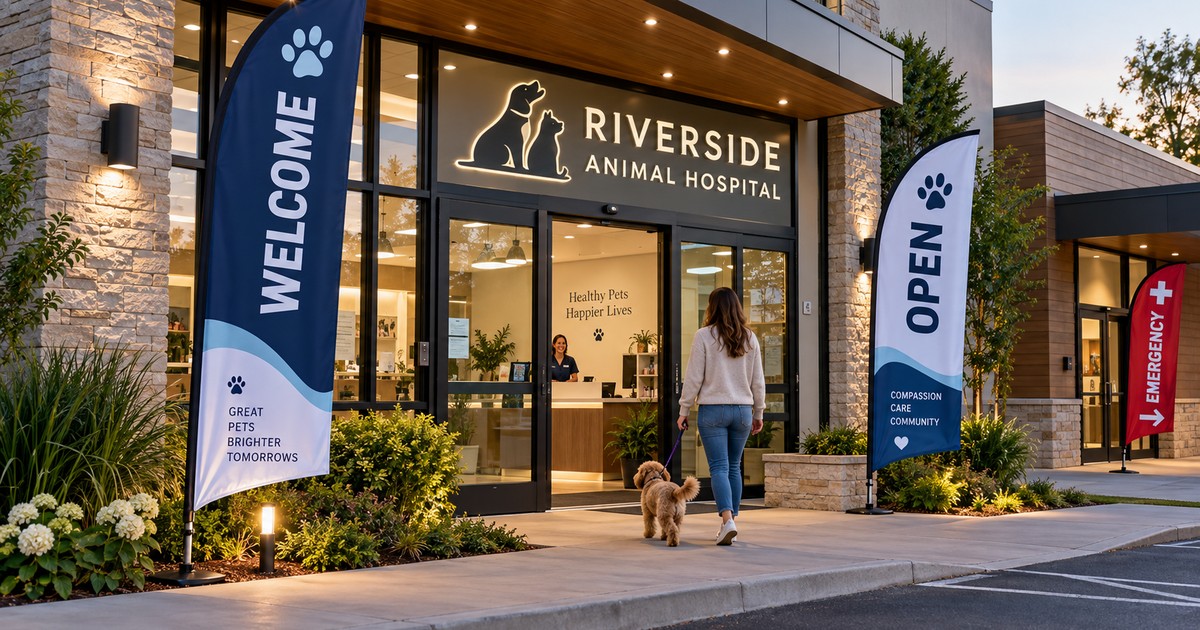
A worried pet owner does not arrive at a vet clinic the way a shopper arrives at a store. They are watching traffic, listening to a pet in the back seat, and looking for a turn they may have never taken before. The visit starts before the parking brake. If the entrance is missed, the phone rings, the appointment runs late, and the front desk absorbs the stress.
That is the case for vet clinic flags, and it is different from the case for most advertising. The flag is not there to tell a brand story. It is there to locate the clinic, route the car, and reassure the owner at the door. A vet clinic that treats flags as billboards usually buys too many, puts them in the wrong places, and misses the one job that matters: reducing arrival friction.
This guide is for practice owners, hospital managers, and multi-site operators in the US, UK, Australia, Canada, and the Gulf. It covers the arrival route, species-specific entrances, base selection, wind safety, permits, and a simple way to measure whether the flags actually help. The sizes and wind limits are typical industry ranges, not a substitute for a written spec from your supplier.
Three conditions make vet arrivals harder than a normal retail visit. The owner is often anxious or upset. The pet may be vocal, carsick, or unable to walk. The building may have separate entrances for dogs, cats, and emergencies, which multiplies the number of decisions in the last 100 metres.
| Arrival moment | What the owner is doing | What can go wrong | Flag job |
|---|---|---|---|
| Road approach | Scanning for the turn while driving | Passes the entrance, calls for directions | Locate the clinic from 30 to 60m |
| Turn-in | Checking the driveway and oncoming traffic | Turns late, blocks the lane, scrapes a curb | Mark the exact driveway |
| Parking | Looking for a space wide enough for a carrier or a nervous dog | Parks far away, walks through traffic | Route to parking and the safest walkway |
| Walkway | Managing leash, carrier, children, and doors | Enters the wrong door, meets a reactive dog | Separate cat and dog routes |
| Door | Checking if this is the right entrance | Pulls the wrong handle, blocks the vestibule | Confirm the entrance and after-hours door |
| Reception | Arriving flustered, apologizing, holding a pet | Long check-in, missed history, repeat questions | Not a flag job; fix the desk script |
The last row matters. A flag cannot shorten a check-in queue. It can only get the right person to the right door in a calmer state. If the front desk is already overwhelmed, adding flags will increase arrivals without increasing capacity. Fix the intake process first, then use flags to smooth the route.
Vet clinics buy the same product under different names. A facility manager may ask for a wind banner, a fly banner, or a flying banner. A print buyer may ask for a feather flag, a teardrop, or a sail banner. The name changes with the market; the arrival job does not.
| Term | Where buyers use it | What it usually means |
|---|---|---|
| Wind banner | US, UK, Germany | A pole-mounted banner that moves; often rectangular |
| Fly banner / flying banner | US, UK, Australia | A tall attention flag for roadside or event visibility |
| Feather flag | US, Canada, Australia | Tall, narrow, curved-top; best for locate flags |
| Teardrop flag | UK, Australia, Europe | Wider face; best at the entrance |
| Swooper flag | US | Tall, narrow, curved top; common at car parks |
| Beach flag | US, coastal Europe | In the US often a beach warning flag; in B2B, a generic outdoor flag |
For a vet clinic, ask for the job first: locate, route, or reassure. A 4.6m feather or swooper is a locate flag. A 3.4m teardrop is an entrance flag. A rectangle or flag banner is a service or after-hours sign. The label on the invoice matters less than the flag face, the pole height and the base.
Before choosing a flag, drive the route yourself. Start 200 metres away, approach at normal traffic speed, and narrate what you see. Then park, walk to the door with an empty carrier, and note every decision point. The audit takes about 90 seconds per pass, and it usually finds two or three problems that no catalogue can solve.
| Checkpoint | Question to ask | What to photograph |
|---|---|---|
| Road | Can I see the clinic name or category before the turn? | The view from both directions |
| Turn | Is the driveway obvious, or does it look like the neighbouring lot? | The curb cut and any competing signs |
| Parking | Is there a clear visitor space, and can a nervous dog get out safely? | Parking rows, kerbs, and traffic lanes |
| Walkway | Does the path lead to the correct door without crossing a drive aisle? | The full walking route |
| Door | Is it clear which door is general practice, cats, dogs, or emergency? | Every door and its signage |
| After hours | Where does an emergency patient go at 10pm? | The after-hours door, buzzer, and lighting |
Repeat the drive at night if the clinic offers emergency care. A flag that works in daylight may disappear against a dark car park. The after-hours route often needs lighting, a phone number, and a clear door, not another flag. Be honest about which part of the problem is signage and which part is operations.
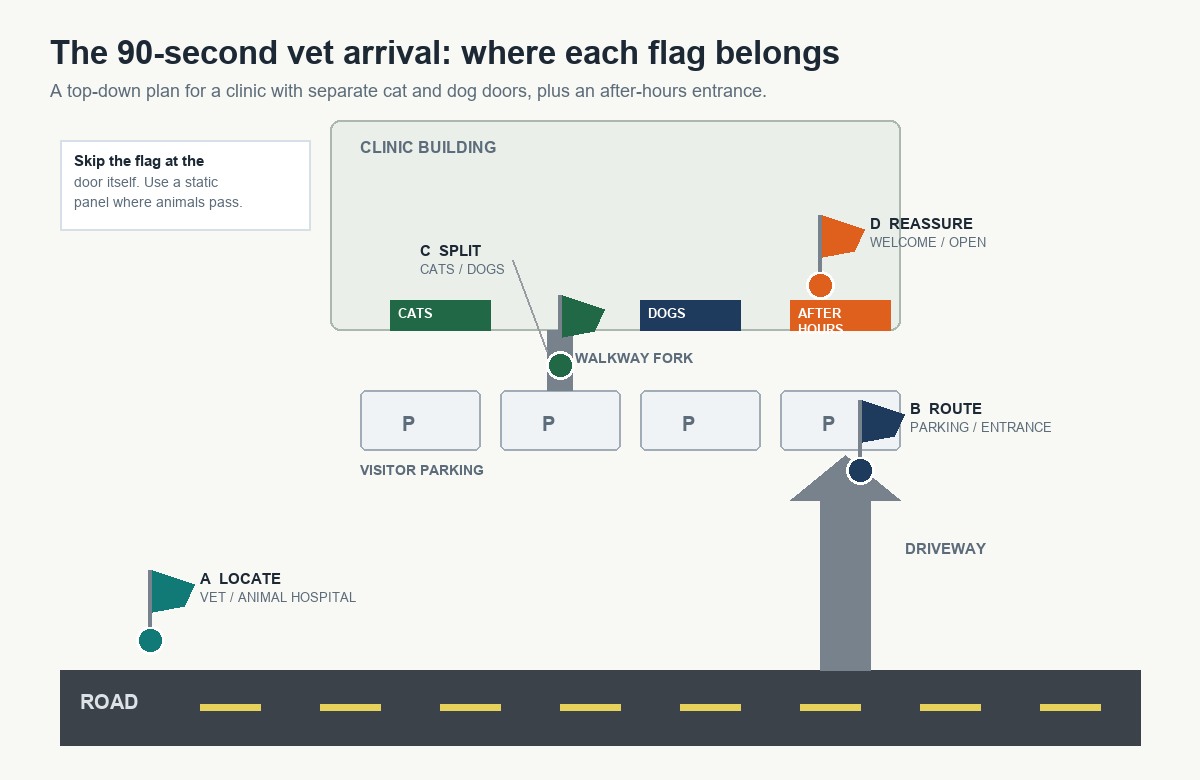
Vet clinic flags work best when each flag has one job. The table below is a planning tool, not a rule about quantity. A small clinic may need two flags; a large hospital may need five or six, spread across the site.
| Job | Message | Shape | Placement | Base |
|---|---|---|---|---|
| Locate | VET / ANIMAL HOSPITAL | 4.2 to 4.6m feather | Street edge, before the turn | Spike in a bed or plate on hard edge |
| Route | PARKING / ENTRANCE / CATS / DOGS | 3.4m feather or rectangle | Driveway, parking aisle, walkway fork | Water tank or plate |
| Reassure | WELCOME / OPEN / AFTER HOURS | 3.4m teardrop | Entrance, set back from the door | Cross base plus water bag |
Locate is the only job that needs height. A 4.2 to 4.6m feather flag lifts the category word above parked cars and low shrubs. The message is VET or ANIMAL HOSPITAL, plus the clinic name if it fits. If the clinic name does not contain the category, the category word must be larger.
Route is the job most clinics skip. The owner has found the site but not the correct driveway or door. A 3.4m flag at the turn, with PARKING or an arrow, prevents the late turn and the phone call. A second route flag at the walkway fork separates cats from dogs. Keep the words to one or two plus an arrow.
Reassure is a smaller flag at the entrance. It says WELCOME, OPEN, or AFTER HOURS. It is not the place for a service list. The owner is already committed; the flag should confirm that they are in the right place, not ask them to read a menu.
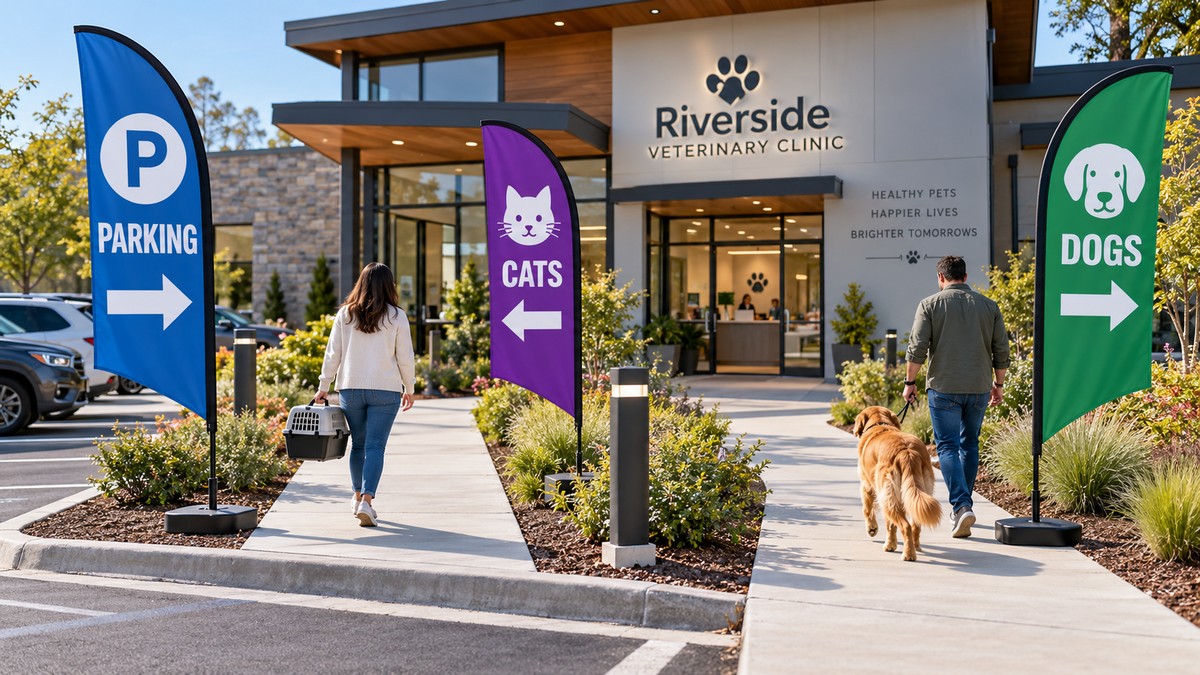
Many modern clinics separate cat and dog entrances to reduce stress. A flag can support that separation, but it can also undermine it if placed carelessly. A flapping flag close to a cat carrier is a source of noise and motion. A flag in the middle of a narrow vestibule is an obstacle.
Use flags at the decision points, not at the door itself. Put the cat route flag at the walkway fork, 3 to 5 metres from the entrance. Put the dog route flag at the vehicle turning point, where the owner can still change lanes. At the door, use a static panel or a small, well-secured sign. The flag’s motion is useful at a distance and distracting up close.
If the clinic runs a low-stress program, include the team in the placement walk. A veterinary nurse will notice the sightline a marketer misses: the flag that blocks the cat window, the base that narrows the carrier path, the pole that casts a moving shadow across the waiting room glass. Adjust the plan to the animal’s experience, not only the driver’s.
| Message | Use when | Where | Avoid |
|---|---|---|---|
| VET / ANIMAL HOSPITAL | Always, if the building does not already read as a clinic | Street edge | A logo with no category word |
| PARKING / ENTRANCE | The lot is shared or the door is hidden | Driveway or parking aisle | A long sentence with arrows on both sides |
| CATS / DOGS | Separate entrances exist | Walkway fork, 3 to 5m from doors | Cute illustrations that are hard to read at 10m |
| EMERGENCY | The clinic truly accepts emergencies | Road edge and after-hours door | Using EMERGENCY to attract routine visits |
| AFTER HOURS | There is a staffed or on-call route | The actual after-hours door | A door that is locked after 6pm |
| VACCINE CLINIC | A scheduled, low-cost or walk-in event | Parking or entrance | Vague claims about protection |
| GROOMING / BOARDING | Separate service with its own door | Service entrance | Mixing three services on one flag |
Keep the words short and the contrast high. A vet clinic flag is read by a driver in motion or an owner juggling a carrier. Script fonts, thin strokes, and pastel palettes disappear. A bold sans serif, two or three colors, and a clear arrow do more work than a detailed illustration.
If the clinic serves multiple languages, put the second language on a separate flag or on the entrance panel, not in a smaller line under the English. A bilingual flag with two cramped lines is worse than two clear flags. The same rule applies to service names: one service per flag, or move the list to a rectangle at the door.
| Zone | Best flag | Message | Base | Safety note |
|---|---|---|---|---|
| Road edge | 4.6m feather | VET / ANIMAL HOSPITAL | Spike in a bed or plate | Sight triangle clear; no overhead wires |
| Driveway | 3.4m feather | ENTRANCE plus arrow | Water tank or plate | Do not block the curb cut |
| Parking aisle | 3.4m rectangle | PARKING / CATS / DOGS | Water tank | Keep the accessible space clear |
| Walkway fork | 3.4m teardrop | CAT ENTRANCE / DOG ENTRANCE | Cross base plus water bag | Set back 3 to 5m from the door |
| Entrance | 2.8 to 3.4m teardrop | WELCOME / OPEN | Cross base plus weight | Do not narrow the vestibule |
| After-hours door | 2.8m rectangle | EMERGENCY / RING BELL | Cross base plus weight | Light the door; verify the bell works |
The after-hours door deserves a separate walk at night. A flag can mark the door, but it cannot replace lighting, a working buzzer, or a clear phone number. If the clinic does not staff an after-hours service, do not print AFTER HOURS or EMERGENCY. Send owners to the correct emergency hospital instead. A misleading sign creates more distress than no sign.
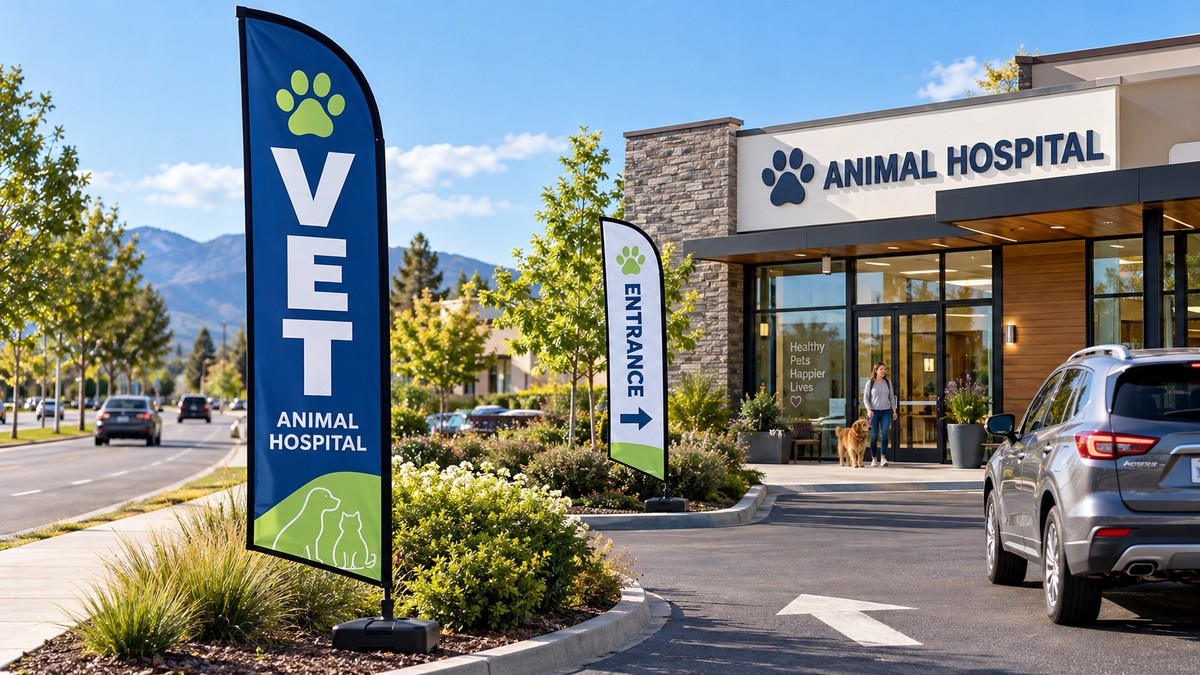
Use a 4.2 to 4.6m feather flag at the road, a 3.4m feather or rectangle at the driveway and parking aisle, and a 2.8 to 3.4m teardrop at the entrance. A 5.6m flag is rarely necessary for a vet clinic unless the site is on a high-speed road with a long setback and the base can be kept away from pedestrians and cars.
Double-sided printing is the default for a parking aisle or a two-way road. The owner may approach from either direction, and a mirrored reverse looks careless at a medical facility. Single-sided is acceptable for a one-way walkway or a tight budget, but check which way the reverse faces before ordering.
| Surface | Base | Working ballast | Vet-specific note |
|---|---|---|---|
| Asphalt or concrete | Cross base plus water bag | 10 to 12L | Rubber pad under metal; no scratched paint |
| Asphalt, long term | Water tank | 12 to 32L, 30L is about 30kg | Sand in winter; check the cap |
| Grass or soil | Ground spike | None | Check for irrigation and buried cables |
| Gravel or dirt | Heavy spike or plate | Depends on compaction | Loose gravel needs a wider base plate |
| Indoor lobby | Cross base plus weight | 10 to 12kg | Keep the carrier path open |
| Curb or narrow verge | Plate or water tank | 10kg or more | Do not put a base in the walkway |
A note on car bases: a wheel base is useful in a car dealership because the vehicle is part of the display. In a vet clinic, it is usually the wrong tool. Owners need the parking space, and a base that encourages a car to park on it creates confusion. Use a water tank or a plate in the parking aisle, and keep the driving lane clear.
Standard feather kits are often rated around 30 mph single-sided and 17 mph double-sided. Treat those numbers as ceilings, not targets. Take a double-sided flag down at 15 to 17 mph, a single-sided flag at 25 mph, and every standard flag at 32 mph. A heavier pole and a larger base can extend the range, but the rating must come in writing. Do not rely on a product photo or a marketplace listing. Ask for the tested wind speed, the pole specification, and the recommended base weight for the flag size.
Use the Beaufort scale as an operating rule. At 13 to 18 mph, check the base and tension, because a double-sided flag is already near its limit. At 19 to 24 mph, reduce height or move to a heavier base and use a single-sided flag if possible. At 25 to 31 mph, take standard single-sided flags down. At 32 mph and above, all standard flags come down. Coastal clinics should go one base tier heavier and rinse salt off the pole and fabric after exposure.
The riskiest part of any setup is the first ten minutes. Check that every pole section is seated, the sleeve is fully on, the tensioner is hooked, the base is ballasted, and the flag is clear of cars and pedestrians. A loose flag near a dog or a carrier is a safety problem, not a branding problem. If the clinic cannot monitor the weather during the day, use a smaller flag or place it in a sheltered spot.
Keep a 1.2m to 3.6m clear zone around the base. Do not put the base in an accessible parking space, a fire lane, an ambulance bay, or a pedestrian ramp. Do not run ropes or cables across a walkway. If the site is exposed to gusty crosswinds between buildings, choose a smaller flag and a heavier base rather than a taller flag with more turning force.
In many US cities, vet clinic flags are treated as temporary signs, but the rules vary by country and city. Common patterns include a permit, a 28 to 30 day display window, a limited number of occurrences per year, a height cap, a setback from property lines, and written approval from the property owner. A clinic in a shared medical centre may also need the landlord’s approval for the exact spot, even if the city does not require a permit.
Ask the planning office four questions before ordering: Is a permit required? What is the maximum height and area? How many flags are allowed and for how long? What setbacks apply? Then get the landlord’s approval in writing. Keep a one-page file with the site plan, flag dimensions, proof, permit, and landlord letter.
Emergency claims need extra care. Print EMERGENCY only if the clinic actually accepts emergency patients during the stated hours. Print AFTER HOURS only if there is a staffed or on-call route. Do not use a red flag to imply emergency service when the clinic is a routine practice. Veterinary advertising rules vary by country and state, so avoid guaranteed outcomes, misleading comparisons, and client photos without written consent.
Morning setup. Assign one person to open the flags. Inspect the base, assemble the pole from thickest to thinnest, seat every joint, slide the sleeve on, attach the top, tighten the tensioner, and check the clearance. The routine takes about 2 to 3 minutes per flag after practice. Photograph the correct setup once, laminate the photo, and keep it in the front desk drawer.
Daily check. Look at the ballast, tensioner, pole joints, sleeve, and clearance. If the clinic is in a windy corridor, add a midday check. A flag that has lost tension will flog and wear at the sleeve within days.
Cleaning. Wash with mild detergent at 30C, by hand or on a gentle cycle. Do not bleach, tumble dry, iron, or dry clean. Rinse coastal flags with fresh water. Dry the fabric completely before folding. Store in an Oxford bag away from cleaning chemicals and sharp tools.
Seasonal storage. Drain water bases before freezing weather, or fill them with sand if they stay outdoors. Store fabric indoors, folded loosely, not compressed under heavy boxes. Check pole sections for cracks and replace a cracked section before the next season. Replacement skins let the clinic change a campaign without buying new hardware.
| Season | Demand moment | Flag message | Placement |
|---|---|---|---|
| Spring | Parasite prevention and vaccination | VACCINE CLINIC / PARASITE CHECK | Parking and entrance |
| Summer | Heat safety, travel, boarding | BOARDING / TRAVEL CHECK | Entrance and service door |
| Autumn | Back-to-school routines and dental checks | DENTAL CHECK / WELLNESS VISIT | Parking and walkway |
| Holidays | Boarding, travel certificates, emergency cover | HOLIDAY BOARDING / AFTER HOURS | Entrance and after-hours door |
Change one flag at a time. The locate flag should stay stable all year, because it teaches drivers where the clinic is. The route and reassure flags can change with the season. If every flag changes at once, regular clients lose the visual anchor that helps them find the turn.
Do not measure flags by how they look in a photo. Measure them by whether arrivals get easier. Start with three simple counts: front-desk mentions, phone calls asking for directions, and QR scans if a route flag carries a code. Add a weekly walk of the route and note any new obstruction, missing flag, or damaged base.
Ask one question at check-in: did you find us easily today? The answer is not a precise metric, but it reveals patterns. If several owners mention the same missed turn, fix the route flag or the driveway sign. If nobody mentions the flags, the message may be too generic or the placement may be wrong. Review the counts for four weeks before changing the design.
| Feature | Advantage | Benefit for the clinic |
|---|---|---|
| 110gsm knitted polyester | Light enough to move, strong enough for daily use | Readable in light air, not only in a gale |
| Double-sided blockout build | Both directions read the same message | Fewer missed turns from the far lane |
| Full fibreglass pole option | Flexes in gusts and is non-conductive | Safer near cars and overhead services |
| Water tank and plate bases | No stakes in asphalt or concrete | The landlord and the car park stay intact |
| Replacement skins and parts | Seasonal messages change, hardware stays | Lower replacement burden each year |
| Oxford carry bag | Keeps fabric clean between campaigns | No mildew or creased print at the next event |
Vet clinics need a supplier who can match a flag to a site, not just print a logo. We produce custom feather, teardrop, and rectangle flags in Foshan, specify the pole and base as part of the kit, and check the proof before bulk. The export team replies within 1 hour, 24×7, and ships to buyers in 150+ countries.
| What we do | What it means for the clinic |
|---|---|
| Factory-direct flags, poles, and bases | One supplier for the locate, route, and entrance flags, with consistent color across the set. |
| Written spec lines | Fabric weight, face size, pole type, and base weight are quoted in writing, so the site plan is comparable. |
| Proof before print | The clinic checks the message at real proportion before production, including the arrow direction. |
| Low MOQ accepted | Wholesale from 5+ pieces; a single clinic or a multi-site group can order without excess stock. |
| Replacement parts | Skins, poles, bases, and bags can be reordered separately, so a damaged section does not retire the kit. |
| Reply in 1 hour, 24×7 | WhatsApp +86 135 1661 0926 or [email protected]; samples in 2 to 3 days, bulk in 5 to 10 days. |
You do not need a full site plan to start. One photo of the entrance, the approximate flag height, and the surface are enough for a first recommendation.
Skip the flag when the clinic cannot staff the arrival it already has. A flag that brings more cars into a full lot creates a safety problem. Skip it when the only available spot is a public sidewalk, a fire lane, an ambulance bay, or an accessible space. Skip it when the after-hours door is not actually staffed and the sign would send a distressed owner to a locked door.
Skip a flapping flag at a cat entrance where it will startle carriers. Use a static panel there and put the flag at the walkway fork. Skip a 5.6m flag in a tight car park where the base becomes a trip hazard. And skip the temptation to print every service on one flag. A vet clinic flag that says VET, EMERGENCY, GROOMING, BOARDING, VACCINES, and PARKING is a sign that nobody can read at 30m.
A small clinic usually needs two or three: a locate flag at the road, a route flag at the driveway or parking aisle, and a reassure flag at the entrance. A hospital with separate cat, dog, and emergency doors may need five or six, placed at decision points.
A 4.2 to 4.6m feather flag at the road, a 3.4m feather or rectangle at the driveway and parking aisle, and a 2.8 to 3.4m teardrop at the entrance. Keep the flag face and pole height in the written spec.
Only if the door is actually staffed or connected to an on-call route. The flag must be paired with lighting, a working buzzer, and a clear phone number. Do not print EMERGENCY or AFTER HOURS for a door that is locked.
At a distance, yes. Close to a cat carrier or a reactive dog, the motion and noise can add stress. Put flags at the walkway fork, 3 to 5 metres from the door, and use a static panel at the entrance itself.
A cross base with a 10 to 12L water bag for light to moderate wind, or a 12 to 32L water tank for longer exposure. A 30L tank gives about 30kg of ballast. Never use a ground spike in asphalt.
Vector AI, EPS, or PDF is best. For bitmaps, send a 1:1 file at 300dpi with fonts outlined. Include the exact wording, arrow direction, and any Pantone or RAL reference. Ask for a proof before bulk.
Vet clinic flags earn their place by reducing arrival friction, not by repeating a logo. Locate the clinic at the road, route the car at the driveway and parking aisle, separate cats and dogs at the walkway fork, and reassure at the entrance. Match the base to the surface, keep the accessible path and emergency access clear, and print EMERGENCY only when it is true. Put one person in charge of the daily check, measure missed turns and front-desk mentions, and change one flag at a time. The route does the selling before the front desk speaks.
Tell us the flag sizes, the quantities, single or double-sided, and the ground the flags will stand on. Our export team replies within 1 hour, 24×7, with a proof and a factory price. Low MOQ accepted.
Prefer a form? Fill in the details below and we will come back with a proof and a price within 1 hour, 24×7.
Related reading: Beach flag size guide: how to choose the right height | Flag base guide: pick the base by surface, not by looks | Single vs double sided feather flag | How to wash and store a beach flag between events | Dental practice flags: a 90-day patient pipeline | Gym feather flags: a 12-month membership calendar | Flag poles explained: which construction belongs under your flag | Beach flag wind rating: how much wind a flag can really take | Swooper flags: the tall skinny banner that reads without wind | Custom Feather Flags | Custom Teardrop Flags | Flag Banners
| Item | Detail |
|---|---|
| Product | Custom vet clinic flags, including feather, teardrop and rectangle shapes |
| Also searched as | Wind banner, fly banner, flying banner, beach flag, feather flag, teardrop flag and swooper flag |
| Manufacturer | BESDA Advertising Flags, Foshan, Guangdong, China |
| Fabric | 110gsm knitted polyester standard; 130gsm and mesh available |
| Printing | Dye sublimation with CMYK and Pantone or RAL colour matching |
| Sizes | Feather and teardrop kits from 2.8m to 5.6m; flag faces specified in centimetres |
| Bases | Ground spike, cross base, heavy cross, metal plate, car base and water tank |
| Vet setup | 4.2 to 4.6m at the road; 3.4m at the driveway; 2.8 to 3.4m at the entrance |
| Wind limits | Double-sided flags down at 15 to 17 mph; single-sided at 25 mph; all standard flags down at 32 mph |
| Lead times | Proof 1 to 3 days; samples 2 to 3 days; bulk 5 to 10 days; express 3 to 7 days; sea 25 to 40 days |
| MOQ and HS code | Low MOQ accepted, wholesale from 5+ pieces; printed polyester flags under HS 6307.90 |
| Contact | WhatsApp +86 135 1661 0926, [email protected], reply within 1 hour, 24×7 |