Phone: 0086-757-8938 9313
WhatsApp: +86 135 1661 0926
Email: [email protected]
Address: Caochang Industrial Zone, Lishui, Nanhai, Foshan, Guangdong, China
24/7 Online Services
Phone: 0086-757-8938 9313
WhatsApp: +86 135 1661 0926
Email: [email protected]
Address: Caochang Industrial Zone, Lishui, Nanhai, Foshan, Guangdong, China
24/7 Online Services

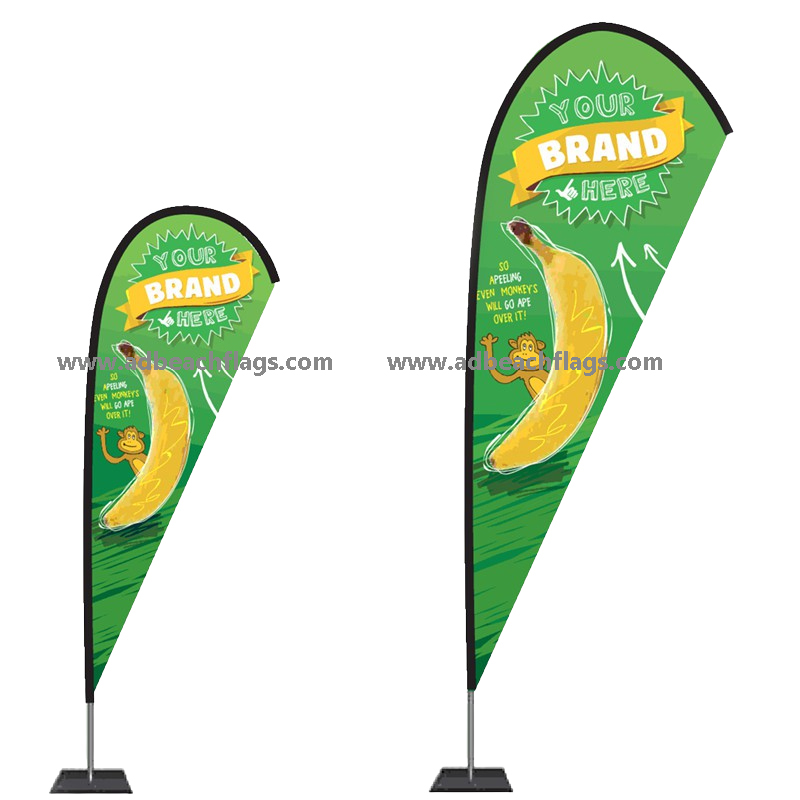
Outdoor flags fight wind. Indoor flag displays fight three quieter problems: a base that can tip in a crowd, a fabric that hangs limp in still air, and a venue that wants a fire certificate before you unbag the poles. Get those three right and the flag does what it does anywhere else: it marks a spot from across the room and pulls people toward it.
This guide is written for the people who place flags inside buildings: mall marketing teams, showroom managers, exhibitors, event organizers, and the distributors who supply them. It covers where indoor flags earn their floor space, how to ballast and place them so a safety officer signs off, and where a flag is the wrong buy. The outdoor basics stay the same, so we link out to the detailed guides instead of repeating them.
The short version: indoors, the base is chosen for foot traffic, not for wind. The height is chosen for the ceiling, not for the road. The fabric is chosen with a fire certificate in hand, not after it. And the message can be longer than outdoor, because the reader is standing still.
An indoor flag display is the same kit buyers know from the street: a printed flag face on a flexible pole, held by a base. The difference is the environment. Inside a mall, a centre, a showroom, or an exhibition hall there is no wind load, no rain, and no ground spike option, because the floor is concrete, tile, or raised access flooring that somebody else owns.
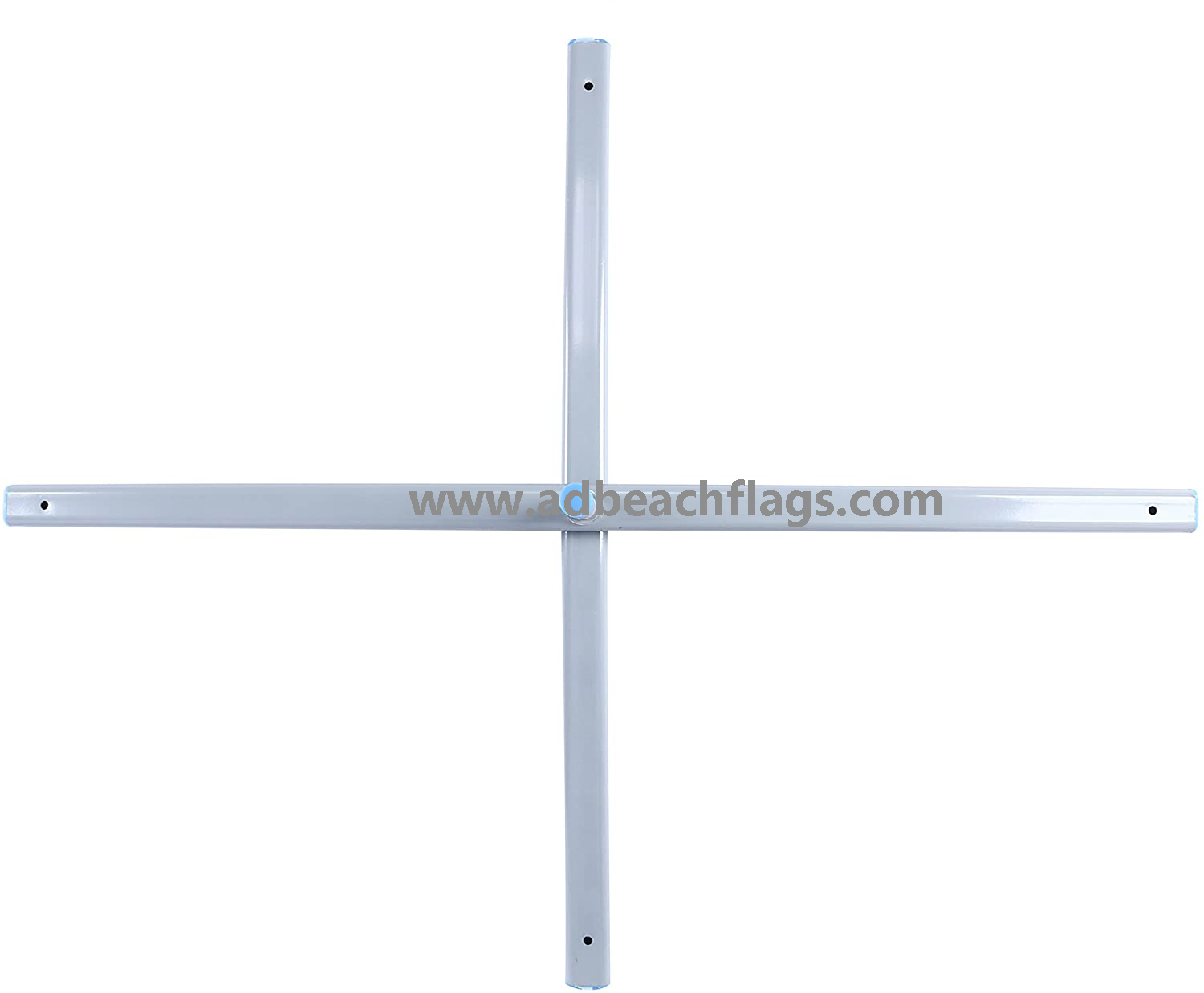
So the kit changes in three places. The base becomes a cross base or a weighted steel base, because it must sit flat on a hard floor and survive a brushing shoulder or a shopping trolley. The height drops to fit the ceiling, with 2.8m to 3.4m doing most indoor work and 4.6m reserved for atriums and double-height halls. The fabric gets specified with a flame retardancy certificate, because most managed venues ask for one in writing before a display stands.
| Part | Outdoor kit | Indoor kit | Why it changes |
|---|---|---|---|
| Base | Spike, cross + water bag, tyre base | Cross base, heavy cross, steel plate | Hard floor, no digging, tip safety near people |
| Height | 2.8 to 5.6m | 2.8 to 3.4m, 4.6m in atriums | Ceiling lines, sprinklers, lighting rigs |
| Fabric | 110gsm standard, mesh for gales | 110gsm, FR finish on request | Venues ask for a fire certificate in writing |
| Message | 3 to 5 words at speed | 3 to 7 words, reader is close | Indoor readers stand still and read twice |
We supply indoor kits to five buyer groups, and each uses the flag for a different job. Mall and centre marketing teams use them to mark promotions, gift wraps, Santa photo points, and survey desks. Showroom managers use them beside product zones, so a customer who walks in blind gets one clear landmark per zone. Exhibitors use them at booth corners to rise above the crowd line. Hotel and resort operators use them in lobbies for seasonal programmes. Distributors and rental companies stock them because one set of hardware serves every indoor client on the calendar.
| Venue | Job of the flag | Typical height | Base | Note |
|---|---|---|---|---|
| Shopping mall or centre | Promotion, gift wrap, photo point | 2.8 to 3.4m | Cross base, weight if near traffic | Management approval and FR cert first |
| Brand showroom | Zone marker, launch highlight | 2.8 to 3.4m | Cross base or steel plate | Match Pantone to the interior palette |
| Exhibition booth | Booth number above the crowd | 3.4 to 4.6m | Cross base + weight | Keep the base inside the booth footprint |
| Hotel lobby or resort | Seasonal programme, event night | 2.8m | Cross base | Swap skins by season, keep hardware |
| Trade hall atrium | Wayfinding, hall numbering | 4.6m | Heavy cross or plate | Clear the sprinkler line by rule |
| Car display or dealer event | Model zone, test drive desk | 3.4m | Steel plate | Keep bases away from door swing arcs |
Every indoor display passes or fails on three checks. A safety officer, a mall manager, or a fire marshal will run them in this order.
1. Ballast: the base must not tip into a person. In still air a light cross base holds a 3.4m flag without help. Near moving crowds the maths changes: a trolley nudge, a child pulling a hem, or a cleaning machine clipping the pole all act like a small wind load. Our rule for managed venues: a bare cross base (1.25 to 1.45kg of steel) is for 2.8 to 3.4m flags in quiet zones; add weight or step up to a heavy cross or steel plate whenever the flag stands within reach of through traffic, and always for 4m and above. The cross base size guide breaks down the footprints, and the metal plate guide covers the weight tiers.
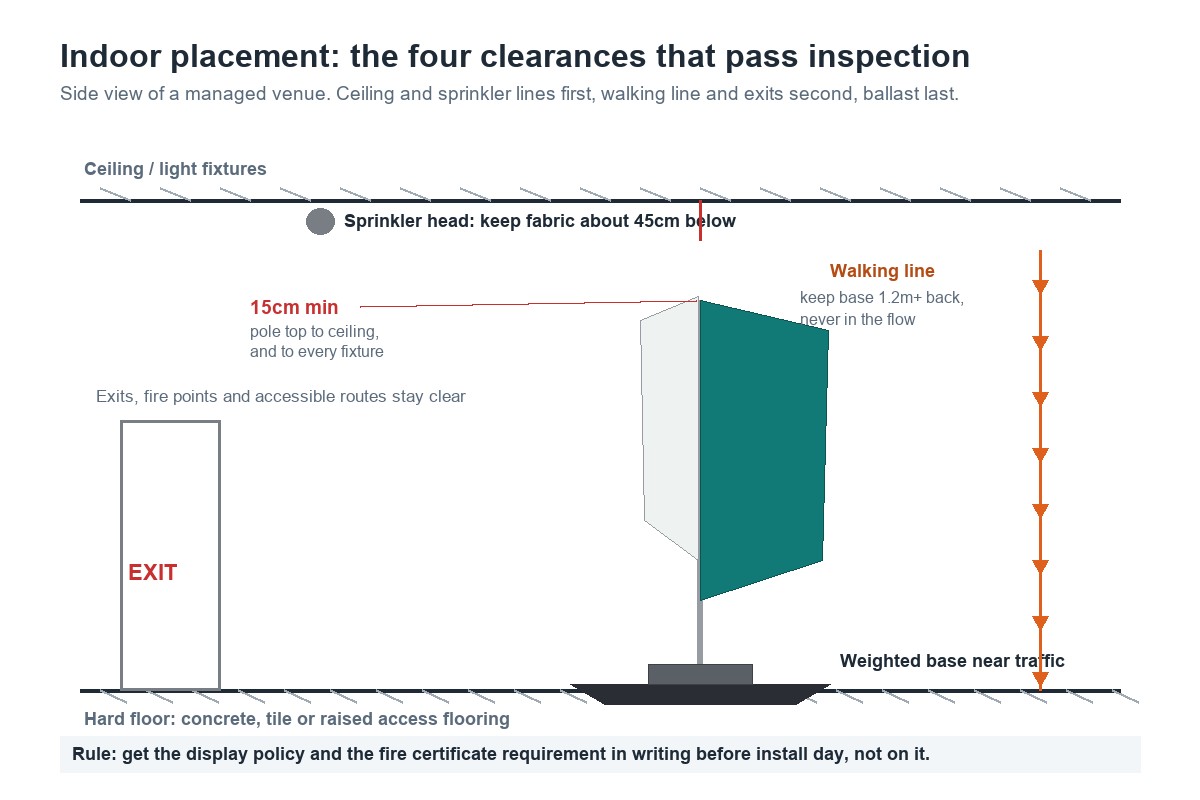
2. Clearance: keep sky around the flag. Leave at least 15cm between the pole top and the ceiling or any light fixture. Keep fabric at least 45cm below sprinkler heads, which is the spacing most fire codes borrow from sprinkler rules. Keep the base 1.2m or more clear of the walking line, out of door swings, and never blocking an exit, a fire point, or an accessible route. If the flag needs a rope to be seen past, it is standing in the wrong spot.
3. Certification: bring the paper before the poles. Venues in the United States commonly ask for NFPA 701 test reports for fabrics displayed in public buildings; German venues work with DIN 4102 B1, and much of Europe reads EN 13501-1 classes. The United Kingdom and Australia follow their own venue rules that land on the same question: is the fabric flame retardant, and can you prove it. We supply flame retardant polyester with certificates on request, in writing, for the specific fabric and order. The flame retardancy guide explains what the test names mean and what to hand the venue office.
| Check | Pass looks like | Fail looks like |
|---|---|---|
| Ballast | Base flat, weight matched to height and traffic | Bare light base under a 4.6m flag by an escalator |
| Clearance | 15cm to ceiling, 45cm to sprinklers, 1.2m to flow | Hem over a walkway, base in a fire lane |
| Certification | Written FR report filed with the venue office | Unmarked fabric, no paperwork, display refused |
Buyers often order the same kit for both worlds, then notice the differences on install day. Indoors, the pole flexes less because there is no gust load, so a full fibreglass top section matters less and an aluminium lower section matters more for straightness. The fabric never dries out from sun, but it also never flutters, so a teardrop or a well-tensioned feather keeps a better silhouette than a loose rectangle. Double-sided builds earn their keep indoors: a mall aisle or a showroom walkway reads from both directions, and the blockout liner keeps each face correct. The trade-off is weight, which is another reason the base step-up rule exists.
The message can be longer indoors. A driver gets three words; a shopper on foot reads five to seven and remembers the offer, not just the brand. That is why indoor skins carry “Gift Wrap Here”, “Level 2”, “Test Drive Desk”, or a department name, while roadside skins carry “OPEN” or “SALE”. If you plan to run both versions of the same campaign, one set of hardware with two skins costs less than two kits. The feather and teardrop use case guide maps nine of these scenarios in detail.
A flag earns its floor space when the site needs a vertical marker that a wall sign cannot give: an open floor with no walls to hang from, a zone that changes every month, a booth that must be found from across a hall. It also wins when the display is temporary, because the whole kit sets up in minutes and packs into one bag.
It is the wrong buy when the ceiling sits under 2.6m, because the flag reads as clutter instead of a landmark. It is the wrong buy in a sealed, airless corridor, where the fabric hangs limp and reads as neglect by the second week. It is the wrong buy for permanent wayfinding that never changes, because printed fabric fades under display lighting over the years and wall signage does the job better. And it is the wrong buy wherever the venue refuses freestanding displays, which some managed centres do; ask in writing before you order, not on install morning.
| Situation | Use the flag | Skip or change |
|---|---|---|
| Monthly promo rotation in a mall | One kit, swapped skins | Do not print a new banner every month |
| Open showroom floor | One flag per zone, plate bases | Do not cluster five flags at one door |
| Exhibition booth, 3m x 3m | One 3.4m flag at the aisle corner | Do not exceed the venue booth height rule |
| Low ceiling under 2.6m | Use a floor-standing banner instead | A flag here reads as clutter |
| Airless corridor, no airflow | Use a tensioned fabric panel | Limp fabric reads as neglect |
1. Get the venue rules in writing. Ask for the display policy, the fire certificate requirement, and the install window in one email. Every later decision keys off this reply.
2. Map the reader’s path. Draw the entrance, the escalators, the aisle junctions, and the destination. The flag goes where the decision happens: the turn toward the promotion, the entry to the zone, the corner of the booth.
3. One flag, one job. Locate, promote, or reassure. A flag that tries to carry a promotion and a wayfinding arrow usually does neither.
4. Size to the ceiling and the distance. A 2.8m flag reads across a shopfront aisle. A 3.4m flag reads across a mall concourse. A 4.6m flag is for atriums and halls with the height to carry it.
5. Match the base to the floor and the traffic. Cross base in quiet zones, weighted or plate base near through traffic, and nothing that rocks on an uneven floor. Check the floor protection rules with facilities; some floors want felt pads under steel.
6. Do a timed install rehearsal. A two-person crew sets a 3.4m kit in under five minutes. Run it once before the real day, photograph the standing position, and keep the photo with the kit so the next operator repeats it exactly. The setup walkthrough shows the assembly order.
We produce the full kit in our own workshop in Foshan, Guangdong: flag face, pole, base, and carry bag specified as one system. For indoor programmes we quote the flame retardancy option up front, with certificates issued in writing for the exact fabric batch. Artwork goes through a proof at real proportion, so the zone name, the Pantone match to your interior, and the safe area are approved before anything is cut.
What we need from you: the venue type, the ceiling height, the floor surface, the flag height you have in mind, the quantity, and the delivery city. A phone photo of the space is enough for us to recommend the height and the base. Distributors and rental companies usually start with a mixed pallet: two or three heights, plate and cross bases, and spare skins per size. Low MOQ accepted, wholesale from 5+ pieces. Typical lead time is 5 to 10 days after proof approval, with certificates attached to the shipping documents.
| Material | Spec | Indoor role | Watch |
|---|---|---|---|
| Knitted polyester | 110gsm, dye sublimation | Standard skins, light and bright | Ask for FR finish if the venue asks |
| FR polyester | Certificate issued in writing | Managed venues, malls, halls | Match the standard to the country |
| Blockout double-sided | Two layers + liner | Aisles and walkways read both ways | Heavier; pair with the heavier base |
| Pole | Aluminium lower, fibreglass top | Straight stand, gentle flex | Seat every joint at install |
| Base | Cross 1.25 to 1.45kg; plates 4 to 12kg | Flat on hard floors | Step up with height and traffic |
| Feature | Advantage | Benefit indoors |
|---|---|---|
| Steel cross and plate bases | Flat footprint on hard floors | Passes the tip test near crowds and trolleys |
| 2.8 to 4.6m height range | Fits shopfront to atrium | One hardware system across every venue type |
| FR fabric with written certificate | Paperwork filed before install day | Venue approval without a scramble |
| Double-sided blockout build | Correct reading both directions | One flag serves an entire aisle |
| Swappable skins | New print, same hardware | Monthly campaigns without new kits |
| One-bag packing | Kit travels in one carry bag | Storage rooms and van shelves stay tidy |
We build indoor and outdoor flag systems for mall marketing teams, exhibitors, rental fleets, and distributors in Europe, the Gulf, Southeast Asia, and the Americas. The kit arrives as one specified system, the paperwork arrives with it, and our export team replies within 1 hour, 24×7.
| What we do | What it means for your venue |
|---|---|
| Factory-direct production | Flag, pole, base, and bag quoted as one kit, not a parts hunt. |
| Written specifications | Fabric weight, FR standard, base weight, and height on the quote line. |
| FR certificates on request | Issued in writing for the exact fabric, ready for the venue office. |
| Proof before production | Real-proportion proof with Pantone match, approved before cutting. |
| Low MOQ accepted | Wholesale from 5+ pieces; a single venue can start with two flags. |
| Reply in 1 hour, 24×7 | WhatsApp +86 135 1661 0926 or [email protected]; we ship to 150+ countries. |
A cross base or a weighted steel base. Cross bases suit 2.8 to 3.4m flags in quiet zones; step up to a heavy cross or a 4 to 12kg plate when the flag stands near through traffic, at 4m and above, or on a double-sided build.
Most managed venues ask for one. United States venues commonly reference NFPA 701, German venues DIN 4102 B1, and much of Europe reads EN 13501-1. Ask the venue which standard they accept, then order fabric with the certificate issued in writing.
Keep 15cm between the pole top and the ceiling or light fixtures. In practice that means 2.8 to 3.4m flags under standard shopfront ceilings and 4.6m flags in atriums and exhibition halls with high bays.
Yes, but still air means no motion. A teardrop shape or a well-tensioned feather keeps its silhouette better than a loose rectangle. Place the flag where door traffic or climate vents give slight air movement and the fabric stays lively.
Two or three per activation: one at the decision point, one at the destination, optionally one at the car park lift. More flags multiply a weak message instead of fixing it, and they crowd the walkway.
The venue type, ceiling height, floor surface, flag height, quantity, single or double-sided, and the delivery city. A photo of the space starts the height and base recommendation, and artwork comes as AI, EPS, PDF, or a 1:1 300dpi file.
An indoor flag display is an outdoor kit with the risk profile turned inside out: no wind to fight, but a floor to protect, a ceiling to respect, and a fire officer to satisfy. Ballast the base for the traffic, keep the clearances, hold the certificate, and give each flag one short job. Do that and the same hardware that marks a beach entrance will run a twelve-month rotation inside a shopping centre without a single refused install.
Tell us the flag sizes, the quantities, single or double-sided, and the ground the flags will stand on. Our export team replies within 1 hour, 24×7, with a proof and a factory price. Low MOQ accepted.
Prefer a form? Fill in the details below and we will come back with a proof and a price within 1 hour, 24×7.
Related reading: Cross base sizes explained: 60cm, 72cm, 80cm | Metal base flags: plate weight, surface and the wind maths | Flame retardant flags: DIN 4102 and NFPA 701 | Flag base guide: pick the base by surface, not by looks | Trade show flags: booth height, aisles and the 20-foot rule | Feather flags and teardrop flags: 9 use cases that work | How to set up your beach flag in minutes | Custom feather flags | Custom teardrop flags | Cross bases for hard floors
| Item | Detail |
|---|---|
| Product | Indoor flag display kits: feather and teardrop flags on steel bases for malls, centres, showrooms, exhibition booths and hotel lobbies |
| Also searched as | Indoor feather flag, mall display flag, exhibition flag stand, showroom banner flag, indoor flag base |
| Manufacturer | BESDA Advertising Flags, Foshan, Guangdong, China |
| Fabric | 110gsm knitted polyester, dye sublimation; flame retardant polyester available with written certificates |
| Fire standards | NFPA 701 (US venues), DIN 4102 B1 (Germany), EN 13501-1 (Europe); certificates on request, in writing |
| Indoor heights | 2.8m to 3.4m under standard ceilings; 4.6m for atriums and exhibition halls |
| Indoor bases | Cross base 1.25 to 1.45kg, heavy cross, steel plates 4 to 12kg; matched to height and foot traffic |
| Clearances | 15cm pole top to ceiling, about 45cm below sprinkler heads, 1.2m base setback from walking lines |
| Buyers | Mall marketing teams, showroom managers, exhibitors, event organizers, rental companies and distributors |
| Lead times | Proof 1 to 3 days; bulk 5 to 10 days after approval; courier 3 to 7 days; sea 25 to 40 days |
| MOQ | Low MOQ accepted, wholesale from 5+ pieces; mixed pallets with spare skins for rental fleets |
| Contact | WhatsApp +86 135 1661 0926, [email protected], reply within 1 hour, 24×7 |