Phone: 0086-757-8938 9313
WhatsApp: +86 135 1661 0926
Email: [email protected]
Address: Caochang Industrial Zone, Lishui, Nanhai, Foshan, Guangdong, China
24/7 Online Services
Phone: 0086-757-8938 9313
WhatsApp: +86 135 1661 0926
Email: [email protected]
Address: Caochang Industrial Zone, Lishui, Nanhai, Foshan, Guangdong, China
24/7 Online Services

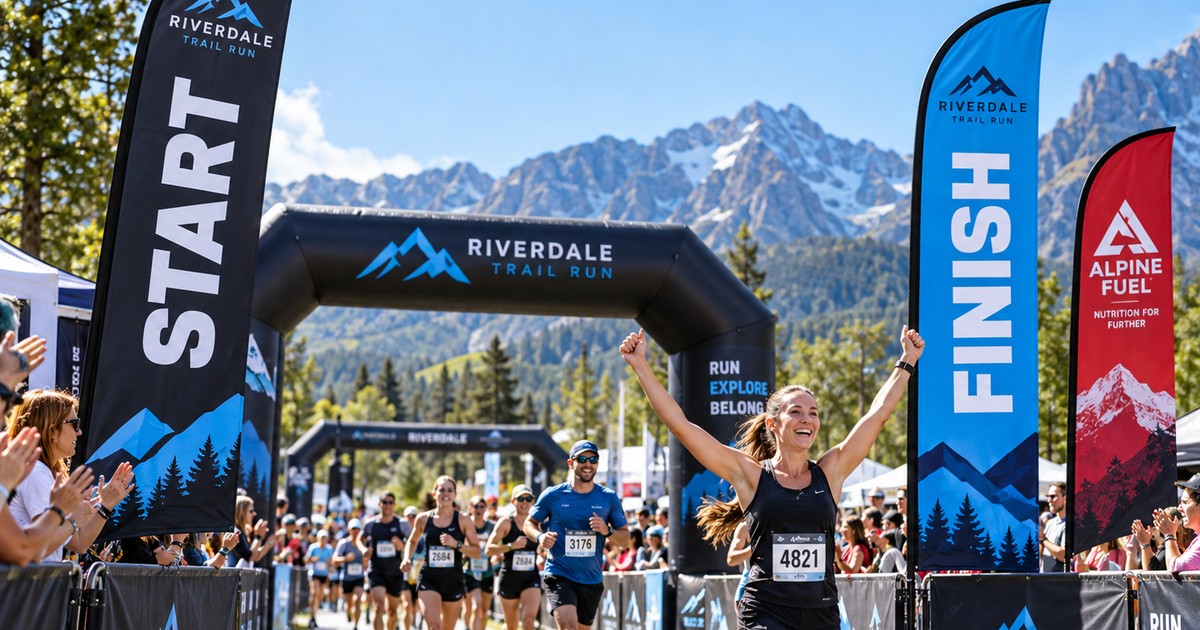
The question is rarely “what is a feather flag?” It is “where will this actually work?” A store opening, a trade show booth, an ice cream queue, a car show with tents, a sports finish line, and a ski resort entrance all need a flag, but they do not need the same flag. The shape, height, base, and message change with the site.
The scenarios are drawn from buyer requests in the US, UK, Australia, Canada, Germany, and the Gulf. The flag does not change by country, but the name, the permit rule, and the ground surface often do.
This guide answers the use-case question first. It covers nine commercial scenarios, the feather or teardrop shape that fits each one, the base that keeps it standing, and the message that survives the distance. The product definition and factory details come after, so a buyer can move from “where” to “which kit” without reading a catalogue.
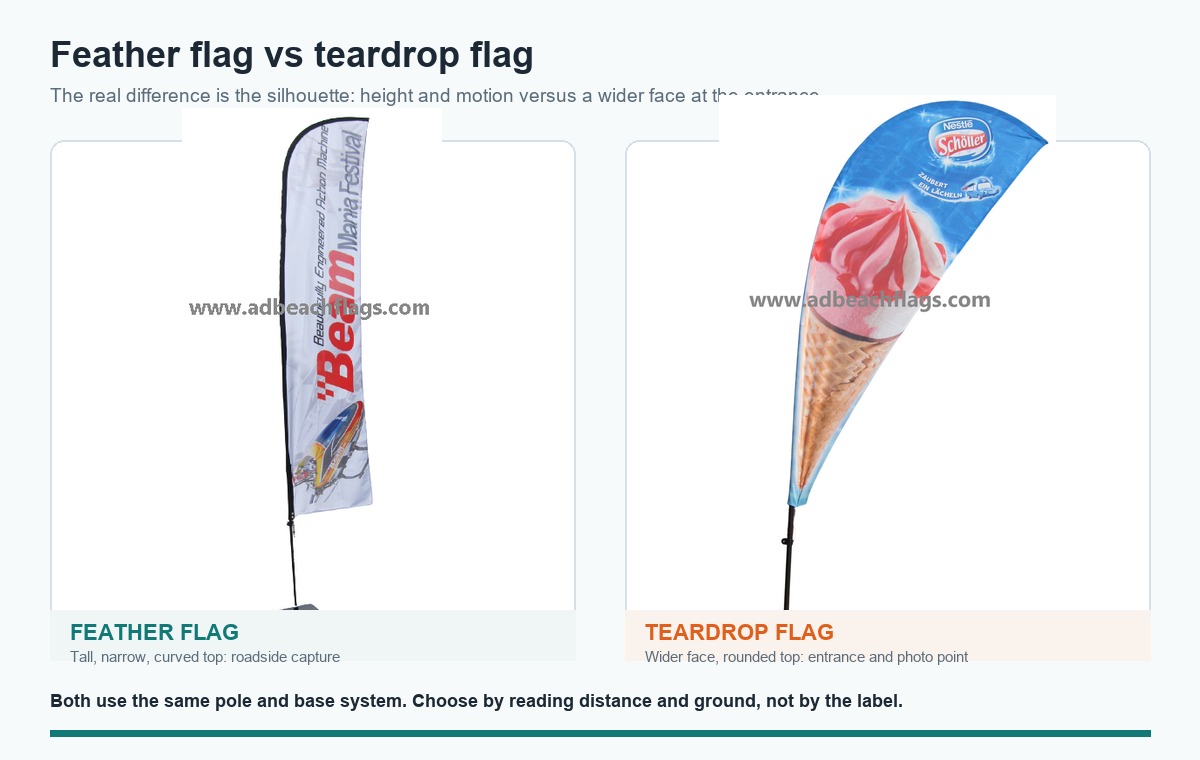
The short version: use a feather flag when you need height and motion at 20 to 60 metres. Use a teardrop flag when you need a wider face at 5 to 20 metres, especially at an entrance or a photo point. Use a rectangle or flag banner when the message needs more words. When the site is windy, crowded, or legally tight, the base and the placement matter more than the shape.
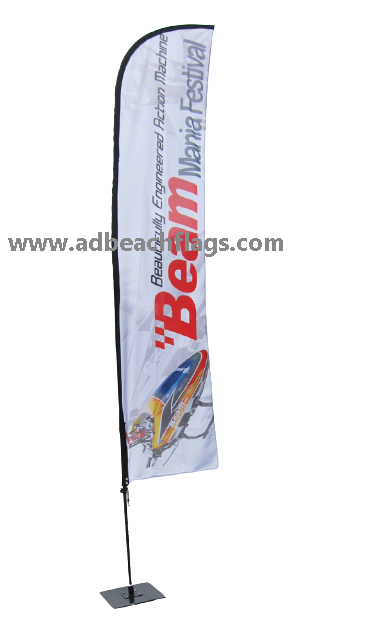
A feather flag is a tall, narrow printed flag with a curved top, mounted on a flexible pole and held by a base. The fabric is usually 110gsm knitted polyester, printed by dye sublimation. The pole is usually aluminium at the bottom and fibreglass at the top, so it can flex in a gust without snapping. A complete kit includes the flag face, pole sections, a base, and often a carry bag.
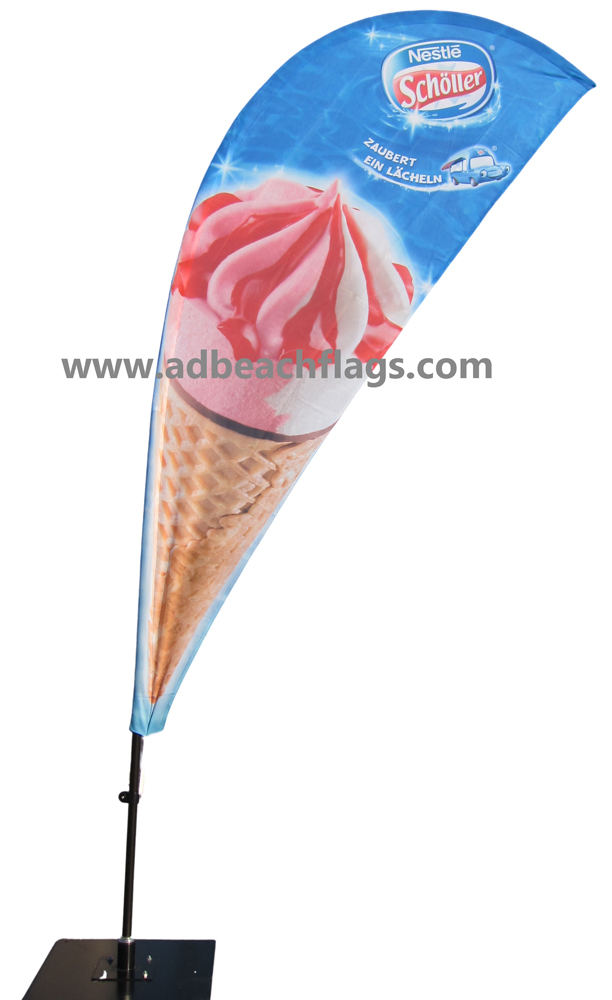
A teardrop flag uses the same materials and hardware, but the flag face is wider and rounded, like a drop. The wider face gives more room for a logo or a short message at the entrance, and the curved pole keeps the fabric taut in light air. The trade-off is wind load: a teardrop catches more air than a slim feather of the same height.
| Shape | Silhouette | Best reading distance | Best job | Typical kit |
|---|---|---|---|---|
| Feather | Tall, narrow, curved top | 20 to 60 m | Roadside capture, parking route | 4.2 to 5.6 m, 70 to 75 cm wide |
| Teardrop | Wider, rounded drop | 5 to 25 m | Entrance, photo point, queue | 2.8 to 4.6 m, 75 to 110 cm wide |
Buyers also use other names for the same hardware. A wind banner, fly banner, or flying banner usually means a printed banner on a pole that moves in the wind. A swooper is the US term for a tall, narrow curved-top flag. A beach flag can mean a generic outdoor flag in B2B, or a beach warning flag in the US. Ask for the flag face size and pole height in writing, not just the label.
Three things make the flag work: height, motion, and contrast. The pole lifts the message above parked cars and crowds. The fabric moves in the wind, which the eye notices before it reads a static sign. The print uses contrast and a short message so the eye can resolve it at speed.
The base is the part that decides whether the flag stays upright. A ground spike works in grass, soil, and packed snow. A cross base with a water bag works on asphalt and concrete. A water tank or metal plate works for longer exposure. A wheel base borrows the weight of a car in a forecourt. The wrong base turns a good flag into a damage claim.
Single-sided flags show a mirrored image on the reverse, with roughly 80 to 90 percent show-through. Double-sided flags use two printed layers with a blockout liner, so both sides read correctly. Double-sided flags weigh more and catch more wind, which lowers the safe wind range. That is why the base and the takedown rule matter more on a double-sided kit.
The nine scenarios below cover most commercial requests we see from event companies, retailers, restaurants, car dealers, sports clubs, and resorts. The table is the quick answer. The sections after it explain the field detail.
| Scenario | Best shape | Typical size | Base | Message |
|---|---|---|---|---|
| Store opening | Feather + teardrop | 4.6m road, 3.4m door | Spike or plate | NOW OPEN |
| Product promotion | Teardrop or rectangle | 2.8 to 3.4m | Cross + water bag | ONE OFFER |
| Trade show | Feather or rectangle | 3.4 to 4.6m | Cross + weight | BOOTH 214 |
| Ice cream shop | Teardrop | 2.8 to 3.4m | Cross + water bag | ICE CREAM + arrow |
| Car show with tents | Feather | 4.6 to 5.6m | Tyre base or water tank | TEST DRIVE |
| Sports event | Feather + rectangle | 3.4 to 5.6m | Spike in grass | START / FINISH |
| Ski resort | Feather or mesh | 3.4 to 4.6m | Snow spike or ground screw | LIFT / RENTALS |
| Festival or market | Feather | 4.2 to 5.6m | Spike or water tank | GATE / STAGE |
| Open house | Feather + teardrop | 3.4m road, 2.8m door | Spike or plate | OPEN HOUSE |
A store opening needs two messages at two distances. At the road, the flag says what the business is and that it is new. At the door, it says welcome and gives the opening hours or the offer. A 4.6m feather flag at the curb and a 3.4m teardrop at the entrance cover both jobs without turning the pavement into a forest of flags. If the opening includes a ribbon cutting or a queue, put the teardrop where it will appear in photos but keep it out of the walking path.
Use a spike in a landscape bed or a metal plate on the hard edge. Keep the base out of the accessible route and the fire lane. For the full sequence, see the grand opening flag setup guide.

A promotion flag has one job: make a passer-by stop. The message should be one offer, not a service list. A teardrop at the entrance or a rectangle at the till works better than a tall feather here, because the reader is close and already walking toward the door. Keep the offer to three to five words: SALE TODAY, NEW MENU, 2 FOR 1, FREE GIFT WITH PURCHASE. If the offer changes weekly, buy a replacement skin and keep the hardware.
Use a cross base with a water bag on pavement, and check the landlord’s rule on pavement displays. A flag that blocks a shop window or a neighbouring entrance will be removed by the landlord before it brings a customer in.
Trade show flags work above the crowd line, not inside the booth. A 3.4 to 4.6m feather or rectangle can carry the booth number and the category word above seated visitors. Indoor venues often cap displays at the 2.4m booth line, so the flag’s message should sit in the top third, above the line and above heads. Use a cross base with a weight, never a spike, and keep the base inside the booth footprint so it does not become an aisle hazard.
One flag at the aisle corner and one at the back wall is usually enough. A row of six flags in a 3m booth hides the product and annoys the neighbouring exhibitor. The trade show sightline guide covers the height and aisle math.

Ice cream buyers are already in a leisure mood, so the flag can be playful without being vague. A 2.8 to 3.4m teardrop at the sidewalk edge, with ICE CREAM and an arrow, does more than a logo-only flag. Put the flag where the queue forms, not where it blocks the door. If the shop has a walk-up window, place the teardrop at the window side and keep the base 1.2m clear of the queue.
A water bag or a plate is enough for a small teardrop. A tall feather at a narrow sidewalk is usually the wrong tool because the base takes up the walking space. For more layout ideas, see the ice cream shop flag guide.
A car show with tents needs a skyline, not a single flag. Feather flags at the lot edge mark the entrance and the aisles; the tents sit behind them as the destination. A 4.6 to 5.6m feather flag with a tyre base or a water tank works on asphalt, and the tall flag can be seen over the roofs of parked cars. Keep the flags out of the driving lanes and away from the tent guy lines.
Use one message per flag: TEST DRIVE, TRADE-IN, FINANCE, or the model name. A car show is a comparison environment, so the flag should help a buyer choose a direction, not repeat the brand five times. The car dealership flag layout guide covers the lot geometry.
Sports events use flags for three jobs: mark the entrance, mark the start or finish, and show sponsor logos. A 5.6m feather at the finish line is visible from the course; a 3.4m rectangle at the registration desk carries the schedule or the QR code. On grass, use a ground spike. On a track or artificial turf, use a plate or water tank and keep the base off the running surface.
Sponsor flags need a clean logo and a high-contrast background, because they are photographed and shared. Put the sponsor flag at the side of the stage or the finish arch, not in the athletes’ path. The sponsor flag guide covers the season-long kit.
Snow changes the base decision. A water-filled base can freeze and crack, so use a snow spike or a ground screw in packed snow, or a plate that stays above the snow line. A mesh flag reduces wind load in exposed alpine sites, and a darker or high-contrast print reads against a grey sky. Bring the flag in during strong gusts; mountain wind can exceed the rating of a standard kit.
Place flags at the base area, ticket window, lift line, and parking walkway. Keep them out of the ski traffic and away from snow-making equipment. A flag that falls on a slope is a safety issue, not a branding issue. The winter market flag guide covers cold-weather storage and takedown.
A festival needs wayfinding more than advertising. Feather flags at the gate, the stage, the food row, and the first-aid tent help people move without asking staff. Use a 4.2 to 5.6m feather on grass with a spike, or a water tank on pavement. At a busy gate, keep the base outside the flow and use a flag with a strong vertical word: GATE, STAGE, FOOD, EXIT.
If the festival runs for several days, check the wind forecast each morning and use a base one tier heavier than a one-day event. The festival flag kit guide covers the site plan and strike list.
An open house flag has to do two things fast: mark the turn and confirm the address. A 3.4m feather at the road turn and a 2.8m teardrop at the door is a reliable pair. Use single-sided flags if the budget matters and the approach is one-way; use double-sided if the street runs both ways. Keep the flag off the neighbour’s lawn and out of the driveway.
The message should be OPEN HOUSE plus the time, not the agent’s full name. A QR code to the listing works at the door, where the buyer is close enough to scan. See the open house flag guide for the car-boot kit.
An honest use-case guide has to include the sites where a flag is the wrong buy. Use a flag when the reader is moving, the message is short, and the ground can hold a base. Use it when the site needs a vertical marker that a wall sign cannot provide. Use it when the event is temporary and a permanent sign would be too slow or too expensive.
Skip the flag when the air is still and the site is indoor with no airflow, because the fabric will hang limp and read as neglect. Skip it when the message needs more than five words, because the text folds in the wind. Skip it when there is no legal ground for a base, or when the only spot is a fire lane, an accessible space, or a public right-of-way without a permit. Skip it in a storm, and skip it when nobody can monitor the weather.
| Situation | Use | Skip or change |
|---|---|---|
| One-day event | 2 to 4 flags, spike or water tank | Do not buy a permanent base for a one-day site |
| Three-month campaign | Heavier base, replacement skin on hand | Do not leave a light cross base unattended |
| Coastal or exposed site | Mesh, full fibreglass, water tank | Do not use a standard double-sided kit in a gale |
| Snow and ice | Snow spike, ground screw, plate above snow | Do not fill a water base and leave it to freeze |
| Indoor hall | Cross base plus weight, low height | Do not use a spike or a tall flag under a low ceiling |
| Public pavement | Check permit and landlord first | Do not assume a shopfront right covers the pavement |
1. Map the reader’s path. Draw the road, the turn, the parking, the walkway, and the door. Mark where the reader is moving fast and where they are stopped. The flag goes where the decision happens, not where the ground is convenient.
2. Give each flag one job. Locate, route, promote, or reassure. A flag that tries to do two jobs usually does neither. If the site needs two jobs, use two flags.
3. Size by distance. At 30 to 60m, use a 4.2 to 5.6m feather with three to five words. At 5 to 25m, use a 2.8 to 4.6m teardrop with a logo and one line. At 3m, use a small teardrop or rectangle with an arrow or QR code.
4. Choose the base by ground. Spike for grass, soil, and packed snow. Cross plus water bag for asphalt and concrete. Water tank or plate for long exposure. Tyre base for a car forecourt. No spike in asphalt, no water base left to freeze, no base in an accessible route.
5. Set the quantity by sightline. Two or three flags per zone are usually enough. A row of ten flags in a small frontage hides the storefront and creates a wind wall. If the site is large, use one flag every 10 to 15m along the approach, not a cluster at the door.
6. Write for the dwell time. A driver gets three to five words. A walker gets five to seven. A person at the door can read a QR code or a short schedule. Do not put the same paragraph on every flag.
We produce feather and teardrop flags in our own workshop in Foshan, Guangdong. The fabric, print, sewing, pole, base, and carry bag are specified as one kit, so the replacement skin fits the hardware and the base matches the site. We work with event companies, distributors, retail groups, sports clubs, and resorts. Neutral labels and private-label packing can be discussed for distributors who resell under their own brand.
Every order starts with a proof. The proof shows the flag face at real proportion, the safe area, the sleeve, and the message at the actual reading distance. We check the artwork for font size, contrast, and bleed before printing. If the brand color matters, we match a Pantone or RAL reference and send a color block for approval before bulk.
What we need from you: the flag shape, the flag face size or pole height, the quantity, the ground surface, the delivery city, and the date the flags need to be standing. A photo of the entrance is enough to start. We can recommend the size and base from the photo and the site description.
| Material | Spec | Best use | Watch |
|---|---|---|---|
| Knitted polyester | 110gsm | Single-sided standard, most events | About 80 to 90 percent show-through on the reverse |
| Heavier knit | 130gsm | Longer outdoor exposure, premium hand feel | Slightly heavier, less motion in light air |
| Mesh polyester | About 120gsm, open weave | Coastal, alpine, exposed sites | Less opaque; ask for the tested wind-load reduction |
| Double-sided build | Two printed layers + blockout liner | Two-way roads, parking aisles, entrances | Heavier and more wind load than single-sided |
| Pole | Aluminium + fibreglass, full fibreglass, full aluminium | Match flex to wind and site | Specify diameter and section count for replacements |
| Base | Spike, cross + 10 to 12L bag, 12 to 32L tank, 4 to 12kg plate, tyre base | Match the ground, not the catalogue | Water freezes; sand adds weight; plates need rubber pads |
Printing is dye sublimation, with CMYK and Pantone or RAL matching. The ink goes into the fiber rather than sitting on a coating, so the print does not crack or peel like a surface print. The standard file is a vector AI, EPS, or PDF with fonts outlined. For bitmaps, send a 1:1 file at 300dpi. Certificates for flame retardancy or restricted substances are available on request, in writing, for the specific fabric and order.
| Step | What happens | What you see or approve |
|---|---|---|
| 1. Brief | Shape, size, quantity, surface, date, delivery city | Quotation with spec lines |
| 2. Artwork check | Fonts, bleed, contrast, safe area | Proof at real proportion |
| 3. Color | Pantone or RAL match, color block | Color approval before bulk |
| 4. Sample | 2 to 3 days for a sample or color block | Photo or video of the sample |
| 5. Fabric cut | 110gsm or 130gsm roll cut to the flag face | Cut list per size |
| 6. Print | Dye sublimation, heat transfer into the fiber | Print check against the proof |
| 7. Sew | Sleeve, top corner, hem, tensioner, double-sided assembly | Stitch and sleeve check |
| 8. QC | Color, size, seam, print alignment, hardware fit | QC record and photos |
| 9. Pack | Flag folded, pole sections bagged, base and bag packed | Packing list and carton weights |
| 10. Ship | Courier, air, or sea; documents for clearance | Tracking and shipping documents |
Typical timings: proof in 1 to 3 days, sample in 2 to 3 days, bulk in 5 to 10 days after proof approval. Courier is usually 3 to 7 days, air 5 to 8 days, and sea 25 to 40 days. If the event date is fixed, work backward from the installation date, not from the order date.
Before the install. Confirm the permit and landlord approval. Walk the site for overhead wires, fire lanes, accessible routes, and vehicle traffic. Check the wind forecast. Match the base to the ground. Put one person in charge of the kit and one spotter if the flag is near a road or a car park.
During the install. Keep the base flat and clear. Assemble the pole from the thickest section to the thinnest. Seat every joint. Slide the sleeve on without twisting the fabric. Attach the top corner, then tension the bottom. Stand the flag up only after the base is ballasted. Keep hands and loose clothing away from the joints.
After the install. Check the tension, the base, the clearance, and the message direction. Photograph the finished setup so the next person can repeat it. Log the install time and the weather. If the site is public, tell the staff who owns the daily check.
| Check | Pass | Fail |
|---|---|---|
| Base | Flat, ballasted, clear of the walkway | Rocks, half-filled bag, base in a parking space |
| Pole | Every joint seated, no cracks | Loose section, tape over a split, missing top cap |
| Fabric | Sleeve fully on, tensioner tight, message facing the reader | Twisted sleeve, sagging face, reverse side facing the road |
| Clearance | 1.2 to 3.6m clear, no overhead wires | Base in an accessible route, flag over a fire lane |
Most kits install in 2 to 3 minutes with one person. A large 5.6m flag or a water tank base is easier with two. The sequence is the same for both shapes; the teardrop needs the curved pole aligned with the sleeve seam so the fabric sits straight.
| Step | Action | Check |
|---|---|---|
| 1 | Assemble the pole from thickest to thinnest | No gap at the ferrules |
| 2 | Slide the sleeve on, bottom first | Seam aligned, fabric not twisted |
| 3 | Insert the top corner into the pole tip | Top corner seated, no fabric caught |
| 4 | Hook the tensioner and tighten | Face flat, seams not stretched |
| 5 | Place the base, stand the flag, check clearance | Base stable, message facing the reader |
The most common mistakes are a pole joint that is not fully seated, a tensioner that is hooked but not tight, a base that is too light for the flag, and a flag that faces the wrong direction. A 60-second check after the first setup catches all four. If the flag is going to stay out for a multi-day event, repeat the check every morning and take it down at night if the site is unattended.
| Feature | Advantage | Benefit for the event |
|---|---|---|
| 110gsm knitted polyester with dye sublimation | Light enough to move, with color in the fiber | Reads in light air and keeps the brand color through the season |
| Feather shape | Height and motion in a narrow footprint | Visible at 20 to 60m without blocking the pavement |
| Teardrop shape | Wider face at the entrance | More room for a logo and one line at 5 to 25m |
| Double-sided blockout build | Both sides read correctly | Works on a two-way road or a parking aisle |
| Three pole constructions | Match flex to wind and site | Fewer bent poles at exposed events |
| Six base types | Match the ground, not the catalogue | Safe on grass, asphalt, snow, and indoor floors |
We produce custom feather and teardrop flags for event companies, retailers, distributors, sports clubs, and resorts. The kit is specified as one system, the proof is checked at real proportion, and the export team replies within 1 hour, 24×7. If you are not sure what to send, one photo of the entrance is enough to start.
| What we do | What it means for your event |
|---|---|
| Factory-direct production | Flag, pole, base, and bag are specified together, so the kit arrives ready for the site. |
| Written specifications | Fabric weight, face size, pole height, and base weight are quoted as lines, not adjectives. |
| Proof and color check | You see the message at real proportion before production, so the 30m test is done on paper, not at the event. |
| Low MOQ accepted | Wholesale from 5+ pieces; a single venue can start with two flags, and a group can standardize across sites. |
| Replacement parts | Skins, poles, bases, and bags can be reordered without buying a whole new kit. |
| Reply in 1 hour, 24×7 | WhatsApp +86 135 1661 0926 or [email protected]; we ship to buyers in 150+ countries. |
A feather flag is tall and narrow with a curved top, best for roadside capture at 20 to 60m. A teardrop flag is wider and rounded, best for entrances and photo points at 5 to 25m. Both use the same pole, base, and dye-sublimation print process.
Yes, with a cross base and a weight, and a height that clears the ceiling. Indoor air is often still, so a teardrop or a tensioned fabric display may read better than a feather that hangs limp. Check the venue’s booth height and aisle rules first.
Use a ground spike for grass, soil, and packed snow. Use a cross base with a 10 to 12L water bag for asphalt and concrete, or a 12 to 32L water tank for longer exposure. In snow, use a snow spike or ground screw, and never leave a water-filled base to freeze.
Start with two: a 4.6m feather at the road and a 3.4m teardrop at the entrance. Add a parking or directory flag only if the site is hard to find. More flags do not fix a weak message; they multiply it.
Yes, if the venue allows them and the booth height works. Use a cross base with a weight, never a spike, and keep the message in the top third above the crowd. Check the booth line and aisle width before you order.
Send the shape, flag face size or pole height, quantity, ground surface, delivery city, event date, and artwork in AI, EPS, PDF, or a 1:1 300dpi bitmap. If you do not have artwork, one photo of the entrance is enough to start the size and base recommendation.
Feather and teardrop flags are not one product with one use. The feather earns its place when the reader is far away and the site needs height. The teardrop earns its place when the reader is close and the site needs a wider face. The base decides whether either flag stays standing, and the message decides whether anyone acts. Match the shape to the distance, the base to the ground, and the quantity to the sightline. That is how a flag becomes a working part of the event instead of a decoration that falls over.
Tell us the flag sizes, the quantities, single or double-sided, and the ground the flags will stand on. Our export team replies within 1 hour, 24×7, with a proof and a factory price. Low MOQ accepted.
Prefer a form? Fill in the details below and we will come back with a proof and a price within 1 hour, 24×7.
Related reading: Grand opening flags: setup guide | Sidewalk flags for restaurants and cafes | Trade show flags: booth height, aisles and the 20-foot rule | Advertising flags for car dealerships | Sponsor flags for sports clubs | Christmas market flags: a winter kit that survives December | Festival flags: building the kit from site plan to strike | Open house flags for real estate agents | Ice cream shop flags | Beach flag size guide: how to choose the right height | Flag base guide: pick the base by surface, not by looks | Flag fabric weight explained: 110gsm vs 130gsm vs mesh | How to set up your beach flag in minutes | Custom feather flags | Custom teardrop flags | Flag banners
| Item | Detail |
|---|---|
| Product | Custom feather flags and teardrop flags for store openings, promotions, trade shows, car shows, sports events, ski resorts and festivals |
| Also searched as | Wind banner, fly banner, flying banner, beach flag, swooper flag, sail banner and flag banner |
| Manufacturer | BESDA Advertising Flags, Foshan, Guangdong, China |
| Fabric | 110gsm knitted polyester standard; 130gsm and mesh available |
| Printing | Dye sublimation with CMYK and Pantone or RAL colour matching |
| Sizes | Feather and teardrop kits from 2.8m to 5.6m; flag faces specified in centimetres |
| Bases | Ground spike, snow spike, cross base, heavy cross, metal plate, car base and water tank |
| Use cases | Store opening, product promotion, trade show, ice cream shop, car show with tents, sports event, ski resort, festival and open house |
| Wind limits | Double-sided flags down at 15 to 17 mph; single-sided at 25 mph; all standard flags down at 32 mph |
| Lead times | Proof 1 to 3 days; samples 2 to 3 days; bulk 5 to 10 days; express 3 to 7 days; sea 25 to 40 days |
| MOQ and HS code | Low MOQ accepted, wholesale from 5+ pieces; printed polyester flags under HS 6307.90 |
| Contact | WhatsApp +86 135 1661 0926, [email protected], reply within 1 hour, 24×7 |