Phone: 0086-757-8938 9313
WhatsApp: +86 135 1661 0926
Email: [email protected]
Address: Caochang Industrial Zone, Lishui, Nanhai, Foshan, Guangdong, China
24/7 Online Services
Phone: 0086-757-8938 9313
WhatsApp: +86 135 1661 0926
Email: [email protected]
Address: Caochang Industrial Zone, Lishui, Nanhai, Foshan, Guangdong, China
24/7 Online Services

A fibreglass pole tip is the top section of a flag pole, the part that bends the most and gets replaced the most. When a feather flag kit comes back from an event with a problem, the skin is usually fine, the base is usually fine, and the tip is split somewhere near the top ferrule. Buyers who understand why that happens stop paying for whole pole sets and start ordering single sections.
The short answer: pole tips almost never crack because the fibreglass was weak. They crack because of fatigue at the ferrule joint, grit inside the sleeve, UV on old composite, cold-weather handling and forced assembly. All five are preventable, and the prevention costs nothing but a habit.
This guide is written for event companies, rental warehouses, distributors and site operators who run flag kits every week and need the poles to survive seasons, not weekends. The figures are typical ranges from supplier specifications and our workshop records in October 2026. Where a number depends on the kit size, the table says so.
A standard feather or teardrop flag pole is not one tube. It is three to five tapered sections that telescope into each other, and each joint is a ferrule: the wider end of one section gripping the narrower end of the next. The tip is the smallest, thinnest section, and it carries the top of the flag sleeve.
Three things make the tip the busiest part of the pole. First, it flexes the most, because the same gust bends a thin section far more than a thick one. Second, it carries the least material, so the wall between fine and failed is thin. Third, it is the section people grab when they pull the flag off the pole, which means it takes handling loads it was never designed for.
| Kit height | Sections | Typical build | Tip section role |
|---|---|---|---|
| 2.8 m | 3 | Aluminium lower, fibreglass upper | Short, stiff, rarely fails first |
| 3.4 m | 4 | Aluminium lower, fibreglass upper | Bends in every gust |
| 4.5 m | 4 | Aluminium lower, fibreglass upper | Long lever, higher flex load |
| 5.6 m | 5 | Aluminium lower, fibreglass upper | Thinnest wall in the kit |
One more term buyers should know: the top stop. Most tips end in a small ball or cap that stops the flag sleeve sliding off. The cap is glued or friction fitted, and it is the second most common failure point after the ferrule entry, because a cap that is lost or cracked leaves the sleeve edge flapping against raw composite.
Across our service records, tip failures cluster into five causes. None of them are mysterious, and four of them are visible in advance if you know where to look.
| Cause | What you see first | Typical trigger |
|---|---|---|
| Ferrule fatigue | Hairline splits starting where the tip enters the joint | Thousands of gust cycles bending the same point |
| Grit in the sleeve | Squeaking on assembly, fine scratches near the entry | Sand or dust assembled into a dirty joint |
| UV embrittlement | Chalky surface, stiff feel, cracks under a light flex | Seasons of sun, usually on stored-outside kits |
| Cold-weather handling | Clean snap during assembly or takedown in winter | Composite below about 5 degrees C, forced flex |
| Forced assembly | Crack at the moment of fitting, often with a hammer mark | Sections driven together instead of pushed with a twist |
Ferrule fatigue deserves one more sentence, because it is the cause buyers argue with. A fibreglass section does not fail from one big load. It fails from many small ones: the same gust, the same bend radius, the same point at the ferrule entry, thousands of times. The material remembers, and one morning the memory shows up as a split that was never there the week before.
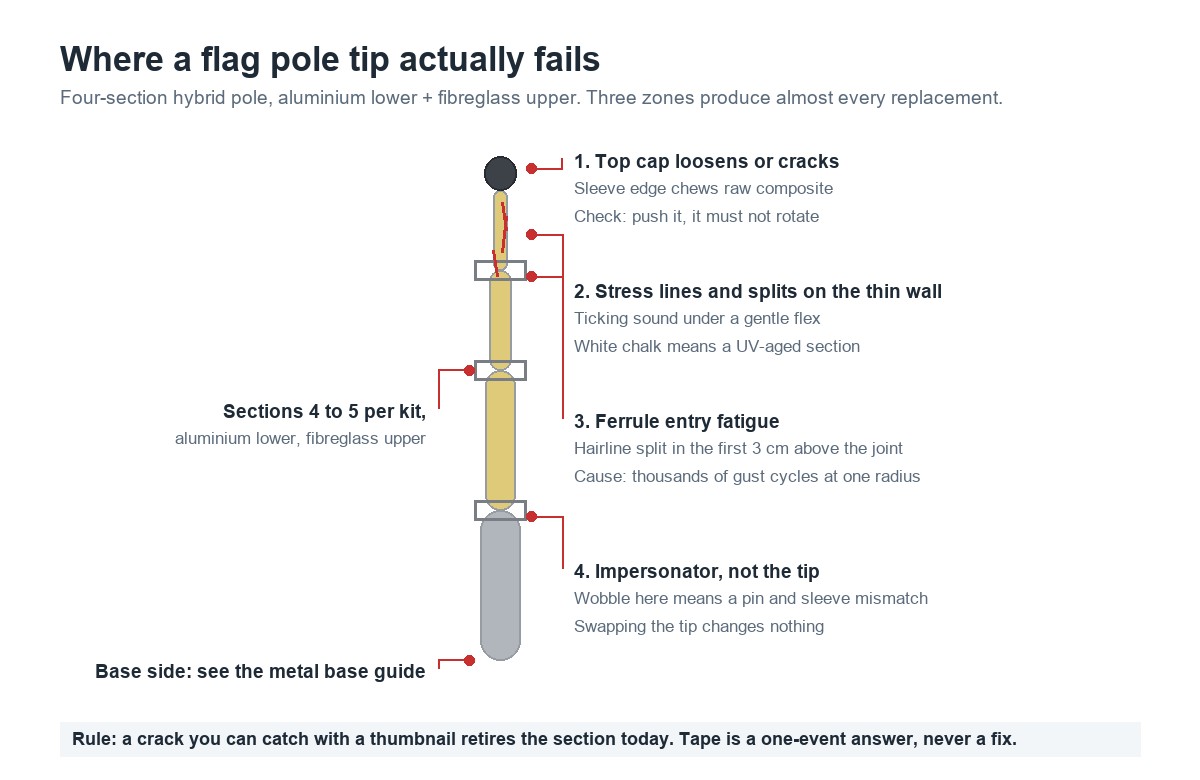
Rental warehouses that run this check before every dispatch catch almost every pole before it fails on a client site. It takes one minute per kit and needs no tools.
1. Flex the tip. Hold the top section at both ends and bend it gently the way wind would. A healthy tip flexes and returns silently. A ticking sound or a white line means the composite has started to split. Retire it.
2. Inspect the ferrule entry. Look at the first 3 cm above every joint. Hairline splits run lengthwise here. Run a thumbnail up the section; a catch you can feel with a nail is already a crack.
3. Check the cap. Push the top stop with a finger. It should not rotate or slide. A loose cap comes off mid-event and leaves the sleeve edge chewing the tip.
4. Assemble and listen. Push sections together with a slight twist. Squeaking means grit. Back the joint off, wipe both surfaces with a dry cloth, and assemble again.
5. Spin the flag. With the kit upright, turn the skin by hand. It should rotate freely on the bearing. A sleeve that binds loads the tip sideways all day, and a loaded tip cracks sooner.
Kits that fail any step get the section swapped before loading. The spare tip costs a fraction of an emergency replacement, and the swap takes less time than reading this paragraph.
Most trade kits are hybrids: an aluminium lower section for stiffness and a fibreglass upper for flex. Full fibreglass sets exist at the premium end, and full aluminium at the budget end. Each choice moves the failure point somewhere different.
| Build | Behaviour in wind | Typical failure | Best fit |
|---|---|---|---|
| Full aluminium | Stiff, transfers load to the base | Bends rather than cracks, kinks stay | Sheltered urban sites |
| Hybrid, fibreglass top | Top bends, bottom holds | Tip fatigue at the ferrule | Most trade and rental kits |
| Full fibreglass | Whole pole flexes, stores energy | Slowest to fail, highest wind rating | Coastal and exposed sites |
| Carbon blend | Light and stiff | Sharp snaps when overloaded | Specialist racing and sport |
Our wind rating figures put standard hybrid kits at about 30 mph single-sided and 17 mph double-sided, with premium full fibreglass sets at about 63 mph and 46 mph. Those numbers describe the whole system. The tip is simply the part that reaches its limit first when the system is abused.
Buyers often ask why a tip that survived a storm fails on a calm Tuesday. The answer is that gust cycles, not peak speed, do the damage. A flag left up through a week of mixed weather takes thousands of bend cycles at the ferrule. A flag taken down at 25 mph sustained takes one storm’s worth and goes back in the bag.
Two field rules follow from that. First, treat gusty 15 mph days as 25 mph days, because gusts run 50 to 100 percent above the sustained reading and the flag sees the top of every gust. Second, never leave a flag up overnight on a site with no windbreak, because night cycles are the ones nobody counts. Rental fleets that enforce the takedown rule report visibly fewer tip replacements per season than fleets that leave flags up until pickup day.
Altitude and coast both move the numbers. A 3.4 m kit on a beach in Western Australia works harder than the same kit in a Birmingham car park, and a kit between city towers works harder than either, because buildings funnel wind into a steady oscillation. The kit does not know where it is. The fatigue count does.
Before ordering a replacement tip, rule out the three impersonators. A pole that wobbles at the base is usually a pin and sleeve mismatch, a 16.5 mm pin rattling in a 14.5 mm sleeve, and swapping the tip will change nothing. A flag that hangs crooked is usually a twisted sleeve or a failed bearing, not a bent tip. And a tip that seems to crack repeatedly in the same spot on different poles is telling you the joint tolerance is wrong in that batch, which is a supplier conversation, not a consumables line.
The fastest diagnostic: assemble the kit indoors, spin the flag, and watch the top 50 cm. If the tip flexes smoothly and the sleeve runs true, the pole is innocent and the fault is below. If the tip kicks sideways every revolution, the sleeve or the bearing is loading it, and a new tip will crack on schedule.
Prevention is mostly handling discipline, and none of it costs money.
Assemble with a push and a twist, never a hammer. Sections should slide home under hand pressure. If a joint needs force, grit or a dent is in the way, and driving it through scores the ferrule every time.
Keep joints clean and dry. Sand is the enemy. Wipe both mating surfaces before assembly, especially after beach and desert work. One grain of sand in a ferrule scratches a line that becomes a crack.
Store poles full length and padded. Tips snapped in transit outnumber tips snapped in wind for many fleets, because a pole rattling loose in a van takes the same hit a thousand times. Padded full-length carry bags solved this for the fleets we supply, and the carry bag guide covers what to check before ordering them.
Rotate stock. UV ages composite even in storage, so kits stored outside under a tarp age faster than kits in a rack. In the Gulf and Australia, full sun through a tarp ages a section in one season; in Canada and Germany, unheated vans do the same job with frost. First in, first out is not just an inventory rule. It is a crack prevention rule.
Stock spare tips, not spare poles. A spare tip for every ten kits covers most fleets. Record the section length and the ferrule diameter with the kit so the spare matches on the first try, the same way the plate spec is recorded for base reorders.
Tape is a temporary answer and an honest one only for a single event. A wrapped crack still flexes, the split underneath keeps growing, and a tip that fails at height drops a composite shard into a crowd. Retire the section the day the crack is confirmed. The economics are not close: a tip section is the cheapest part in the kit, and one dropped shard at a public event in the US, UK or Australia costs more than a whole pallet of tips.
The SKIP IT list is short. Skip epoxy inside a cracked ferrule, because the joint needs to slide. Skip soldering wire around the split, because it concentrates the next crack. Skip cutting the tip shorter to remove the damage, because it changes the taper and the sleeve fit, and the flag will wear a new line in a month.
The feature is a spare parts shelf for every kit we ship. The advantage is a one-day section swap instead of a cancelled event. The benefit is a fleet that treats a cracked tip as a line item, not an emergency.
| What we do | What it means for your fleet |
|---|---|
| Sections stocked separately | Tips, mid sections and lower sections ship as single items, so a crack is a parts order, not a kit order. |
| Spec on file | Section length, ferrule diameter and cap type are recorded with your artwork, so reorders match first time. |
| Matched tolerances | Ferrule and sleeve pairs are checked together, which is what stops repeat cracks at the same joint. |
| Low MOQ accepted | Wholesale from 5+ pieces, mixed kits and spare parts in one shipment. |
| Reply in 1 hour, 24×7 | WhatsApp +86 135 1661 0926 or [email protected]; we ship to buyers in 150+ countries. |
Three signs: a ticking sound when you flex the top section, white stress lines along the thin wall, and a hairline split at the ferrule entry you can catch with a thumbnail. Any one of the three means the section should be swapped before the next event.
Yes. Pole sections are separate items. Measure the section length and the ferrule diameter of the section below, order the matching tip, and telescope it in. No special tools are needed, and the kit record we keep for your artwork makes the match automatic.
The joint is where the thin section meets a stiff grip, so every gust bends the same small zone through the same radius. That is classic fatigue. Keeping grit out and assembling gently slows it; nothing stops it entirely, which is why tips are consumables.
For coastal and exposed sites, yes. Full fibreglass sets carry higher wind ratings, about 63 mph single-sided and 46 mph double-sided against about 30 and 17 for standard hybrid kits, and the whole pole shares the flex instead of concentrating it at one joint.
Cold makes composite stiffer and more brittle, so a section that flexes safely at 25 degrees C can snap at 5 degrees C when the same force is applied. Winter crews should assemble poles warm, flex them gently, and never force a stiff joint.
One spare tip for every ten kits covers most fleets, plus two full spare poles for emergencies. Record the section spec with each kit so spares match without measuring on site.
A fibreglass pole tip fails from fatigue, grit, UV, cold and forced assembly, in that order, and four of the five are visible before they become failures. Run the 60-second check before dispatch, assemble with a push and a twist, store poles padded and full length, take flags down at 25 mph sustained, and hold one spare tip per ten kits. When a crack is confirmed, replace the section the same day and send us the kit spec, and the matching tip ships with your next order inside the normal 5 to 10 day bulk window.
Tell us the flag sizes, the quantities, single or double-sided, and the ground the flags will stand on. Our export team replies within 1 hour, 24×7, with a proof and a factory price. Low MOQ accepted.
Prefer a form? Fill in the details below and we will come back with a proof and a price within 1 hour, 24×7.
Related reading: Flag poles explained: which construction belongs under your flag | Oxford carry bags: what distributors should check | Beach flag wind rating: how much wind a flag can take | Metal base flags: plate weight and the wind maths | How to wash and store a beach flag between events | Custom feather flags | Custom teardrop flags | Flag banners
| Item | Detail |
|---|---|
| Product | Fibreglass pole tips and replacement sections for feather, teardrop and rectangular flag kits |
| Manufacturer | BESDA Advertising Flags, Foshan, Guangdong, China |
| Kit sections | 2.8 m kits 3 sections; 3.4 m and 4.5 m kits 4 sections; 5.6 m kits 5 sections |
| Typical build | Aluminium lower sections with fibreglass upper sections; full fibreglass sets available |
| Crack causes | Ferrule fatigue, grit in the sleeve, UV embrittlement, cold-weather handling, forced assembly |
| Wind limits | Standard hybrid kits about 30 mph single-sided and 17 mph double-sided; premium full fibreglass about 63 mph and 46 mph; takedown at 25 mph sustained |
| Check routine | 60-second pre-event check: flex test, ferrule inspection, cap check, assembly listen, flag spin |
| Fleet spares | One spare tip per ten kits plus two full spare poles; section spec recorded with kit |
| Lead times | Proof 1-3 days; sampling 2-3 days; bulk 5-10 days; express 3-7 days, air 5-8, sea 25-40 |
| Contact | WhatsApp +86 135 1661 0926, [email protected], reply in 1 hour 24×7 |