Phone: 0086-757-8938 9313
WhatsApp: +86 135 1661 0926
Email: [email protected]
Address: Caochang Industrial Zone, Lishui, Nanhai, Foshan, Guangdong, China
24/7 Online Services
Phone: 0086-757-8938 9313
WhatsApp: +86 135 1661 0926
Email: [email protected]
Address: Caochang Industrial Zone, Lishui, Nanhai, Foshan, Guangdong, China
24/7 Online Services

Type flag winter storage into a search bar and the results fall into two camps. Most are written for national flags on tall poles: halyards, pulleys and the etiquette of retiring a flag. The rest are short tip lists for banners, five or eight pointers with no numbers in them. Almost nothing is written for the equipment this site is about: the feather flags, teardrop flags and banner flags that stand outside shops, venues and trade fair halls on fibreglass poles and weighted bases.
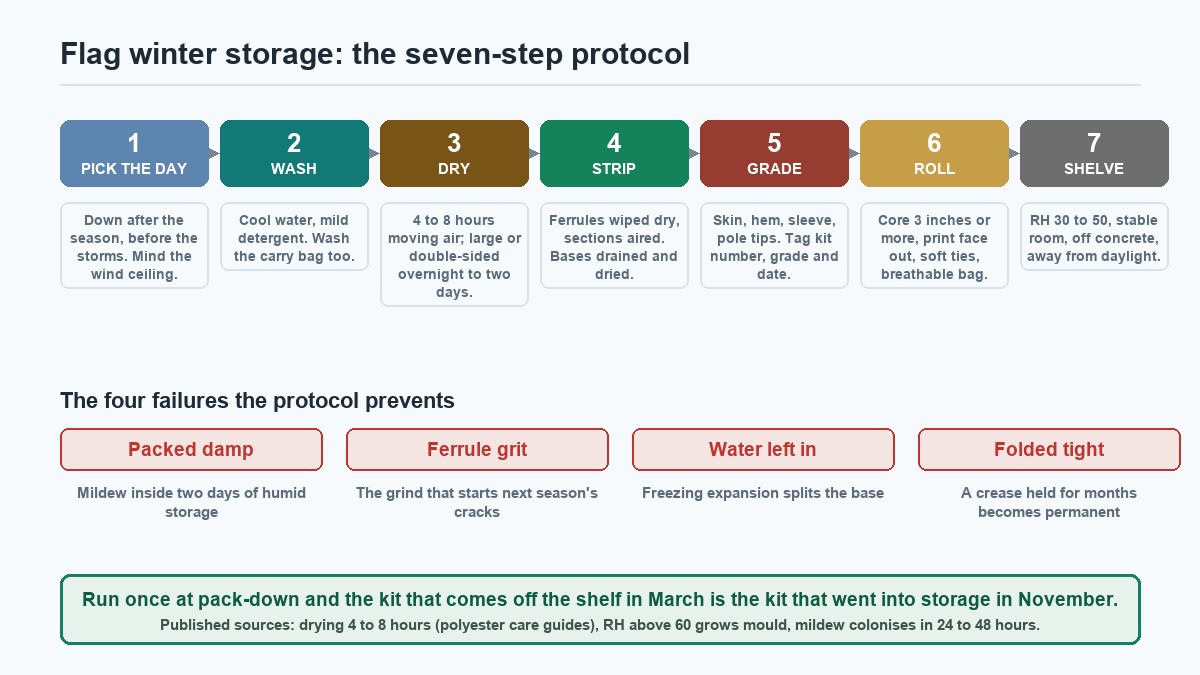
This guide is the missing document. It is written for the people who own fleets of flags rather than one: event companies packing down after a season, distributors holding stock for clients, retail chains rotating campaign skins across branches, schools and councils run by busy volunteers, and exhibition teams flying from hall to hall. The protocol below has seven steps. Each step has an order, a time window and a test that tells you it is done. Run it once and the kit that comes off the shelf in March is the kit that went into storage in November.
Every figure in this article comes from published conservation guidance, manufacturer manuals or trade sources, and the notes at the end list the sources behind the numbers. Prices are left out on purpose. The economics work in counts, hours and seasons.
A printed flag skin is the cheapest part of the kit and the only part with a countdown running. Industry lifespans are consistent across sources: a skin flown outdoors every day fades in six to twelve months, and a skin used occasionally, washed cool and rolled between events, lasts two to three years or more. The gap between those two numbers is not the fabric. It is the handling, and most of the handling happens at the end of the season, in the hour when everyone wants to go home.
The failure modes are boring and preventable. Skins packed damp grow mildew within a day or two of humid storage. Poles stored wet at the ferrules stain and seize. Water left in a base freezes, expands, and splits the plastic. None of that happens to a kit that went through the seven steps. All of it happens to kits that went into a shed wet, folded, and forgotten.
Storage starts on a decision, not a date. Bring the flags down when the calendar says the season is over, not when the first storm does. A flag left standing through autumn gales loses months of life in a week of flapping, and a pole that comes down bent stays bent.
Two anchors help. The first is wind: single-sided skins should already be coming down around 25 mph and double-sided builds earlier, around 15 to 17 mph, with 32 mph as the ceiling for any standard kit. Our wind rating guide explains the reasoning and the base weights behind it. The second anchor is the event calendar. In much of the northern hemisphere the outdoor season ends between late October and early December. In central Europe it does not end at all, because the indoor trade fair season runs straight through winter; January alone lists hundreds of trade shows across Europe. Step 1 for a Munich exhibitor and Step 1 for a Chicago retailer are different decisions. The rest of the protocol is the same.
Dirt left on fabric over winter becomes food for mould and a set-in stain by spring. Wash every skin before it goes on the shelf. Cool water, mild detergent, gentle cycle or by hand, then air dry. The full method, including the stain field guide and what never to machine wash, lives in our flag washing and storage guide, so this step gets one paragraph here.
One addition matters at pack-down: wash the bag too. An oxford carry bag that spent the season in a van holds grit in the seams. Shake it out, vacuum the corners, wipe the lining, and let it dry open. The bag is the skin’s roommate for the next four months.
Drying is the step where seasons are lost, and the acceptance test is simple: the fabric must feel identical to dry stock, cool and slippery, not cool and clammy. Any dampness at the hem or inside the pole sleeve comes back as mildew, and mildew colonises fabric within one to two days of damp storage.
The time window depends on the build. Published care guides put a standard polyester flag at two to three hours in moving air, and up to four to eight hours for larger pieces in humid weather. Plan around those numbers and then check the heavy cases by hand. A big double-sided build carries two printed layers plus a blocker liner, so it holds water far longer than a single-sided skin; overnight is the floor, and a full day or two indoors is normal before it passes the touch test. Hang skins so air reaches both faces, keep them out of direct sun while they dry, and never pack a skin that failed the test, even if the van is leaving.
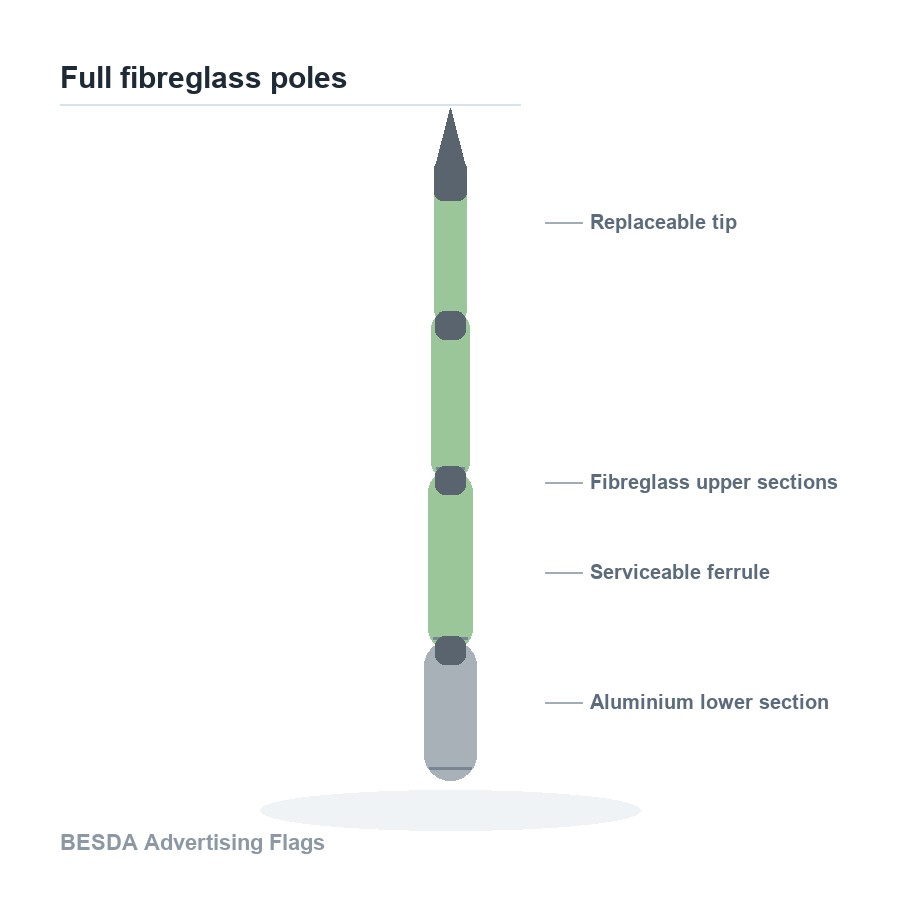
Poles come apart next. Take each pole down to its sections, wipe every ferrule clean of grit and moisture, and let the sections air dry before they meet a bag. Sand inside a ferrule is what makes the push-and-twist joint grind; if a joint ever creaks, pull it apart and start again rather than forcing it. Wipe aluminium lower sections with a damp cloth and dry them; fibreglass upper sections need nothing beyond drying.
Bases get their own attention, and there is more on the water-filled ones below. Cross frames get wiped and checked for bent arms. Plate bases get checked for chipped coating that could mark a floor. Spike bases get knocked clean and checked for bent points. Everything that ships in a bag should go back into that bag dry.
Storage is the one moment in the year when every kit is in one room. Professional rental companies treat the off-season as an inventory window, checking every item for loose fasteners, wobble and wear, and the same habit pays for owned fleets of any size.
Grade as you go. A skin passes if the hem is sound, the sleeve slides freely and the print still reads at distance. A skin fails if the fly-end hem has opened, the sleeve seam has started to run, or the print has faded past legibility; those go on the reorder list instead of the shelf. A pole section fails if a crack catches a fingernail near the ferrule entry, which is where most cracks begin; our pole tip guide has the sixty-second check. Tag each bag with the kit number, the pole set it belongs to, the grade and the date. A printed label on a clear box beats a memory every spring.
Rolling wins for long storage. Roll each skin around a core of at least three inches, print face outward so printed faces never grind against each other, and tie with soft fabric strips rather than rubber bands, which perish and stick. A loose fold is survivable for knitted polyester, but a crease held for four months becomes a permanent memory in the fabric, and print shops who ship rolled goods literally label the tubes DO NOT FOLD.
Slide the roll into a breathable bag, not sealed plastic, because trapped humidity has nowhere to go. The oxford carry bags that ship with our kits, covered in detail in the carry bag guide, are sized for exactly this. Store the rolled skin horizontally in a clear box or bin, label the outside with the kit number, and never stack weight on top of a stored roll. Skins and poles travel in separate bags so sharp hardware never touches print.
The room matters more than the shelf. Museum conservation guidance for textiles is a good yardstick for warehouses too: aim for roughly 40 to 50 percent relative humidity, a stable temperature around normal room range, and keep humidity under 60 percent at all times, because sustained dampness above that line grows mould on stored fabric. General indoor-air guidance agrees: below 60 percent, ideally 30 to 50.
That rules out the three places kits usually end up. Garages, sheds and unfinished lofts swing between damp and dry with the weather, which is precisely what fabric and ferrules hate. Pick an interior room, keep kits off concrete floors, keep them away from windows and daylight, and leave air space around the stack. If the building itself runs humid in winter, as much of Britain and northern Europe does, a small dehumidifier or a tub of silica gel in the storage cupboard is cheap insurance. A monthly glance at the shelf, the routine one trade guide recommends for high-use owners, catches a damp box before it becomes a ruined skin.
Here is the failure that never appears in the tip lists: water left in a base over a frost. Water expands as it freezes, and a rigid base filled for the winter can split at the seam. Manufacturer manuals for water-filled bases say it plainly: drain before freezing conditions or protect with antifreeze. Patio owners discovered the same thing the hard way and it shows up all over gardening forums as a cracked-base postmortem.
The winter routine for bases is short. Drain every water bag and water tank completely, rinse it, and stand it upside down to dry so no puddle sits in a corner. Store caps and plugs in the kit bag so spring does not start with a hunt. Where a base must stay outdoors through winter, swap water for dry sand, which cannot freeze; our water bag and tank comparison covers the trade-offs. And never let a snowbank rest on stored hardware: wet snow can weigh twenty pounds per cubic foot, which is load that plastic bases and hollow frames were never designed to carry.
Fibreglass is tough in wind but it has a cold habit: like most composites it loses flexibility in deep cold, and practitioner experience puts the brittle point for standard layups around minus 18 degrees Celsius. The damage is reversible in the material, which recovers at room temperature, but a section that snaps while cold stays snapped. Thermal cycling adds its own stress; repeated freeze-thaw swings are harder on composites than steady cold.
Three habits cover it. Store poles at full length, padded and horizontal on a rack or in their bags, rather than propped in a corner where a lean becomes a set. Assemble and pack down at reasonable temperatures; our own workshop rule is that a section that bends safely at 25 degrees can crack near 5, so indoor assembly in a heated room beats doing it on a frozen pavement. And keep the ferrules clean and dry all winter, because grit in a joint is the start of next season’s cracks. The full crack map lives in the pole tip guide.
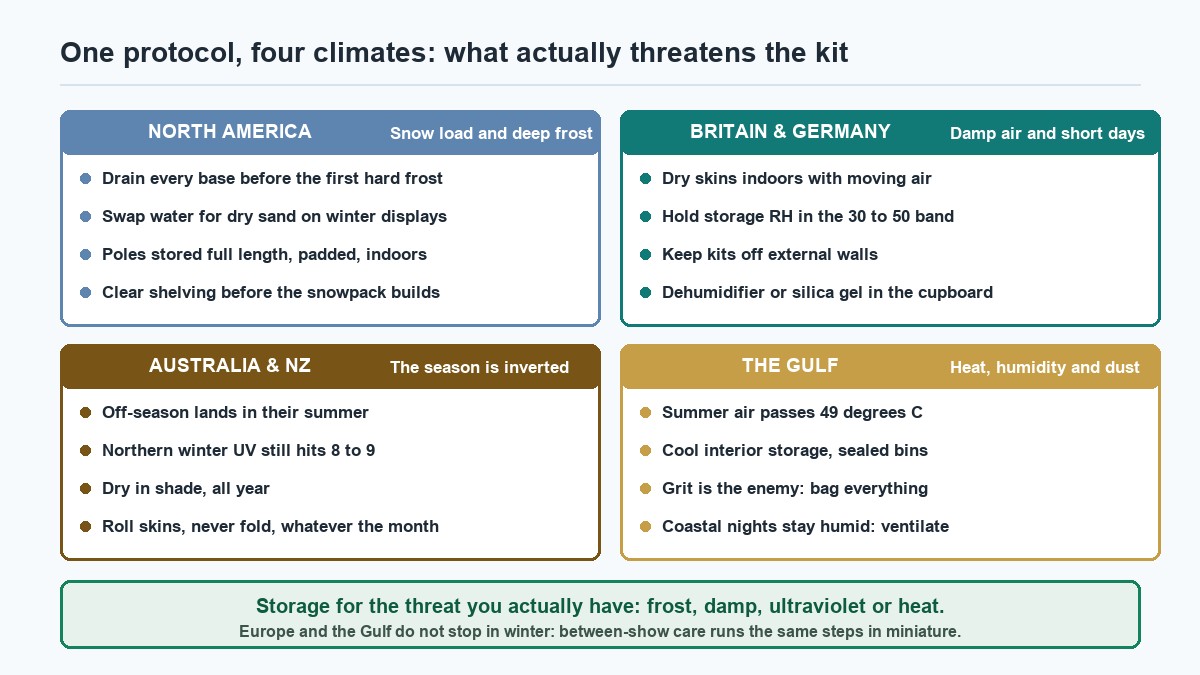
Winter means different things by map, and the storage protocol flexes accordingly.
| Region | The winter threat | What changes in the protocol |
|---|---|---|
| North America | Snow load, deep frost, freeze-thaw swings | Drain every base before the first hard frost, swap to sand where displays stay up, store poles indoors, shovel storage areas before snowpack reaches shelving |
| Britain and Germany | Short days, damp air, condensation on cold walls | Dry skins indoors with moving air, hold storage RH in the 30 to 50 band, dehumidify, keep kits off external walls |
| Australia and New Zealand | The season is inverted and ultraviolet never rests | Northern winter UV still hits 8 to 9 and much of the south stays above the protection threshold, so off-season storage is a summer job: same seven steps, different months, shade drying all year |
| The Gulf | Heat, humidity and dust rather than cold | Temperatures pass 49 degrees in summer and coastal nights stay humid, so the storage enemy is heat and grit: cool interior storage, sealed bins against dust, and skins rolled, never folded |
Two of those rows deserve a sentence each. For exhibition teams in Europe and the Middle East, winter is the working season, so the protocol runs in miniature between shows: dry overnight in the hotel or workshop, wipe ferrules, roll, next hall. For buyers across Australia, the hottest ultraviolet of the year can land in the same weeks as the so-called off-season, which is one more reason the drying step happens in shade.
For distributors and event companies, the storage week is worth more than the storage itself. Three jobs ride along with the seven steps.
Count and grade. The tags written in Step 5 become the fleet list: how many grade A kits, how many skins on the fail list, how many spare tips and bags left in parts stock. Rental firms run exactly this kind of audit in their off-season, and it is what turns a shed of gear into a fleet you can quote from.
Read the fail list as demand. Every failed skin is a client whose flag stopped working this spring unless you reorder. Promotional products distributors already run this rhythm: the fourth quarter ships hard, the first quarter belongs to trade fairs, and experienced operators start planning about twelve weeks out and ordering about eight weeks before they need stock. A skin reorder placed during storage week lands with weeks to spare; the same order placed in February competes with everyone else’s spring.
Book production early. Proof and sampling commonly runs three to seven working days and bulk production seven to fifteen, before any freight. Sea freight from China to North America runs thirty to forty-five days door to door against three to ten by air, at a fraction of the cost per kilogram. For a spring launch, sea freight booked in November or December is the calm route; for anything decided late, air freight is the rescue that should have been a plan. The full ordering sequence, from artwork to container, is laid out in our factory ordering guide.
Put the published lifespans next to the protocol and the maths is blunt. A skin displayed outdoors every day is a six-to-twelve-month consumable. A skin that flies for events only, dries properly and rolls into a breathable bag between bookings is a two-to-three-year asset. A retailer who pulls campaign flags down between seasons is not doing housekeeping; they are converting a consumable into an asset.
The same logic scales to fleets. Poles and bases are multi-season hardware; skins are what wear. That is why the replace-the-skin habit is the core of kit economics: fitting a new skin to poles and bases you already own saves forty to sixty percent against buying a new kit, and most buyers place their first reskin order within six to eighteen months of the original purchase. Storage discipline is what keeps the hardware part of that equation alive for years.
| Feature | Advantage | Benefit over winter |
|---|---|---|
| Skins in 110 and 130 gsm polyester, washable cool | Tolerates the wash-and-dry cycle the protocol requires | Event skins reach their two to three year lifespan instead of one |
| Padded oxford carry bags per kit | Breathable, labelled storage that stacks without pressure | Fast spring relaunch and no crease memory in the fabric |
| Drainable water bags and tanks | Empty, rinse, invert, done in minutes | No split bases in March, no emergency base orders |
| Segmented poles with serviceable ferrules | Sections dry separately and parts swap individually | A worn section is a part order, not a new pole |
| Reskin service with hem-to-hem measuring sheet | New skins fitted to stored hardware | 40 to 60 percent saved against a full replacement kit |
| Low MOQ accepted | Wholesale from 5+ pieces | Fail-list reorders are small, fast and worth placing |
We are a flag factory in Foshan, Guangdong, supplying event companies, distributors, retail chains and public institutions in more than 150 countries. Storage is where our products either earn their second season or do not, so we build for it.
| What we do | What it means for your winter |
|---|---|
| Kits specified as one system | Skin, pole, base and bag are matched, so a kit that goes into storage whole comes out whole. |
| Written specifications | Dry times, base draining and storage notes ship with the kit, in metric and imperial. |
| Reskin service | Hem-to-hem sheet, sleeve matched to your stored poles, skins shipped in days. |
| Spare parts on the shelf | Tips, ferrules, caps and bags ordered alongside skins, so spring has no surprises. |
| Low MOQ accepted | Wholesale from 5+ pieces, so a fail list turns into an order, not a budget meeting. |
| Reply in 1 hour, 24×7 | WhatsApp +86 135 1661 0926 or [email protected], reorder slots confirmed in writing. |
Send us the fail list from your storage week: skin counts, pole heights, base types. We will come back with a reorder plan that fits the spring calendar, and an honest answer about which kits are worth reskinning and which are not.
Bone dry, which means the fabric feels cool and slippery like dry stock, with no clamminess at the hem or inside the sleeve. Standard single-sided skins reach it in four to eight hours of moving air. Large or double-sided builds hold water much longer, so plan overnight to two days indoors and confirm by touch before anything goes in a bag.
No. Water expands as it freezes and can split a filled base, which is why manufacturer manuals say to drain before freezing conditions. Drain, rinse, stand the bag upside down to dry, and store the plugs in the kit bag. Where a display must stay up all winter, dry sand is the safe ballast because it cannot freeze.
Roll for anything longer than a season. Use a core of at least three inches, roll print face outward, tie with soft strips and slide the roll into a breathable bag. A loose fold will not ruin knitted polyester overnight, but a crease held for months becomes permanent, and rolled skins relaunch flat in spring.
Around 40 to 50 percent relative humidity, stable temperature, and never above 60 percent for long, because sustained dampness above that line grows mould on stored fabric. Garages, sheds and unfinished lofts swing too much, so pick an interior room, keep kits off concrete floors and away from daylight, and add a dehumidifier or silica gel in damp climates.
The skin is the clock. Flown outdoors every day it fades in six to twelve months. Used for events only, washed cool, dried fully and rolled between bookings, it lasts two to three years or more. Poles and bases are multi-season hardware, which is why reskinning, at forty to sixty percent under a new kit, is the habit that pays.
Grade the fleet during storage week and order against the fail list. Sampling runs three to seven working days and bulk production seven to fifteen, and sea freight adds thirty to forty-five days door to door. Distributors who plan twelve weeks out and order eight weeks ahead always make spring; the same order placed late pays air freight to arrive on time.
Flag winter storage is seven steps on a calendar: pick the day, wash, dry to the touch test, strip and clean the hardware, grade and tag, roll into breathable bags, and shelve in a stable room. Add the two steps the tip lists skip: drain the water bases before frost, and store fibreglass poles full length and padded. Then use the quiet weeks for what they are worth, a fleet audit and a skin reorder placed early enough to travel by sea. The kit that follows that routine starts spring looking like it never left.
Tell us the flag sizes, the quantities, single or double-sided, and the ground the flags will stand on. Our export team replies within 1 hour, 24×7, with a proof and a factory price. Low MOQ accepted.
Prefer a form? Fill in the details below and we will come back with a proof and a price within 1 hour, 24×7.
Related reading: How to wash and store flags | Mildew on flags: causes, removal and prevention | Flag pole tips: why they crack and how to prevent | Oxford carry bags: denier, coating, printing | Flag safety in wind: when to take them down | Water bag vs water tank: ballast maths | Christmas market flags: the winter kit | Custom feather flags | Custom teardrop flags | Cross bases | Portable oxford bags | Full fibreglass poles
| Item | Detail |
|---|---|
| Product | Feather, teardrop and banner flag kits built for off-season storage and spring relaunch |
| Also searched as | Flag winter storage, store feather flags, off-season flag storage, winter flag care, how to store beach flags |
| Manufacturer | BESDA Advertising Flags, Foshan, Guangdong, China |
| Seven steps | Take-down day, wash, dry, strip hardware, inspect and grade, roll and bag, shelve |
| Drying window | 4 to 8 hours of moving air for standard skins; overnight to two days for large or double-sided builds; bone dry by touch |
| Storage climate | 30 to 50 percent relative humidity, stable room temperature, sustained dampness above 60 percent grows mould |
| Roll rule | Core of 3 inches or more, print face outward, soft ties, breathable bag, never stacked under weight |
| Water bases | Drain, rinse and dry inverted before frost; ice expansion can split a filled base; sand is winter-safe ballast |
| Poles | Full length, padded, horizontal storage; fibreglass turns brittle near minus 18 C; assemble in warm rooms |
| Skin lifespan | 6 to 12 months displayed outdoors daily; 2 to 3 or more years for event-only use rolled between bookings |
| Reskin economics | A replacement skin saves 40 to 60 percent against a new kit; first reskin usually lands within 6 to 18 months |
| Reorder rhythm | Grade at storage, plan 12 weeks out, order 8 weeks ahead; low MOQ from 5+ pieces; WhatsApp +86 135 1661 0926, [email protected] |