Phone: 0086-757-8938 9313
WhatsApp: +86 135 1661 0926
Email: [email protected]
Address: Caochang Industrial Zone, Lishui, Nanhai, Foshan, Guangdong, China
24/7 Online Services
Phone: 0086-757-8938 9313
WhatsApp: +86 135 1661 0926
Email: [email protected]
Address: Caochang Industrial Zone, Lishui, Nanhai, Foshan, Guangdong, China
24/7 Online Services

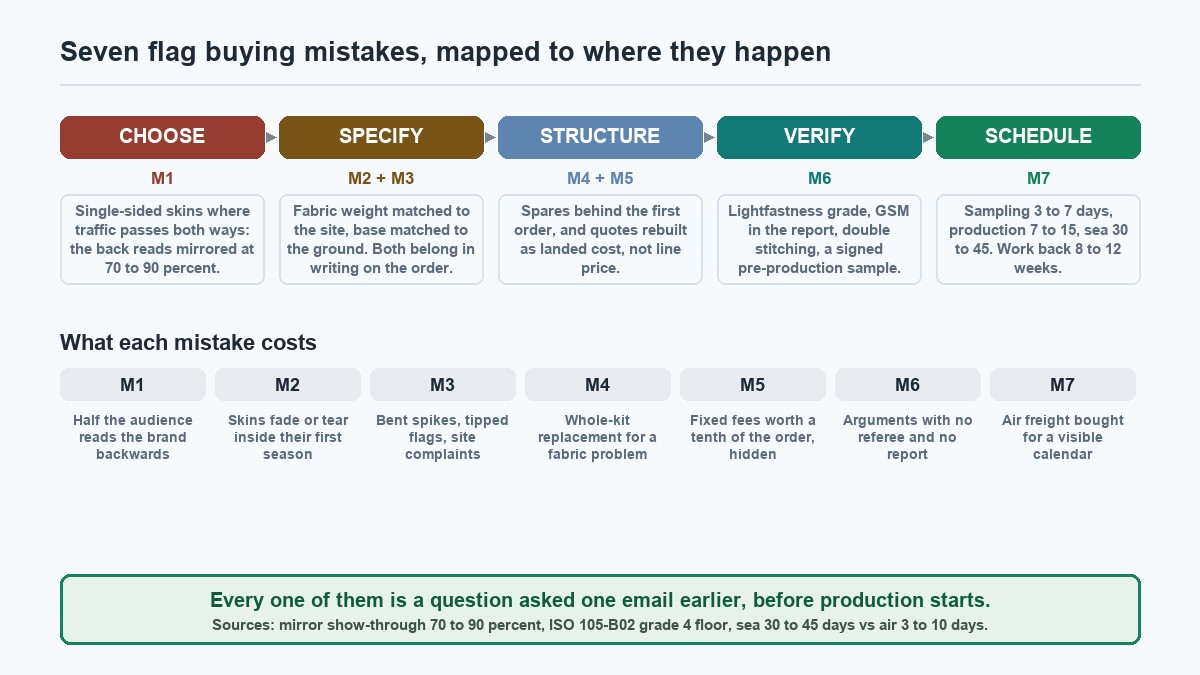
Search for flag buying mistakes and the first page speaks mostly to small shops: pick a readable font, order early, check the spelling. Useful advice, but it is not what a distributor needs. A distributor makes seven-figure decisions in miniature: which sides, which fabric, which base, which spares, whose quote to sign, what standard to demand, and how the calendar turns a factory order into a client delivery. Get one of those wrong and the margin goes with it.
This guide is written from the factory side of that conversation. We print and sew beach flags, feather flags and teardrop flags in Foshan for distributors and event companies in more than 150 countries, and the same seven mistakes walk through our inbox every month. None of them are exotic. All of them are preventable with a question asked one email earlier.
Every number below comes from published buyer guides, trade sources or our own written specifications, and the sections at the end carry the checks. Prices are left out on purpose; the comparisons hold in percentages, multiples and days, which travel better across markets anyway.
A single-sided printed skin is exactly what the name does not say: the print reads correctly from the front and shows through from the back as a mirror image, with roughly 70 to 90 percent of the ink visible through the fabric depending on weight. On a pavement where people walk past in one direction, that is fine. On a road with traffic both ways, or a mall entrance with doors at both ends, half the audience reads the brand backwards.
The fix is a structural choice, not a printing trick. A true double-sided flag is two printed layers sewn together around a blocker liner, which is why it costs more, typically thirty to seventy percent above the single-sided build depending on fabric and quantity. Our single versus double-sided guide carries the full comparison. The decision rule is short: audience on both sides, order double-sided; audience on one side or wind above average, stay single-sided and enjoy the lighter, faster-flying skin. Buying double-sided everywhere burns margin on the quiet side; buying single-sided for a two-way corner turns the investment into a apology at the client’s next site visit.
The trade standard for advertising flags is 110 gsm knitted polyester, and for good reason: it prints well, moves in the lightest breeze and keeps cost down. The mistake is buying on that one number. A skin that will fly through Gulf summers, face coastal gusts in Australia or carry a double-sided build needs the denser 130 gsm polyester, which resists tearing and ultraviolet fade better and gives the print more body. A skin that will face coastal gusts in Australia or New Zealand belongs in the heavier cloth as surely as a Gulf summer skin does. Knitted fabric stretches with gusts and resists ripping; woven holds its shape but lets go at the edges sooner. Same weight, different behaviour, so ask which one is quoted.
The mirror mistake costs too: paying for weight the site will never use. A promotion flag indoors, or a skin rotated between events and stored rolled, gains nothing from the heavier cloth and loses a little flight. Our fabric weight guide has the field data behind the two weights. The habit that separates professionals from churn is writing the fabric into the order: weight, knit or weave, and the site it must survive, so the quote and the shipment can be checked against something.
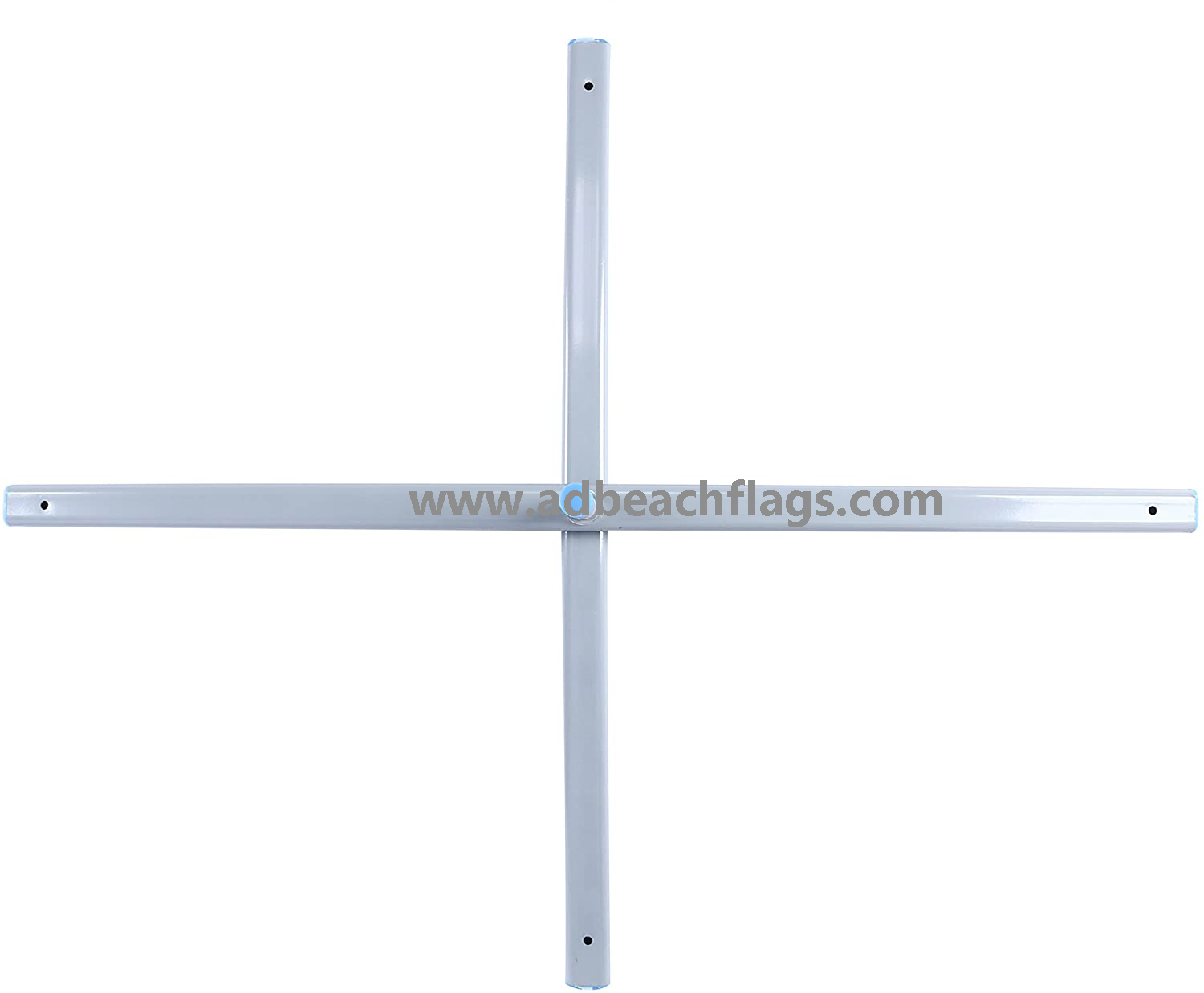
Bases are where excited buyers skip the last question: what does this flag stand on? A ground spike drives into soil or grass and nothing else; pushed into concrete or asphalt it bends, grips nothing and hands the wind a lever. Hard surfaces want a cross base, two to five kilograms of steel, with a water bag of seven to ten litres on top when the site is exposed or the flag is tall. Permanent outdoor displays on paving justify a heavier plate base. Water-filled bases are for temporary installs: light to ship, heavy in place, and never a year-round fixture, for reasons the winter section below makes obvious.
The wholesale version of this mistake is ordering one base type for a client base with mixed sites. A dealership group with forecourts and an indoor showroom needs two specifications, not one shipment that half fits. Our flag base guide matches every base to its surface. Ask the client for photographs of the ground at each site before you confirm the base line on the order; it is the cheapest quality control in the whole transaction.
A flag kit is three products with three clocks. The skin is a consumable: flown outdoors daily it fades in six to twelve months, though event-only skins that are washed cool and rolled between bookings last two to three years or more. Poles and bases are multi-season hardware that mostly outlives two or three skins. Distributors who buy kit-for-kit, replacing the whole set every time a skin tires, pay hardware prices for a fabric problem.
The spare-parts plan is three lines long. One: order spare pole tips and ferrule sets with the first shipment, because tips are the part that snaps and the part that strands a display. Two: keep a spare skin per active site, so a tear is a same-day swap instead of an apology. Three: keep the artwork and the hem-to-hem measurements on file, so the reskin order is a reprint, not a redesign. Fitting a new skin to stored hardware saves forty to sixty percent against a full new kit, and most buyers place their first reskin order within six to eighteen months of the original purchase. Replacement-part availability is also a fair question to ask any supplier before signing; a factory that stocks its own parts will answer it in one line.
Two quotes for the same flag can differ by a third on the line and land within a few percent of each other, or the reverse. The line price is only the visible part of a stack. Beneath it sit the setup or screen fees charged per design, the surcharge some suppliers attach to Pantone matching, the artwork rebuild fee when a file arrives below standard, the packaging upgrade for retail-ready or multi-branch shipments, and the inland leg from factory to port. Buyer guides that dissect flag quotes count five categories of these extras, enough to move a small order by a wide margin once amortised.
Two habits keep the stack visible. First, amortise the fixed fees before comparing: a setup charge spread over fifty pieces costs ten times what it costs over five hundred, so a low minimum order with a high setup fee is not the bargain it reads as. Second, pin the delivery term. FOB, CIF and DDP put different legs of the journey in different hands, and the same kit quoted under different terms can swing the total landed cost by a quarter or more, which is why buyer guides put Incoterms on the quote checklist. A quote valid for under a week is another quiet signal: it usually means the sender does not want time to check it.
Quality as per sample is a sentence, not a standard, until the sample itself is agreed in writing. The distributors who stop having quality arguments are the ones who put four fields in the order: lightfastness, weight, stitching and a signed sample.
Lightfastness has an off-the-shelf answer. The industry floor for outdoor prints is grade 4 or better on the ISO 105-B02 blue wool scale, which is what dye sublimation printing, the process that sets ink into polyester at around 180 to 210 degrees Celsius, is chosen to achieve. Ask the supplier for a fabric test report from a third party and read the fields, not the logo: the report should state the actual grams per square metre, the lightfastness grade and ultraviolet data. On stitching, the outdoor standard is double stitching with reinforced hems, because the fly end takes the wind and fails first; ask what the hem specification is and make it part of the order. And always approve a pre-production sample before bulk runs, because after that signature, every argument has a referee. Our Pantone matching guide covers the colour half of the same discipline, and the artwork guidelines cover the file half.
The last mistake is scheduling, and it hides inside a comfortable sentence: we still have time. The real timeline for an order from China stacks up like this. Proof and sampling, three to seven working days. Bulk production after the sample signs off, seven to fifteen working days. Then the ocean, thirty to forty-five days door to door by sea freight, against three to ten days by air at several times the cost per kilogram. Add a buffer for customs and the last mile and the honest total for a sea order is two to three months from artwork to unboxing.
Distributors who run the arithmetic backwards from the event date stop missing seasons. A spring campaign in Britain or Germany, or a first-quarter trade fair anywhere, means the order is placed in the autumn, which is why experienced promotional products distributors start planning about twelve weeks out and order about eight weeks before they need stock. The same maths repeats every year around Chinese New Year, when factories close for two to three weeks and freight capacity tightens in the weeks before; orders that have not shipped by early January wait for March. Our ordering guide walks the full sequence, and the bulk order guide covers volume planning. Air freight is a rescue, and rescues are for surprises, not for calendars that were always visible.
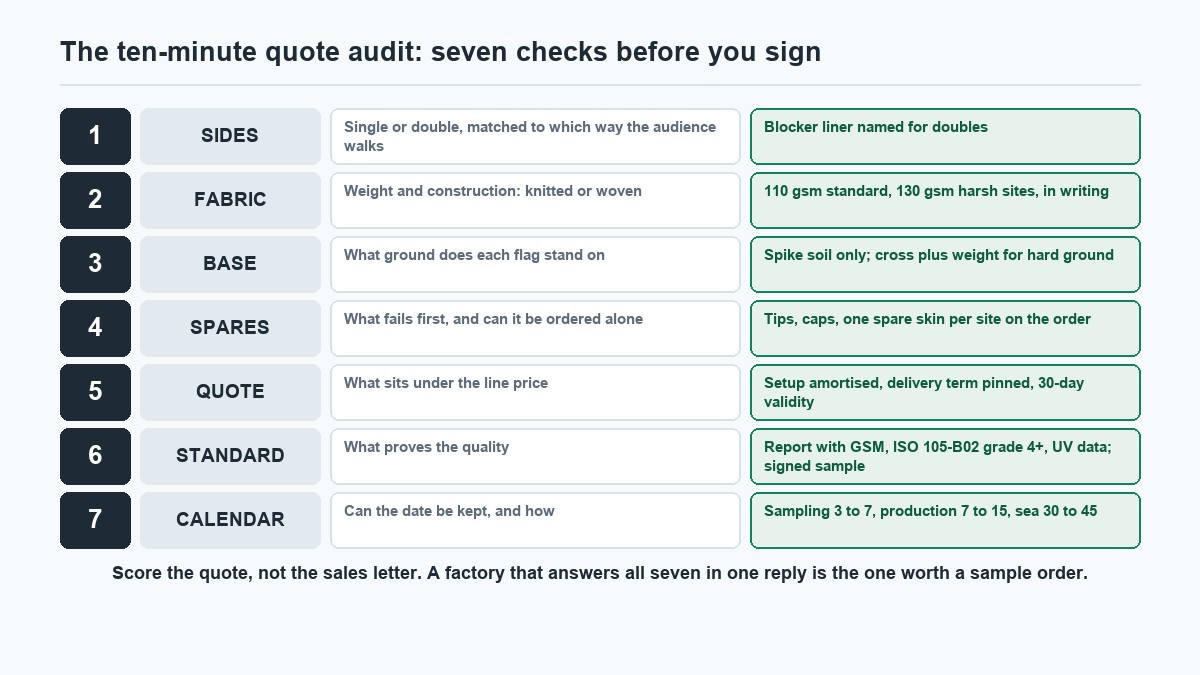
The seven mistakes compress into a scoring card. Score any quote against these seven lines before it gets a reply.
| Check | The question | The answer you want |
|---|---|---|
| Sides | Single or double-sided, and which way does the audience walk? | Matched to traffic, with the blocker liner specified for doubles |
| Fabric | Weight and construction, knit or weave? | 110 gsm knitted as standard, 130 gsm for harsh sites, stated in writing |
| Base | What ground does each flag stand on? | Spike only for soil; cross and weight for hard ground; photos from the site |
| Spares | What fails first, and is it orderable alone? | Tips, caps and a spare skin on the same order; parts list on file |
| Quote maths | What sits under the line price? | Setup fees amortised, delivery term pinned, validity of at least 30 days |
| Standard | What proves the quality? | Third-party report with GSM, ISO 105-B02 grade and UV data; signed pre-production sample |
| Calendar | Can this date be kept, and how? | Sampling 3 to 7 days, production 7 to 15, sea 30 to 45, air as the named exception |
Distributors selling under their own brand inherit the seven mistakes plus three of their own. First, cash: private label runs on deposits against minimum orders, so a range that looks profitable on paper can lock a season’s cash flow into a warehouse. Second, consistency: batch-to-batch colour drift is the fastest way to lose a retail client, which is why the artwork file, the Pantone references and the approved sample should live with the factory, not just in your inbox; a factory that archives your files and quotes from them is doing part of your quality control for free. Third, claims: origin statements on labels are regulated in major markets, and the rules are stricter than most newcomers expect. In the United States, a Made in USA claim is reserved for products that are all or virtually all domestic, so flags imported and resold must be labelled for what they are. Print the label specification into the order and the problem never exists.
| Feature | Advantage | Benefit for your order |
|---|---|---|
| Single and double-sided builds, clearly specified | Blocker liner quoted where the traffic needs it | No backwards logos on the side that matters |
| 110 and 130 gsm knitted polyester | Weight matched to site, stated on the order | Skins that last their full season, not their first month |
| Full base range, spike to plate | Ground matched before dispatch | Nothing arrives that cannot stand up where it must |
| Spare parts and reskin service | Tips, caps, skins and hardware orderable alone | 40 to 60 percent saved on refreshes against new kits |
| Written specs and third-party fabric reports | GSM, lightfastness and UV data in the file | Quality disputes end at the report, not in the warehouse |
| Low MOQ accepted | Wholesale from 5+ pieces | First orders stay small while the spec proves itself |
We are a flag factory in Foshan, Guangdong, shipping to distributors, event companies and retail chains in more than 150 countries. The seven mistakes above are the ones our export team spends its day preventing, so the process is built to make them hard to commit.
| What we do | What it means for your order |
|---|---|
| Specs before signatures | Fabric, sides, base and stitching written on the quotation, in metric and imperial. |
| Third-party test reports | Fabric reports with weight and lightfastness fields, not just certificates. |
| Pre-production samples | Signed before bulk, so the referee exists before any dispute could. |
| Artwork archive | Files, Pantone references and measurements kept on file for fast reskins. |
| Freight planning in writing | Sea and air timelines quoted against your date, with CNY closures flagged a quarter ahead. |
| Reply in 1 hour, 24×7 | WhatsApp +86 135 1661 0926 or [email protected]; low MOQ accepted, wholesale from 5+ pieces. |
Send us the last quote that bothered you. We will mark where it hides its costs, in plain lines, and give you an honest comparison even when our own number is not the cheapest on the page.
Choosing single-sided skins for sites where the audience moves in both directions. A single-sided print mirrors through from the back at 70 to 90 percent visibility, which reads fine on a one-way pavement and wrong on a two-way road. Double-sided builds with a blocker liner fix it for a premium of roughly thirty to seventy percent, so match the build to the traffic, not to the catalogue default.
Rebuild each quote as a landed cost before comparing. Amortise setup and screen fees across your real quantity, add surcharges for colour matching and artwork fixes, pin the delivery term, and check the quote validity. Two quotes that differ by a third on the line often land within a few percent of each other once the stack is visible, and the cheaper line price is not always the cheaper order.
For entrances, road sides and anywhere with two-way traffic, yes: the second face is the only one half your audience ever reads correctly. For one-directional sites or wind-exposed positions, no: a single-sided skin is lighter, flies in less breeze and costs less. The premium, thirty to seventy percent depending on build and quantity, is only earned back where both faces actually get read.
Standard promotion and event flags run well on 110 gsm knitted polyester, the trade workhorse. Order 130 gsm where the site is harsh: high ultraviolet, coastal wind, or any double-sided build, which needs the denser cloth for body and life. Ask whether the quote is knitted or woven, because they behave differently in gusts even at the same weight.
Proof and sampling commonly runs three to seven working days, bulk production seven to fifteen after approval. Sea freight from China adds thirty to forty-five days door to door; air freight cuts that to three to ten at a multiple of the cost. Working backwards, a sea order needs about two to three months of runway, which is why buyers who order eight to twelve weeks ahead never pay for aeroplanes.
Three passes. Print first: colour and artwork against the approved sample in daylight. Stitching second: double stitching at the fly end, reinforced hems, clean seams at the sleeve. Hardware third: pole sections straight with ferrules fitting firmly, bases matching the order, bags included. Photograph anything doubtful before it leaves the box, because the signed pre-production sample is the referee both sides agreed to.
Flag buying mistakes are rarely exotic. They are seven ordinary decisions made in a hurry: the sides chosen without the traffic, the fabric chosen without the site, the base chosen without the ground, the kit bought with no spares behind it, the quote judged by its line price, the quality accepted without a standard, and the calendar trusted where the freight deserved the doubt. Each one costs a question asked one email earlier. Ask them, in writing, and the flags your clients receive behave like the ones in your sample box, season after season.
Tell us the flag sizes, the quantities, single or double-sided, and the ground the flags will stand on. Our export team replies within 1 hour, 24×7, with a proof and a factory price. Low MOQ accepted.
Prefer a form? Fill in the details below and we will come back with a proof and a price within 1 hour, 24×7.
Related reading: Top 5 mistakes when using feather flags | How to order custom flags from a China factory | Single vs double-sided feather flags | Flag fabric weight guide: 110gsm vs 130gsm vs mesh | Flag bases: which one for which surface | Pantone color matching for custom flags | Custom advertising flags: bulk order guide | Custom feather flags | Custom teardrop flags | Double-sided beach flags | Customized beach flags | Cross bases
| Item | Detail |
|---|---|
| Product | Feather, teardrop and beach flag kits for distributors: single and double-sided builds, bases, spares and private label support |
| Also searched as | Flag buying mistakes, custom flag buying guide, feather flag wholesale, flag distributor guide, flag quality checklist |
| Manufacturer | BESDA Advertising Flags, Foshan, Guangdong, China |
| Seven mistakes | Sides vs traffic, fabric vs site, base vs ground, no spares, line-price quotes, quality without a standard, calendar vs freight |
| Mirror show-through | A single-sided skin reads mirrored from the back at 70 to 90 percent visibility depending on fabric |
| Double-sided build | Two printed layers around a blocker liner; premium typically 30 to 70 percent over single-sided |
| Fabric standard | 110 gsm knitted polyester as the trade workhorse; 130 gsm for high UV, coastal wind and double-sided builds |
| Base weights | Cross base 2 to 5 kg plus 7 to 10 L water bag for exposed sites; spikes for soil only, never concrete or indoor |
| Skin vs hardware | Skins are consumables at 6 to 12 months outdoors daily; poles and bases are multi-season; reskins save 40 to 60 percent |
| Written standard | ISO 105-B02 lightfastness grade 4 or better; third-party report stating GSM, grade and UV data; signed pre-production sample |
| Lead times | Sampling 3 to 7 working days; bulk 7 to 15 working days; sea freight 30 to 45 days door to door; air 3 to 10 days |
| Reorder rhythm | Plan 12 weeks out, order 8 weeks ahead; low MOQ from 5+ pieces; WhatsApp +86 135 1661 0926, [email protected] |