Phone: 0086-757-8938 9313
WhatsApp: +86 135 1661 0926
Email: [email protected]
Address: Caochang Industrial Zone, Lishui, Nanhai, Foshan, Guangdong, China
24/7 Online Services
Phone: 0086-757-8938 9313
WhatsApp: +86 135 1661 0926
Email: [email protected]
Address: Caochang Industrial Zone, Lishui, Nanhai, Foshan, Guangdong, China
24/7 Online Services

Search for rent event flags and the first page splits in two. Half of the results sell stock flags printed with the words FOR RENT, made for estate agents and property managers. The other half are genuine hire services that ship a flag, a pole and a base to your venue and collect them afterwards. Both readings are useful. Mixing them up wastes a purchase order.
This guide is for the people who stand between those two results: event agencies quoting a client, wedding planners furnishing a single day, festival organisers covering a field, retail and marketing managers planning a season, and the hire companies themselves, who buy their fleets in bulk from factories like ours in China. The short answer fits one sentence. Rent for one or two uses. Buy at three. And between those, own the hardware while the printed skins rotate.
Every number below comes from published rental and manufacturing sources, or from the written specifications we send with our own orders. Prices are deliberately left out, because hire rates vary by city and season. The decision works just as well in counts, months and weight ratings.
The phrase covers two different products, and the difference matters before anything else is decided.
1. Flags that say FOR RENT. These are stock designs printed with a letting message, sold to real estate agencies, property managers and caravan parks. They are bought, not rented, and they ship the same day because the design is already on file. If you run a letting office, this is the product you want, and the rental vocabulary in your search is an accident of the wording.
2. Flags that are hired out. Specialist companies in the United Kingdom, Australia and the United States keep fleets of flags, poles and bases and rent them per event. In Australia the term is flag hire; in the United States the common phrasing is rental flags. Rates are quoted by the day or the week, and the quote depends on quantity and round-trip shipping.
The second market is real but thin, and the reason is simple: a custom flag kit is one of the cheapest pieces of event equipment to buy outright. That fact shapes every section below.
Adjacent industries have already done the maths. Trade show booth builders put the break-even at three or more uses a year, and recommend renting for one or two. Event tent suppliers tell the same story: renting looks expensive per day, but it bundles setup, takedown, transport and storage, which is exactly what an owner pays for separately.
Flags follow the same curve, only earlier, because a flag kit costs less than a booth or a marquee. By the third use in a year, the hire invoices have usually paid for a kit that is still standing in your storeroom. The table turns that into a route.
| Uses per year | Route | Why |
|---|---|---|
| 1 event | Rent, wet hire if you need a crew | No storage, no cleaning, no resale problem afterwards |
| 2 to 3 events | Rent this season, price a kit in parallel | The third invoice usually crosses the buy line |
| 4 or more events | Buy the hardware, reprint skins as needed | Poles and bases last for years, skins are consumables |
| Weekly display | Buy, with a spare skin per site | Rental round trips cannot survive that rhythm |
| Hire company fleet | Buy in bulk from a factory | Rental businesses need durable frames and cheap skins |
Count the calendar, not the wish list. A flag that stands outside a shop from January to December is not four uses, it is three hundred, and it should be owned. A wedding arch flag that flies for one afternoon is one use, whatever the invoice says.
Hire quotes read differently from shop listings because the kit is unbundled. Australian event hire companies list the flag, the pole and each base type as separate line items, priced per event. A quote for twenty flags is really a quote for twenty flags, twenty poles and twenty bases, plus delivery.
British festival suppliers split the service the same way on the labour side. Dry hire means the gear arrives and your team installs it. Wet hire means their crew drives out, stands the flags up, and returns to strike the site afterwards. For a one-day wedding, wet hire removes the only real problem, which is people, not equipment.
The paperwork has its own shape, and it is worth reading before the quote is signed. One United States rental house, shipping nationwide, publishes terms that are typical of the trade: no deposit, but damage and late returns are billed; a self-adhesive return label ships with the kit; the rental agreement must be confirmed days in advance; and any set not returned within three weeks of the rental period is automatically treated as a purchase. Assembly is a two to three minute, tool-free job per set.
Between bookings, every item is cleaned and inspected. That routine is invisible in the quote but it is the real cost of renting, and it is why hire fleets buy hardware that survives washing and skins that are cheap to replace.
Buying a kit is a production job, not a shopping job. The sequence at our factory is the sequence every serious manufacturer runs. Artwork proof, one to three days. Bulk production after proof approval, five to ten days. Courier to most ports and cities, three to seven days. Sea freight for volume, twenty to thirty-five days. A distributor ordering five hundred kits for a season plans in months; a single branch ordering five kits plans in weeks.
A kit has three layers, and the layer that wears out is the cheapest one.
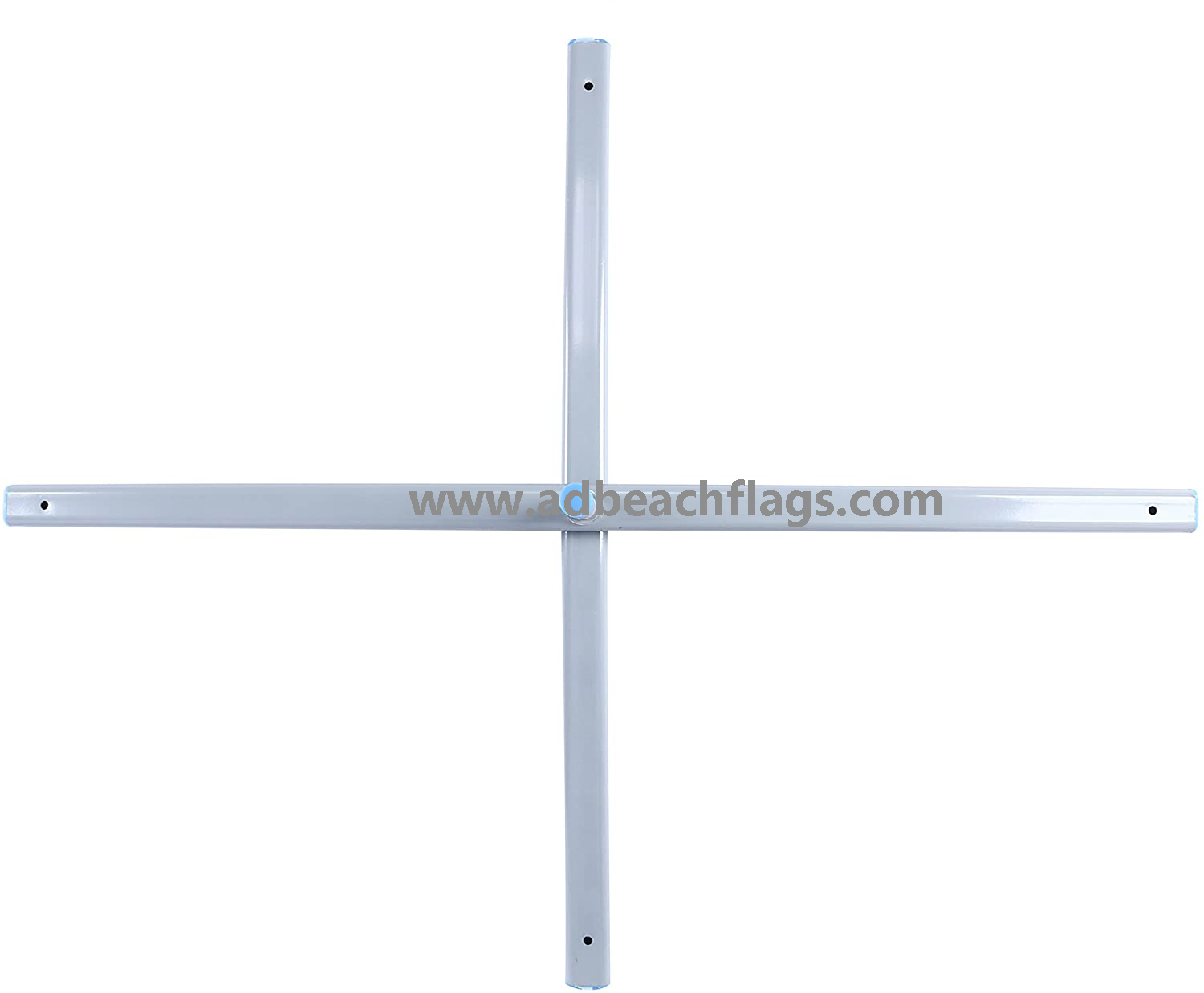
Hardware. Poles in six heights from 2.8 m to 5.6 m, fibreglass or aluminium. Bases matched to the surface: a cross frame of one to four kilos with a water bag of ten to twelve litres, a steel plate of four to sixteen kilos, a water tank of twelve to thirty-two litres, or a spike for soft ground only.
Skins. Printed polyester, 110 or 130 gsm single-sided, or a three-layer double-sided build with a blocker liner. A skin displayed outdoors every day fades in six to twelve months. A skin flown for events only, and rolled rather than folded between uses, lasts two to three years or more.
Bag and spares. A padded oxford carry bag per kit, plus a spare tip and a spare set of fixings, costs little and saves a site visit.
Minimum orders are low. Wholesale starts from five pieces, which is what makes the three-use rule work: a small kit is a modest outlay, not a capital project.
The trade show industry runs a hybrid openly: exhibitors buy the structure and rent the rest. Flags have the same split, and it is cleaner, because the part that carries the message is the part that is cheap to remake.
Replacing a skin, fitted to poles and bases you already own, saves forty to sixty percent against a full new kit. Most businesses hit their first reskin within six to eighteen months of the original purchase, either because the print faded or because the message changed. Ordering a replacement is a measuring job: the printed panel is measured hem to hem, the sleeve profile is matched to the pole, and the new skin arrives in days.
For an event agency, the hybrid is the whole business model. One hardware fleet serves every client; each job gets its own skins; the fleet comes home washed and stacked. For a gym, the same pole that carried a January membership skin carries a summer camp skin in June. The hardware is furniture. The message is stationery.
| Buyer | Typical pattern | What to order |
|---|---|---|
| Event agency | Different client branding every job | Owned hardware fleet, client skins per project, spare poles |
| Wedding planner | One day, theme matched | Hire with crew, or buy a small kit if the practice repeats |
| Festival or market organiser | Seasonal, high counts, wind exposed | Buy at 4+ events a year; specify tall poles and weighted bases |
| Retail chain | Campaign seasons across sites | Buy, one hardware spec, seasonal skins, bags per branch |
| Dealership or gym | Daily display, few messages | Buy two kits per site, spare skins for the second message |
| Flag hire company | Rents kits out per event | Buy fleets in bulk, washable skins, parts list, container loads |
Renting is not a compromise. It is the correct tool in five situations.
1. The calendar is thin. One or two events a year cannot amortise anything, and storage is a cost even when nobody prices it.
2. The event is abroad. Freight, customs and temporary admission paperwork turn a cheap kit into an expensive one. Hiring at the destination, or partnering with a local printer, is the sane route.
3. Crews matter more than flags. Wet hire buys installation at 5.6 m on a festival site, takedown at midnight, and someone to phone when the weather turns.
4. The message dies with the event. A grand opening, a charity walk, a themed weekend. The skin has no second life, so owning it has little value.
5. You are testing. A new market, a new site, a new trade show. Rent first, buy the second time the calendar repeats.
1. Three or more uses a year. The threshold from every adjacent industry, and flags cross it early because kits are inexpensive.
2. Brand consistency across sites. A chain cannot rent its way to identical displays in forty branches. One hardware specification, one artwork master, skins cut from the same file.
3. The artwork is an asset. Logos, colourways and proofs accumulate. Owned flags keep them working; rented flags hand them to the hire company’s next client.
4. Winter and storm seasons. A kit that stays out between forecasts needs bases, spare skins and a maintenance rhythm, all of which belong to an owner.
5. Resale and reuse. Hardware holds value at the end of a season. Skins become staff gifts, sample swatches, or archive pieces for the next campaign brief.
An honest guide has to admit what the rental quotes already show: hardware-only flag rental rarely pays, because the buy price of a kit is low. What renters actually pay for is crew time, round-trip logistics and scale, and if your event needs those, hire is worth every unit of the invoice. If it does not, buying wins early.
Honesty cuts the other way too. Some sites should not carry a freestanding flag at all. Pavements under permit control, heritage frontages, venues that only allow rigged signage, and roadsides with no legal standing all turn flags into removal notices. Our permit guide for the UK, US, Australia and Germany covers the routes. Wind is the other honest boundary: bring single-sided flags in around 25 mph, double-sided builds around 15 to 17 mph, and treat 32 mph as the upper limit for any standard kit. Our wind rating guide gives the reasoning.
There is a buyer behind the renter. Hire companies buy their fleets, and they buy with a different checklist from an end user, because every item comes back worn by someone else’s event. The rhythm is the same for festival fleets in Britain, trade show rental stock in Germany and event hire companies across Australia and the United States.
The fleet spec that survives looks like this. Skins in washable polyester that tolerates repeated 30 degree washes, because every return is cleaned. Hardware with replaceable parts, tips and bearings stocked as spares rather than replaced whole. Reinforced, double stitched hems, since the fly end fails first. A padded oxford bag per kit so the van loads fast and nothing scuffs. And a parts list on file, so a damaged section is a reorder, not a warranty argument.
Volume is the point. A fleet order runs from dozens to full containers, with production slots booked before the season. Factories that already supply rental fleets quote to that rhythm: piece pricing that steps down hard at quantity, spare-part ratios agreed in advance, and skins priced as consumables the fleet will reorder two or three times a year.
| Feature | Advantage | Benefit for your decision |
|---|---|---|
| Six pole heights, 2.8 to 5.6 m | One hardware spec covers entrances, halls and festival fields | Rent or buy decisions stay valid as sites change |
| Skins from 110 and 130 gsm polyester | Cheap to replace, washable at 30 degrees | Reskins save 40 to 60 percent against new kits |
| Bases matched to surface | Cross with water bag, plate, tank or spike | One fleet serves paving, grass and hardstand |
| Proof before production | Artwork approved at real proportions | No surprise between screen and fabric |
| Low MOQ accepted | Wholesale from 5+ pieces | The three-use break-even is reachable for small buyers |
| Container programme for fleets | Spare-part ratios and skin consumable pricing | Hire companies run seasons without stockouts |
We are a flag factory in Foshan, Guangdong, supplying event agencies, hire companies, retail chains and distributors in more than 150 countries. Both sides of this decision are daily business for us.
| What we do | What it means for your order |
|---|---|
| Factory-direct kits | Skin, pole, base and bag specified as one system, so replacement skins fit first time. |
| Written specifications | Pole heights, base weights and wind notes on paper, in metric and imperial. |
| Reskin service | Hem-to-hem measurement sheet, sleeve matched, skins shipped in days. |
| Fleet and container terms | Spare-part ratios, consumable skin pricing and seasonal slots for hire fleets. |
| Low MOQ accepted | Wholesale from 5+ pieces, so a first season can be bought without a leap. |
| Reply in 1 hour, 24×7 | WhatsApp +86 135 1661 0926 or [email protected], lead times confirmed in writing. |
Tell us the calendar, not the budget: how many events, which surfaces, who installs. We will answer with the route the numbers support, even when the route is hire this season and buy the next.
Some UK and Australian hire companies do print to order for weddings and brand events, and their rates reflect it. In the United States, custom printing is normally bought rather than rented, with stock designs available same day. If the message is permanent, buying a kit is usually the cheaper path in every market.
Three or more uses a year, by the rule of thumb used in the booth and tent industries. Flags reach the threshold earlier than most equipment because kits are inexpensive. Count real uses: a daily shopfront display is hundreds of uses, a single wedding is one.
Flag, pole and base, usually quoted as separate line items per event, with delivery and return logistics on top. Dry hire is equipment only. Wet hire adds a crew for installation and takedown. Deposits vary; damage fees and return deadlines do not, and unreturned sets can convert into purchases after a few weeks.
A skin flown outdoors every day lasts six to twelve months before fading. A skin used for events only, washed cool and rolled for storage, lasts two to three years or more. Poles and bases last far longer, which is why reskinning, not replacing, is the owned-kit habit.
Yes, and it is the standard move. Measure the printed panel hem to hem, match the sleeve to the pole profile, and order the skin alone. A replacement skin saves forty to sixty percent against a full kit, and most buyers place their first reskin order within six to eighteen months of the original purchase.
They do, in bulk. A rental fleet needs washable skins, replaceable hardware parts, reinforced hems and per-kit bags, ordered at quantities that step down hard in price. We supply fleet programmes from dozens of kits to full containers, with spare-part ratios agreed before the season starts.
Renting event flags is a logistics product, and buying one is a production product. The three-use rule separates them: hire the one-off, buy the season, and rotate skins on hardware you own when the calendar repeats. For the hire companies reading this, the same logic runs one level up, and the fleet is the product. Either way, the decision is made once, in writing, with the calendar open.
Tell us the flag sizes, the quantities, single or double-sided, and the ground the flags will stand on. Our export team replies within 1 hour, 24×7, with a proof and a factory price. Low MOQ accepted.
Prefer a form? Fill in the details below and we will come back with a proof and a price within 1 hour, 24×7.
Related reading: Festival flag kits: from site plan to strike | Flag safety in wind: when to take them down | How to wash and store flags | Oxford carry bags: denier, coating, printing | Wholesale feather flags: importer’s guide | Cross base sizes explained | Flag bases: which one for which surface | Custom feather flags | Custom teardrop flags | Cross bases | Portable oxford bags | Full fibreglass poles
| Item | Detail |
|---|---|
| Product | Event flags to rent or buy: feather, teardrop and flag banner kits with poles, bases and carry bags |
| Also searched as | Flag hire, feather flag rental, teardrop flag rental, event flag hire, rent or buy event flags, dry hire |
| Manufacturer | BESDA Advertising Flags, Foshan, Guangdong, China |
| Three-use rule | Rent at 1 to 2 uses a year; buy at 3 or more; threshold used by booth and tent rental industries |
| Rental kit contents | Flag, pole and base quoted as separate line items per event; dry hire is equipment only, wet hire adds a crew |
| Typical rental terms | Day or week rates, quote based, damage billed, return deadlines enforced, unreturned sets convert to purchase |
| Hybrid route | Own hardware, rotate skins; a replacement skin saves 40 to 60 percent against a full new kit |
| First reskin | Most buyers reskin within 6 to 18 months of the original kit |
| Skin lifespan | 6 to 12 months displayed outdoors daily; 2 to 3 or more years for event-only use with cool washes and rolled storage |
| Hardware | Poles 2.8 to 5.6 m in six heights; cross base 1 to 4 kg with 10 to 12 L water bag; plate 4 to 16 kg; tank 12 to 32 L |
| Lead times | Proof 1 to 3 days; bulk 5 to 10 days; courier 3 to 7 days; sea freight 20 to 35 days |
| MOQ and contact | Low MOQ accepted, wholesale from 5+ pieces; WhatsApp +86 135 1661 0926, [email protected], reply within 1 hour, 24×7 |