Phone: 0086-757-8938 9313
WhatsApp: +86 135 1661 0926
Email: [email protected]
Address: Caochang Industrial Zone, Lishui, Nanhai, Foshan, Guangdong, China
24/7 Online Services
Phone: 0086-757-8938 9313
WhatsApp: +86 135 1661 0926
Email: [email protected]
Address: Caochang Industrial Zone, Lishui, Nanhai, Foshan, Guangdong, China
24/7 Online Services

Mildew on flags is a storage disease, not a weather event. The rain rarely stains the skin; the packing bag does, two days later, when a damp flag gets folded into a closed space with last week’s dirt still in the weave. Then the kit comes out for the next event wearing grey freckles and a smell that no customer will mistake for quality.
This guide is for the people who own flag fleets: rental companies running weekend events, distributors holding stock for resellers, retail chains rotating seasonal skins, and venue crews who pack up after every activation. It explains what mildew actually is, the five ways flags catch it, a removal ladder that runs from a gentle wash to an oxygen soak, and the storage routine that makes the whole problem rare. It also covers the honest end of the scale: when a skin is past saving and a replacement is the better spend.
The whole method rests on one habit. Dry the skin fully, to the deepest fold, before it goes anywhere near a bag. Everything else in this article is either a way to achieve that or a way to recover from skipping it.
Mildew is a surface fungus that grows on damp fabric when three things line up: moisture, organic dirt to feed on, and still air. Textile labs and remediation guides agree on the timeline that matters to flag owners: on a damp surface in a warm room, colonisation can start within 24 to 48 hours. A flag rolled up wet on Sunday is a growing surface by Tuesday, even if it never leaves the van.
On printed polyester the first signs are small grey, white, or black specks along the folds and the sleeve, where fabric touches fabric and moisture hides longest. The smell arrives before the spots do: a musty, cellar-like odour that survives a quick rinse. Underneath the stains, the fungus eats sizing and residual dirt; left for a season, it works into the weave itself, and that is the point where cleaning stops being realistic.
Print method matters here. Dye sublimation puts the ink inside the fiber, so the print itself does not feed the fungus and survives careful washing. A flag printed with surface coatings has more to lose, because aggressive cleaning can lift the print along with the stain. That is one reason we print all skins by dye sublimation as standard.
After years of replacement-skin orders, the same five causes explain almost every case. None of them happen on the pole; all of them happen between the pole and the shelf.
| Cause | What happens | The fix |
|---|---|---|
| Packed damp after rain | Folded wet into the bag; colonisation starts within 24 to 48h | Hang and shade-dry the same night, deepest fold first |
| Sealed plastic storage | Trapped residual moisture has nowhere to go | Breathable oxford or cotton bags, never sealed plastic |
| Ground contact | Concrete floors breathe moisture into fabric on the bottom shelf | Shelving above the floor, off the garage slab |
| Multi-day events | Nightly repack in humid air, never fully dry for a week | Morning airing over a rail, fans in the stock room |
| Stored dirty | Organic residue feeds the fungus between seasons | Wash before long storage, dry, then shelve |
Climate sets the stakes. Rental fleets on the Gulf coast, in Singapore and Malaysia, across Brazil and the wider Latin America humidity belt, and through a German or British winter all fight the same fungus with different urgency. In dry climates a damp flag often survives a careless night; in coastal humidity the same mistake costs a skin. Distributors serving several markets usually find their mildew complaints come from the wet ones, not the careless ones.
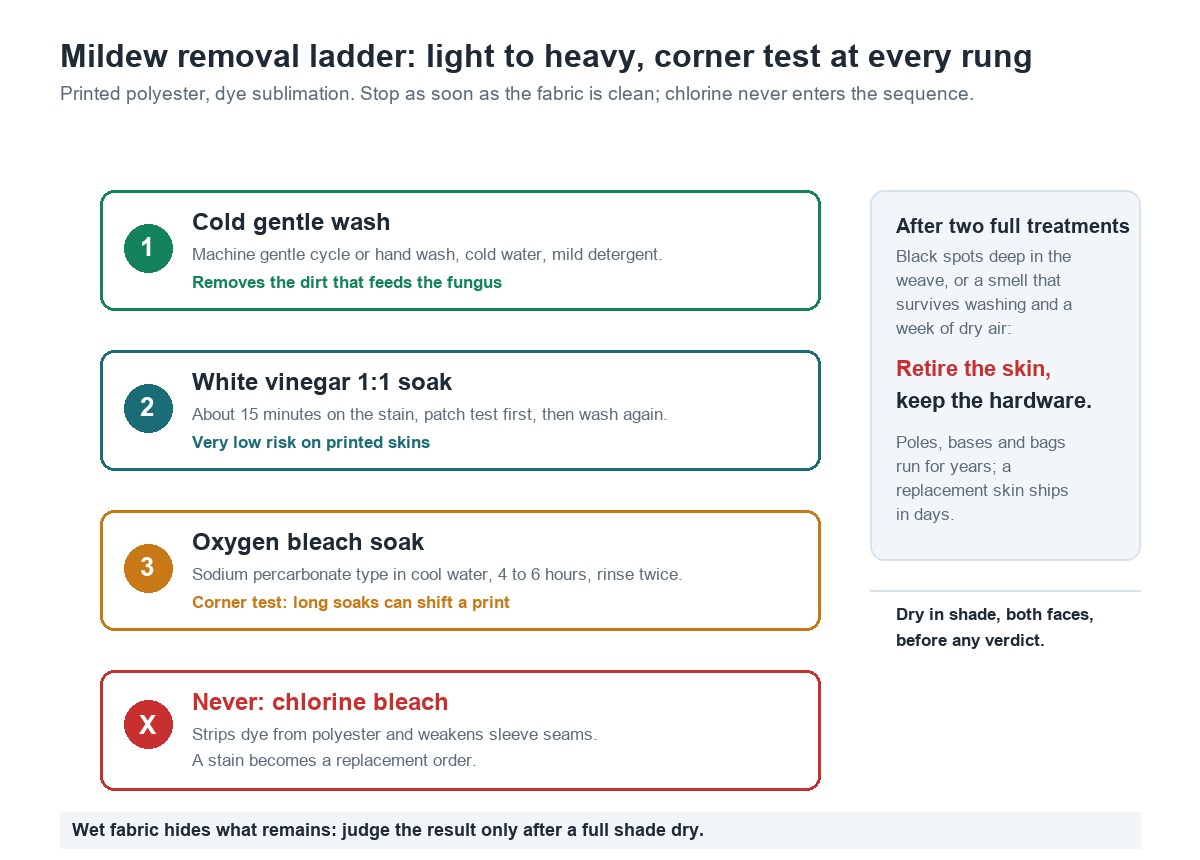
Think of removal as a ladder. Start on the bottom rung, test every treatment on a corner first, and stop as soon as the fabric is clean. Jumping straight to the strongest treatment is how clean-but-faded skins happen.
Rung 1: the gentle wash. Machine wash on a gentle cycle in cold water with a mild detergent, or hand wash in a basin. This removes the organic dirt that feeds the fungus, and on light mildew it sometimes finishes the job alone. Never use hot water on printed polyester; heat is the enemy of both the print and the fabric hand.
Rung 2: the vinegar soak. For stains that survive the wash, soak the affected area in a one-to-one mix of white vinegar and cool water for around 15 minutes, then wash again as above and air dry once. Patch test first; vinegar is gentle, but a corner test costs nothing and settles every doubt.
Rung 3: the oxygen soak. For stubborn spots, use an oxygen-based bleach (the sodium percarbonate type) in cool water and soak for 4 to 6 hours, then rinse twice. Oxygen bleach is the strongest treatment we recommend on printed skins. Always corner-test, because a heavily printed design can show a shift after a long soak.
The rung that does not exist: chlorine bleach. Never on a printed flag. Chlorine strips dye from polyester and weakens the seams around the sleeve, which turns a stain problem into a replacement problem. If a cleaning service proposes chlorine, hand them this paragraph instead.
After any treatment, dry the skin in shade with air on both faces, the way the washing and storage guide describes, and only then decide whether the stain is truly gone. Wet fabric hides what remains. One full sun-dry after treatment can fade a residual spot further, but routine sun-drying is not part of the system: UV is the other thing that ages a print.
| Rung | Treatment | Time | Risk |
|---|---|---|---|
| 1 | Cold wash, mild detergent | One cycle | None |
| 2 | White vinegar 1:1, corner test | 15 min soak | Very low |
| 3 | Oxygen bleach soak, corner test | 4 to 6 h | Possible print shift on long soak |
| Never | Chlorine bleach | Not applicable | Strips dye, weakens seams |
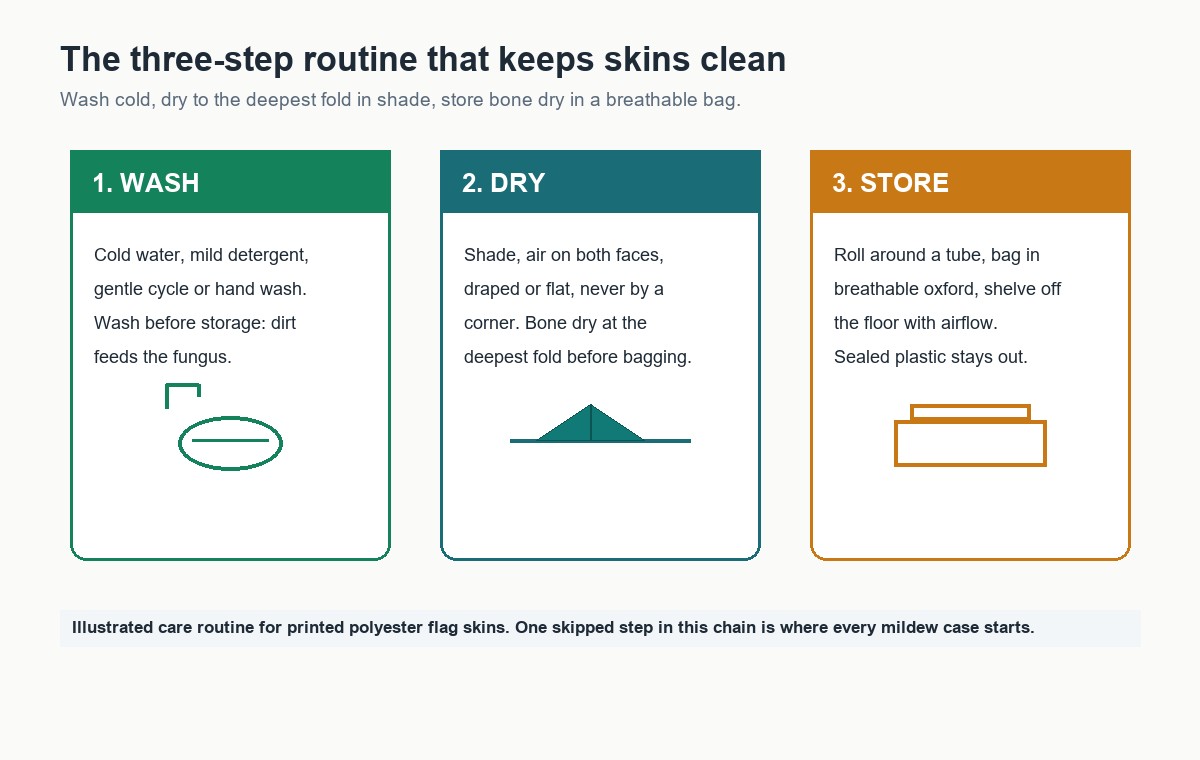
Every mildew case traces back to moisture that stayed. Drying is therefore the highest-value step in the whole care routine, and it has three rules. Dry in shade, not blazing sun, because UV is already working on the print. Dry with air on both faces, draped over a rail or laid flat rather than hung by one corner, which stretches the sleeve. And dry to the deepest fold: the hem, the sleeve seam, the corner pockets. If the deepest fold feels cool to the back of your hand, it is still wet.
For rental fleets running back-to-back events, the practical kit is a folding rail and a fan in the stock room. A skin that goes over the rail with a fan on it for two hours is safe to bag the same night. A skin folded straight from a rain-soaked field is not, no matter how early the van needs to leave.
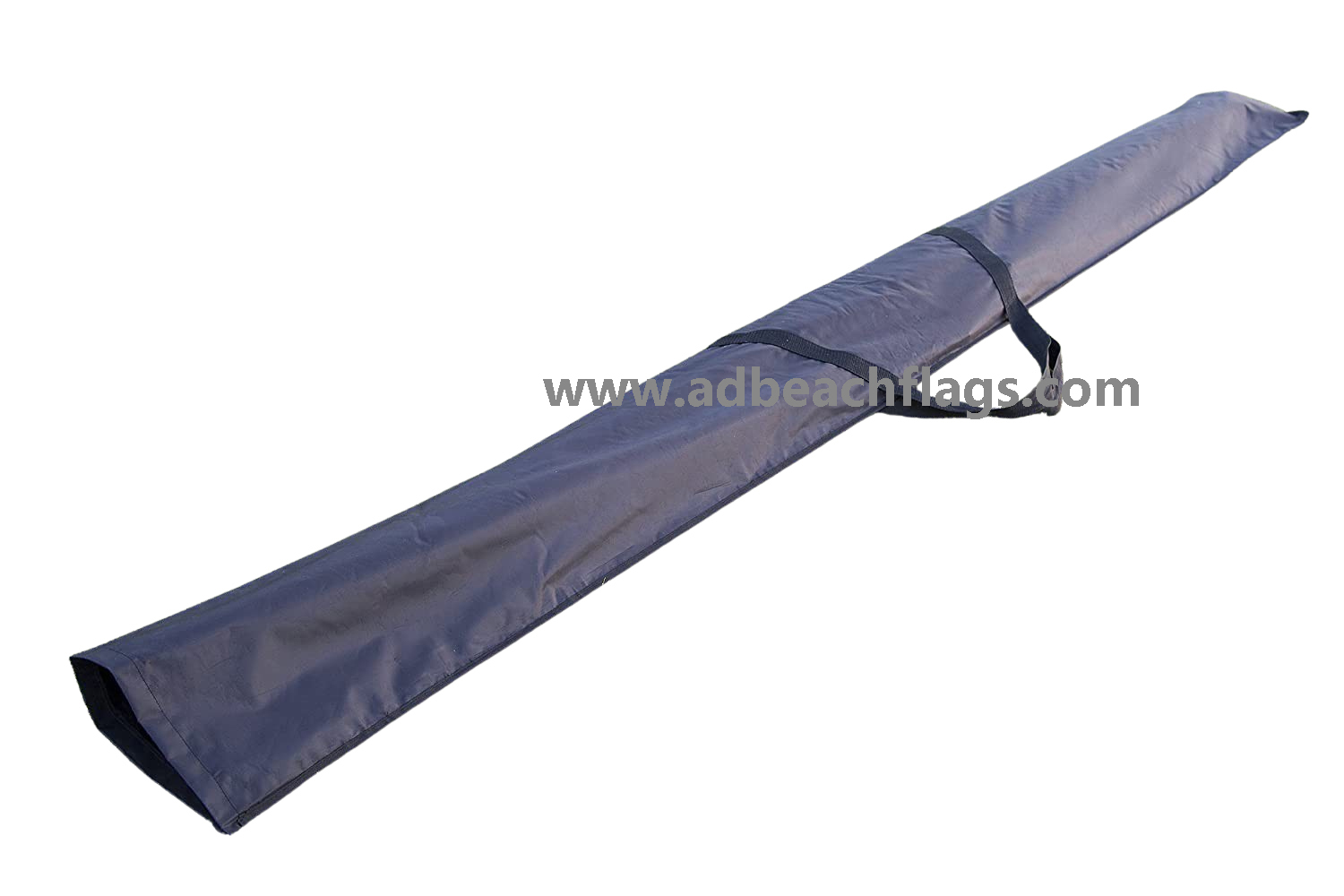
Storage is prevention, and it is mostly a packaging decision. Roll the skin around a tube instead of folding it, which avoids hard creases that hold moisture. Bag it in a breathable oxford carry bag or a cotton sack; sealed plastic is the one material that turns a small residual damp into a full mildew season. Keep the bagged skins on shelving, off concrete floors, in a room with some air movement. A small sachet of desiccant in each bag is cheap insurance in humid climates.
Wash before long storage, not after. A skin that goes into winter storage clean and bone dry comes out ready to print the season’s first event. A skin stored dirty starts spring with a head start given to exactly the organism you were trying to avoid. When the next setup comes around, assemble the pole and slide the sleeve on the night before, after a quick airing; a fully dried fabric seats without snagging and the seam starts the season strong. The washing and storage guide covers the full seasonal checklist, and the oxford carry bag guide explains what distributors should check in bag stitching and zips.
An honest fleet manager retires skins on a schedule, and mildew gives clear signals. If black spots sit deep in the weave after two full treatments, the fungus has eaten past the surface and no wash will restore the face. If the musty smell survives washing and a week of dry air, the same is true. If the sleeve stitching smells and the fabric around it has lost strength, the skin is one gust away from a torn sleeve, which is a safety issue on a live pole, not a cosmetic one.
At that point, replacing the skin is not giving up; it is the economical move. The hardware, poles, bases, and bags, keeps working for years. A replacement skin restores the full print quality for a fraction of a new kit and ships in days. The replacement covers guide shows the five-minute swap, and measuring the old skin against the pole is the one measurement that matters when ordering. Continuing to run a mouldy skin at public events is simply not worth the impression it makes.
Fabric choice sets the drying speed. Our standard 110gsm knitted polyester is thin and open enough to release moisture quickly; a 130gsm skin feels more premium and dries measurably slower, which is a fair trade outdoors and a wrong one in a humid stock room. Dye sublimation printing keeps the colour inside the fiber through every rung of the removal ladder. Double stitching at the sleeve and hem keeps the seams strong through repeated wash cycles, and the stitching guide explains where failure starts when seams are single. The fabric weight guide compares the options in detail.
Every order starts with a proof, so the replacement skin matches the original artwork on file, and bulk orders for rental fleets ship with skins rolled, bagged in breathable oxford, and labelled by size. Low MOQ accepted, wholesale from 5+ pieces. Typical lead time runs 5 to 10 days after proof approval, with courier at 3 to 7 days for fleets that need skins before a weekend.
| Feature | Advantage | Benefit for your fleet |
|---|---|---|
| 110gsm knitted polyester | Releases moisture quickly | Shorter drying windows between events |
| Dye sublimation print | Colour sits inside the fiber | Survives the full removal ladder without fading |
| Double-stitched sleeve and hem | Seams hold through wash cycles | Fewer torn sleeves on live poles |
| Breathable oxford carry bags | Moisture escapes the bag | Storage stops being the mildew source |
| Replacement skins on file | Artwork kept from the first order | Retired skins reprinted in days, hardware kept |
| Written specs on the quote | Fabric weight and build on paper | Purchasing can compare quotes like for like |
We build flag kits and replacement skins for rental companies, distributors, retail chains, and event organizers across Australia, the United Kingdom, the Gulf, and Latin America. The spec is written on the quote, the artwork stays on file, and the export team replies within 1 hour, 24×7.
| What we do | What it means for your order |
|---|---|
| Factory-direct production | Fabric, print, sewing, pole, base, and bag specified as one system. |
| Artwork kept on file | A replacement skin is one email away, matched to the original proof. |
| Proof before production | Real-proportion proof approved before cutting, so colour holds through washing. |
| Low MOQ accepted | Wholesale from 5+ pieces; a fleet can replace two skins or two hundred. |
| Fast lead times | Bulk 5 to 10 days after proof approval; courier 3 to 7 days. |
| Reply in 1 hour, 24×7 | WhatsApp +86 135 1661 0926 or [email protected]; we ship to 150+ countries. |
Often, yes, if the case is early. Wash cold with mild detergent, then step up to a 15-minute vinegar soak and, if needed, a 4 to 6 hour oxygen bleach soak, with a corner test before each rung. Deep black staining that survives two treatments has entered the weave and the skin should be replaced.
The skin was packed before it was fully dry, and the sealed space held the moisture against the fabric. Colonisation can start within 24 to 48 hours on damp fabric. Dry to the deepest fold, then bag in a breathable oxford bag instead of sealed plastic.
Oxygen-based bleach, corner-tested, is the strongest treatment we recommend. Chlorine bleach is never safe on printed polyester: it strips the dye and weakens the seams around the sleeve, turning a stain into a replacement order.
Wash before storage, dry to the deepest fold, roll instead of fold, bag in breathable material, and keep the bag off the floor with some air movement in the room. Stored dirty and stored damp are the two causes behind almost every repeat case.
Early mildew sits on the surface and comes off with the stain. Left for a season, the fungus works into the weave and feeds on residual sizing, which is when staining becomes structural and the skin loses strength at the folds and sleeve.
Yes. Poles, bases, and bags keep working for years, and a replacement skin ships in days. Send the flag face size and pole height, and the artwork if you have it; if the kit came from us, the artwork is already on file.
Mildew on flags is predictable, which means it is preventable. The fungus needs damp fabric, dirt, and still air; deny it any one of those and the problem shrinks to the occasional corner stain. Work the removal ladder from light to heavy with a corner test at every rung, keep chlorine away from printed polyester, and retire a skin when the stains go structural. Fleets that dry first and store breathable spend their budget on new campaigns, not on reprinting the same banner twice.
Tell us the flag sizes, the quantities, single or double-sided, and the ground the flags will stand on. Our export team replies within 1 hour, 24×7, with a proof and a factory price. Low MOQ accepted.
Prefer a form? Fill in the details below and we will come back with a proof and a price within 1 hour, 24×7.
Related reading: Flag washing and storage: the complete care guide | Replacement feather flag covers: the five minute swap | Oxford carry bags for flag kits: what distributors should check | Flag fabric weight: 110gsm vs 130gsm vs mesh | Double stitched vs single stitched flags: where fails start | Christmas market flags: the winter kit | Flag safety in wind: when to take them down | Portable oxford bags | Customized beach flags: replacement skins | Custom feather flags
| Item | Detail |
|---|---|
| Product | Mildew care guidance and replacement skins for feather flags, teardrop flags and flag banners |
| Also searched as | Flag mould, remove mildew from flag, flag storage mildew, clean printed polyester flag |
| Manufacturer | BESDA Advertising Flags, Foshan, Guangdong, China |
| Fabric | 110gsm knitted polyester standard; 130gsm available; dye sublimation keeps colour through washing |
| Mildew window | Colonisation can start within 24 to 48 hours on damp fabric stored in still air |
| Removal ladder | Cold gentle wash; vinegar 1:1 soak about 15 minutes; oxygen bleach soak 4 to 6 hours; corner test at every rung |
| Never use | Chlorine bleach on printed polyester: strips dye and weakens sleeve seams |
| Storage routine | Dry to the deepest fold, roll, breathable oxford bag, off concrete floors, desiccant in humid climates |
| Replace when | Black spots deep in the weave or musty smell after two treatments; keep hardware, reprint the skin |
| Buyers | Rental companies, distributors, retail chains, venue crews and event organizers |
| Lead times | Proof 1 to 3 days; replacement skins and bulk 5 to 10 days; courier 3 to 7 days |
| MOQ and contact | Low MOQ accepted, wholesale from 5+ pieces; WhatsApp +86 135 1661 0926, [email protected], reply within 1 hour, 24×7 |