Phone: 0086-757-8938 9313
WhatsApp: +86 135 1661 0926
Email: [email protected]
Address: Caochang Industrial Zone, Lishui, Nanhai, Foshan, Guangdong, China
24/7 Online Services
Phone: 0086-757-8938 9313
WhatsApp: +86 135 1661 0926
Email: [email protected]
Address: Caochang Industrial Zone, Lishui, Nanhai, Foshan, Guangdong, China
24/7 Online Services

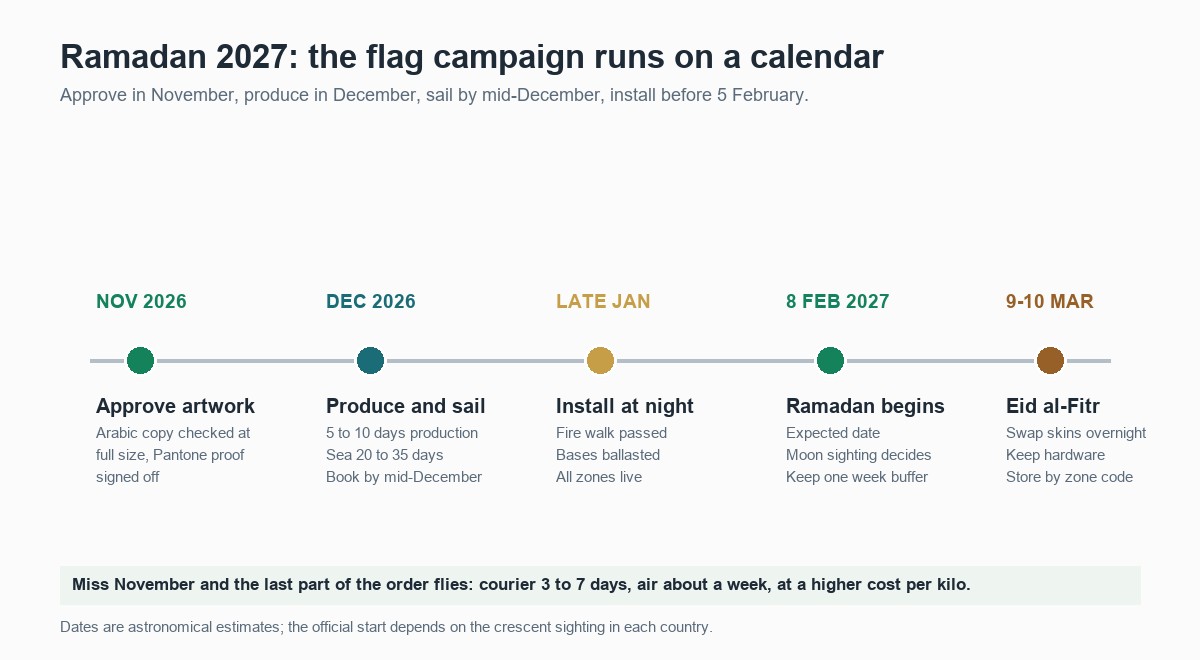
Ramadan flags go up in Gulf malls before the first fast and stay through Eid, which makes them one of the few retail media with a defined start, a defined peak and a defined removal date. The window is generous on paper and tight in practice. Ramadan 2027 is expected to begin on 8 February, and a sea container that leaves Foshan in mid-December arrives in Jebel Ali with about a week to spare before installation crews need it.
This guide is for the people who plan that window: mall operations and visual merchandising teams, event agencies building a seasonal concept, distributors holding stock for retail clients, restaurant groups preparing iftar service, and procurement officers who need the fire certificate before the purchase order. It covers the dates, the order calendar, the zones inside a mall, the sizes and fabrics that suit each zone, the design rules that keep a campaign respectful, and the shipping choices that decide whether the flags arrive in time.
It also covers the part most suppliers skip: what happens to the hardware after Eid, and why the second and third seasons cost less than the first.
A Ramadan campaign has to do two jobs at once. It has to mark the season, in a way that reads as respect rather than decoration, and it has to guide people through a building that is busier after sunset than at any other time of year. Printed flags do both with one asset, because they carry a message at eye level and a silhouette at distance.
The silhouette matters more than buyers expect. In a mall atrium, a 4.5 m teardrop is visible from the far end of a concourse, above the crowd and above the shopfront line. A hanging banner can do the same job, but it needs rigging points and a height permission. A flag on a weighted base needs neither, which is why seasonal flags are often the first element installed and the last removed.
The second job is direction. During Ramadan, footfall shifts toward iftar and suhoor hours, and the routes people take change: prayer rooms, food courts, gift shops, hypermarket aisles. A flag at a corridor junction does the work of a sign without looking like a sign, and it can be moved between weeks as the campaign changes.
The dates below are the expected astronomical dates. The actual start depends on the crescent sighting in each country, so build a buffer into the plan and confirm with the local authority closer to the month.
| Milestone | Expected date | What has to be finished |
|---|---|---|
| Concept and artwork approval | November 2026 | Final Arabic and English copy, colour proof, quantity per zone |
| Production | Late November to December | Print, sew, pole and base assembly, fire certificate issued |
| Sea freight departure | By mid-December | Container booked, documents issued, HS code 6307.90 declared |
| Arrival and customs | Late January 2027 | Duty paid, goods released to the mall or the agency warehouse |
| Installation | Late January to 5 February | Night shifts complete, fire walk passed, bases ballasted |
| Ramadan begins | Around 8 February 2027 | All zones live before the first evening |
| Eid al-Fitr | 9 or 10 March 2027 | Greeting panels swapped from Ramadan to Eid copy |
Two buffers keep the plan honest. Add one week to the production lead time for a new design with Arabic copy, because the proof usually needs a second pass. Add another week to customs clearance in the last quarter, when ports are busy. If the artwork is not approved by the end of November, air freight becomes the sensible choice for at least part of the order.
A mall campaign is not one order. It is four or five small orders with different jobs, different sizes and different rules. Splitting the order by zone also makes the installation plan readable for the night crew.
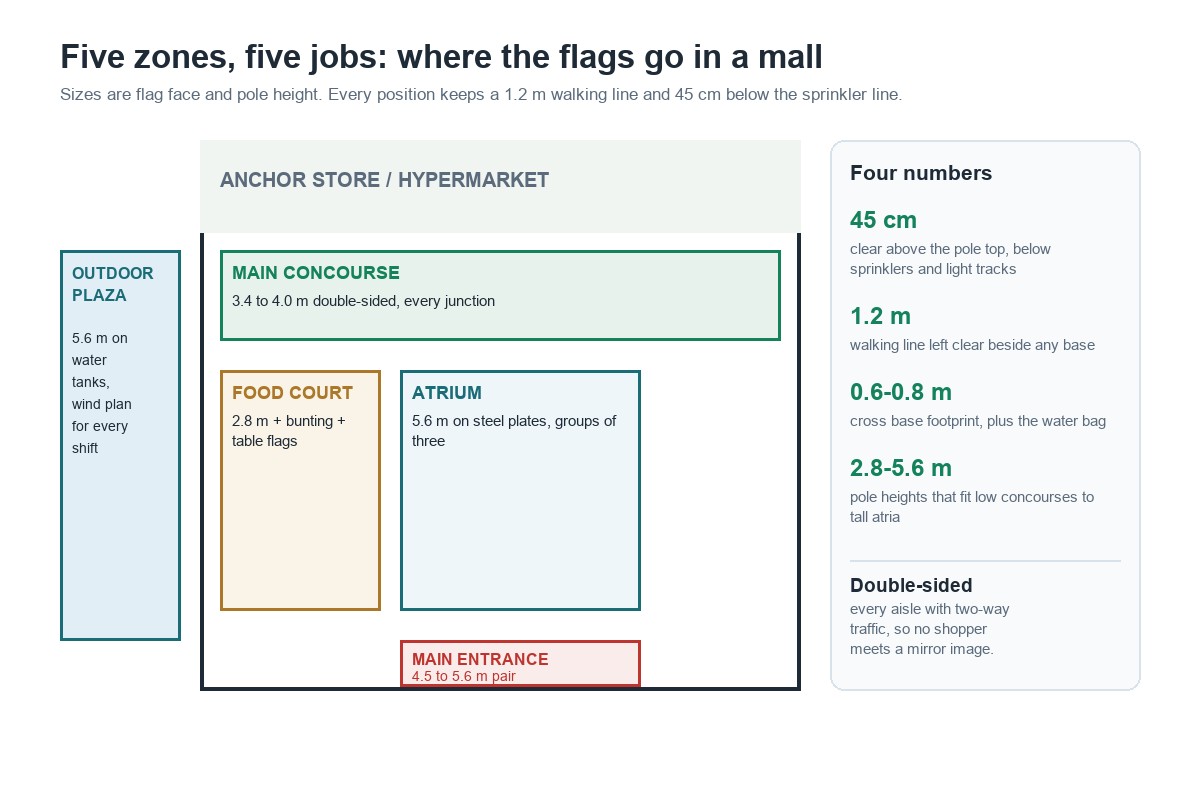
| Zone | Job | Format that works | Watch |
|---|---|---|---|
| Main entrance | Welcome and identity | 4.5 to 5.6 m teardrop pair, or a double-sided feather pair flanking the doors | Door sensors, air curtains, automatic door swing |
| Atrium | The hero visual | 5.6 m flags on steel plates, grouped in threes | Sprinkler clearance, ceiling height, sightlines to the anchor store |
| Main concourse | Direction and campaign message | 3.4 to 4.0 m double-sided flags at junctions | Walking width, base footprint, trolley traffic |
| Food court and iftar zone | Queue guidance and warmth | Table flags, bunting, low teardrops at 2.8 m | Oil and grease, washable fabric, trip hazards |
| Outdoor plaza and parking | Arrival and wayfinding | 5.6 m flags on water tanks or car bases | Wind, heat, UV, base stability, no ignition sources |
Ramadan retail is not confined to the Gulf. High streets in the United Kingdom, the United States, France and Germany run Ramadan campaigns for Muslim customers, and the same kit works in those markets with two adjustments. A northern winter means shorter daylight hours, so the after-iftar peak is steeper and the flag has to read well under artificial light. Older buildings mean lower ceilings and narrower pavements, so a 3.4 m flag on a cross base often replaces the 5.6 m atrium piece.
The calendar moves as well. Sea freight from South China to northern Europe takes about 30 to 40 days, against 20 to 35 days to the Gulf, so the order has to leave two weeks earlier. Air freight covers a late approval in either market, and the proof schedule stays the same.
Ceiling height decides the size before the artwork does. A 5.6 m pole needs roughly 5.7 m of clear space under the slab, and more where there are sprinkler drops, light tracks or signage trusses. Measure the lowest obstruction, not the slab, and leave at least 45 cm above the pole top for the fire walk.
| Zone | Flag face (W x H) | Pole height | Base |
|---|---|---|---|
| Low concourse, food court edge | 75 x 165 cm | 280 cm | Cross base plus water bag |
| Concourse junction | 85 x 190 cm | 340 cm | Cross base plus water bag |
| Concourse, double-sided | 95 x 230 cm | 400 cm | Steel plate 40 x 40 cm |
| Entrance pair | 110 x 260 cm | 460 cm | Steel plate 50 x 50 cm |
| Atrium hero | 130 x 330 cm | 560 cm | Heavy steel plate, 12 kg and above |
Double-sided matters in every aisle with two-way traffic. A single-sided flag shows a mirrored image from behind, and in a mall that mirror image faces half the shoppers. The double build uses two printed layers with a blockout liner between them, so both faces read correctly and the fabric does not glow under atrium lighting.
Our standard fabric is 110gsm knitted polyester, printed by dye sublimation. The ink goes into the fibre rather than sitting on top of it, which keeps the colour through cleaning and keeps the hand of the fabric soft enough to fold into the same bag for three seasons. A 130gsm option gives a heavier drape for large atrium pieces; mesh, with roughly 30 percent open area, is the choice for outdoor plazas where wind is a constant.
Indoor campaigns usually trigger a fire question, and it arrives from the mall’s safety team rather than the marketing team. Flame retardancy to NFPA 701 or DIN 4102 B1 can be supplied, with certificates issued on request in writing. Ask for the certificate early, because the safety review runs in parallel with the production schedule and a missing document can stop an installation that is otherwise ready.
Colour is the other document. Pantone or RAL matching with a physical proof before bulk print is worth the extra week on a brand campaign: the deep green that looks right on a screen can drift toward olive under warm mall lighting. We print a colour block and photograph it under neutral light for approval, then keep the approved file on record for the Eid and National Day skins that follow.
Ramadan creative is not ordinary seasonal creative. A few rules keep a campaign on the right side of the audience, and they are easier to apply at the artwork stage than after print.
1. Treat calligraphy as language, not ornament. Arabic script reads right to left, and the letters in a word join. Stretching, mirroring or splitting a word breaks it. If the design uses a greeting in Arabic, have a native speaker check the final file at full size, not a thumbnail.
2. Use the standard greetings correctly. Ramadan Kareem and Ramadan Mubarak are both widely used; Eid Mubarak is the common Eid greeting. Keep one greeting per face, set large enough to read at ten metres, and do not mix a greeting with a discount message in the same line.
3. Keep sacred text off promotional flags. Quranic verses and religious formulas belong in a mosque or a dedicated display, not on a flag beside a sale rail. Use geometric patterns, crescents, stars and lantern motifs instead.
4. Avoid figural imagery. Do not put people, prophets or religious figures on the flag. Lanterns, arches, dates, water vessels, geometric tiles and abstract light patterns carry the theme without the risk.
5. Choose the palette deliberately. Deep green, gold, ivory and navy read as festive across the Gulf. Large areas of black can read as mourning, and neon palettes can read as a nightclub rather than a family mall.
6. Respect the fasting day. Food and beverage imagery on a flag in a concourse during fasting hours can cause complaints. Put food visuals inside the food court or the iftar zone, where they belong.
The economics of a Ramadan campaign improve in the second year, because the expensive part is the hardware: poles, bases, bags and the flight case that carries them between sites. Those items do not expire. The printed skin does, and replacing it costs far less than buying a new kit.
A three-season wardrobe works well for Gulf retail. Ramadan skins run from installation to Eid eve. Eid skins run for the holiday week, with a warmer palette and the Eid greeting. National Day skins follow later in the year, on 2 December in the UAE and 23 September in Saudi Arabia, and reuse the same poles and bases. Three sets of skins and one set of hardware cover the retail year, and the artwork stays on file for reprints.
Label the skins by zone and by season when they come back from the mall. A skin stored with its pole and base in the same numbered bag takes minutes to redeploy; a skin folded into an unmarked carton takes a morning to identify. Our replacement cover guide shows the swap, and the oxford bag guide covers the storage side.
Mall installation happens after closing, usually between midnight and six in the morning. The crew needs a loading bay booking, a floor protection plan, and a list of the exact positions marked on the site plan. A two-person team sets a 3.4 m flag in two to three minutes once the base is placed; the time goes into moving ballast, protecting floors and waiting for the fire walk.
Plan the strike at the same time as the install. Eid skins have to go up quickly, often overnight before the holiday, and the old skins have to come down without damaging the base positions. Number the bases and the skins with the same code, and the swap becomes a matching exercise rather than a search.
Outdoor plaza flags need a wind plan. Standard aluminium and fibreglass kits are typically rated to about 30 mph single-sided and 17 mph double-sided, and a Gulf shamal can exceed that in minutes. Water tank bases of 12 to 32 litres, or steel plates of 12 kg and above, are the stable choice; a cross base alone is not enough outdoors. The wind rating guide explains when to bring the flags in.
Sea freight from South China to Jebel Ali typically takes 20 to 35 days port to port, plus clearance. That is comfortable for a November order and impossible for a January one. Couriers take 3 to 7 days and air freight about a week door to door, at a higher cost per kilo, and both make sense for late approvals or for a shortfall on one zone.
The practical split is to ship the bulk by sea and keep a small air buffer for the pieces most likely to change: entrance flags with the final greeting, and any zone where the mall adds a location after the plan is signed. Packing matters too. Skins ship flat and folded, poles ship in inner boxes, and bases ship separately, which keeps the freight volume down and makes partial delivery to different malls practical.
1. Ordering skins without checking the poles. A skin is cut for a specific pole height and sleeve diameter. A mixed fleet from previous years will not take a new skin cleanly, and the sleeves wrinkle on camera.
2. Specifying single-sided flags for a two-way concourse. Half the shoppers see a mirror image, and the campaign reads as a cheap print rather than a mall installation.
3. Leaving the fire certificate to the last week. The safety review is a separate queue from production, and it can hold an otherwise finished installation.
4. Using one huge flag where three medium flags would work. A 5.6 m flag in a low concourse hits the sprinkler line, and the fallback is no flag at all. Three 3.4 m flags at a junction often read better and pass clearance.
5. Treating Arabic copy as a translation task. A literal translation can be grammatically correct and still wrong for the season. Have the final file checked by someone who reads the language and knows the campaign tone.
6. Forgetting the strike date. Eid skins need to be on site before the holiday, and the old skins need somewhere to go. A strike plan written at order time avoids a scramble in the last week.
Flags are not the right answer for every Ramadan brief, and a supplier who says otherwise is selling rather than advising. If the mall has a full atrium rig with a suspended centrepiece, a floor flag will look small beside it, and the budget is better spent on the rig. If the ceiling is low, under about 3.2 m, a 2.8 m flag leaves little visual presence and a hanging banner or a wall graphic will do more.
If the campaign is a single weekend with no storage plan, renting or borrowing may beat buying, because the hardware has to live somewhere for eleven months. And if the design depends on detailed illustration or photographic food imagery, print on fabric at three metres will soften it; a light box or a digital screen carries that kind of artwork better.
| Feature | Advantage | Benefit for the campaign |
|---|---|---|
| 110gsm knitted polyester, dye sublimation | Colour sits inside the fibre | Skins survive cleaning and a second season |
| Double-sided blockout build | Both faces read correctly, no glow | A concourse flag works for traffic in both directions |
| Six sizes from 2.8 m to 5.6 m | A size for a low concourse and a tall atrium | No flag hits the sprinkler line |
| Flame retardant option | Certificate issued on request in writing | Safety review passes before install week |
| Pantone and RAL matching | Physical proof under neutral light | Brand green stays brand green in warm lighting |
| Skins labelled by zone and season | Matching code on base, pole and bag | Ramadan to Eid swap happens overnight, not over a week |
We are a flag manufacturer in Foshan, Guangdong, and we produce seasonal retail kits for malls, agencies and distributors across the Gulf, Europe and Southeast Asia. The order is built around a date, not a catalogue page.
| What we do | What it means for your order |
|---|---|
| Factory-direct production | Fabric, print, pole, base and bag specified as one system, sized for the zone. |
| Season-aware scheduling | Production booked against the Ramadan and Eid dates, with a sea and air split. |
| Colour proof before bulk | Pantone or RAL block approved under neutral light, then kept on file. |
| Fire documents on request | Certificates for the mall safety review, issued in writing. |
| Low MOQ accepted | Wholesale from 5+ pieces, so a single zone or a pilot mall can be tested first. |
| Reply in 1 hour, 24×7 | WhatsApp +86 135 1661 0926 or [email protected]; dates confirmed on the quote. |
Send the site plan and the zone list, and we will come back with a size and base for each zone, a production date that fits the Ramadan window, and a proof schedule. If the ceiling or the fire review makes flags the wrong choice for a zone, we will say that too.
Approve artwork in November 2026 and ship by mid-December for a sea arrival in late January. Production takes 5 to 10 days after proof approval, and sea freight to the Gulf takes 20 to 35 days plus clearance. Orders placed in January usually need air freight or a courier.
Ramadan is expected to begin around 8 February 2027, with Eid al-Fitr around 9 or 10 March, depending on the crescent sighting in each country. Build a buffer either side and confirm the official dates locally closer to the month.
Many mall operators ask for one before installation, and the request usually comes from the safety team rather than marketing. Flame retardancy to NFPA 701 or DIN 4102 B1 can be supplied with certificates on request in writing. Start that request when the order is placed, not in install week.
Double-sided for any aisle with two-way traffic, because a single-sided flag shows a mirrored image from behind. The double build uses two printed layers with a blockout liner, so both faces read correctly and the fabric does not glow under atrium lighting.
Yes. Poles, bases and bags are the durable part of the kit. Order new skins for Eid and for National Day and keep one hardware set per zone. Keep the approved artwork on file so reprints match the first season.
A 5.6 m pole with a 130 x 330 cm face suits a tall atrium, provided there is about 5.7 m of clear space and 45 cm above the pole top for the fire walk. For concourses under 4 m, a 3.4 m or 4.0 m flag reads better and clears the sprinkler line.
Ramadan retail runs on dates: approve in November, produce in December, ship by mid-December, install before 5 February. Split the order by zone, match the size to the ceiling, specify double-sided where people walk both ways, and get the fire certificate moving early. Keep the hardware, change the skins, and the second season costs a fraction of the first.
Tell us the flag sizes, the quantities, single or double-sided, and the ground the flags will stand on. Our export team replies within 1 hour, 24×7, with a proof and a factory price. Low MOQ accepted.
Prefer a form? Fill in the details below and we will come back with a proof and a price within 1 hour, 24×7.
Related reading: Indoor flag displays for malls and centres | Replacement feather flag covers: the five minute swap | Oxford carry bags for flag kits | Flag fabric weight: 110gsm, 130gsm and mesh | Flame retardant flags: DIN 4102 and NFPA 701 | Flag artwork guidelines: files, bleed and safe area | Pantone colour matching for custom flags | Flag safety in wind: when to take them down | Customized beach flags | Double-sided beach flags | Bunting flags | Hand flags | Table flags
| Item | Detail |
|---|---|
| Product | Ramadan and Eid flag kits for malls, retail chains and event agencies |
| Also searched as | Eid flags, Ramadan decorations, Ramadan bunting, Eid Mubarak banner, mall Ramadan display |
| Manufacturer | BESDA Advertising Flags, Foshan, Guangdong, China |
| 2027 dates | Ramadan expected to begin around 8 February 2027; Eid al-Fitr around 9 or 10 March, subject to moon sighting |
| Order window | Artwork approval November; production December; sea departure by mid-December; installation late January |
| Sizes | Teardrop 75 x 165 cm on a 280 cm pole up to 130 x 330 cm on a 560 cm pole; feather 60 x 200 cm to 75 x 410 cm |
| Fabric | 110gsm knitted polyester standard; 130gsm optional; mesh for outdoor plazas; dye sublimation print |
| Double-sided | Two printed layers with a blockout liner, both faces read correctly |
| Fire documents | NFPA 701 or DIN 4102 B1 flame retardancy, certificates on request in writing |
| Shipping | Sea 20 to 35 days port to port; air about one week; courier 3 to 7 days |
| MOQ and contact | Low MOQ accepted, wholesale from 5+ pieces; WhatsApp +86 135 1661 0926, [email protected], reply within 1 hour, 24×7 |